
Biography of Captain Alexander McCarraher
- The McCarraher Family and the British Atlantic World (c. 1710â1749)
- The McCalla Family in Pennsylvania and Ireland (1732â1749)
- Alexander's Childhood and Social Position (1749â1773)
- Marriage to Polly Pritchard and the Growth of His Family (1773â1780)
- Captain of the 5th Battalion of the Chester County Militia (1777â1778)
- Yellow Springs and the Washington Hall Hospital Complex (1778)
- Witness to Dr. Samuel Kennedy's Will (1778)
- Life in Pikeland and the Kennedy Estate (1779â1780)
- Alexander's Slaveholding and the Chester County Slave Register (1780)
- Alexander and the Yellow Springs Community During the War (1780â1781)
- Supporting Local Prisoners of War (1781)
- Innkeeper at Yellow Springs (1783â1786)
- Property, Status, and the Pikeland Community (1779â1787)
- Death and Probate (1787â1790)
- The Kennedy Estate and Alexander's Final Connection to Yellow Springs (1792)
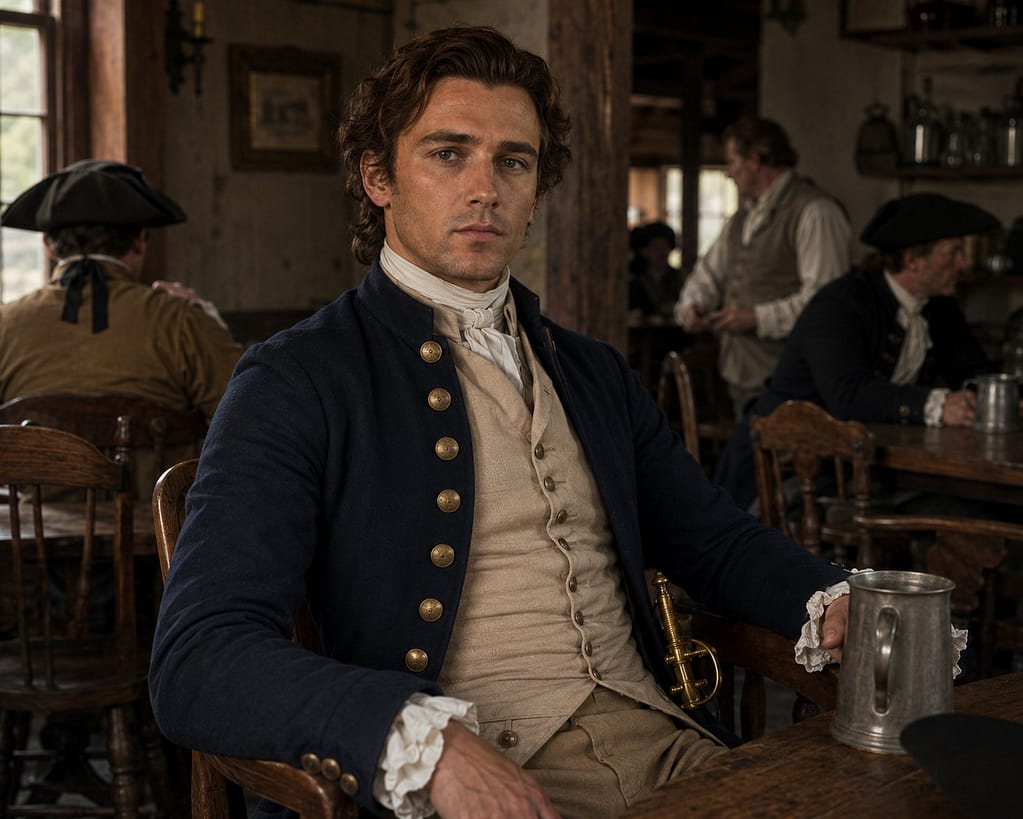
Captain Alexander McCarraher was a Chester County militia officer, innkeeper at Yellow Springs, and member of the local community during the Revolutionary era. He was born in Pennsylvania in 1749 to a family whose history stretched across Ireland, Scotland, Jamaica, and Pennsylvania. His father, James S. McCalla, came from Armagh, County Armagh, Ireland, and was recorded as Scottish. His mother, Sarah Ann Lloyd, was born in Jamaica and appears to have belonged to the island’s white British planter class.
Alexander’s family background connected him to several different British colonial societies. His father’s family belonged to the Scottish Protestant population that had settled in Ulster, while his mother’s family belonged to Jamaica’s plantation society. His family also maintained connections in Pennsylvania, including with the powerful Logan family near Philadelphia. These connections help explain the social position Alexander occupied later in life.
Alexander married Mary “Polly” Pritchard in Philadelphia in 1773. Through Polly, he became connected to the prominent Pritchard family of Chester County. He later became a captain in the Chester County militia and a close friend of Dr. Samuel Kennedy of Yellow Springs.
That friendship became one of the most important connections of Alexander’s life. During the Revolutionary War, the Kennedy property at Yellow Springs became the site of a major Continental Army hospital complex. Washington Hall served as the large general hospital, while additional patients occupied nearby barns and other buildings. Alexander remained closely connected to the property during and after the hospital’s operation.
The McCarraher Family and the British Atlantic World (c. 1710–1749)
Alexander McCarraher was born in Pennsylvania in 1749. His father was James S. McCalla, who was born around 1710 in Armagh, County Armagh, Northern Ireland. Despite the location of his birth, records of the times identified James as a Scott.
James’s background places the McCalla family within the Scottish Protestant population of Ulster. Beginning in the seventeenth century, Scottish and English settlers moved into northern Ireland through the Plantation of Ulster. Additional migration continued during the following decades, particularly from Lowland Scotland and the border regions of Scotland and northern England.
By James McCalla’s generation, these communities had become established within the political and economic structure of Protestant-controlled Ireland. This system later became known as the Protestant Ascendancy. Protestant landowners held most political power, while the indigenous Irish Catholics of the area faced extensive legal restrictions on landholding, political participation, and religious practice. Presbyterians occupied a more complicated position. They belonged to the broader Protestant population, but they did not all belong to the wealthy landed elite that dominated Irish politics.
The available evidence does not establish that James himself belonged to the highest ranks of the Irish Ascendancy, but it does place him among them. What information we have on him does show that he came from the Scottish Protestant population of County Armagh and that his family belonged to a community shaped by Britain’s colonization of Ireland.
Alexander’s mother, Sarah Ann Lloyd, came from a very different part of the British Empire. She was born in Jamaica around 1711, but based on her place in society at the time, she would have been a member of Jamaica’s white colonial planter class.
England had captured Jamaica from Spain in 1655. During the following decades, British settlers expanded across the island and developed a plantation economy that depended heavily upon enslaved labor. Jamaica’s white population included immigrants and descendants of families from English, Scottish, and Scots-Irish families. However, some of these colonists also came from older English Caribbean colonies like Barbados and Bermuda.
Scottish settlers became especially prominent in Jamaica’s white population. Scottish merchants, planters, and professionals participated heavily in the island’s sugar economy and became part of its colonial elite. Sarah’s background therefore placed Alexander’s maternal family within a British plantation society that derived considerable wealth from enslaved labor.
Alexander’s parents both came from two very different colonial societies, but they were both from places where the English empire featured especially ruthless acts of colonization. Both societies had been shaped by decades of British colonization and by unequal systems of land and labor.
The McCalla Family in Pennsylvania and Ireland (1732–1749)
The McCalla family’s surviving records suggest that they did not make a simple, one-directional migration from Northern Ireland to Pennsylvania. Instead, the family appears to have maintained connections on both sides of the Atlantic for years.
Alexander’s second-oldest brother, Captain William McCalla, was born on November 17, 1732, on the Logan Estate near Philadelphia. His birthplace was the plantation estate later known as Stenton, the country seat of James Logan. Logan was one of the most influential men in colonial Pennsylvania. He arrived in the colony with William Penn in 1699 and became Penn’s secretary, attorney, and trusted political associate. Logan later served in major provincial offices and accumulated substantial land and wealth. His country estate covered approximately 500 acres and functioned as a working plantation. The property included agricultural fields, livestock, gardens, and domestic facilities. Stenton also depended upon enslaved labor. Enslaved people worked within the household and on the surrounding plantation alongside other forms of dependent and free labor.
William McCalla’s birth at the Logan Estate places the McCalla family in direct proximity to one of colonial Pennsylvania’s most prominent households. The surviving evidence does not tell us why William was born there, but the location of his birth establishes that the McCallas exsisted within the planter-class elite social circles of colonial Pennsulvania.
However, Alexander’s older brother, James McCalla, was born in Downpatrick, County Down, Ireland, in 1736. He is the only one of Alexander’s known siblings who is recorded as having been born outside Pennsylvania. However, the places of James’s birth suggests that the family continued moving between Pennsylvania and Ireland for some time. That being said, by the time Alexander was born in Pennsylvania in 1749, the McCalla family seems to have settled in Pennsylvania (especially around Bucks County) more concretely.
Alexander’s Childhood and Social Position (1749–1773)
Little is currently known about Alexander’s childhood, but his family being members of the colonial planter class provides us important clues about the world in which he grew up. Those circumstances suggest that Alexander grew up in a household with access to education and social connections beyond an ordinary farming family. The surviving records do not allow us to reconstruct his schooling, but his later life indicates that he was sufficiently educated to participate in military administration, legal documents, property matters, and business.
His family also appears to have had access to dependent labor. That possibility is consistent with the social background of both sides of his family. Enslaved labor formed an important part of Jamaica’s plantation economy, while slavery and other forms of dependent labor were also widely present in Pennsylvania. This was especially common in wealthy families, such as the Logans of Philadelphia or the Rustons of Londonderry.
It is important to note here that Alexander used several versions of his surname throughout his life. Records identify him as McCalla, McCaraher, and McCarraher- among several other variants in spelling. He appears to have preferred “McCarraher” or “McCaraher” when signing his own name. This variation was not unusual in the eighteenth century, when clerks often spelled Scottish and Irish surnames according to pronunciation.
By the time Alexander reached adulthood, he had established himself within Pennsylvania society. His later marriage, military position, property, and relationships with prominent Chester County families show that he occupied a respectable place within the local community.
Marriage to Polly Pritchard and the Growth of His Family (1773–1780)
Alexander married Mary “Polly” Pritchard in Philadelphia on December 2, 1773. He was twenty-four years old.
Polly belonged to the prominent Pritchard family of Chester County. Her family maintained strong local connections, including relationships with people who would later appear in the records of Yellow Springs. The marriage gave Alexander another important connection within southeastern Pennsylvania society. His relationship with the Pritchards continued throughout his adult life and overlapped with his later work and friendships at Yellow Springs.
Alexander and Polly had at least five known children. Their son Alexander was born around 1774, followed by James in 1775. Their daughter Sarah was born in 1776, Margaret followed in 1777, and Mary Ann was born in 1780. Unfortunately, we currently know little about them.
However, Alxeander and Polly’s children were born during a period of extraordinary political and military change. Alexander was establishing his family at the same time that Pennsylvania was moving from colonial rule into open revolution. His oldest child was born before the declaration of independence, while his youngest known child was born during the later years of the war. Because of this, the McCarraher children spent their earliest years in a household affected directly by the Revolution. Their father served in the local militia, and the family lived within a region increasingly occupied by military personnel, hospitals, and displaced civilians.
Captain of the 5th Battalion of the Chester County Militia (1777–1778)
By 1777, Alexander had entered military service as a captain in the Artillery Company of the 5th Battalion of the Chester County militia.
Pennsylvania organized its militia through local battalions and companies. Chester County had eight battalions, and the companies were geographically based within the county. Local men elected their officers, making militia rank closely connected to community reputation.
Alexander was twenty-eight years old when he held his captaincy. His position indicates that he had already established enough standing within the county to command the confidence of local men.
The timing of his service was significant. British forces captured Philadelphia in September 1777, forcing the Continental government and many civilians to leave the city. George Washington’s army spent the winter at Valley Forge, while Chester County became an important region for military transportation, supplies, and support.
Yellow Springs lay within this same military landscape. Alexander’s militia service placed him within the military network surrounding the region even before the Continental hospital complex at Yellow Springs reached its full scale. Additionally, his personal connection to Dr. Samuel Kennedy gave him an additional reason to remain involved at Yellow Springs.
Yellow Springs and the Washington Hall Hospital Complex (1778)
Our records suggest that Alexander had developed a close friendship with the Kennedy family while still a young man. By 1778, that relationship placed him inside one of the most important civilian households connected to the Continental Army’s medical system.
Dr. Samuel Kennedy owned the Yellow Springs plantation. He had volunteered some of his land for use by the Continental Army so that they could build a hospital there. The Yellow Springs plantation had hosted “rebel hospitals” out of local barns since at least 1776, but by the winter of 1777-1778, Yellow Springs had transformed into an incredibly important hospital complex. Yellow Springs became the main medical supply depot for the Middle States and was made the headquarters for the Hospital Department. However, the most striking transformation was the construction of an extensive, state-of-the-art general hospital that was known as Washington Hall.
Soldiers suffering from disease and wounds received treatment there. The hospital complex provided aide for the sick and dying sent from Valley Forge. Physicians and surgeons directed medical care, while nurses, surgeons’ mates, commissaries, and other workers kept the hospital operating. Local families provided Yellow Springs with food, supplies, and support.
Yellow Springs was not a military hospital complex alone. Prior to the war, it had been a well-known colonial spa and tavern. The tavern operated both before and after the war, and Alexander would become the keeper of that tavern later in life.
Witness to Dr. Samuel Kennedy’s Will (1778)
Dr. Kennedy’s health deteriorated during the spring of 1778. Reverend Dr. James Sproat, who served as the Chaplain for the Hospitals in the Middle Department, visited Yellow Springs several times and described Kennedy as seriously ill.
Sproat recorded visiting Kennedy, praying with him, and lodging at his home. His journal shows that Kennedy’s condition had become a major concern within the Yellow Springs community. Alexander would also have been present at the property during this same period.
On June 14, 1778, Alexander McCarraher signed Dr. Samuel Kennedy’s written will as a sworn witness at Yellow Springs.

Witnessing the will was a formal legal act. A witness could later attest that Kennedy had signed the document properly and that the document represented his final wishes. Alexander therefore participated directly in the legal arrangements surrounding the physician’s death.
The event also provides unusually strong evidence of Alexander’s relationship with Kennedy. Kennedy was seriously ill and arranging his affairs. Choosing Alexander as one of the witnesses suggests a level of trust that went beyond a casual acquaintance.
After Dr. Kennedy’s death, ownership and leadership of the property changed. His widow, Sarah Ruston Kennedy, became responsible for his estate, while Dr. Bodo Otto Sr. emerged as the chief physician of Washington Hall. Despite these changes, Alexander remained connected to the Kennedy family after Dr. Kennedy’s death.
Life in Pikeland and the Kennedy Estate (1779–1780)
By 1779, Alexander appears to have established his own residence outside the immediate Yellow Springs village, although still within Pikeland Township. A 1779 record places him in Pikeland. Another record dated December 6, 1779, connects him with the witnessing and probate of Dr. Kennedy’s will. We know that during this time, Alexander had replaced Samuel Culbertson as the tavernkeeper at Yellow Springs.
Alexander’s Slaveholding and the Chester County Slave Register (1780)
One of the clearest records of Alexander’s economic position comes from the Chester County slave register of 1780.
Alexander appears three times in the index. One entry identifies him as Alexander McCalla in Charlestown, while another places him in Pikeland. The records attribute three enslaved people to him.
The different spellings and locations initially complicate the identification. Alexander’s repeated use of both McCalla and McCarraher, along with the surrounding biographical evidence, strongly indicates that the entries refer to the same man.
This record places Alexander within Pennsylvania’s slaveholding population during the Revolutionary period. Pennsylvania had passed the Gradual Abolition Act in 1780, but the law did not immediately free people already held in slavery. Enslaved people remained part of Pennsylvania households and businesses for decades afterward.
Alexander’s three enslaved people were therefore living under a system that Pennsylvania had begun to dismantle but had not yet abolished. The surviving index does not provide enough information to identify these individuals or reconstruct their lives. Their names, ages, family connections, origins, and daily responsibilities are not established by the evidence currently available.
Their presence nevertheless reveals an important aspect of Alexander’s life. His maternal family came from Jamaica’s white planter society, where enslaved labor was central to the plantation economy. His father’s family came from a Scottish Protestant society shaped by British colonization and unequal landholding. Alexander himself participated in Pennsylvania’s system of slavery.
His social position therefore cannot be separated completely from the labor systems that supported colonial wealth.
Alexander and the Yellow Springs Community During the War (1780–1781)
Alexander remained connected to Yellow Springs after the most intense period of hospital activity had passed.
Dr. Bodo Otto Sr. had become one of the leading medical figures associated with the hospital after Dr. Kennedy’s death. The Kennedy family continued managing the property, while local residents continued maintaining their connections with one another. Alexander remained part of this network.
The war had also created personal consequences for local families. Men from the surrounding area had served in the military, and some had been captured by British forces. Alexander became involved in one such case in 1781.
Supporting Local Prisoners of War (1781)
On January 23, 1781, Alexander signed a letter associated with Dr. Bodo Otto Sr.
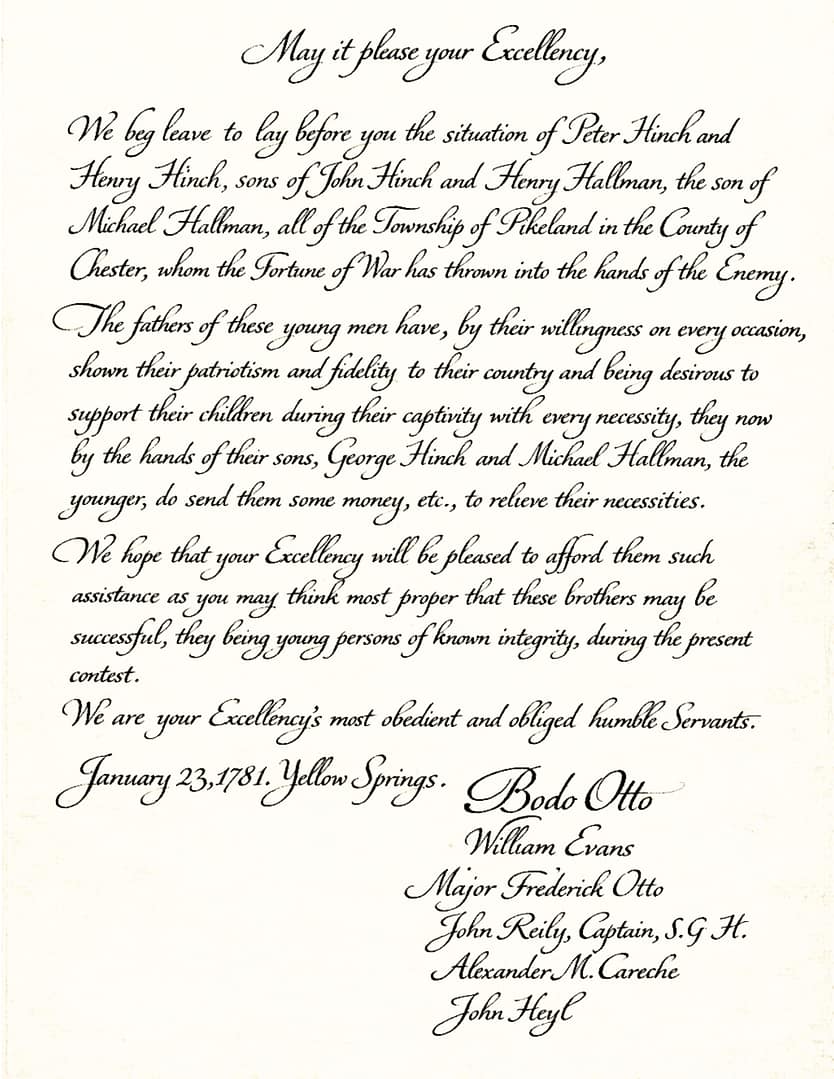
Otto wrote to George Washington to request assistance for Peter Hench, Henry Hench, and Henry Hallman. The three young men came from local Yellow Springs families and had been captured during the Revolutionary War. They were being held aboard the infamous Old Jersey prison ship.
British prison ships had become notorious for overcrowding, inadequate food, poor sanitation, and disease. Prisoners could spend years in captivity under conditions that caused thousands of deaths during the war.
Otto’s letter asked for intervention on behalf of the three local men. Alexander joined him by signing the appeal.
Alexander’s participation is significant because it shows that his connection to Yellow Springs had become more than a business or property relationship. He was participating in efforts to protect members of the local community whose families he knew.
His signature also provides evidence that he remained closely connected to Dr. Otto.
The Yellow Springs community had changed since the summer of 1778, but the relationships formed around the hospital and Kennedy household continued to shape local life.
Innkeeper at Yellow Springs (1783–1786)
After the Revolutionary War, Alexander returned to Yellow Springs in a new professional role.
By 1783, Alexander McCaraher, or McCalla, was listed as the innkeeper for Mrs. Sarah Ruston Kennedy at Yellow Springs. This position brought him back into the Kennedy family’s property affairs. Sarah Kennedy was now the widow responsible for the estate, and Alexander operated the inn on her behalf.
Taverns served important social and economic functions in eighteenth-century Pennsylvania. Travelers relied upon them for food and lodging. Local residents used them as meeting places, and tavernkeepers often encountered people from outside the immediate community.
Alexander’s position therefore gave him a visible role within the postwar Yellow Springs community.
The location was especially meaningful because of its recent history. Only a few years earlier, the property had supported a large military hospital. Washington Hall had housed sick and wounded Continental soldiers, while nearby barns provided additional hospital space.
His work as the tavernkeeper illustrates the transition of Yellow Springs from wartime medical center back into a local community. The people who had lived around the hospital remained part of the area’s social fabric after military demands declined.
A residence record again places Alexander in Pikeland in 1786, showing that his connection to the surrounding township continued alongside his work at Yellow Springs.
Property, Status, and the Pikeland Community (1779–1787)
By the final years of his life, Alexander occupied an established position within the Chester County community.
His military rank, marriage, property, business activities, and social relationships all indicate that he belonged to the locally influential class of men who participated actively in public and economic affairs.
He was not necessarily part of Pennsylvania’s highest political elite. His importance was more local.
Alexander’s marriage connected him with the Pritchard family. His friendship connected him with the Kennedys. His military rank connected him with the county militia. His relationship with Dr. Otto connected him to the Revolutionary medical community.
His slaveholding also indicates a level of economic independence. Three enslaved people appeared under his name in the 1780 register.
These facts place Alexander within a society where family networks mattered greatly. His own family had maintained connections between Ireland and Pennsylvania. His brother had been born at the plantation of James Logan. Alexander then established his own network through marriage, military service, and business.
His life demonstrates how social standing in eighteenth-century Pennsylvania could be built through overlapping family and community relationships.
Death and Probate (1787–1790)
Alexander died in Pennsylvania in September 1787 at approximately thirty-eight years of age.
One surviving record gives September 19, 1787, as the date of his death. A burial record associated with Phoenixville gives September 16, 1787. Because the burial date appears earlier than the recorded death date, the surviving documents contain an unresolved discrepancy.
A Chester County record dated October 19, 1787, identifies Alexander McCarraher as the decedent.
His estate remained in probate after his death. A record from January 20, 1790, shows that the settlement of his affairs continued more than two years later.
Alexander’s death came at a comparatively young age and also followed the death of his wife, Polly, in the same year.
Their five known children were therefore left without either parent while still young. Further estate and guardianship research may reveal how responsibility for the children was divided among relatives.
The Kennedy Estate and Alexander’s Final Connection to Yellow Springs (1792)
Alexander’s name remained connected to the Kennedy family several years after his death.
On March 16, 1792, the settlement of Dr. Samuel Kennedy’s estate listed Alexander McCarraher among those paid in connection with Kennedy’s coffin and reburial.
Alexander had already died in 1787, so he could not personally have received the payment in 1792. The record appears to preserve an obligation or expense associated with his earlier involvement in the Kennedy household.
The payment also demonstrates how long Kennedy’s estate remained unsettled. Kennedy had died in 1778, yet his estate was still generating financial transactions fourteen years later.
Alexander’s continued appearance in those records reflects the lasting nature of his relationship with Kennedy.
He had witnessed Kennedy’s will during the physician’s final illness. He remained involved in the estate after Kennedy’s death. His name eventually appeared in the records associated with Kennedy’s coffin and reburial.
Even after Alexander’s own death, his connection to Yellow Springs remained visible in the documentary record.
Research is Ongoing!
Bibliography
Gibson, James E. Dr. Bodo Otto and the Medical Background of the American Revolution. Springfield, IL: Charles C. Thomas, 1937.
Historic Yellow Springs. “Captain Alexander McCarraher Family Tree Research.” Ancestry.com Family Tree. Research database compiled by Historic Yellow Springs. Accessed August 18, 2026. https://www.ancestry.com/family-tree/person/tree/209359850/person/322759103136/facts
Copyright Disclaimer: Under Section 107 of the Copyright Act 1976, allowance is made for ‘fair use’ for purposes such as criticism, comment, news reporting, teaching, scholarship, and research. All materials sourced from sources indicated throughout this post are referenced for the purposes of education for reference purposes.