
Biography of Johonnis Christoph Friederich Hench
Context and Genealogical Records
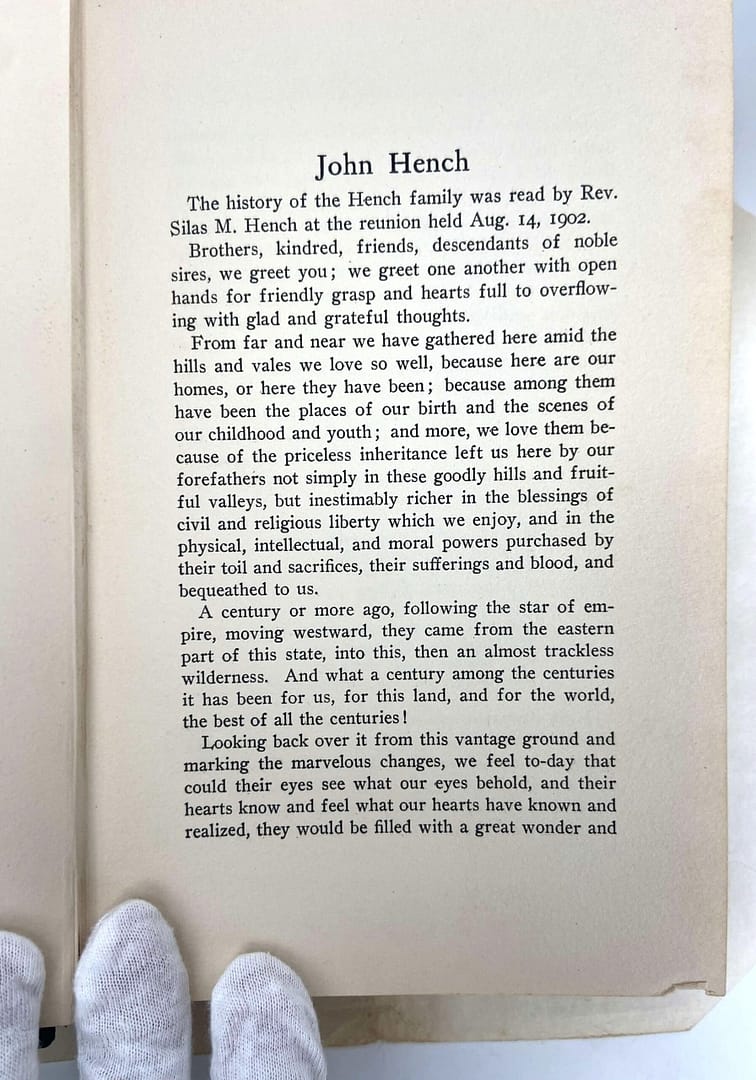
Most accounts of Johonnis Hench come from genealogical records that his descendants compiled long after his death. The earliest published collection currently available is the Records of the Annual Hench and Dromgold Reunion, which Lelia Alice Dromgold Emig compiled and published in 1913. Emig descended from several of the families discussed in the book and worked as a family genealogist. Her volume preserves presentations given at Hench and Dromgold family reunions in Perry County, Pennsylvania, between 1897 and 1912.
The genealogical sketch about Johonnis Hench begins on page 1 of Emig’s book. It calls him John Hench, a name he appears to have used more often after settling in Pennsylvania. Reverend Silas M. Hench, one of his descendants, supplied the account. He wrote it as a speech and read it at the family reunion on August 14, 1902. Reverend Hench did not list his sources, so we cannot determine exactly which records or family accounts he used. Some details resemble oral history, while others appear to match tax records and other documents from Hench’s lifetime.
We should also remember that the family members who made these accounts held personal connections to the people they described. Their accounts sometimes reflect family traditions and memories. Emig also recorded information that genealogists had gathered in the late 19th and early 20th centuries. Researchers at that time had far fewer records available to them than genealogists have today. For that reason, later family accounts cannot always establish dates or events on their own. They still preserve oral history and memories passed down through generations. In some cases, those accounts also agree with records created during Hench’s lifetime.
Birth and Early Life (c. 1721-1743)
Johonnis Hench’s Early Life in Württemberg
One important claim in Reverend Hench’s account concerns Johonnis’s birth year.
Later genealogists repeatedly gave 1712 as his year of birth, including Lee Owen Hench’s The Johannes Hench Family in America: The Immigrant Progenitors and Their Descendants, published in 1981. His Find-a-Grave entry and the DAR Patriot Ancestor Profile for Johonnis also use 1712.
Reverend Hench appears to have reached that date by working backward from Johonnis’s reported age at death. His calculation represents the earliest known reference to a 1712 birth year, but the surviving evidence does not show how he reached it.
A primary baptismal record that we found on the databases hosted by Ancestry.com points to a different year. This scan of an original record identifies Johonnis as an infant who received baptism on March 7, 1721.

It also records a girl named Josephin, born to the same parents, who received baptism two days later. It is believed this is Johonnis’s twin sister, Josephin. Later genealogical sources describe Johonnis and Josephin as twins and sometimes place their births in December 1711. Those sources appeared long after the twins died, so the 1711 date may reflect a calculation, a memory error, or confusion over an unclear number in an older record.
Lutheran baptism practices in the region provide further support for the 1721 date.
Families in this denomination in Württemberg commonly baptized newborns within a few days of birth. Parents could arrange baptism on the day of birth when a sick infant seemed unlikely to survive.
This may be why Johonnis was baptized a few days before Josephin. If his parents had thought Johonnis was sickly, his baptism may have been rushed and may have occurred on the day of his birth.
Otherwise, if the baby was healthy, families usually waited about two or three days to prepare for a less-impromptu baptismal ceremony.
The baptismal entries describe Johonnis and Josephin as infants, rather than older children and place their baptisms only two days apart. If the twins had been born between 1711 and 1712, they would not be young enough to be recorded as ‘infants’ in 1721. Their late baptisms also would have been highly unusual for a Lutheran family in rural Württemberg in the early 18th century.
Based on this evidence, the twins most likely arrived in early March 1721, with Johonnis probably born around March 6 or 7.
Johonnis and His Family
Johonnis “John” Hench was born Johonnis Christoph Friederich Hünche in a small village called Hundersingen, located in the state of Baden-Württemberg, in southwest Germany. We place his birth on March 7, 1721.

Lutherans in Hundersingen
Hundersingen is a village in the Münsingen District, and a Lutheran Church in this area was where Johonnis and his twin sister, Josephin were baptized.
In 1721, the Duchy of Württemberg included the Münsingen District. This powerful Lutheran government strictly enforced the state religion across towns like Kohlstetten, Münsingen, and their specific section of of Hundersingen.
During this time, Duke Eberhard Ludwig ruled the powerful, Protestant Duchy of Württemberg as an absolute monarch. He controlled most of the central Swabian region from his massive new palace in Ludwigsburg. His powerful Lutheran government strictly enforced the state religion across towns like Kohlstetten, Münsingen, and their specific section of of Hundersingen.
Württemberg’s political boundaries did not yet cover the southern lands around village of Hundersingen. They also did not control most of the village in 1721. Instead, most of the village was controlled by the Catholic House of Waldburg.
The Waldburg counts governed this village as part of the independent County of Friedberg-Scheer. From nearby Castle Scheer, these rulers issued strict political orders and collected taxes from the residents. The rest of Hundersingen answered directly to these local Catholic lords and the distant Holy Roman Emperor.
However, families in the northern Lutheran sector of Hundersingen village enjoyed full legal protections under the duchy’s established church laws.
The Lutheran district of Hundersingen, located nearby the ruins of Hohenhundersingen Castle, was legally considered part of the town of Münsingen. In the modern day, these places are about 8.0 kilometers (5.0 miles) apart.

Politically, the community in northern Hundersingen stood as a strategic Protestant stronghold directly bordering independent, hostile Roman Catholic territories. These Lutheran families paid heavy taxes to the duke while slowly rebuilding their farms after devastating European wars.
Siblings and Parents
Johonnis Hench and his twin sister, Josephin Hünche, appear to have been the oldest children of their parents. Their father was Johann “Joseph” Conrad Hünche, born in Metz in 1688. Their mother was Anna Margaretha Krehlerin, usually called Margaretha, who was born in Metz in 1695.
Metz stood near the borders of present-day France, Germany, and Luxembourg. When Joseph Conrad was born, French King Louis XIV controlled the city and used Metz as a major French military stronghold. The Nine Years’ War began that same year, and directed major construction work began on Metz’s defenses.
Louis XIV had also revoked the Edict of Nantes in 1685, driving thousands of French Huguenots from the city and disrupted its Protestant communities. Catholic authorities also restricted Protestant worship after 1685.
German-speaking workers and merchants who had moved into Metz during earlier military construction were faced with persecution. Very little information survives about Joseph Conrad and Margaretha’s early lives, though they were likely part of the same community of German-speaking Protestants who had came to Metz for employment.
Records identify Joseph Conrad’s parents as Johann Georg Hünche and Anna Helena. By Joseph Conrad’s baptism in July 1692, the family had moved out of Metz to the city of Frankfurt in the German state of Hesse. We do not yet know whether Joseph Conrad had siblings.

By the time his parents died, however, he and Margaretha had at least three children. Johonnis and Josephin appear to have been twins. Their baptismal records provide the only known details about Josephin’s life.
The family also had a younger son named Johan Stieronimer Hünche. His baptism in Wiesbaden places him in Hesse by February 25, 1725. Johonnis therefore likely spent part of his childhood in Hesse as well. However, since Johonnis’s mother, Margaretha later died in the state of Württemberg, the family probably did not remain there permanently.
Immigration to Pennsylvania (1743)
Johonnis’s next firmly dated appearance comes more than two decades later. On September 20, 1743, The 1902 contribution by Reverend Silas M. Hench to the record mentions that a man named Johonnis Hench arrived in Philadelphia aboard the ship Lydia.
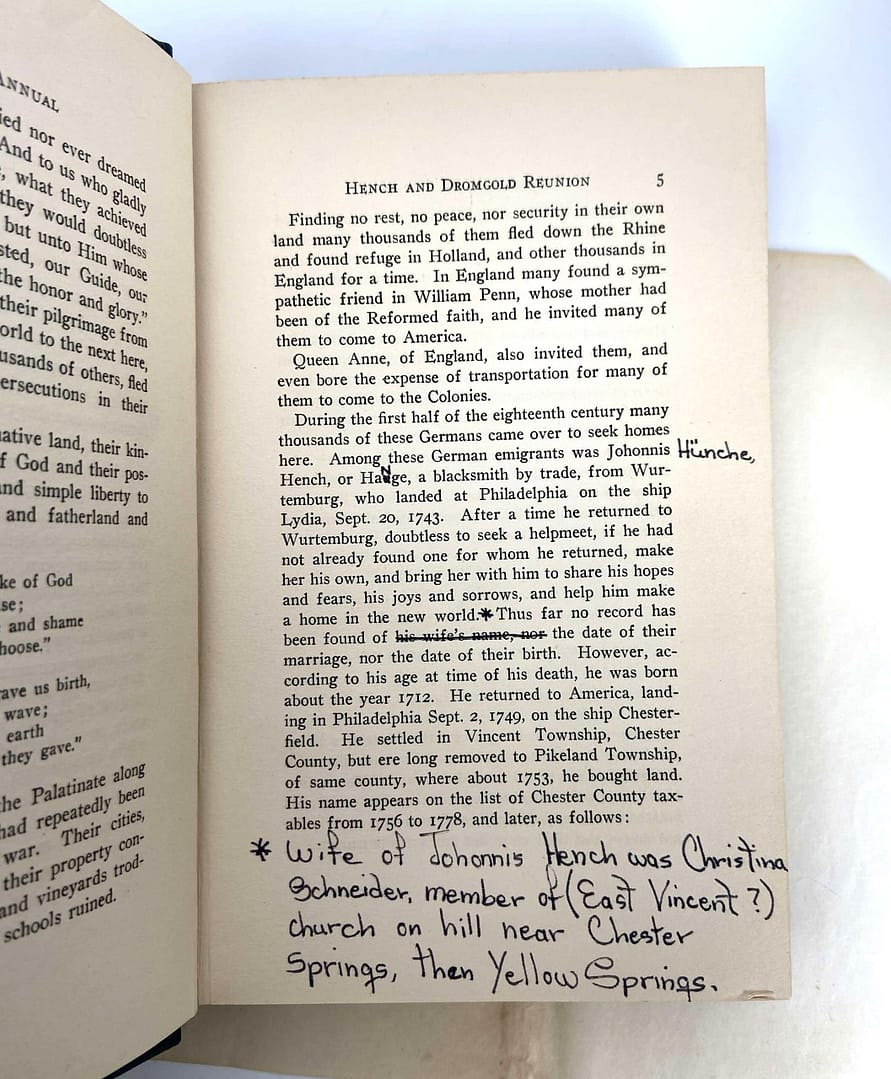
If the 1721 baptismal record identifies the same man, Johonnis was about 22 years old when he reached Pennsylvania. His trade, place of origin, and arrival date provide the first clear record connecting him to his later life in Pennsylvania. The evidence therefore places his birth in Württemberg in early March 1721 and his arrival in Pennsylvania in September 1743.
Johannis was among the thousands of German emigrants who came to the Americas in the 18th century seeking freedom and peace.
Source: Records of the Annual Hench and Dromgold Reunion Held In Perry County, PA. From 1897 to 1912. These records contain the Genealogies of Nicholas Ickes, Johannes Hench, Zachariah Rice, John Hartman, Thomas Dromgold and kindred families who were among the early settlers of Chester Co., and served in the Revolution. Compiled by (Mrs.) Lelia Dromgold Emig, 1913, The United Evangelical Press Harrisburg, Pa.
- Johannis (or John) Christian Hench (also referred to as Hanch, Hinch, Hangh, or Hange), born around 1712, was a blacksmith from Wurttemberg (modern-day Germany) who landed in Philadelphia on the ship Lydia on September 20, 1743
- returned to Wurttemberg to secure a helpmeet (companion/wife) for the Americas
- 1749 – Wed Christina Hench (born Schneider) in Miltenberg, Wurttemberg, Germany
- September 2, 1749 – Johannisand Christina returned to Philadelphia on the ship Chesterfield
- Settled in Vincent Township in Chester County; before long he re-moved to Pikeland Township, where he bought land in 1753
- Name appears on list of Chester Co. taxables from 1756-1778, and later, as follows: 1756 – John Hanch, Pikeland, Tax, 5-3 1757 – John Hench, Pikeland, Tax 1-6 1758 – John Hange, Pikeland Tax 1£, 4s 1760 – John Hinch, Pikeland, Tax 1£, 6s, 9d 1762 – John Henche, Pikeland Tax, 7-9 1763 0 John Hance, Pikeland Tax 1£, 4s, 6d 1764 – John Hangh, Pikeland Tax, 103 acres with building, 45 acres, woodland, 5 horses, 7 cattle, 5 sheep, 1 servant man and blacksmith.
- 1770 – Johannis bought the farm of John Millhouse, adjoining that of Johannis Hartman, in Pikeland Township, where he continued to farm and blacksmith
- 1774 – tax list record: John Hanch, Pikeland, 286 acres and buildings, 4 horse, 6 cattle, 4 sheep
- 1778 – tax list record: John Hench, Pikeland, 220 acres and buildings, 3 horses, 5 cattle, 6 sheep
- 1787 – tax list record: John Hench, Jr., 100 acres of land, 1 horse, 1 cow. – Jacob Hench, 75 acres of land, 1 horse, 1 cow – George Hench, 75 acres of land, 2 horses, 2 cows (these names most likely refer to his sons and not Johannis himself)
- Johannis and his family pioneered the “forest” on only bridle-paths (trails for riding horses) and inhabited a primitive dwelling consisting of a kitchen and bedroom and a large open fireplace on the first floor and a garret (attic space) for the children on the second
- As window glass was an expensive import at the time, the Hench’s used heavily oiled paper
- John Hench and his wife had 8 children: 5 sons and 3 daughters
- The sons were Peter, Henry, John, Jacob, George; the daughters were Mara Elizabeth, Christina, and Betsy (or Elizabeth); all survived to adulthood
- The family was patriot-sided during the rev war
- 1774 – Peter, a fifer and drummer, and Henry, enlisted on a war vessel during the Revolutionary War
- Both were captured and died of neglect and starvation aboard a prison ship in New York; buried under a mound in Trinity Churchyard, New York
- 1777 – John Jr. enlisted in the War and was made Second Lieutenant, Fourth Battalion Penna (Pennsylvania?) Continental Line, under kinsman and neighbor Major Peter Hartman. His name also appear in Penna. Archives
- The Hench family supplied cattle to the Continental Army
- Mrs. Christina Hench served sick and wounded soldiers in the hospital at Yellow Springs, which was near to the Hench home
- These listed incidents recorded by Dr. William D. Hartman, great-grandson of Mrs. Hench: After Battle of Brandywine (Sept 11 1777) a portion of Gen. Wayne’s division retreated cross the valley hill and encamped that night in the meadow of John Hench’s farm
- Johannis, a patriot, told the soldiers they could have what they wanted
- After they pitched their tents and lighted their camp-fires, 40 head of fat-bullocks were driven into the barnyard and slaughtered till their needs were met. The skin from the animals were used to create make-shift shoes for soldiers. Each soldier also took a knapsack of peaches. Mrs. Hench made bread for soldiers.
- The next morning, Mrs. Hench found upon inquiry that 2 wounded soldiers were about to fight a duel. Their waiters were downstairs cleaning and loading their pistols. She settled the quarrel by taking the pistols and going to the officers’ room and lecturing them, declaring she would not allow such conflict in her house.
- The quarrel arose from a dispute in reference to the Battle of Brandywine days prior. Mrs. Hench restored the men’s friendship before they left.
- In her ministries to the sick soldier at the hospital erected by Washington in Yellow Springs, she and her neighbor Abigail Hartman Rice, wife of Zachary Rice, both contracted typhus Fever during the War, which (among other complications at the hospital) contributed to the decline in their health.
- 1789 – Abigail died in while giving birth to twin girls Abigail and Anna Marian (the latter of whom also passed).
- July 22 1787 – Mrs. Christina Hench died.
- St. Vincent German Reformed Church, the old mother church in Chester co., was where Johannis Hench and his family attended church; possibly also attended St. Peter’s Church at Pikeland.
- Records of St. Vincent Church contain the confirmations of 6 of his children, ranging from 1776-1778, and the ages of each at the time of confirmation.
- St. Vincent also contains records of the baptisms of several of Johannis’ grandchildren.
- Johannis Hench was called a Presbyterian, but it comes from the original name of Vincent Church the title of which in Halle, Germany, was Presbyterian. The original communion set of St. Vincent was of German silver or pewter, and inscribed: “From the Church in Halle to the Presbyterian Church in Schuylkill.”
- Spring 1789 – The Hench family, who had lived prosperously and happily in Chester County, had their land seized by the foreclosure of an old English mortgage. John Hench, alongside 113 other farmers, lost his property.
- In succession of these owners, who hailed their own possession of land going up a line to William Penn, Pikeland Township was held by Samuel Hoare, a wealthy merchant of London. He sold Pikeland tract to Andre Allen, a merchant of Philadelphia.
- Johannis Hench was unable to redeem his property; it was bought by Nicholas Ickes, who soon afterward took possession thereof.
- Johannis’ neighbor Zachary Rice also lost his property. He fathered 21 children, 17 of whom remained to him after the death of his wife Abigail.
bold text below – finished paraphrasing; unbolded text below – still needs paraphrasing
St. Vincent German Reformed Church was the old mother church in Chester County. Here our ancestor, John Hench, and his family, attended church and doubtless later on perhaps to some extent at St. Peter’s Church at Pikeland. But the records of St. Vincent Church contain the confirmations of nearly all his children, six of them, with dates of their confirmation from 1776 to 1778, and the ages of each at the time of the confirmation. Also the records of the baptisms of several of his grandchildren. From our kinsman, Mr. John M. Hartman, of Mt. Airy, Philadelphia, who has done so much and spared no pains and expense in gathering the records and employing the data for the history of the ancestry of our kindred families, we quote the following: From this old mother church went forth a numerous family to build up our country and leave their impress for good on the communities in which they settled. Many of them migrated to Perry County. On the old church books appear the names of Henche, Shull, Hipple, Yeager, Acker, Laubach, Naylor, Foose, Reiss, Hartman, Shimer, Christman, Wagner, Miller, Stiteler, Olewein, Hass, Kepner, etc. These names are still to be found in Perry County. The first John Henche was called a Presbyterian, but it comes from the original name of Vincent Church the title of which in Halle, Germany, was Presbyterian. The original communion set of St. Vincent was of German silver or pewter, and inscribed: “From the Church in Halle to the Presbyterian Church in Schuylkill.” The Hench family lived prosperously and happily in Chester County, until the spring of 1789, when their land was seized by the foreclosure of an old English mortgage. John Hench, with 113 other farmers lost his property. In the succession of owners, from William Penn down, Pikeland Township was finally held by Samuel Hoare, a wealthy merchant of London. Hoare sold Pikeland tract to Andrew Allen, a merchant of Philadelphia. Allen paid Hoare a small part of the contract price and gave him a mortgage for the balance. Allen then divided the tract into farms of two hundred and three hundred acres, and sold them to the German emigrants as they arrived, and pocketed the money. Being a man of prominence, and a member of the Continental Congress, there was no suspicion of any fraudulent action on his part. After the Revolution was on and Lord Howe had captured Trenton, Allen turned traitor, went to Trenton and threw himself upon Lord Howe for protection. Later he went to London and died. These German emigrants, relying upon Allen’s honesty, accepted the papers he gave them when they paid the money and made no back searches for titles. After the Revolution was over and civil courts were established in Chester County, Ezekiel Howard, the sheriff, was given writs to sell out all the Pikeland tract under foreclosure of the Hoare-Allen mortgage, dated August 26, 1789. Every farm was sold and even St. Peter’s Church, built by the emigrants, went to satisfy the greed of the Merchant Hoare. This caused widespread disaster, as many of the farmers were now left without property, and must begin over again to secure homes. John Hench being unable to redeem his property, it was bought by Nicholas Ickes, who soon afterward took possession thereof. Thus for one who had toiled so many years, and met other sad losses, the death of two sons in the Revolutionary War, and then that of his faithful wife, now at nearly four score years to see the fruits of all his toil so quickly and unexpectedly taken away, must have been a heavy stroke. But with other children strong and brave and true still about him, and grandchildren rising up to give cheer and promise of comfort, we find that he still gave his strength and thought to the duties and affairs of practical life. Among others who lost their farms was Zachary Rice, neighbor of John Hench, and ancestor of the Rice family. He is well known to all from the well prepared history of the family given here on a former similar occasion. Zachary was the father of twenty one children, seventeen of whom remained to him after the death of his wife Abigail. His descendants’ to-day are a numerous host. He with his children then set out in search of cheaper land. Three of his children, one son and two daughters, had married two sons and one daughter of John Hench. Zachary Rice and children proceeded westward till they found a suitable place in Milford Township, Mifflin County, later Juniata County. There he bought a tract of land and settled on it in 1790. About that time or soon after his sons-in-law, John and Jacob Hench, also settled, the one in the same county, and the other in what became the county of Perry. After a few more years the aged patriarch, their father, followed these children, with his two other daughters, and settled in Milford Township, Juniata County, about 1800 or 1801. He was 90 years old or over at that time. His son John, who married Margaret Rice, was a blacksmith, and in the pursuit of his trade, carried his anvil and tools on his back from place to place in the sparse settlements where he worked for the early settlers. He died in November, 1800, aged fifty years, and was buried at Loysville, Perry County. The will of Emigrant John Hench, a copy of which we have here to-day, was made June 28, 1801. This was but a short while before the testator’s death, as the will was probated December 9, 1801. He was buried at Academia, Juniata County, Pa. The legatees named in the will were his surviving children, the widow of his deceased son John, and children and grandson John, of his son John. The nobility of spirit, the paternal devotion to his children, and his simple trust in God remained with him to the end of life. Well may we honor his memory and emulate his virtues. We should like to-day to trace out for you the branches of the family tree, but time forbids this. We may give here to the third and fourth generation the names, especially that bring down the original family name of Hench; the more complete record or history will, we trust, be given you later in a permanent form, when time permits us to accomplish this. Those noble ancestors have done well their work, and they call us to follow on and rise to the eminence they foreshadowed and which the privileges we enjoy and the time we live in demand of us. ” ‘Neath hoary moss on crumbling stones Their names are fading day by day, The fashion of their lives and speech From sight and sound have passed away. “We owe them all we have of good, Our sunny skies, our fertile fields. Our freedom which to all oppressed, A continent of refuge yields.” 1st Johannis Hange (Hench) emigrant from Germany. Sons – Peter, Henry, John, Jacob, and George. Daughters – Maria Elizabeth, Christina, and Betsy or Elizabeth. Peter and Henry died in the Revolutionary War. 2d John Hench married Margaret Rice, daughter of Zach Rice. Children of 2d John Hench: Sons—Peter, Jacob, John, Samuel, and Conrad, who was killed when young. Daughters — Elizabeth, married John Bryner; Jane Christina, married Joseph Bryner; Susanna, married Daniel Motzer; Sallie, married Jacob Strauch; Rebecca, married John Ritter; Judith, married Jacob Evinger; Catharine, married to George Rausch; Pauline, single. Children of 1st Jacob Hench, son of emigrant John Hench. His wife’s name, Susanna Rice: Sons,—John, Zachariah, Major Peter. Daughters—Abigail, Mary, and Nancy. Children of 1st George Hench son of emigrant John Hench: Son—John. Daughter—Maria. Children of 2d Peter Hench, brother of Grandfather Samuel Hench: Sons—Parkinson H. and Samuel H. Daughters—Jane and Margaret. Children of 2d Jacob Hench, brother of Grandfather Samuel: Sons — George Hench and John Hench. Daughters—Elizabeth, Mary, Susan, and Rebecca. Children of 3d John Hench, brother of Grandfather Samuel Hench: Sons — John, Jacob, Conrad, and Samuel. Daughters—Elizabeth and Margaret. Children of Samuel Hench, grandfather: Sons – Jeremiah Hench, George Washington Hench. Daughters— Bandina, married John Dromgold; Sarah Ann, married John B. Ritter; Margaret, married Joseph Kell. Children of Jeremiah Hench, married to Ellen Conly: Sons — Owen L., William Scott, Calvin. Daughter—Matilda, married William Kell. Children of George Washington Hench, married to Frances Rice: Sons—Silas Martin, Samuel Nevin, Allison Linn, George William, and Charles Luther. Daughters — Martha Jane, Mary Elizabeth, Ines Lecosta, Annie Kate, Adella Susan, Ada Lulu, Margaret Ellen. Children George Hench, son of John Hench: Sons – George, Henry, Peter, John, and William. Henry had family. Lived in Raccoon Valley. Buried at Donnally’s Mills. Children of 3d Peter Hench, son of Jacob, son of John: Sons—George Hench, Nicholas, and Samuel. George married four times. Sons—Atchison L., Rev. Thomas H. Hench, D.D., Alexander M., Prof. George A. Daughters of George Hench, son of Peter—Mary M. Hench, Martha A., Elizabeth, and Margaret. Children of Zachariah Hench, son of Jacob Hench: Sons—William, John, Samuel E., Stewart, James, George, Thomas J., and Orin Linn. William Hench, only surviving child of above at this time, is 82 years old. Sons—Samuel M., James Stewart, Franklin Pierce, John McLaughlin, and George. Daughters Sarah Ellen, Maria, and Mary. Children of Nicholas Hench, son of Peter Hench, who married Elizabeth Ickes: Sons—George Hamilton, Nicholas Ickes, Frank Hamilton (killed at Gettysburg), Samuel, William Benton. By second wife: John, Fernall, Harry Foster, and Willis Rannels. Daughters—Elizabeth Ann, Mary Ellen, Catharine; and by second wife, Catharine. Children of George Hamilton Hench, son of Nicholas: Sons—Frank and William. Daughter— Mary. Children of Nicholas Ickes Hench, son of Nicholas: Sons — Thompson Stewart, Edwin Leroy, Nicholas Paul. Daughters—Maude Amelia, Lillie Coyle, and Annie Weakley. Children of Samuel Hench, son of Nicholas Hench: Sons—Ralph Woods, Samuel Ross, William Stewart. Jacob Hench, son of John, brother of Grandfather, children of above—four sons and seven daughters. Conrad Hench, son of John, had fifteen or sixteen children by two wives. Samuel Hench, son of John, had five daughters and two sons. The Henches were noted for their great strength and longevity. Remarkable feats of strength were said to have been performed by Peter Hench. Henry Hench was known between Perry County and Baltimore as “Whip cracker Harry,” because of his skill in cracking his long blacksnake whip. Among these families there have been successful merchants, manufacturers, mechanics, and artisans of various kinds. Some of them have adorned the profession of law, teaching, and the ministry. Useful machinery has given the stamp of inventive genius to the name, and the manufactures whose names stand at the beginning of this reunion title, to whose thought and effort we owe its origin and much of its success, have done much to carry the name to the bounds of our country and to foreign lands.
–