Emma Podolin
Artist Statement:
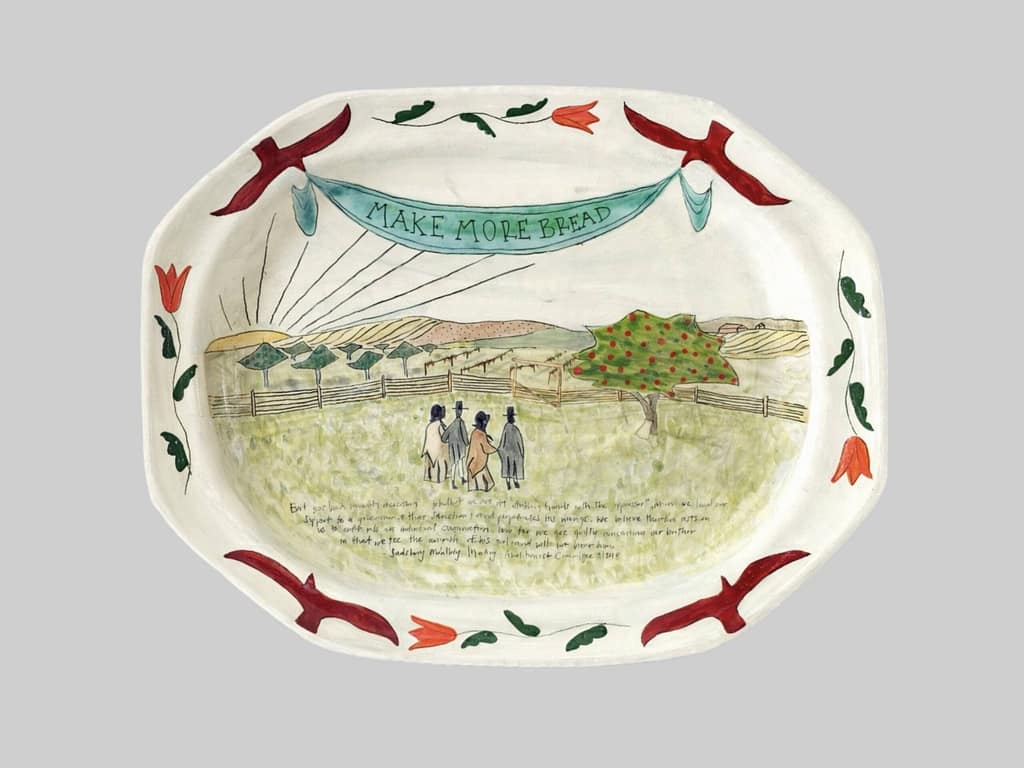
Mahlon Brosius was my 5x great-grandfather, a German immigrant, potter, Quaker, and abolitionist in Kennett Square, PA. This platter illustrates an act of radical compassion carried out in Lancaster, PA in 1851:
Immediately following what is now known as the Christiana Resistance, Levi and Sarah Pownall and their children risked everything to safeguard, aid, and protect two people, William Parker and his brother-in-law, Alexander Pinckney. They rented a home and land from the Pownalls farmstead, which was an active station on the Underground Railroad. The Pownalls assisted in an escape from capture by Parker and Pinckney’s former owners shortly after the nefarious Fugitive Slave Act was passed in 1850. While their home and community were under a hostile occupation succeeding the conflict of the Resistance, the Pownalls managed to conceal William and Alexander from the enemy: slave catchers and police. Sarah Pownall directed her two daughters to, “Get a clean pillow case and fill it with bread and meat,” to which her daughter replied, “All these people in the house to feed and barely enough bread for breakfast.” Sarah undoubtedly insisted, “Make more bread.” The pillowcase was filled and left at the base of the apple tree by the gate. The two men were provided with clothes to disguise them as gentlemen callers, and at an opportune moment, the Pownall daughters walked beside them to the gate to begin their journey north on the Underground Railroad. If the guards saw them, they supposed them to be callers of the young women.
To me, “Make more bread” is synonymous with “Absolutely no excuses for not helping our fellow brothers and sisters.” By immortalizing and remembering these stories, it begs us to examine ourselves and actions in our own time – In what ways are we, like the Pownalls, “Making more bread?”
Beyond the gate in the platter is a field of fig trees and grape vines, referencing the biblical verse Micah 4:4, often alluded to by George Washington, representing peace and security, “But they shall sit every man under his vine and under his fig tree; and none shall make them afraid”. The eagles in the corners lifting the banner symbolize the longed-for but not necessarily realized freedom in the creation of a new country. The tulips were a design implemented by many German potters working with earthenware clay in southeastern PA.
The platter reads: “Evil has been steadily increasing…whether we are not striking hands with the oppressor when we lend our support to a government that sanctions and perpetuates his wrongs. We believe a responsibility therefore rests on us to enter into an individual examination how far we are guilty concerning our brother in that we see the anguish of his soul and will not hear him.”
– Sadsbury Monthly Meeting Abolitionist Committee minutes 1848 (Sarah Pownall was on this committee and signed these minutes)
Learn more on Emma’s website