
Throwback Thursday: (Pottery) Fragments of the Past
We Identify and Date Several Pieces of Mysterious Pottery Found on the HYS Property
Setting the Scene
Today, pottery and sculpting are a big part of what makes Historic Yellow Springs special. Students come here to learn from talented teachers, and our pottery workshops are especially popular with visitors who love art. Our ceramics shows (like the recent Ceramics National 2025) are wonderful places to show off the creativity and techniques of artist from near and far.
That being said, what many people may not know is that pottery and ceramics have been important to this land for a very long time.
Earlier this year, we welcomed elders from the Lenape Tribe to our campus. During their visit, they joined a pottery workshop and made pots using native clay dug from our property, just as their ancestors once did. Pottery has been a key part of life at Historic Yellow Springs for thousands of years, and it still is today.
What makes our situation even more interesting is that our land not only gives us native clay for modern pottery, but also reveals pottery fragments from long ago.
Did You Know? A ‘sherd’ is a piece of pottery that is found at an archeological site, but is not part of a complete vessel
As we update our archives and prepare for our America 250 exhibitions, we plan to feature some of these pottery sherds we have found on our property and in our archives. Before adding them to our exhibits, we want to identify them and better understand how and when they were used.
Pottery Sherd A
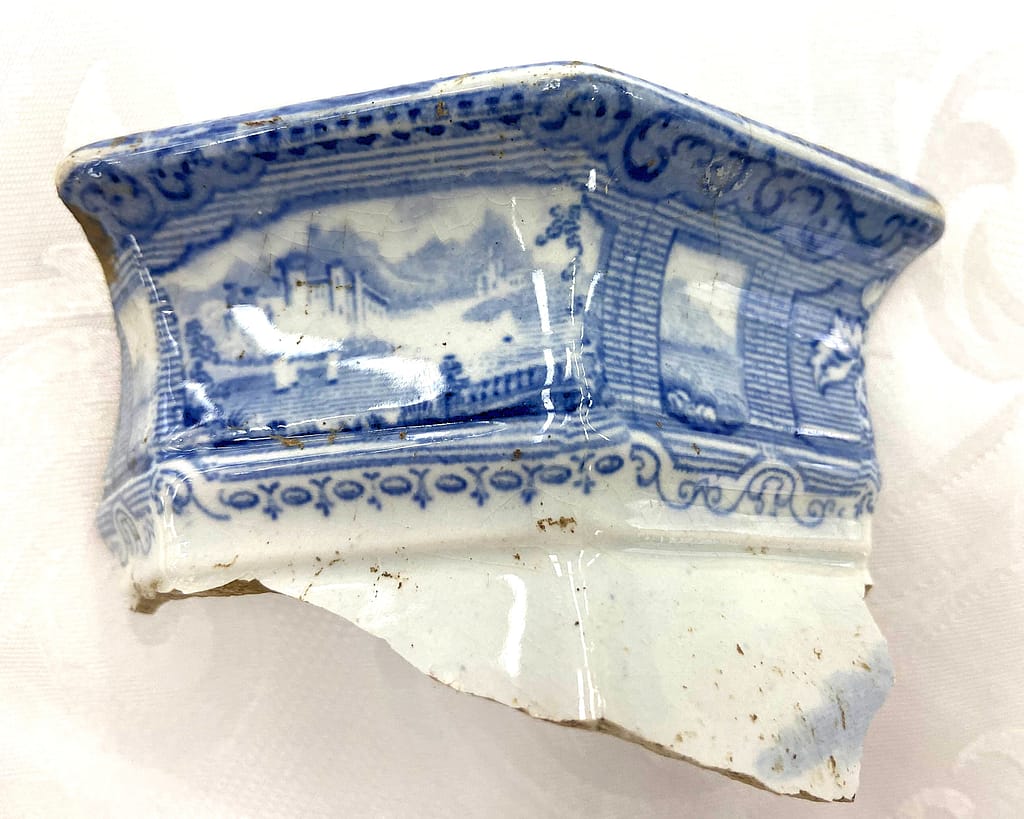
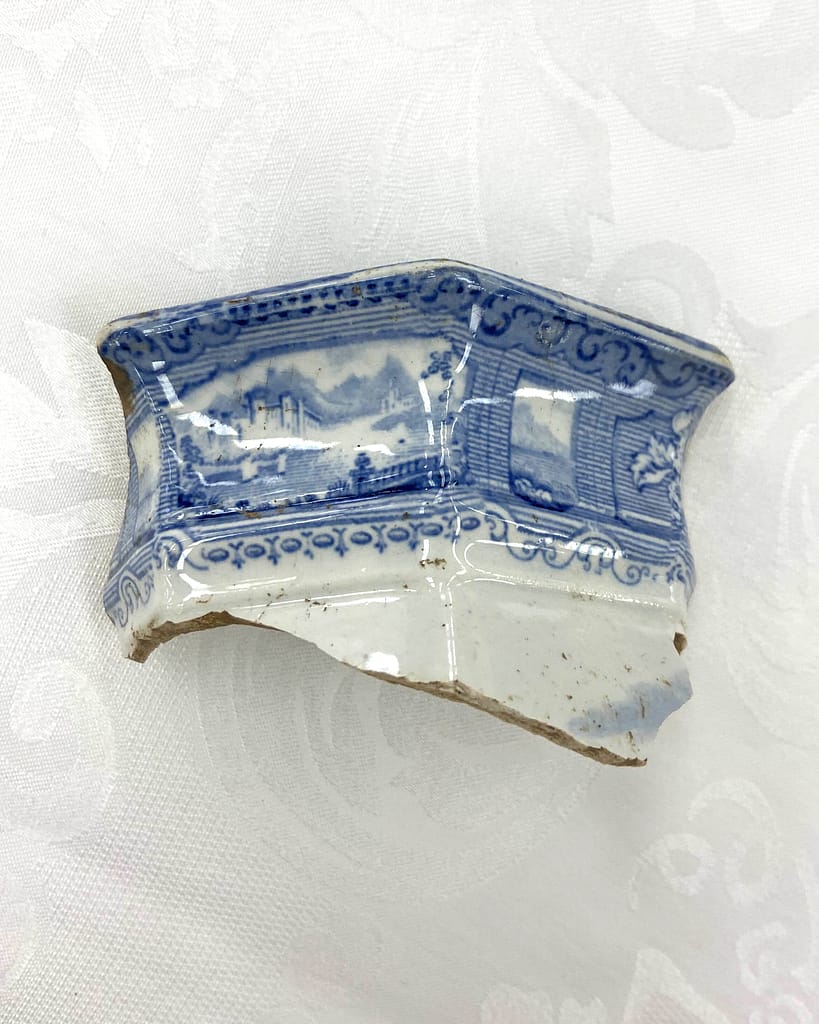
We found this piece in boxes from earlier archaeological digs stored in the Limbo Room of the Moore Archives. We mentioned this group of unusual artifacts when we looked at slip-trailed redware in a recent post. Even at first glance, though, it’s clear this pottery is quite different from those slipware shards.
We begin by visually assessing the object as a physical artifact.
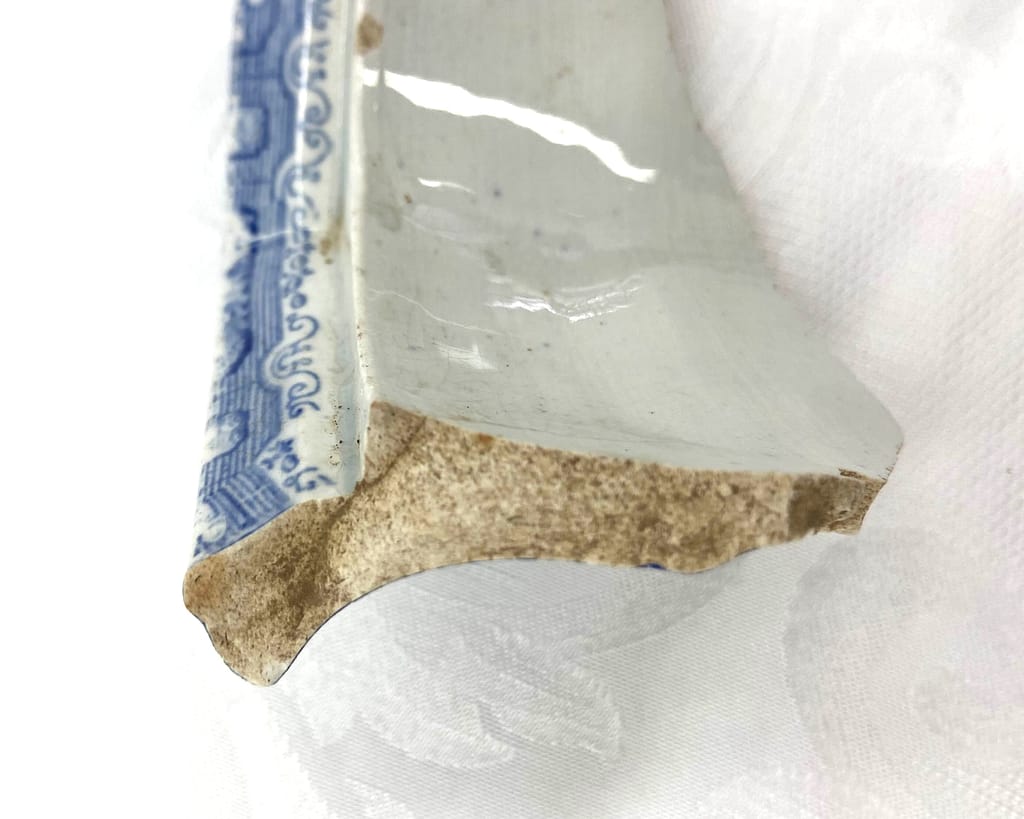
This is a ceramic rim sherd from a large vessel. The rim is flat, straight, and slightly angled outward. The vessel wall descends evenly from the rim before curving inward. The ceramic surface is smooth and coated with a clear, glossy glaze. The clay body visible at the break (pictured below) is white, fine, and compact, with no visible sandy grain in the paste.
Form and Function
Blue printed decoration appears on both the exterior and interior surfaces. On the interior, the decoration sits just below the rim, indicating a decorative band that wrapped around the inside of the vessel. The straight alignment of both interior and exterior decoration shows that the vessel had straight sides.
After documenting these physical properties, archaeologists identify the form of the vessel.
‘Form’ refers to the original shape and function of a ceramic object. The straight rim edge and angled wall of our Sherd A rule out plates and bowls, which are circular and curve evenly. The thickness of the sherd and the placement of decoration indicate a serving vessel rather than individual tableware.
These features identify the object as a rectangular serving platter. Rectangular platters commonly have interior rim decoration and exterior panels, both meant to be visible during table use.
Next, we identify the type of ceramic ware this item is. ‘Ware’ is a category based on clay type, firing temperature, and surface treatment. We identify the ware of Sherd A as refined whiteware.
Whiteware is a type of earthenware pottery made from highly processed white clay and fired at moderate temperatures.
The bright white paste, smooth texture, and clear glaze confirm this identification for our sherd here. The decorative technique that was used here defines the object further. The blue design was applied using underglaze cobalt transfer printing.
A Blue Scene
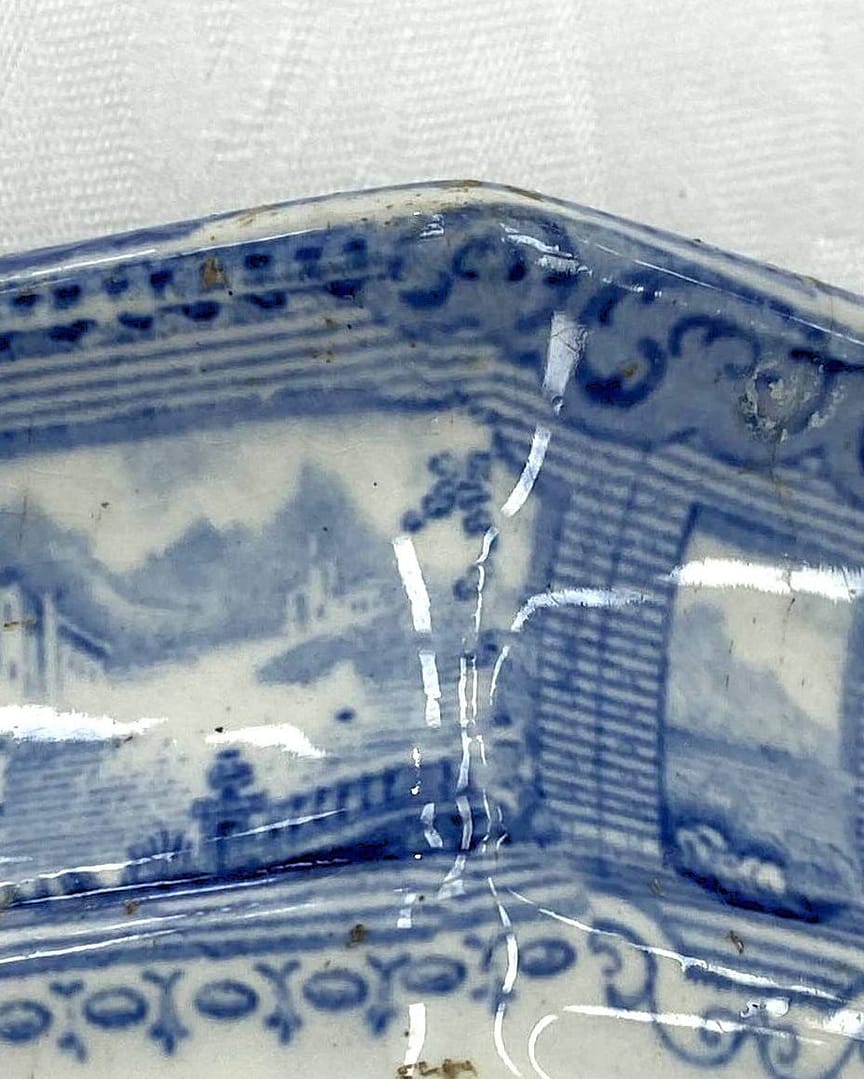
In the cobalt transfer printing process, potters engraved a design onto a copper plate. They applied cobalt blue pigment to the plate and transferred the image onto the ceramic surface using thin paper. The vessel was then coated with a clear glaze and fired in a kiln.
This sealed the design in beneath the glaze, which was a technique that was more sophisticated than earlier decoration techniques that saw the design placed on top of the glaze. However, the sharp edges and consistent tone of the decoration on this sherd confirm transfer printing rather than hand painting. This technique was commonly used on whiteware table ceramics during the nineteenth century, not earlier.
The ware type, decoration, and manufacturing technique allow archaeologists to date the object. Refined whiteware became common in our region (and around the world) after around 1820. Underglaze cobalt transfer printing was widely used during the same period, and press-molded rectangular platters are most common in the mid-nineteenth century.
Earlier ceramics relied on hand-painted decoration or tin glaze, which are absent here. After about 1870, ceramic decoration shifted toward brighter colors, molded relief designs, and decal transfers. These changes do not appear on this object, so we can date this sherd to approximately 1820 to 1870.
This means this item is likely from a middle-class household, but they had enough disposable income to have access to imported pottery. While “blue willow” patterns were very popular for blue transferware patterns, our design does not seem to be typical of the blue willow designs.

This makes matching our specific item a bit more rare, but this style of pottery is still incredibly indicative of the trans-Atlantic trade networks that made English ceramics broadly available in the U.S. after the War of 1812.
Revolutionary Pottery?
Pottery sherd A dates to between 1820 and 1870, which is too late for use at Washington Hall during the Revolutionary War. Even so, using it for comparison helps us understand how pottery evidence reveals the lives and choices of people who came before us.
Pottery Sherd B
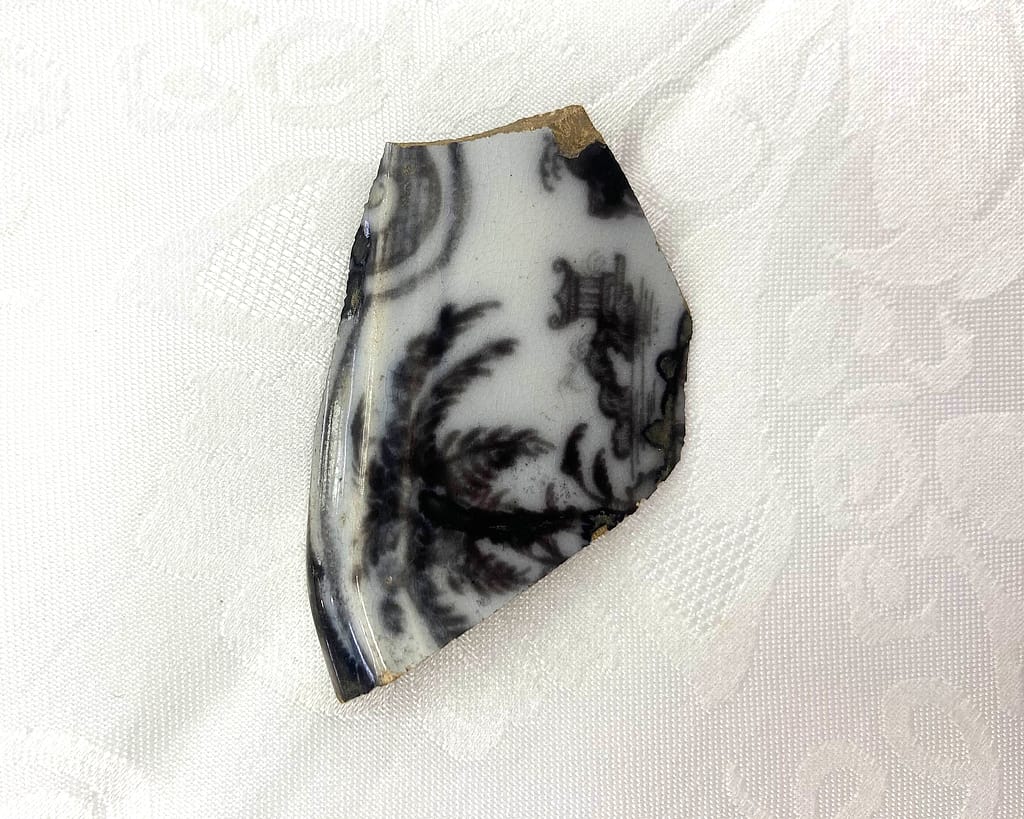
The piece above, though much smaller than sherd A, is also a type of transferware.
It has exterior decoration printed in black, or very dark glaze, on a light slip body. The fragment is thin and refined, and the glaze appears smooth, continuous, and shiny. It does not have the matte or salt-glazed surface typical of stoneware.
The body of the sherd, while thinner, appears to be of a similar paste.
Although this fragment is much smaller than pottery sherd A, a nature scene is still visible on the surface, showing that the vessel was once fully decorated.
Like pottery sherd A, this piece was probably imported from England. Staffordshire black transferware plates and bowls were commonly produced between 1820 and 1860.
Known maker patterns, such as the Ridgway family’s black-and-white transferware prints, used black underglaze transfers on a white body, which closely matches this fragment.
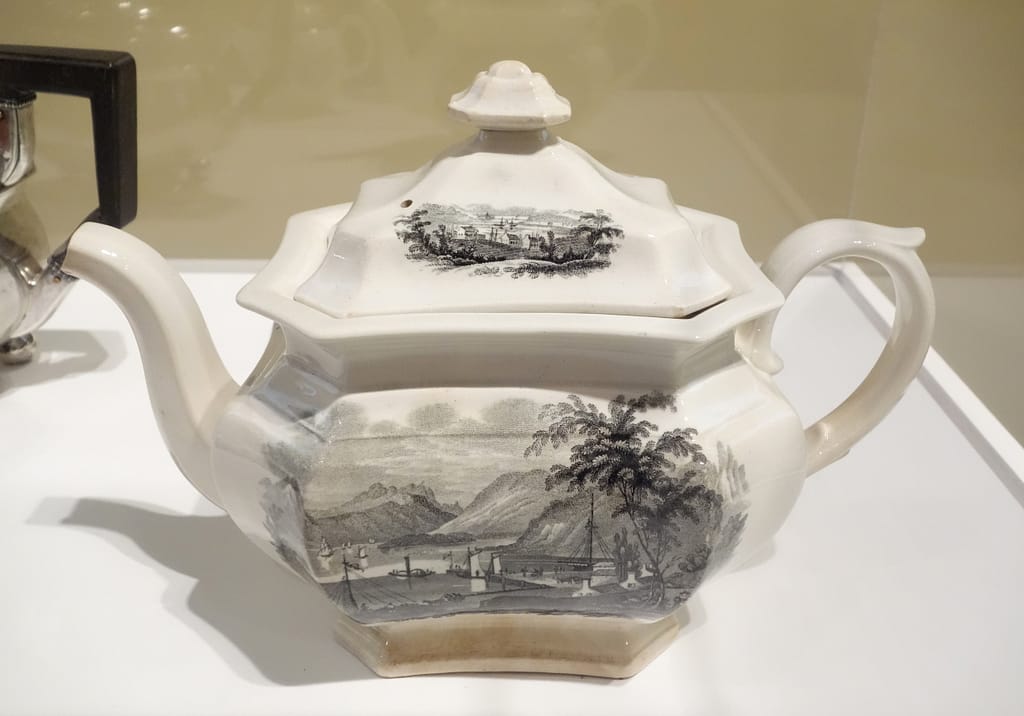

While our fragment is too small to confidently identify it as a Ridgway print, the style looks very similar. It was likely made using the same technique and produced around the same time period.
Black transferware appeared in many designs, including landscapes, architectural scenes, figures, pastoral imagery, and historical or commemorative motifs. Often inspired by older, more expensive porcelain imported from places like China and Japan, people buying transferware got pottery that looked very high-class but was still affordable on a lower budget.
These themes mirror those found on blue transferware like sherd A, though black transferware was a much rarer color and wasn’t produced as often.
Pottery Sherd C
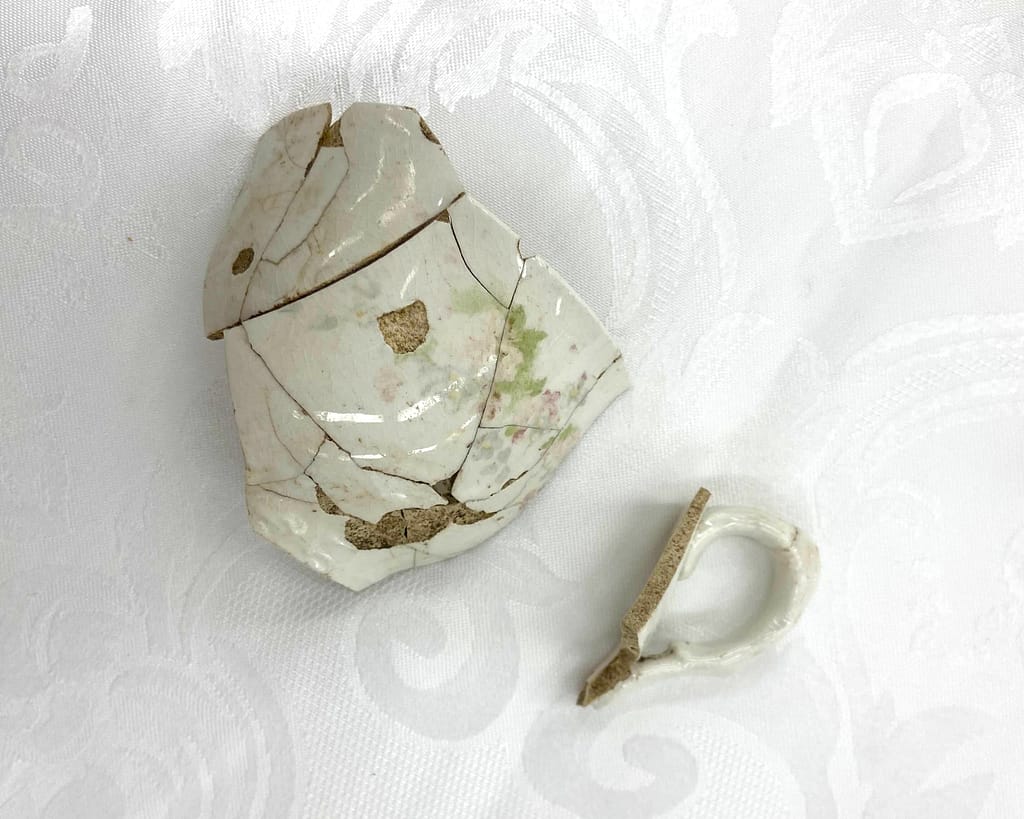
Pottery Sherd C was not found in the same box in the Limbo Room as the other fragments we examined. Instead, we discovered it near the forgotten springs on the hill earlier this year during the spring of 2025. Based on our research, we date this fragment much earlier than fragments A or B.
Sherd C consists of multiple ceramic fragments that together form a small handled vessel- a teacup.
Originally, it included several body sherds and a separate handle fragment. The handle joins the body at a sharp angle. Many of the fragments fit together well, and our archivist reconstructed part of the vessel.
The ceramic ranges from light buff to off-white in color throughout. The body sherds curve gently, and the curvature remains consistent across all fragments. This curvature matches a small, upright vessel rather than a bowl. The handle fragment is narrow, arched, and solid, which confirms that the vessel functioned as a teacup rather than an open form.
The vessel walls are thin and fairly even in thickness, though they are not perfectly uniform. This unevenness shows that the potter shaped the vessel by hand, most likely on a potter’s wheel. The interior surfaces are smooth and undecorated. The exterior surfaces preserve areas of painted decoration, which is green and pink and forms a floral design that looks faded and incomplete.
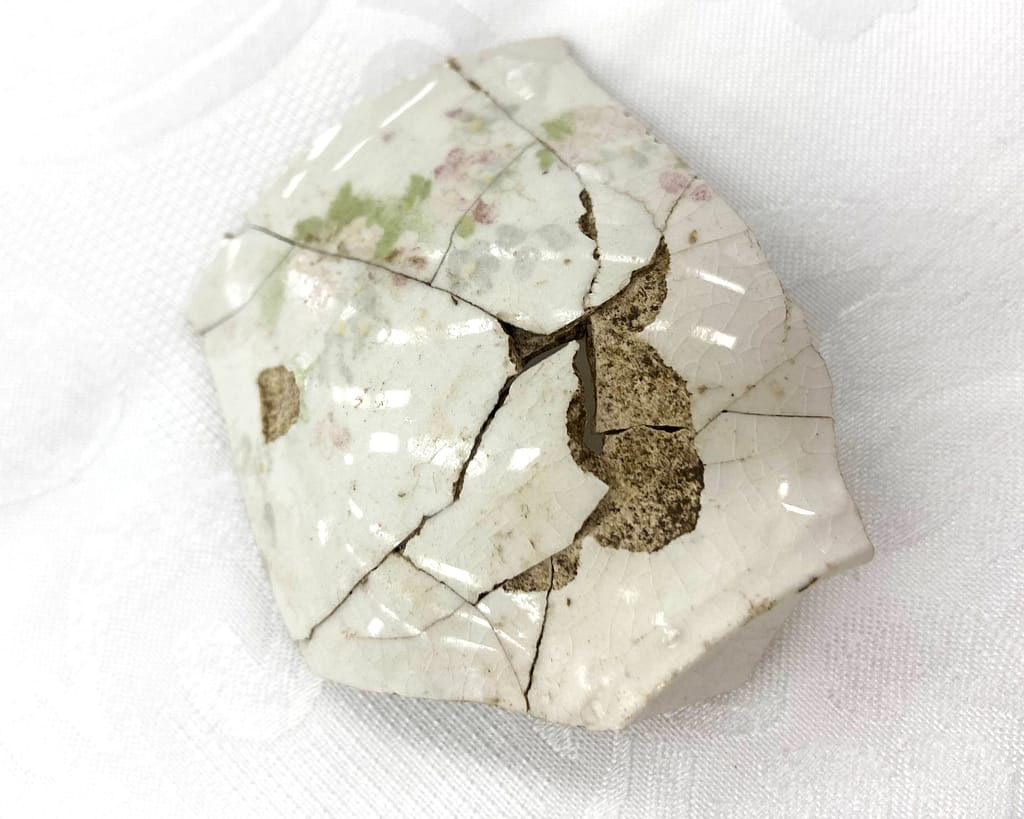
Visible brush strokes vary in thickness, which shows that the potter applied the decoration freehand. Unfortunately, during reconstruction and cleaning, some of the paint washed away, which proves that the decoration was more delicate than we first expected.
The painted decoration sits directly on the vessel surface and shows wear in several areas. The paint loss appears smooth and consistent with abrasion rather than flaking. This wear indicates that a thick clear glaze did not protect the decoration.
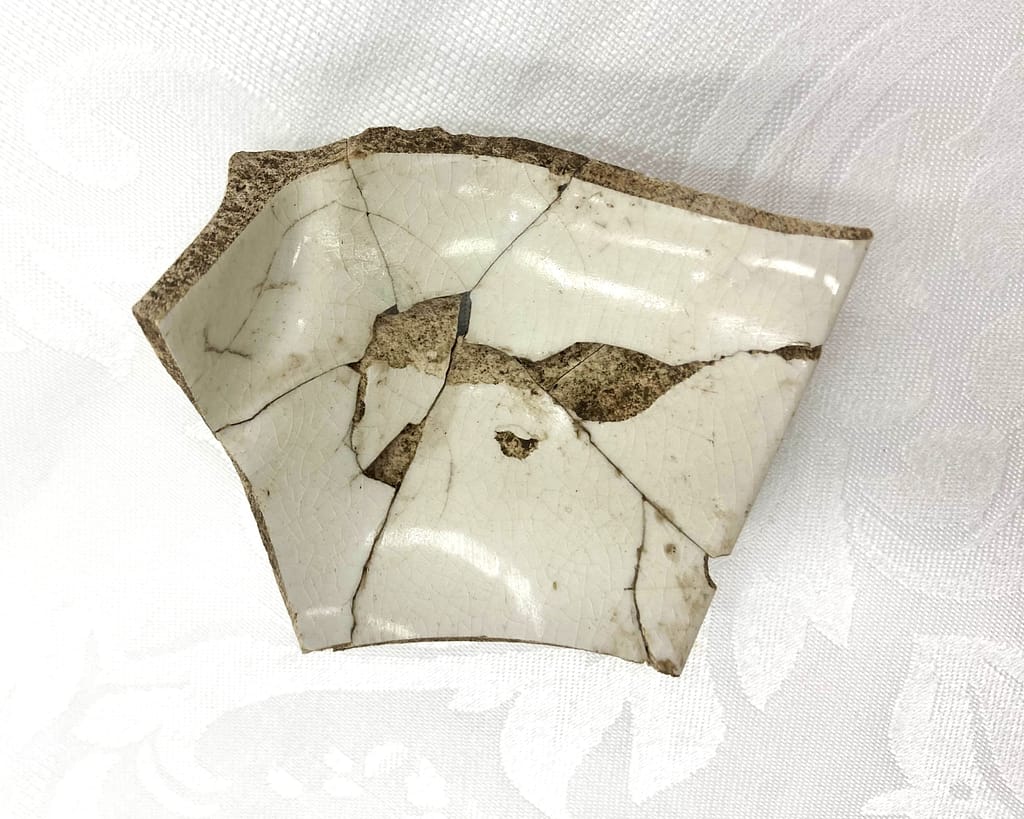
The broken edges expose the paste of the pottery. No sand, grit, or large inclusions are visible. The paste shows a light color and appears opaque. It breaks cleanly instead of crumbling and shows no glassy texture. These traits indicate low to moderate firing temperatures and confirm that the ceramic body is earthenware.
Together, these features identify the vessel as tin glazed earthenware.
Tin Glazed Earthenware
Potters made tin glazed earthenware by coating an earthenware vessel with a glaze that contained tin oxide. Tin oxide created an opaque white surface. After glazing, potters painted designs directly onto that surface using metal oxide pigments. The green pigment seen on this vessel came from a copper based compound. Because the decoration sits on top of the glaze, it remains exposed and wears away easily. This process explains the paint loss visible on the sherds.
The potter used freehand brush painting over a tin glaze to decorate this vessel. Uneven brush strokes and the lack of repeating patterns rule out mechanical decoration methods. The potter likely threw the vessel on a wheel, allowed it to dry, fired it once, coated it with tin glaze, fired it again, painted the decoration, and fired it a final time. This production process reflects skilled ceramic manufacture rather than local utilitarian pottery.
Online research suggests that this vessel may specifically be a Royal Vienna hand painted teacup. During its time of use, such an item would have been imported and very expensive. A more complete tea set of the same type appears in an online listing, which can be seen here.
From Vienna to Pennsylvania
European potters produced tin glazed earthenware teacups and imported them into British North America during the late seventeenth and early eighteenth centuries. In Pennsylvania, these wares most commonly appear between about 1680 and 1740. After this period, refined white earthenwares replaced tin glazed vessels for tea drinking. The hand painted decoration and lack of industrial features place this teacup firmly within that earlier date range.
However, people continued to use and value these wares into the late eighteenth century, and they likely remained popular during the time of Washington Hall.
The presence of a handle confirms that the vessel functioned as a teacup. Tea drinking became more common during the early eighteenth century, and teacups carried strong social meaning. People associated them with refinement and social display. Tin glazed teacups cost much more than plain pottery and represented status rather than everyday use.
In Chester County, Pennsylvania, archaeologists commonly find tin glazed earthenware in early colonial contexts tied to English and Welsh settlement. Merchants imported these ceramics, often from places such as Vienna, through Philadelphia and distributed them to wealthy householders in nearby rural communities.
A Teacup In Revolutionary Times
Records from our archives suggest that several structures once stood on the hill, near the springs we mentioned earlier. Though they are lost now, finding this teacup near where those structures once might have been helps us paint a clearer picture of what life might have been like here during the Revolutionary era.
During the Revolutionary period and the time of Washington Hall, this teacup would have represented wealth and refined taste, even as many people faced difficult conditions.
For people such as Dr. Kennedy and his family (who we know from his will had a taste for the finer things) and Dr. Otto and his sons, this type of teacup likely appeared during visits with high status guests and formal social occasions- such as having tea with the visiting chaplain, Reverend James Sproat; or hosting people like Dr. Benjamin Rush.
To Us, Today
By comparing these pieces of pottery, we can learn about what they would have meant to the people who used them. Though by now the most faded and plain-looking of the bunch, in its heyday sherd C would have been a very fine and expensive piece of pottery.
In contrast, the people who used sheds A and B would have been emulating the kind of wealth that the people who owned sherd C would have had, though because transferware was easier to produce on a larger scale, they were able to have fine and fancy serving wares without spending as much money.
Taken all together, this tells us a bit- a fragment, if you will- about how fortunes rose and fell, here at Yellow Springs.
🫖☕🍵
Learn more about the history of Yellow Springs
You can read the more in-depth version of this post here
Follow us on Substack, Instagram, and Facebook
🫖☕🍵