
Throwback Thursday: Slipping into Slip-Trailed Redware
Could The Fragments of an Old Bowl be Connected to Life at Washington Hall?

Shelves, Boxes, and Shards of the Past
As we have mentioned in previous posts, the Moore Archives has a limbo-room, where we keep items that have been found on the property, but that have not been accessed into our archives yet.
While going through some of the shelves in this room, the archivist found a shelf full of cardboard boxes, simply labeled as: “Archaeology- Historic Yellow Springs”.
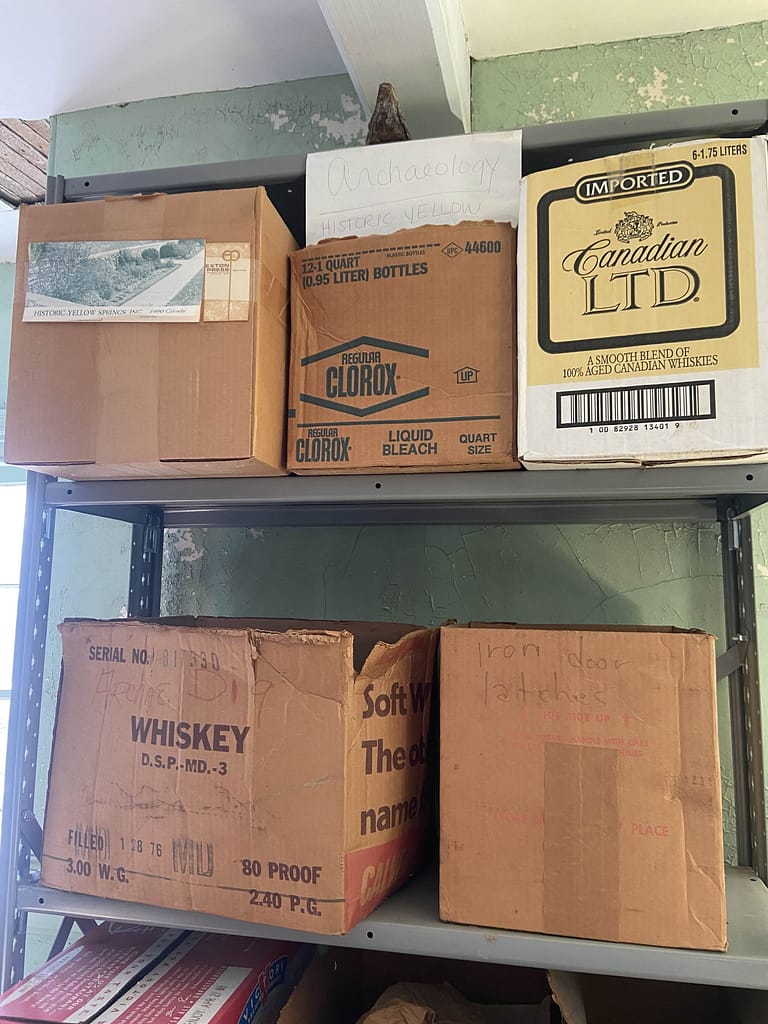
While this had caught her eye before, today we decided to dig into one to see what we could find.

This collection contains a wide variety of items, including glass and what (we think) are butchered deer or pig bones.
However, what immediately caught the archivist’s attention was the inclusion of a large amount of redware among the findings.
For context, ‘redware’ refers to a type of pottery defined by archaeologists as common, coarse, and reddish in color, made from iron-rich clay.
This type of pottery was popular in colonial America, and was commonly used for making pots and bowls. It is characterized by its earthy red hue, which is often glazed (sometimes with lead), and may feature specific designs as well.
The box does not include documentation for these items, so we don’t have details about where they were found. However, this type of redware and some pottery styles can help us learn more about what these items mean.

Based on the root still clinging to this shard of redware, we can assume that these were found underground on the property, probably during some of the construction that has occurred in the past 30 years.
Because they are not bagged, identified with a site number, or dated, we do not think that these were found during one of the official archeological digs that has occurred on the property– though that does not stop us from digging a little deeper.
Dig a Little Deeper
While due to the current cold weather, we can’t literally go digging for more information, we instead selected one of the boxes to bring back to our archaeology room for analysis.
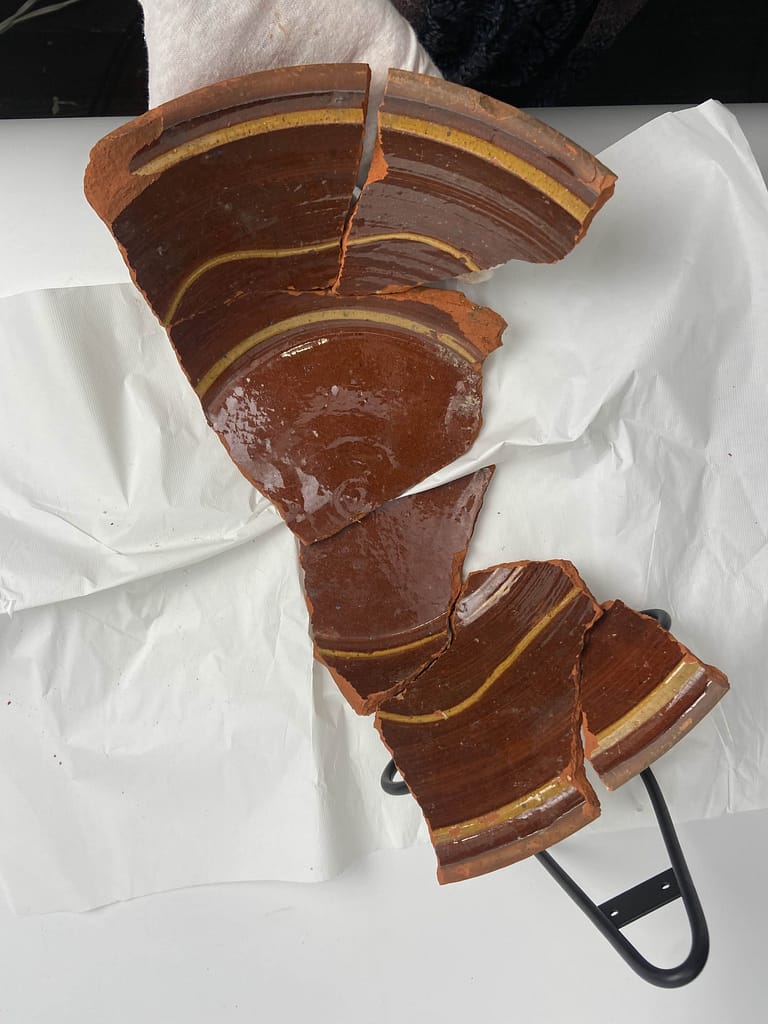
Inside this box, we discovered several shards that appeared to be from the same type of redware. This means they are probably from the same original vessel.

Note the ‘squiggle’ design on the shard above. It features a distinct design that we call ‘slipware’ or ‘slip-trailed redware’ today.
From her previous experience at the Brandywine Battlefield, our archivist recognized this material.
After cleaning the shards, we double-checked this assertion by comparing them to the extremely helpful Florida Museum of Natural History’s online database for historic period archaeological ceramics.
On the page for slip-trailed redware, the Florida Museum of Natural History describes this type of ceramic as follows:
Red to red-orange coarse earthenware paste. Decoration is applied by slip-trailing in white, and is simple and geometric. Designs include broad bands, stripes, loops, and lobes. The interior surface is covered with a clear lead glaze. Vessel walls are generally heavy, reflecting the utilitarian nature of this pottery.

Looking at what we have, this seems to match that description.
Slipped Up
We believe this is slip-trailed redware, so we tried to piece together larger fragments to see the vessel’s original shape. Understanding its shape helps us learn about its possible uses.


We don’t have all the pieces, so we can’t fully reconstruct the vessel. However, we have enough pieces to see the shape begin to take form. By comparing this with published examples from a diagnostic archeological report on slip-trailed redware, we hypothesize that the original form was a large, shallow bowl.
Shallow Bowls

Ceramics in this style emerged from the Pennsylvania Dutch communities, which are made up of German immigrants. Archaeologists have reconstructed two distinct types of deep bowls from Pennsylvania redware assemblages.
The first type, shown in the photo from Gibble’s report, has sides that angle more steeply. The decoration of these bowls indicates they served multiple purposes, acting both as food preparation vessels and as serving bowls on the table.
The second type consists of large, shallow bowls that have a wider body than height.
Archeologists recovered several nearly complete examples of this vessel form from the Camp Security site in York County, which functioned as a Revolutionary War encampment for British and Hessian prisoners. These vessels possess steep sides that form a sharp angle at the base and feature ridged rims.
Many of these bowls showcase decorative polychrome slip-trailing on their upper surfaces, displaying linear and wavy lines, as portrayed in Gibble’s Figure 6. These bowls likely served to prepare and serve large quantities of stewed foods for the camp occupants.
We believe our bowl closely resembles the second type, which was most commonly used from around 1760 to 1783.
Glazed on One Side?
While examining these shards, we initially puzzled over why such a decorated bowl had glaze only on the inside. As we worked, we discovered remnants of glaze on the outside as well, though only a small amount remained.

This discovery indicates that the bowl had buried for a long time, causing the exterior glaze to wear down and expose the bare redware ceramic beneath.

It seems that the burial protected the inside, which explains why the glaze and pattern on the fragments remained beautifully preserved.
Putting it All Together
The Florida Museum of Natural History’s database has a few comments about slip-trailed redware that we thought we should include here:
Simple, slip-trailed redware vessels were produced at several locations in the Anglo-American colonies after 1750, initially by German potters who emigrated to Pennsylvania, New England and North Carolina. The simple geometric band and loop decoration on utilitarian forms is often referred to as “Philadelphia style”, although as noted such wares were made in a number of centers in Eastern North America. The are most common from the third quarter of the eighteenth century into the first decades of the nineteenth century.
This kind of ceramic vividly evokes the Yellow Springs area. Many immigrants who settled here were of German descent, and there was a significant Pennsylvania Dutch presence shaped the local culture at that time.
This type of ceramics has a date range (1750-1810) that places it in the colonial era. By narrowing it down further based on the vessel’s shape, we conclude it dates back to when Yellow Springs served as a hospital complex during the American Revolutionary War.
To Us, Today

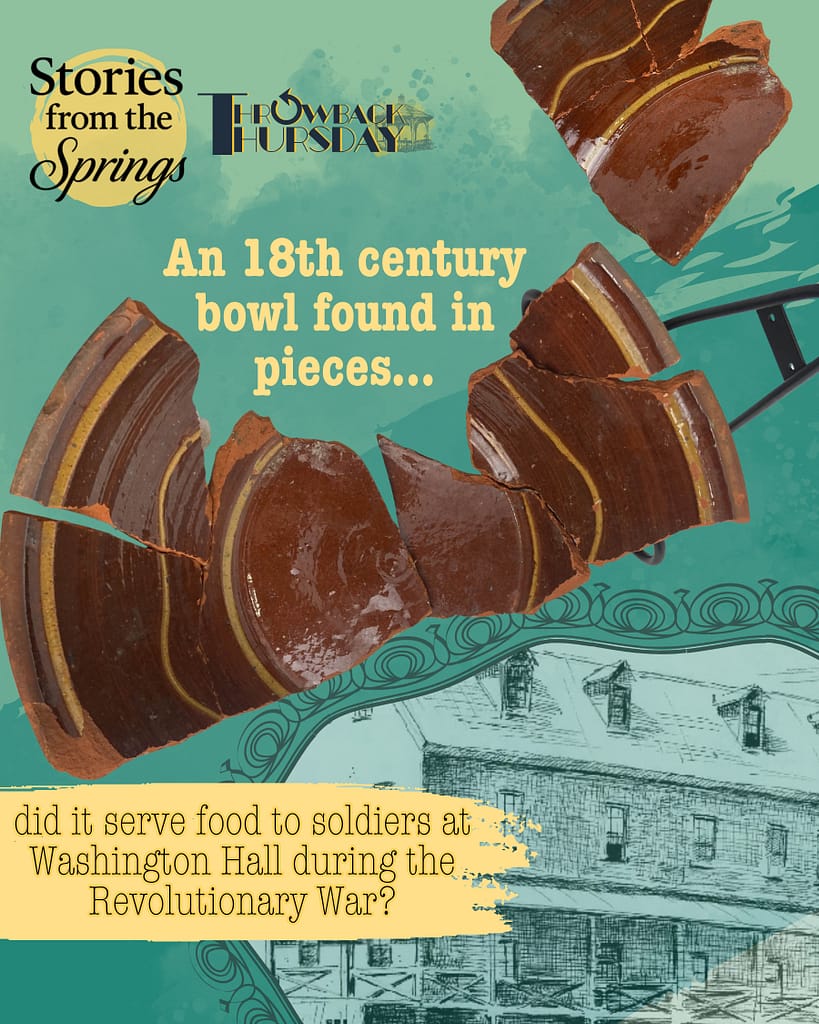
This very bowl could likely have served large meals to soldiers treated at Washington Hall, offering us a tangible piece of history we can hold and piece back together bit by bit.
The iron-rich clay used to make the vessel might have come from our property, but the technique employed is specific to a certain community of German immigrants.
This community, including figures like Dr. Bodo Otto and Abigail Hartman-Rice, played a crucial role at Washington Hall. They helped save the lives of many sick and dying soldiers at Valley Forge.
As we celebrate the 250th anniversary of the United States, we must remember that Independence wasn’t won through battles and strategies alone. The care and collaboration communities and the contributions of its immigrants were– and continue to be– vital pieces that together, built our nation.
🏺🖌️🪴
Learn more about the history of Yellow Springs
You can read the more in-depth version of this post here
Follow us on Substack, Instagram, and Facebook
🏺🖌️🪴