
Throwback Thursday: A Study of Medical Services
A 1971 Report On Revolutionary War Hospitals Helps Us Understand Our Past
Setting the Scene
The Moore Archives at Yellow Springs are in the middle of a careful reckoning.
Staff are reorganizing collections, digitizing all folders, and preparing for an upcoming exhibit on the Revolutionary War. This work exposes a familiar challenge: the Moore Archives did not exist during the eighteenth century.
For the Revolutionary War period, original documents tied directly to Yellow Springs are rare. Washington Hall, the war hospital built on these grounds, survives today as ruins rather than paper.
Much of what survives instead comes from research materials gathered decades later. Compared to other eras of Yellow Springs history, we have very little direct access to original documentations. That absence forces historians to look closely at how earlier archivists built meaning.
Understanding their research tools becomes part of understanding the past itself.
Torres-Reyes’ Report
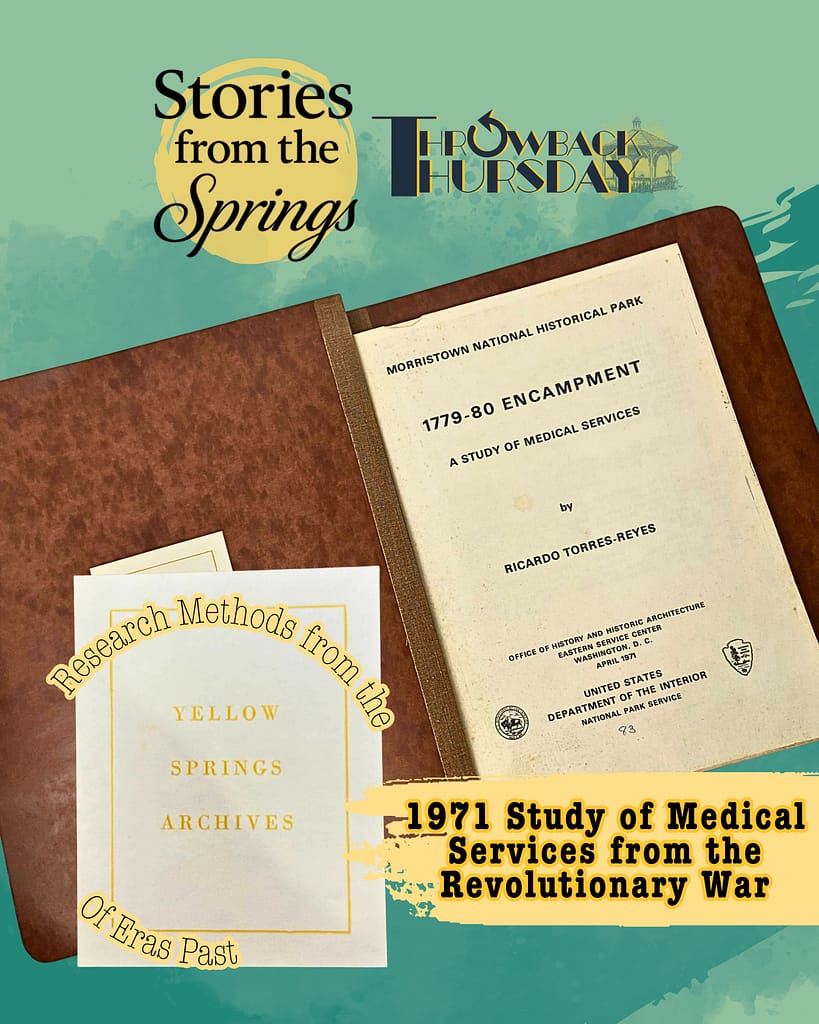
One of our artifacts, a report on the 1778-1780 Encampment at Morristown, helps us see what previous archivists used to reconstruct this era.
Published in April of 1971 for Morristown National Historical Park and prepared by Ricardo Torres-Reyes, the report was published through the Office of History and Historic Architecture for the Department of the Interior and the National Park Service.


The interior cover carries the original Yellow Springs Archive logo.

That logo only appeared during the earliest years of the archive, from around 1970 to the mid 1980s. Its presence signals active use by researchers rather than passive storage.
This book lived in the research library, and the booklet is filled with handwritten notes from a previous archivist as they pieced together history from the pages.
In the early 1970s, archivists worked without internet access and relied on printed studies, photocopies, and correspondence. This report served as a foundational reference.
Although it focuses on Morristown, it repeatedly mentions Yellow Springs.
More importantly, it explains the Hospital Department structure that governed care at Washington Hall. The artifact shows how early archival interpretation at Yellow Springs relied on regional comparison rather than isolated local records.
What Is a Hospital
During the Revolutionary War, the word hospital meant far more than a building. In our previous post, we touched briefly on the different forms of ‘hospital’ during the Revolutionary War, and this report from 1971 details those distinctions a bit further. Congressional records used the term to describe the entire medical administration of the army , often corresponding with the Hospital Department.

Congress initially failed to establish a medical department in 1775, prompting Washington to demand reform.
The resulting Hospital Plan created centralized authority under a Director General supported by surgeons, apothecaries, clerks, matrons, nurses, and laborers.

Later reforms divided the system into geographic districts, including the Middle District that encompassed Yellow Springs.
This structure explains why Washington Hall functioned as part of a coordinated network.
Yellow Springs did not operate independently. It followed standardized reporting, shared supply chains, and answered to district leadership.
For earlier archivists, this framework clarified how a hospital could exist here without extensive surviving paperwork.
Clean or Else
Cleanliness dominates the hospital regulations described in the report.
Orders required burning straw bedding after death or discharge and mandated washing and airing clothing before reuse. Officers enforced personal cleanliness as a measure of discipline and morale. Surgeons submitted weekly returns listing sick men and their disorders.

These rules attempted to control putrid fever, dysentery, and smallpox, which the report identifies as leading killers. Those familiar with the history of Washington Hall at Yellow Springs may know that smallpox inoculations was part of what brought well-known medical men of the era, such as Dr. Bodo Otto, to the hospital here.


Overcrowding and poor ventilation turned hospitals into sites of infection rather than recovery. This matters deeply for Yellow Springs interpretation.
Washington Hall was not only a place of treatment. It was a regulated environment shaped by routine labor, sanitation, and discipline.
These details allow the ruins to speak about daily life rather than only crisis and death.
Numbers Speak Loud
The report provides hard data that anchors Yellow Springs in the medical record. One general return lists Yellow Springs with fifty five total patients admitted during one month between 1778 and 1780.
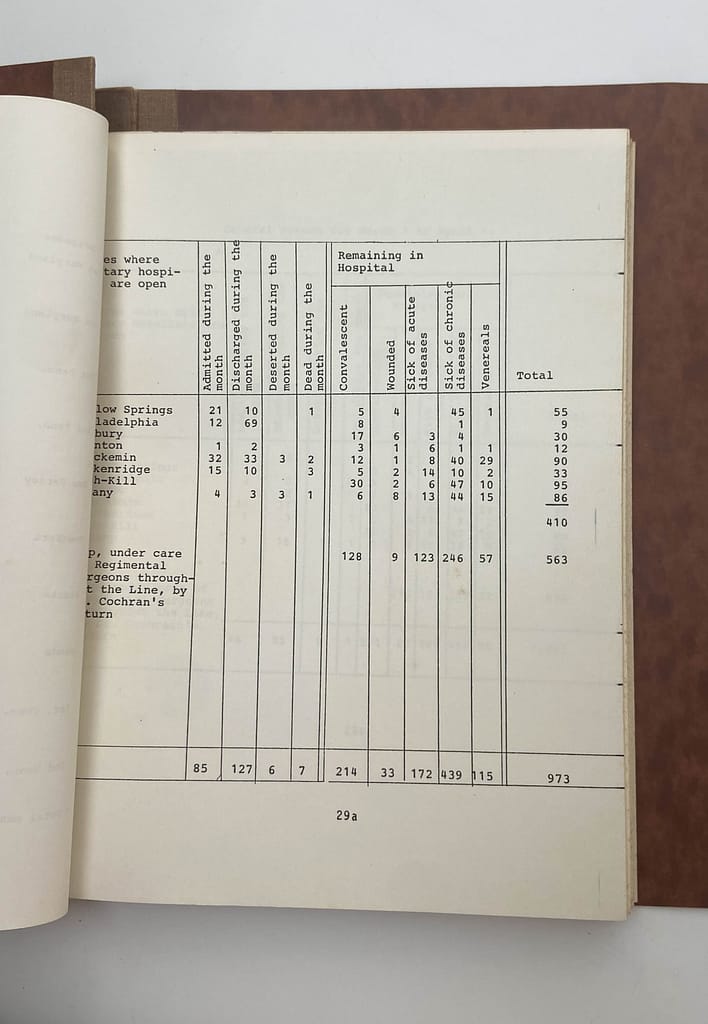
That figure includes wounded soldiers, acute disease cases, chronic illness, and venereal disease. Nearby hospitals such as Buckemin and Baskenridge report higher totals, while Philadelphia and Trenton list fewer patients during the same period.
Later monthly returns show Yellow Springs maintaining steady numbers rather than brief surges.

These figures establish Washington Hall as an active medical site rather than a marginal outpost. For the Moore Archives, these numbers help replace assumption with evidence.

We have seen reports that claim that upwards of 1,000 soldiers were treated here, but from these records, we can assume that this is a number that is either inflated or is accounting for all the patients treated at Washington Hall during the decade or so it operated.
These more concrete records and numbers allow interpreters to discuss scale, capacity, and patient flow using documented comparison rather than speculation.
Bleed Them Better
The report also explains how doctors treated patients in various different forms.
Remedial medicine followed tradition and humoral theory. Physicians bled patients for fevers, inflammation, rheumatism, and mental distress.


Bloodletting dominated practice across armies– and we know that it was an important treatment undertaken at Washington Hall.
Records at Yellow Springs mention surgeon’s mate John Rose describing Dr. Bodo Otto’s desire to bleed Dr. Kennedy during his final days of illness. Mrs. Kennedy refused the treatment, and Dr. Kennedy died. Rose, as recorded in the book about his life (Incognito: An Affair of Honor by Mardee de Wetter), later seemed unsettled by this episode, though this is likely more about how the doctor died rather than the treatments offered to him.
The booklet does not narrate this event, but it explains its logic. Otto’s insistence reflects standard medical belief, not personal cruelty. It does, however, make the elder doctor fit rather concretely into the stereotype of “German surgeons” that seems to have existed at the time– unafraid to get more than a little bloody.

Herbs and Hands
The report also details medicines used across the Hospital Department. Apothecaries prepared standardized medical chests for regimental surgeons.
We mentioned an apothecary named Dr. Cutting in our post from last week, and we have touched on the importance of herbals and pharmacopeias during this time, but this particular report allows us a bit more clarity about the kind of medicines that would have been used here.
Dr. William Brown, while working at Lititz, published an American Pharmacopeia in 1778 to guide less experienced medical staff. Interestingly, Dr. Kennedy was also stationed at Lititz, and it is likely that he was influenced there by Brown’s work.

This account of Brown’s recommendations listed botanicals such as Peruvian bark, ipecac, rhubarb, gentian root, and many others found in hospital chests.

However, in his Pharmacopeia, he also included more native plants that could be sourced locally rather than through English-controlled trade networks. This mix of herbs can be seen in the lists provided in the report.


These lists help interpreters imagine what passed through Washington Hall. The citations included in the 1971 report also give us leads on where to look further.
The final few pages of the report include plates with photographs of medical instruments that would have been used during the era.


These details in the report show how Yellow Springs connected to broader medical supply systems. Care here relied on shared knowledge, collaboration, apothecary chests, and limited imports rather than isolated, independent folk practices– though those likely played a role as well.
If interested, you can see more of the pages of this book here, with their transcripts included.
Why This Still Matters
This 1971 report still shapes how Yellow Springs understands itself.
It shows how early archivists built interpretation before digital search tools existed. They relied on comparison, structure, careful research, and lots of patience.
For today’s readers, the artifact reminds us that local history often survives through research rather than original records.
The Moore Archives at Yellow Springs preserve not only the past, but the methods used to recover it. That layered story matters. It teaches how evidence, absence, and care intersect.
🏛️📜🩺
Learn more about the history of Yellow Springs
You can read the more in-depth version of this post here
Follow us on Substack, Instagram, and Facebook
🏛️📜🩺