
Throwback Thursday: The Will and Estate of Dr. Samuel Kennedy
- Research is Bringing Notable Figures from Yellow Springs' Past to Life (and death) In Preparation for the 250th Anniversary of the Declaration of Independence
- Washington Hall
- Dr. Samuel Kennedy
- The Will of Dr. Kennedy
- The Estate of Dr. Kennedy
- The Settling of Kennedy's Estate
- What Does This Tell Us?
- What's In A Legacy
- To Us, Today
Research is Bringing Notable Figures from Yellow Springs’ Past to Life (and death) In Preparation for the 250th Anniversary of the Declaration of Independence
Healing and War at Yellow Springs
Today, visitors to Historic Yellow Springs are often told about how our campus served a vital role in the American struggle for Independence. The ruins of a Revolutionary War-era hospital, known colloquially as the Hospital Ruins, are a significant feature of the property.
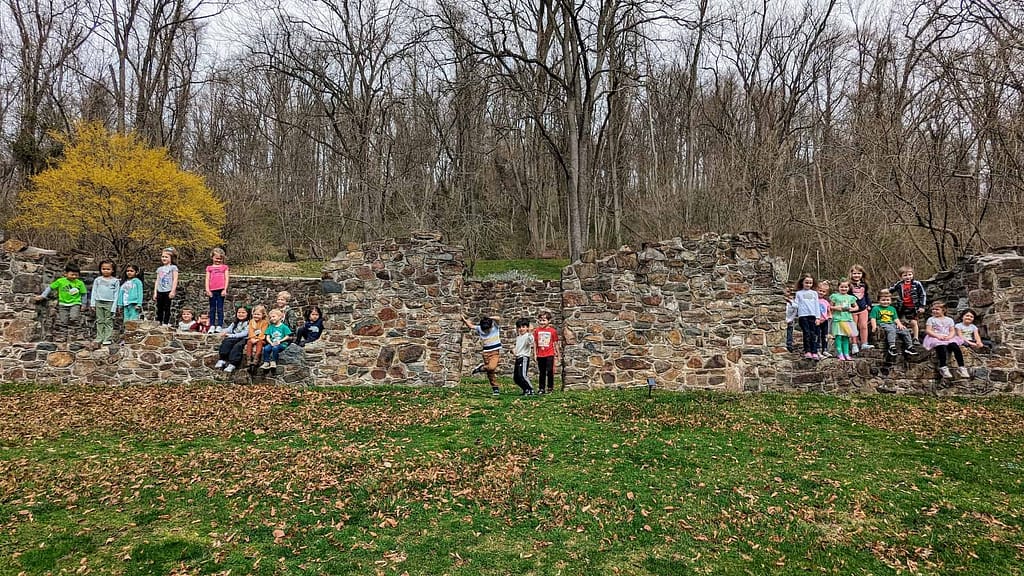
These stone walls often draw the attention of history enthusiasts and interested amateurs alike; and they are all that remains of the first military hospital commissioned by Continental Congress.
After retreating from the Battle of Brandywine on September 11th, 1777, General George Washington and his troops headed towards Yellow Springs and Malvern. On September 16th, they prepared to fight the British forces advancing towards Philadelphia. But this was a confrontation that never happened: now known the Battle of the Clouds.
During the Battle of the Clouds, Washington used the tavern at Yellow Springs as his headquarters for the night. The soldiers made camp here as well. The army left shortly afterwards, headed to Warwick furnace.
Though Washington and his men moved on for the time being, many of those soldiers would return to Yellow Springs by the years’ end.
The Yellow Springs property, owned by Dr. Samuel Kennedy at the time, would soon become the site of a significant military hospital.
Although there are some indications that “rebel hospitals” were already operating in Yellow Springs before Washington’s visit, Dr. Kennedy officially permitted part of his property to be developed into a general hospital for the military once the area received approval from Washington.
This hospital would be the only hospital of its kind commissioned by the first Continental Congress. It became known as Washington Hall.
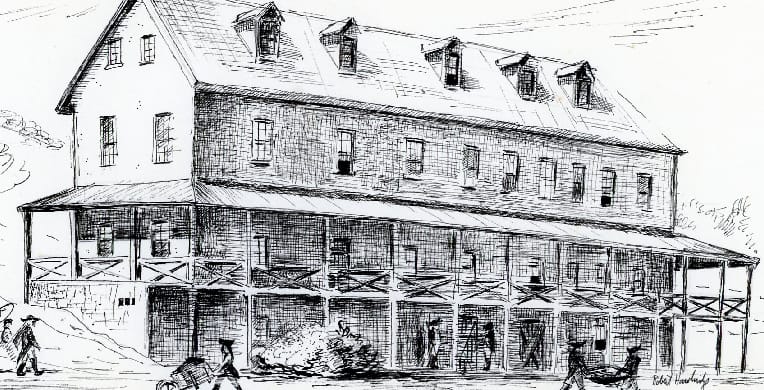
Washington Hall
The ruins of this structure still stand on our campus as a memorial. While burned down twice, during the Revolutionary War, it was three stories tall, over 100 feet long, well-ventilated, and state-of-the-art.
Though the entire story of the hospital is rather complicated and extensive (and we will be getting into all that at a later date), its importance during the winter of 1777-1778 cannot be understated.
During this time, the Continental forces were encamped at the notorious Valley Forge. It was a famously bleak and harsh winter, and unsanitary conditions, along with low supplies, left many soldiers sick and injured. “Flying hospitals” were common, designed to serve specific regiments.
However, the General Hospital at Yellow Springs catered to all the sick from Valley Forge who were well enough to march there. Additionally, it served as the headquarters for the Continental Army’s Hospital Department.
Dr. Kennedy had previously campaigned in Canada and served as a regimental surgeon in locations such as Lititz. When Washington Hall was ready for use, he was called back to Yellow Springs. He was appointed the Senior Surgeon and administrator of the hospital, a significant elevation for a man whose influence in the broader medical community had been fairly provincial up to that point.
While the wards of Washington Hall also played host to more well-known medical men of the day, such as Dr. Bodo Otto and Dr. John B. Cutting, the life and death of Dr. Kennedy in his hospital at Yellow Springs is one of the most impactful stories that we can trace from that time.
Dr. Samuel Kennedy
The Moore Archives is researching Washington Hall and Yellow Springs’ role during the Revolutionary War for our upcoming Revolutionizing Medicine exhibit, opening in January 2026.
We are diving into our archives and comparing them with online materials that weren’t available when our record-keeping began in the 1970s. Through this process, we are building a more comprehensive biography of Dr. Kennedy as a person.
While we can’t cover his entire life story in this post, we will highlight some important facts about Dr. Kennedy here. He was respected by his peers and superiors as a patriot and did not receive any payment for the use of his property. His surgical skills, humane treatment, and well-mannered demeanor helped him rise from a country doctor at a regimental hospital to the administrator of Washington Hall.
Dr. Kennedy was well-noted by his contemporaries for being exceptionally hands-on and compassionate with his patients. Letters written about him highlight his strong work ethic as well. Dr. Cutting, chief apothecary for the Medical Department, noted that Kennedy often worked himself to the point of “near exhaustion”.
This combination of patriotism, dedication, and attentive care contributed to the success of Washington Hall.
Kennedy’s influence and attitude seem to have played a significant role in setting the standard of care at the hospital. Out of the over 700 soldiers who passed through the wards at Yellow Springs (though some estimates and accounts have that number exceeding 1,000 soldiers), only around 130 are reported to have died.
Unfortunately for Dr. Kennedy himself, he would also meet his death at Yellow Springs.
The Death of Dr. Kennedy
Dr. Kennedy’s exact date of death is rather contested in our sources. Some accounts suggest he died in early June 1778, while his headstone states that his death occurred on June 17, 1779, and others indicate he may have died in July 1778.
However, what remains consistent is that Kennedy succumbed to a “putrid fever”.
At the time, “putrid fever” refers specifically to typhus– a disease that was relatively common at Valley Forge.
Typhus, like typhoid and smallpox, were known as “camp diseases”. They were spread due to poor living conditions and contaminated food and drink. Typhus specifically is spread by human parasites (such as lice and ticks).
Those who cared for the sick at Washington Hall had a very strict hygiene regiment for the day. All contaminated clothing, bedding, and straw was thoroughly washed or disposed of.
However, as we mentioned earlier, Kennedy was known to be very personally involved in the maintenance of the hospital and the care of the sick.
This is probably how the doctor contracted the illness that would claim his life.
The Will of Dr. Kennedy
During our online research to clarify the circumstances surrounding his death, our archivist discovered a record containing his will and details of his estate.
These records were obtained from the digitized archives of Chester County and were matched to a file in our archive that contains a photocopy from the 1970s or early 1980s.
These digital scans provide clarity on some details that were missing from our photocopies, and allowed us to digitally enhance our records to match.
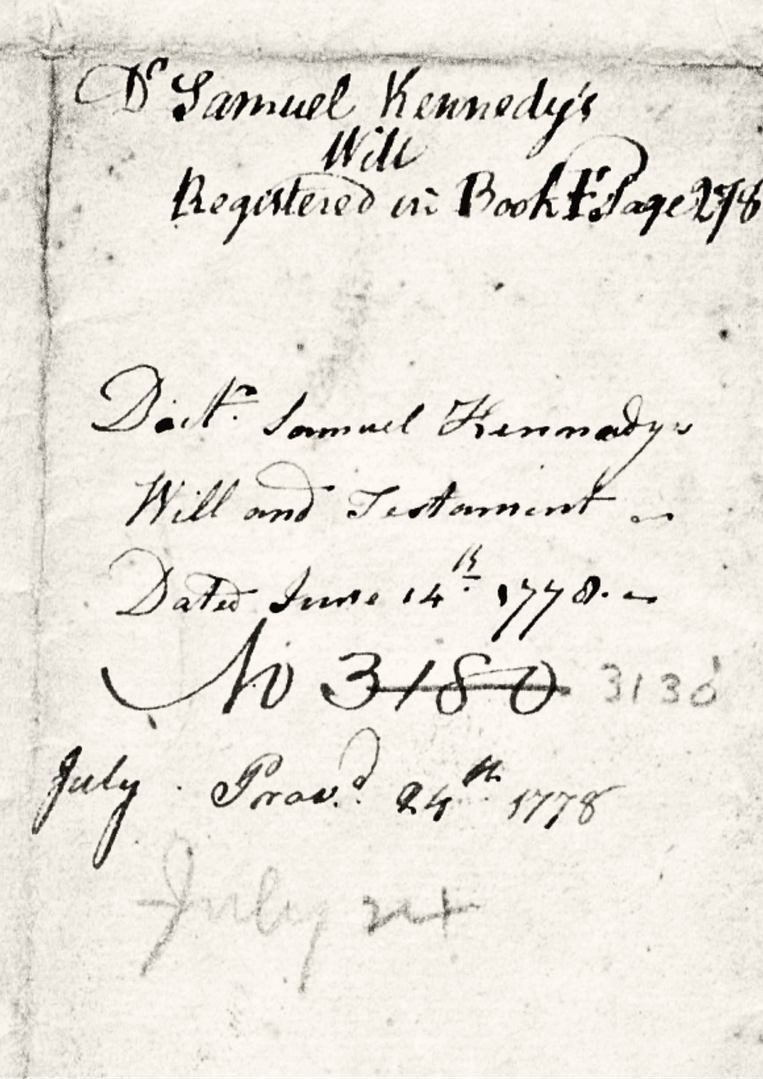
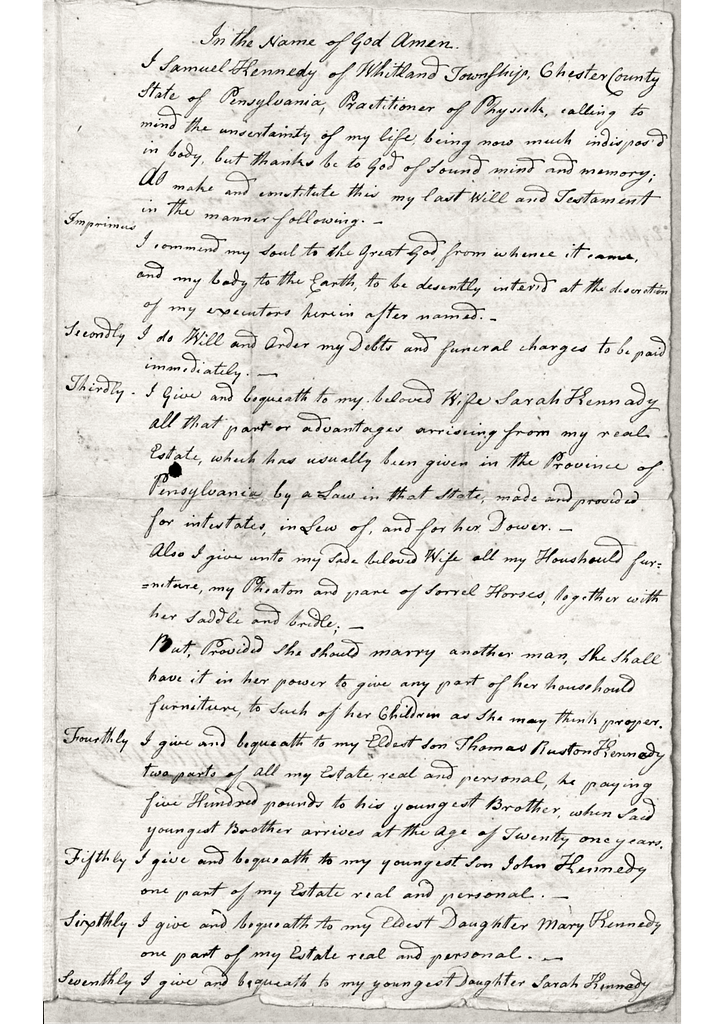
Dr. Kennedy’s original will and estate index are stored at the Chester County Archives. They are filed under number 3130 in the Wills & Administrations records of 1714-1923.
The images shown below are composite versions of our photocopies that have been digitally cleaned up for readability. We used the digitized records from the Chester County Archives to fill in any gaps.

What Does This Mean?
This information reveals several important points. Firstly, Dr. Kennedy must have died after June 15th, 1778, as this is when he wrote his will. He had several sworn witnesses, and he is very aware that his body was failing.
This is very likely the disease that killed him, allowing us to reasonably conclude that Kennedy did not live to see 1779, despite what his headstone claims.
We should note here that Kennedy was first buried at Yellow Springs, along with the rest of the dead from Washington Hall. He was later moved to Charlestown Presbyterian Graveyard, where he remains today.
This transfer is probably what caused the incorrect date on his grave marker.

Image courtesy of Flababo, user on Find a Grave
We can also see that he appointed his wife, Sarah Ruston Kennedy, and his brother, Montgomery Kennedy, as executors of his will and estate.
He seems to have both trusted them greatly and held great fondness for both of them.
In particular, he refers to Sarah as his “beloved wife” almost every time he mentions her. This overt affection towards his wife is also notable in our records of letters that Kennedy sent Sarah while he was stationed away from Yellow Springs.
Before addressing his wife, brother, children, or property, Kennedy ensures that he first commits his soul to god and his body to the earth.
While this wording is not too uncommon in other wills from the same era, it does shed light on his mindset while on his deathbed.
The Estate of Dr. Kennedy

On the first page of the record concerning Kennedy’s estate, a few notable details emerge. The first piece of “property” mentioned is an enslaved woman, approximately 40 years old at the time of Kennedy’s death.
We know from other records that this woman’s name was Rina, and it is likely that she began working for the Kennedy family when Sarah married Samuel.
Sarah Ruston Kennedy was the daughter of Job Ruston, one of the wealthiest men in the area at that time, who owned over 100 slaves.
While this remains speculative, we suspect that Kennedy’s family was not initially wealthy enough to have owned slaves before this connection.
In the slave records established in Pennsylvania following the gradual banning of slavery in the state in 1790, Rina is listed as a mulatto woman aged 45, enslaved to the heirs of Dr. Samuel Kennedy.
Two enslaved girls, named Lucia and Kitte, are recorded as well, and we see them here too.
While we cannot confirm any biological relationship, there is some suggestion that Rina may have been their mother.
Secondly, we note the notation of “d’o” in the record. This is shorthand for “ditto”, meaning that it is meant to be read the same as the line above.

On the second page, we note the signature of Samuel Culbertson, the man who Kennedy employed as the tavernkeeper at Yellow Springs.
Culbertson shows up many times in the petitions for tavern ownership, an index of which can be found here.

The Settling of Kennedy’s Estate

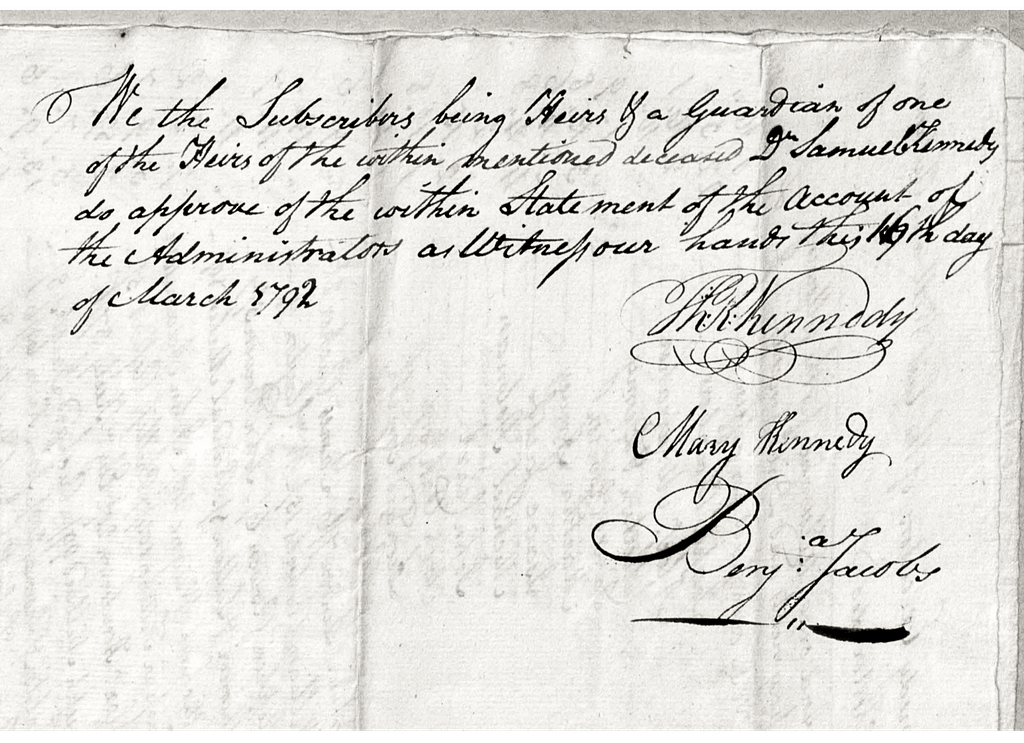

These documents, containing the signatures of Sarah Kennedy, Montgomery Kennedy, and two of Dr. Kennedy’s children (Thomas Ruston and Mary) tell us how Kennedy’s estate was settled.
He had some notable depts, which were paid, and hen the rest of his estate was given to his heirs. The matters seem to have been settled and accepted by March 16th, 1792.
What Does This Tell Us?
At Historic Yellow Springs, we often recount our past in the form of stories.
This practice allows us to feel connected with it and enables certain characters to tug at our heartstrings. By all accounts, Dr. Kennedy was recalled as a kind man and a skilled doctor who dedicated himself to serving his patients and his country, even at the cost of his life.
However, when we look at his will and estate, we see that he was also very much a man of his time.
It is difficult to reconcile the image of Dr. Kennedy as a caring doctor and a loving husband and father when we also know that he participated in the abhorrent practice of owning another person.
While records suggest that Rina, Lucia, and Kitte likely served as house servants (likely as lady’s maids), and the horrors of chattel slavery were less prominent in states like Pennsylvania– they lived their entire lives as people who were treated like mere property.
We cannot imagine what that must have been like, and no one ever should have had to endure it.
However, we learn an important lesson from this crossroads. When we look at the will and testimony and estate of Dr. Samuel Kennedy, we see the remnants of a man who was deeply human.
What’s In A Legacy
When we recall history, it can be easy to make heroes and villains and to simplify the story to fit a neat narrative– which can be helpful and certainly has its time and place.
But when we record history scholastically and evaluate an archive, we must recount events and circumstances with transparency and as they honestly occurred. Dr. Kennedy existed as a man of his time, for better and for worse.
The hospital he helped create saved the lives of hundreds of people, but he owned Yellow Springs and had the property to build the hospital on in the first place because he played by the rules of a “country gentleman” of his era.
Many remember Dr. Kennedy as a patriot; in some of our records, he is referred to as a hero. By our standards today, it would be easy to fully condemn him for being a slave owner and participant in the horrific system of dehumanization of an entire group of people.
All of these points are valid perspectives because Dr. Samuel Kennedy was all of these things.
To Us, Today
We need to remember that Kennedy was a real person, a real figure in our local history, and minimizing an entire life to a black-and-white legacy does a disservice to all those who came before us. The only thing we can do is remember them, and remember them honestly.
All humans embody good and bad, molded by the circumstances of their time and place in society.
When we tell stories to ourselves about our history, we must remember to set aside our rose-tinted glasses and our red flags so that we can truly see things as they were– all in shades of gray.

⚰️⚕️📜
Learn more about the history of Yellow Springs
You can read the more in-depth version of this post here
Follow us on Substack, Instagram, and Facebook
⚰️⚕️📜