
Throwback Thursday: Valley Forge, The Doctors Otto, and Washington Hall
- Picture a Bleak Winter
- Feature Spotlight: Valley Forge Park Alliance Facebook Post
- Feature Spotlight: Stevenson's Essay
- Dr. Bodo Otto and a Medical Network at War
- Ottoâs Sons and the Cost of Service
- Kennedy, Disease, and the Work That Continued
- Civilian Care and the Roads Between
- What This Connection Means Today
In Collaboration with the Valley Forge Park Alliance, We Analyze the Deep Winter of 1777–1778 and the Role of Dr. Bodo Otto, His Sons, and Washington Hall
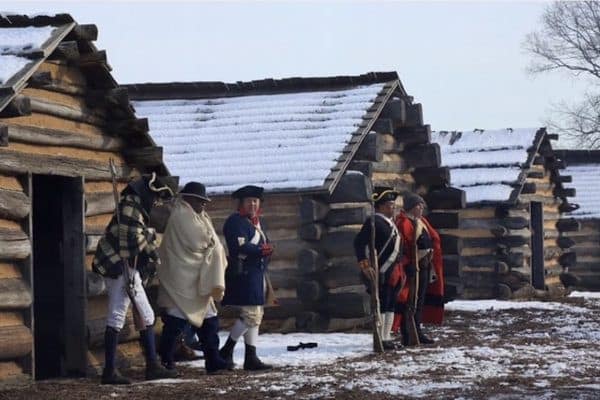
All credit for image to original photographer and the Valley Forge Park Alliance
Picture a Bleak Winter
Most people picture Valley Forge as one frozen image: snow, hunger, bare feet, and an army reduced to endurance.
Andrew Stevenson’s recent essay for the Valley Forge Park Alliance pushes us to hold a sharper truth alongside that familiar one. Valley Forge was not only a symbol of suffering.
It functioned as a living community of labor, logistics, faith traditions, and constant medical triage, recorded in orderly books, letters, diaries, and the Muster Roll itself.
Earlier this month, the Valley Forge Park Alliance reached out to us at Historic Yellow Springs to collaborate as both sites prepare for the celebration of the 250th anniversary of the founding of the United States.
We were thrilled and honored to receive this opportunity, not only because they have been putting out some incredible work lately, but also because this collaboration echoes important truths that made the bleak winter of 1777-1778 survivable.
As Stevenson’s essay points out, those at Valley Forge (and Yellow Springs) relied on a network of collaboration and communications to sustain them. In the current day, history is often looked at much more independently.
We tend to treat historic sites like standalone slices of the past, neatly boxed and separated into “their” story and “our” story. Real history does not behave this way– as they say; no man is an island, and nothing happens in a vacuum.
Between the Forge and the Springs
In the winter of 1777 to 1778, a pathway formed between Valley Forge and Yellow Springs.
Half-frozen soldiers, marching officers, surgeons, and wagons wore that connection into the landscape.
People carried food, clothing, straw, firewood, and sometimes men who could not walk another mile.
When we collaborate as stewards of history today, we echo that same logic of survival: care, organization, and shared labor are what make the story possible to remember at all.
Feature Spotlight: Valley Forge Park Alliance Facebook Post
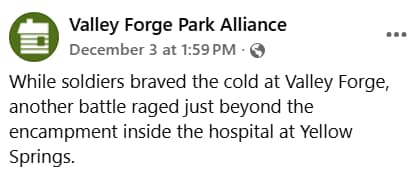
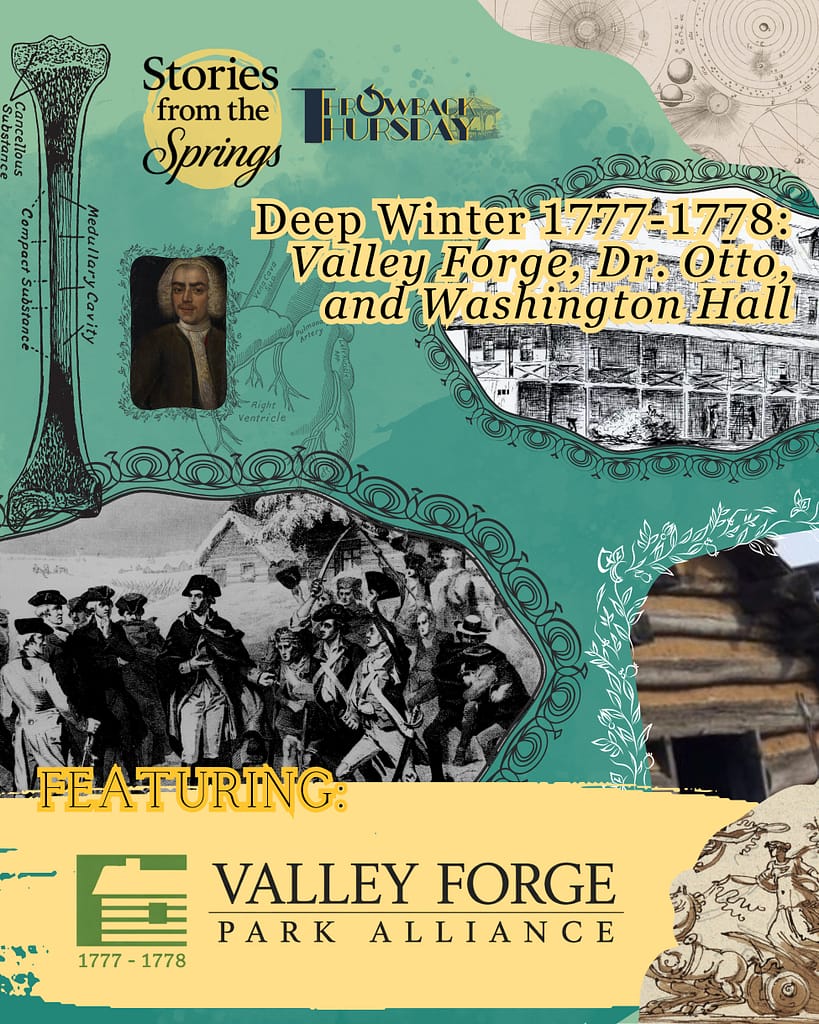
The Valley Forge Park Alliance’s December 3, 2025 Facebook post reframes the winter story in an essential way.
Rather than centering Valley Forge as an isolated site of suffering, the post explicitly situates Washington Hall at Yellow Springs inside the winter crisis. Disease is treated as an active enemy, and medicine as one of the tools used to fight it.
Dr. Bodo Otto Sr. appears not as a background figure, but as a central actor. An immigrant physician serving as Surgeon-in-Chief, Otto oversaw inoculations, hospital administration, and the movement of patients between sites. The post emphasizes that survival depended on organization as much as endurance.
This framing mirrors the historical record.
Washington Hall did not merely exist near Valley Forge. It functioned as part of the army’s medical infrastructure. Soldiers who were too sick to remain in brigade huts, or too weak to march with their units, were sent westward to Yellow Springs. Wagons that delivered supplies often returned carrying the ill.
The Facebook post invites the public to recognize that connection and to help build the Muster Roll so those contributions are not lost. That invitation reflects the same collaborative impulse that sustained the army during the war.
Feature Spotlight: Stevenson’s Essay
Read the essay here
Stevenson’s essay “A Winter Holyday: Christmas at Valley Forge, 1777” avoids the temptation to simplify the encampment into a single symbolic holiday moment.
Instead, Christmas serves as a lens through which the instability of the early encampment is revealed.
The army had been stationed there for less than a week, and the huts were unfinished, food supplies were inconsistent, and religious observance varied widely. Washington’s orders focused on rations, supply chains, and correspondence rather than celebration (Stevenson 2025).
The essay heavily relies on the Muster Roll and related records, which categorize men as “present,” “sick,” “on command,” or “absent.”
Stevenson illustrates how these administrative categories reflect the lived experiences of the soldiers rather than mere abstractions.
This distinction becomes significant when we consider Washington Hall. A man listed as “sick” at Valley Forge did not simply vanish into statistics; he was examined, triaged, and often relocated.
Some remained in brigade hospital huts, while others were sent to outlying hospitals, such as Washington Hall, where conditions, resources, and staff varied significantly.
Our records from the archives reveal a similar pattern.
Those who were able to march from Valley Forge did so, but many were not physically capable of it. An intricate network of medical practitioners, civilians, and logistics was essential to ensure that these sick and injured soldiers received the medical treatment they needed.
By treating Valley Forge as a system rather than just a scene, Stevenson’s work provides the framework necessary to understand Washington Hall’s role during that winter.
Dr. Bodo Otto and a Medical Network at War
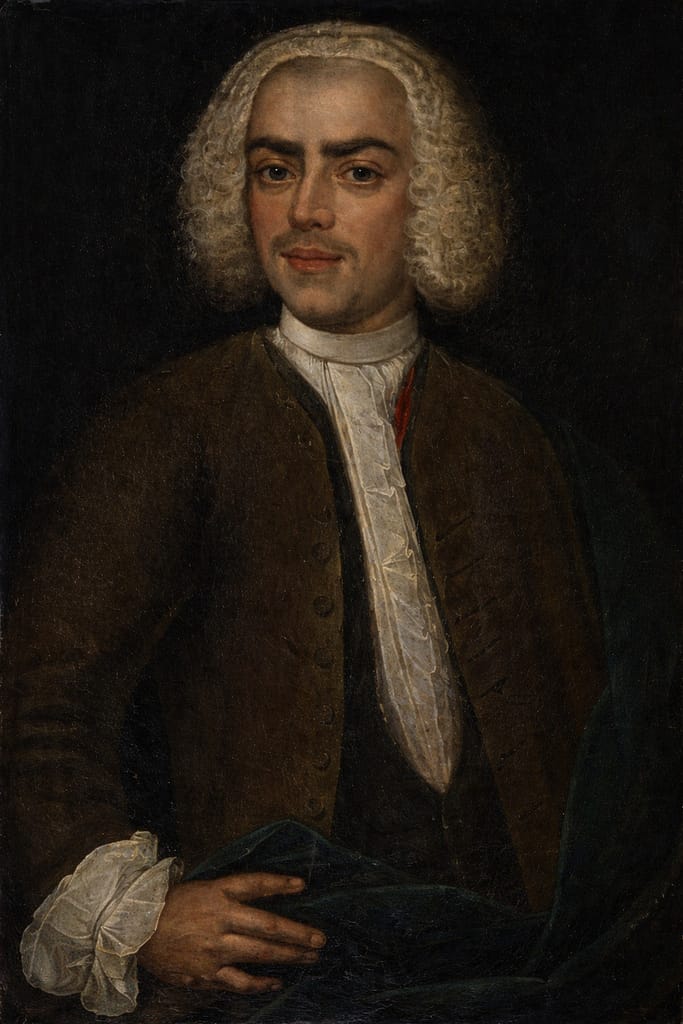
James E. Gibson’s 1937 book, Dr. Bodo Otto and The Medical Background of the American Revolution, is one of the most valuable resources in the Moore Archives Library.
Our original edition contains a wealth of information about Dr. Otto, a prominent medical figure in the Middle Department and a leading practitioner on the cutting edge (sometimes quite literally) of inoculation and medical care. Stevenson’s essay highlights Dr. Bodo Otto Sr. as one of the surgeons working in the Continental hospitals near Valley Forge.
Gibson’s book provides similar insights and mentions Dr. Otto alongside notable figures from local history and the American Revolution, such as Samuel Kennedy, William Shippen Jr., Jonathan Potts, James Craik, and John Cochran (Gibson, p. 170).
This list underscores an important point: medical care during the war was a collective effort. Otto did not operate in isolation; he was part of a layered system that included surgeons, assistants, apothecaries, commissaries, and chaplains.
This network required careful coordination between the encampment and the surrounding hospitals.
Gibson describes the brigade hospital huts at Valley Forge as clearinghouses for serious cases, which were then transferred to better-equipped facilities under the guidance of hospital leadership (Gibson, p. 176).
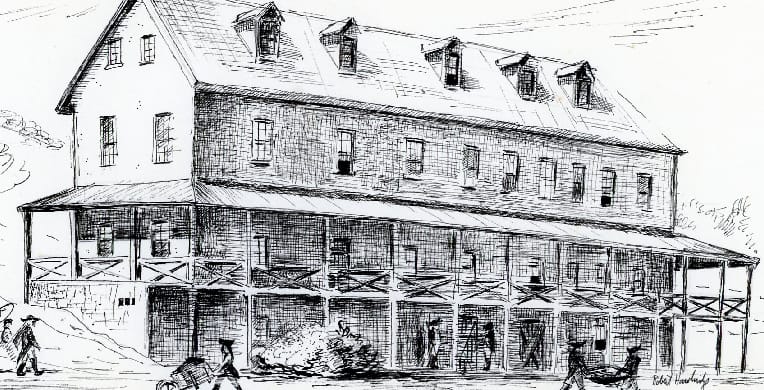
Yellow Springs emerged as a practical center for this work. Located ten to twelve miles west of Valley Forge, it already featured medicinal springs, baths, barns, and usable buildings. The property was owned by Dr. Samuel Kennedy, who was among the first physicians assigned there (Gibson, p. 176).
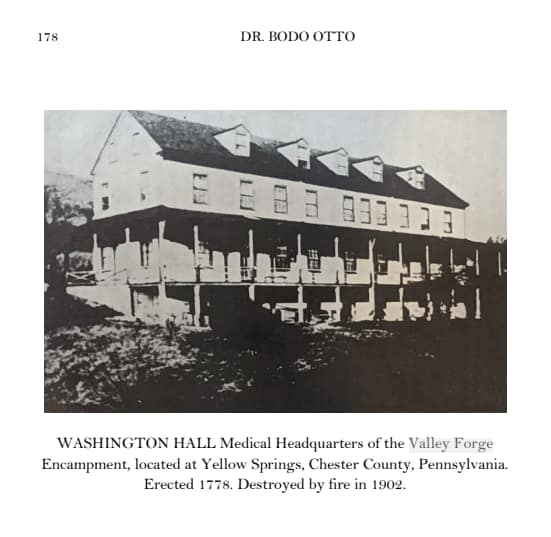
Washington Hall became the medical headquarters for the Valley Forge encampment, managing patient intake and implementing protocols to minimize chaos and reduce unnecessary fatalities (Gibson Gibson, p. 178).
However, it is Dr. Bodo Otto and his sons, not Dr. Kennedy, that are often remembered as the most influential medical practitioners at Washington Hall.
Otto’s Sons and the Cost of Service
Dr. Bodo Otto was a German-trained physician from Hanover who served as chief surgeon at the fortress of Kalkberg before emigrating.
In Pennsylvania, he opposed the Stamp Act, served on the Berks County Committee of Safety, led smallpox inoculations at Trenton, treated Hessian soldiers, joined Franklin’s American Philosophical Society, and trained his sons as army physicians.
He had three sons: Fredrick Otto, Bodo Otto Jr., and John Augustus Otto, all of which trained as doctors under their father and all of which served with him during his service in the war. They also all served medical roles at Yellow Springs.
According to Gibson’s records, Frederick Otto, Bodo Otto Jr., and John A. Otto were also part of the medical staff serving in the Continental hospitals during the Valley Forge period (Gibson, pg. 170).
Our research suggests that at least one of Otto’s sons remained at Valley Forge to care for soldiers who were too ill to be transported. As Washington Hall became fully operational, another son joined his father and brothers at Yellow Springs.
The challenges of this service are vividly revealed in a letter preserved by family tradition and recorded by Gibson. One of Otto’s sons wrote home to his wife, detailing the relentless hunger and smoke-filled conditions of the encampment.
“My darling wife,
I miss you and the children, and I miss your cooking. Here, we have to change the order of our courses to get a variety. For breakfast, we have bacon and smoke; for dinner, smoke and bacon; and for supper, smoke.”
(Gibson, pg. 173)
The authorship of this letter is uncertain; however, based on the timelines we’ve been able to reconstruct, we suspect it was likely written by either Bodo Otto Jr. or John A. Otto.
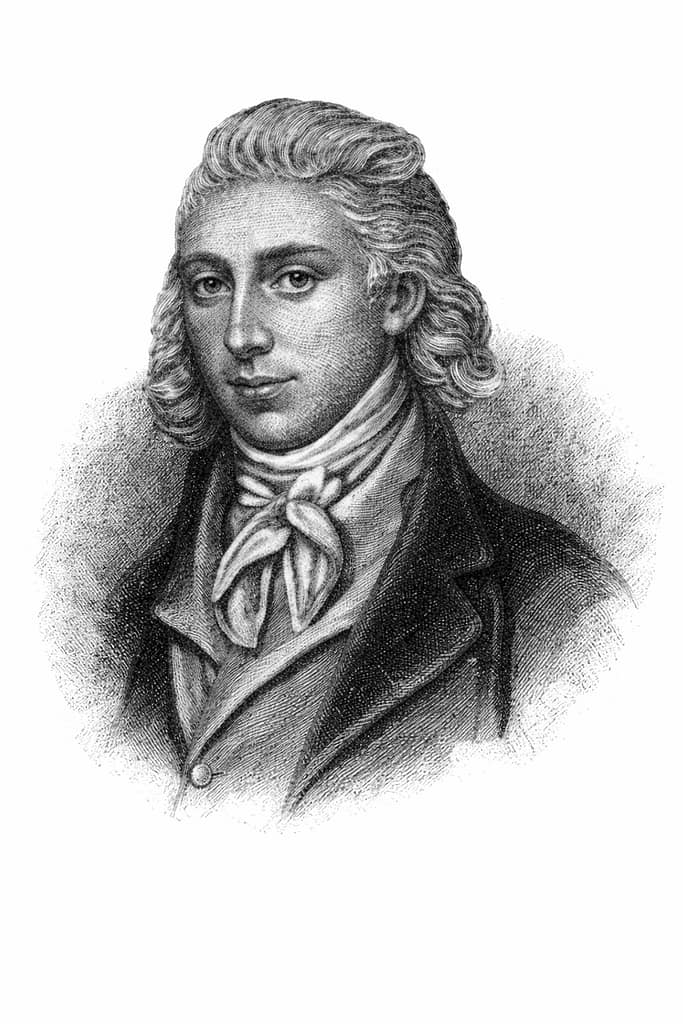
If Bodo Otto Jr. was indeed the author, it’s worth noting that his wife was named Catherine Schweigenhauser.
Soon after the letter was written, she and their children were forced to flee their home when it was burned down by royalists while Bodo Otto Jr. was stationed at Yellow Springs.
Bodo Otto Jr. himself would die in his early 30s, due to a disease he caught while working at the camp and Washington Hall.
While his specific authorship of this letter speculative, the connection illustrates that while life at Valley Forge could sometimes seem impossibly bleak and mundane, it was also punctuated by the jarring realities of the war that had injured the soldiers to begin with. Regardless of which of Otto’s sons wrote this letter, that connection remains largely in tact.
Yet through it all, this network between medical practices, soldiers, civilians and sites continued to operate like a literal lifeline.
Kennedy, Disease, and the Work That Continued
In our previous posts, we have focused on Washington Hall and mentioned Dr. Kennedy several times. To provide a brief explanation, Dr. Kennedy was the first director of Washington Hall and the owner of Yellow Springs at that time.
While Dr. Otto and his sons were serving at Trenton and Valley Forge, Dr. Kennedy worked alongside Dr. Brown in Lititz as a regimental surgeon.
During the harsh winter of 1777-1778, when the encampment at Valley Forge was at its most difficult, both men were brought to Yellow Springs.
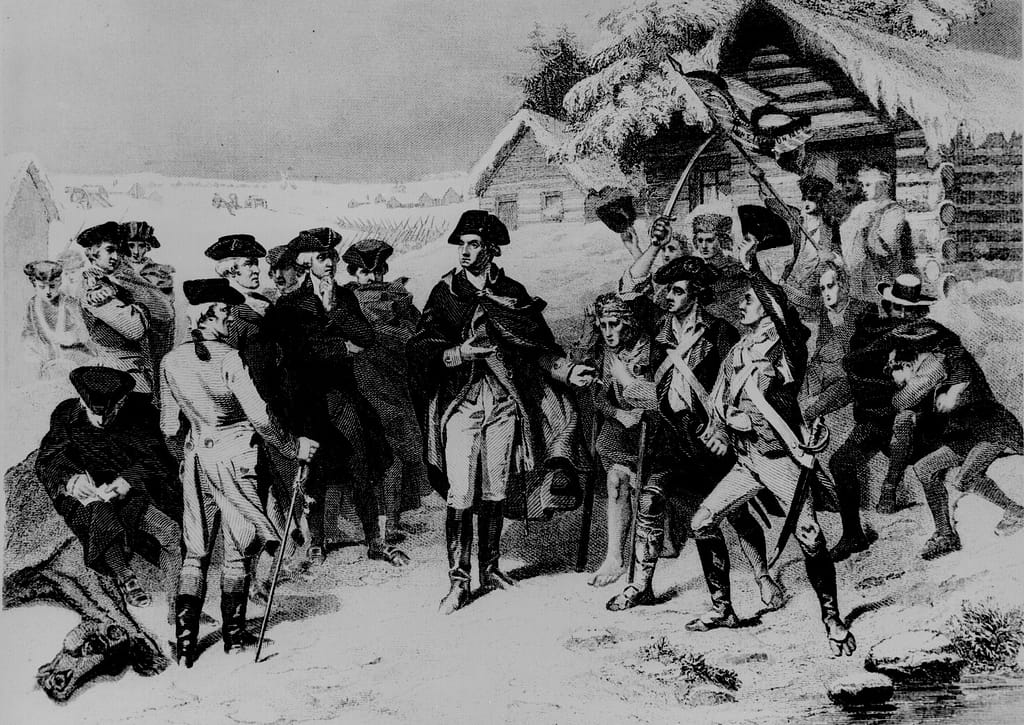
While General Washington was meeting with Congress to demand a more organized treatment of the sick soldiers, Washington Hall was being built out to do just that.
The organization of the Medical Department was an important system to maintain that order, and Gibson’s book mentions Dr. Kennedy, Dr. Otto, and all of his sons as important features of that network.
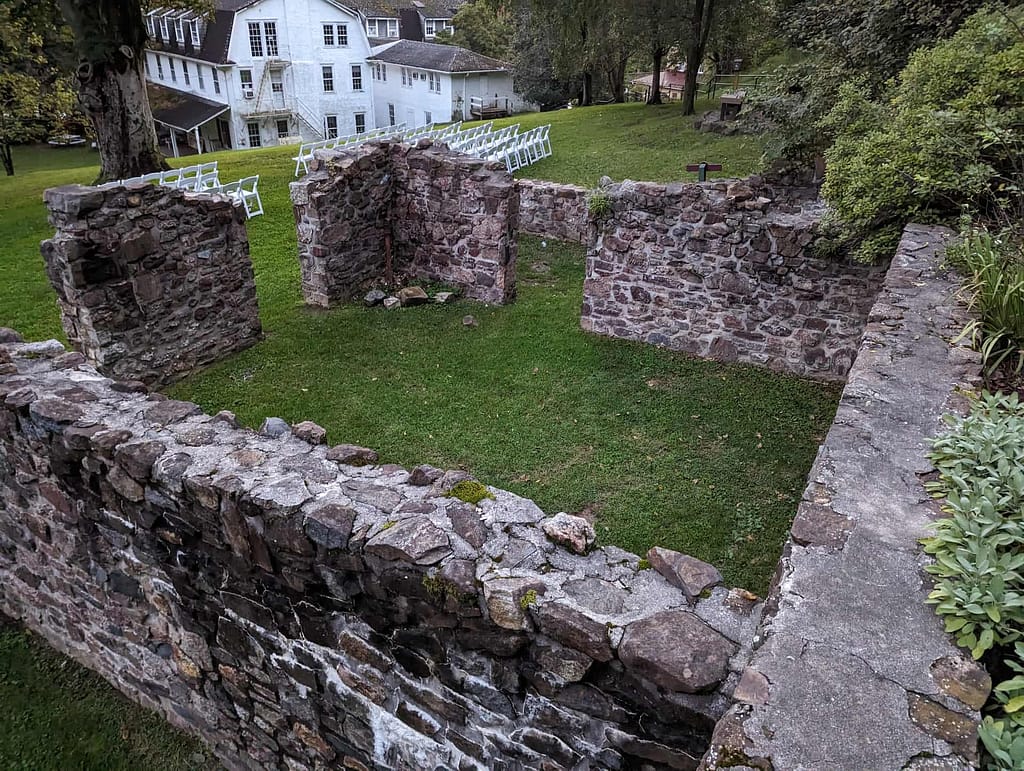
Kennedy’s death during the summer of 1778 removed a key figure from that system.
Contemporary accounts describe his illness as putrid fever, likely typhus– a disease that was rampant in crowded camps. Dr. Otto Jr. would also die of a camp disease, and another of Otto’s sons (John A. Otto) would become incapable of continuing his duty after a 3 years because he caught a camp disease as well.
Though Dr. Otto Sr. himself did not succumb the same way Kennedy did, undoubtedly the hard work at Washington Hall took a great toll on him as well.
After Kennedy’s death, Otto assumed greater responsibility for leadership at the hospital, overseeing care during a time when disease posed a greater threat than British forces.
His expertise in smallpox inoculation was particularly significant, as were his extensive series of hard-won skills. This transition underscores the fragility of wartime medical infrastructure, where effective leadership, organization, and continuity are vital.
Stevenson’s focus on medical returns and hospital records helps clarify why these changes had significant implications for survival rates (Stevenson 2025).
Civilian Care and the Roads Between
The connection between Valley Forge and Washington Hall existed thanks to the efforts of the local community around Yellow Springs.
The community of German farmers in the surrounding countryside provided food not only for the hospital but also for the soldiers still encamped at Valley Forge, sustaining an army when official supply chains were sabotaged or failed.
Local civilians, such as Zachariah Rice, would operate wagons that collecting supplies from nearby farms and delivering them to the encampment.
These shipments contained food, clothing, and other materials that the soldiers desperately needed. When the wagons returned, they returned filled with the sick and injured.
Those that could not march took the wagons, and those that could not take the wagons had to remain in the flying hospitals at camp.
Local farmers’ wives took on the role of nurses for the soldiers while also providing them with food, clothing, and agricultural support. Abigail Hartman-Rice and Christina Hench, both from the area surrounding Yellow Springs, assisted with the daily care of sick and injured soldiers at Washington Hall.
Their work was constant, personal, and largely unacknowledged in official records.
Medical staff also used this same route.
All of the Dr. Ottos did not stay fixed in one location either.
One of Dr. Bodo Otto’s sons, likely John A. Otto or Frederick Otto, remained at Valley Forge in field and brigade hospitals to treat soldiers who could not yet be moved. He later rejoined his father and brothers at Yellow Springs, bringing back valuable experience from the encampment to Washington Hall.
What This Connection Means Today
This connection between the two sites served as a vital lifeline for those who managed to survive the harsh conditions of the encampment. Valley Forge and Yellow Springs were never separate stories.
They were interconnected through roads, records, wagons, and people. This connection made survival during the winter possible and influenced the course of the war itself.
As we approach the 250th anniversary of the Declaration of Independence, this collaboration is important because it reflects historical truth. The Revolution was not driven solely by acts of isolated heroism; it was sustained through systems of care, coordination, and shared labor.
When we come together as caretakers of history today, we follow the same established paths between these sites. We honor not only the spirit of endurance but also the organization that made that endurance achievable.
❄️🪵🧺
Learn more about the history of Yellow Springs
You can read the more in-depth version of this post here
Follow us on Substack, Instagram, and Facebook
❄️🪵🧺