Timeline of the Chester Springs Studio at Yellow Springs
Contents
- Colonization of Yellow Springs
- Colonial Era Tavern and Spa
- The American Revolutionary War
- Fashionable Health Spa
- Pennsylvania Soldiers' Orphan School
- Pennsylvania Academy of the Fine Arts: Country School
- Good News Productions
- Early Years and Formation of the Yellow Springs Foundation
- Chester Springs Studio
- Historic Yellow Springs
Colonization of Yellow Springs
1600 – 1722
1600s – 1690s
- 1616– Dutch captain Cornelis Hendrickson found a safe channel into Delaware Bay and explored much of the Delaware River. The Dutch named it the “South River”.
- 1620– Thomas Dermer entered Delaware Bay while traveling between Virginia and New England.
- 1624– The Dutch built Fort Nassau, one of the first European trading posts on the Delaware River. They abandoned it the following year.
- 1637– The Swedish West India Company founded the colony of New Sweden under Peter Minuit at present day Wilmington, Delaware. Swedish and Finnish settlers established farms and traded with Indigenous peoples.
- 1638– Peter Minuit renamed Minquas Creek as Christina Creek in honor of Queen Christina of Sweden. Swedish leaders claimed the west side of the Delaware River to Trenton.
- 1638-1664– Swedish and Finnish settlers created small settlements along the Delaware River. They lived alongside Indigenous peoples while Dutch, Swedish, and English governments competed for control.
- In 1649, King Charles I was executed during the English Civil War. Oliver Cromwell ruled England for the next decade. His conquest of Ireland would leave many Irish people destitute and starving while English and other wealthy protestant peoples from the British Isles moved in and took land from the original Irish Catholic population, contributing to the amount of indentured Irish people entering the colonies in the following decades.
- 1660– Back in England, Charles II returned to the English throne after the Restoration.
- 1664– King Charles II granted New Jersey and Delaware to his brother, James II. England secured control of the former Dutch colony of New Amsterdam. Also in 1664, James, Duke of York, granted East New Jersey to John Berkeley, 1st Baron Berkeley of Stratton and George Carteret.
- 1667– The Treaty of Breda officially ended the Second Anglo-Dutch War and confirmed English control of former Dutch lands.
- 1674– Lord Berkeley sold his share of West New Jersey to Edward Byllynge (an English Quaker, London brewer, and colonial proprietor) and John Fenwick (also an English Quaker). West and East New Jersey became separate colonies.
- 1675– William Penn became a trustee for Edward Byllynge’s land. This role gave Penn valuable experience in colonial planning and government.
- Also in 1675, John Fenwick founded Salem, New Jersey, one of the region’s earliest permanent Quaker settlements.
- 1677– Quaker settlers founded Burlington, New Jersey, creating another important settlement along the Delaware River.
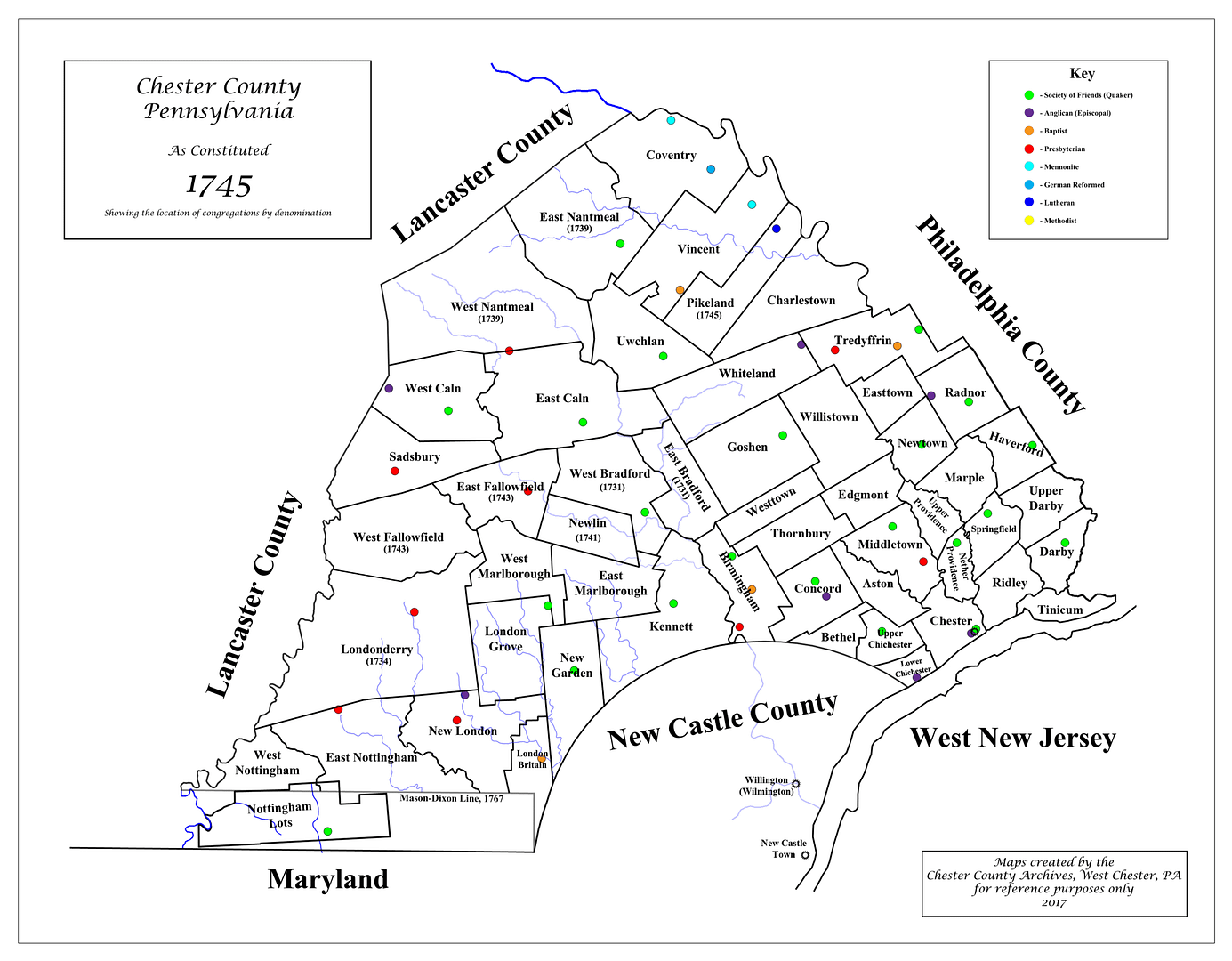
- 1681– King Charles II granted William Penn the land that became Pennsylvania to repay a debt owed to Penn’s father, Admiral Sir William Penn. This grant contained what we now know as Pikeland, which contains Yellow Springs.
- 1682– Quaker leaders hoped Pennsylvania and New Jersey would create a large region where members of the Society of Friends could govern themselves with religious freedom. William Penn and eleven other Quakers purchased East New Jersey after George Carteret’s death. The group later divided ownership among twenty-four proprietors.
- Also in 1682, Dr. Daniel Coxe became one of the twenty-four proprietors of East New Jersey. He was one of the few owners who was not a Quaker.
1680s through the early 1700s
- 1680s– Dr. Daniel Coxe, Sir Matthias Vincent, and Major Robert Thompson became the original landowners whose properties later formed Vincent and Pikeland Townships.
- 1685– Benjamin Chambers, a friend of William Penn, surveys the area between the Delaware River and the Susquehanna River. His map (digitally enhanced by HYS) can be seen below.

- 1690– One of the oldest recorded permanent settlements in the area, now located at 1461 Art School Road, appears in records as early as 1690.
- Today, the site is home to the Fagley homestead, built in 1860 and listed on the National Register of Historic Places. Although outside modern-day Yellow Springs, the property reflects the broader settlement of the Pikeland area and once contained a major iron deposit owned by Phoenix Iron Co.
- 1690s– William Penn’s government attracted settlers from many backgrounds by offering religious freedom, representative government, and generous land policies. These principles shaped the early development of Pennsylvania.
Early 1700s
- 1700s– European settlers (especially German immigrants) began living on this land more permanently. The Hench property, for example, at 1446 Clover Mill Hill just outside modern-day Yellow Springs, is said to date to 1715 and was purchased by the Hench family, German immigrants who were part of a migration from Lehigh, Berks, and Montgomery Counties that began in 1709.
- 1705– William Penn granted a tract of over 30,000 acres to Matthias Vincent, who then leases over 10,000 acres, known as “Pikeland,” to Joseph Pike
- 1721– The “Iron Springs” are first noted on a map of the Township of Pikeland by Isaac Taylor.
- Another house in the neighboring community of Yellow Springs, the Dietrich House (at modern-day 1337 Art School Road, previously known as Arkadia) has an original construction dating back to 1721.
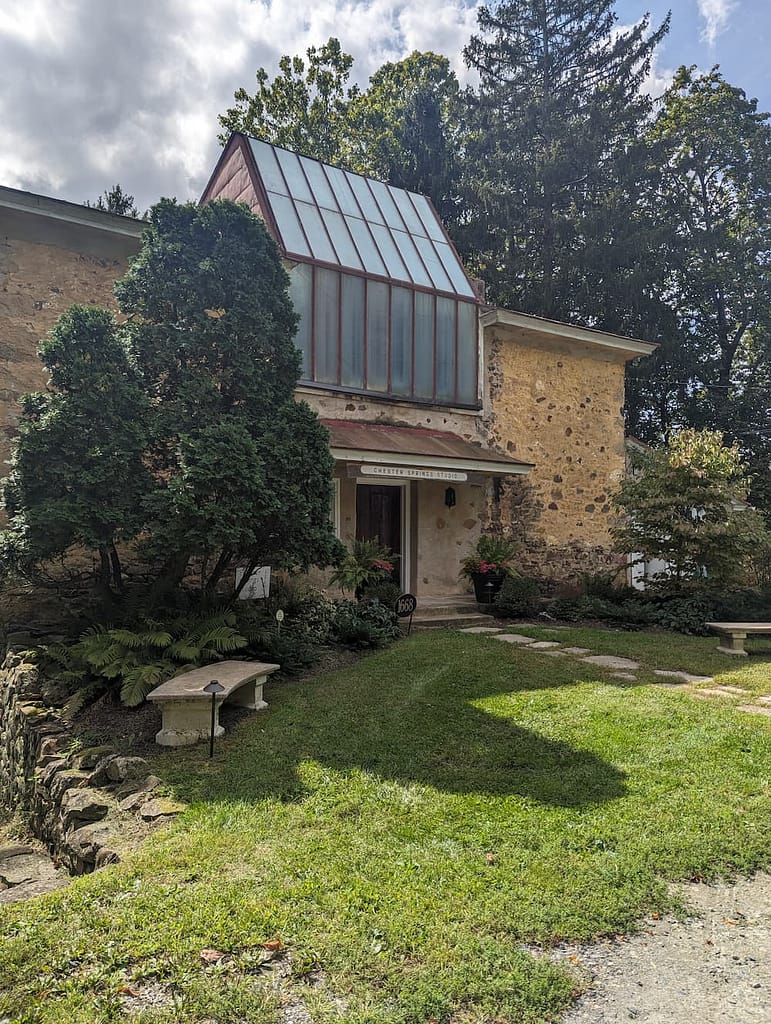
- 1722– the American Weekly Mercury out of Philadelphia reports on a letter from New York about a mineral spring in the Great Valley about 30 miles away from Philadelphia. This mineral spring would later become known as “Yellow Springs”
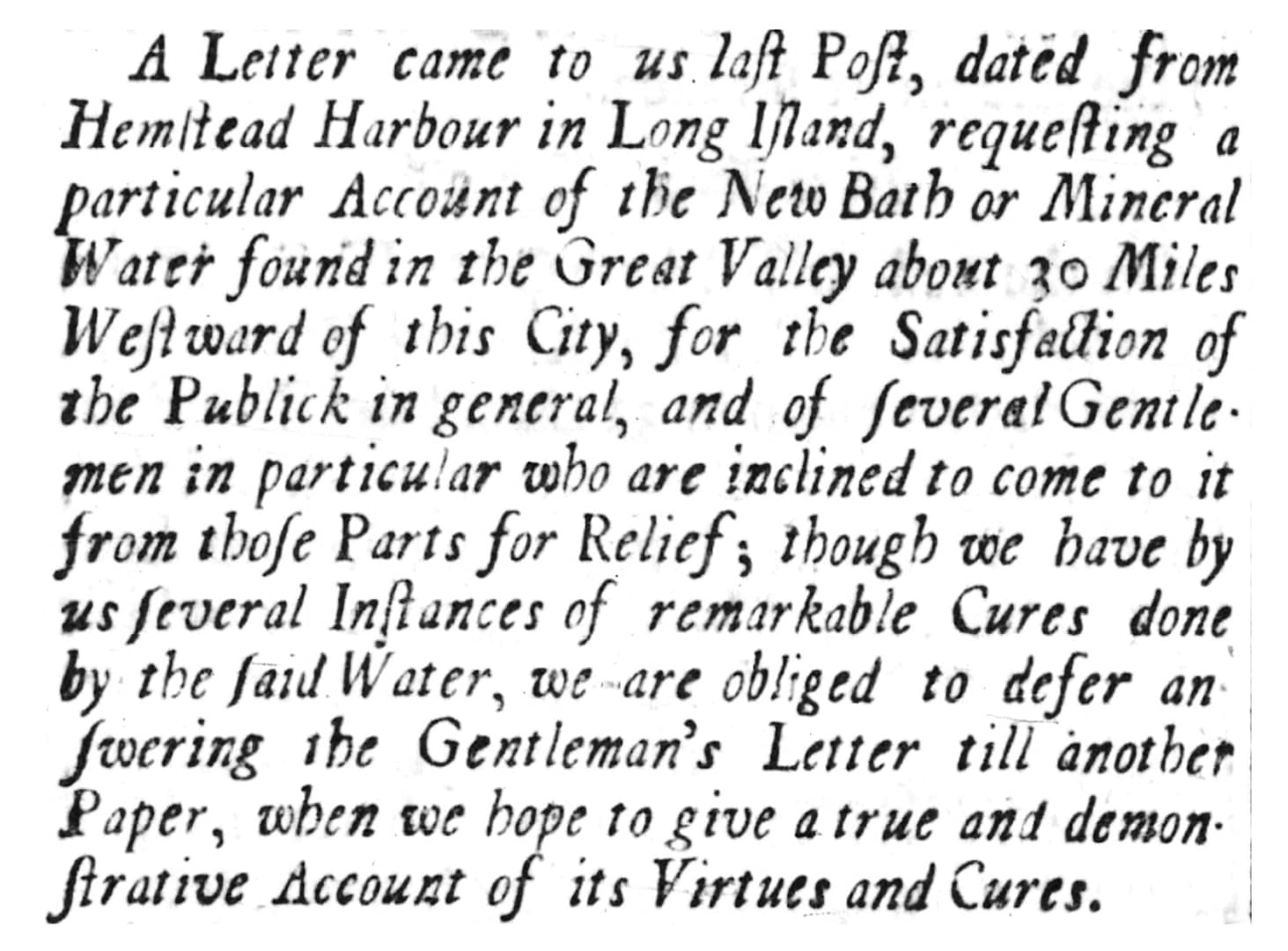
- 1740s-1760s– The village of Yellow Springs was settled by German immigrants. The 18th-century barn, originally a horse (livery) stable, was built in the distinct German style. It would later become converted into an art studio, and is what is today known as the Chester Springs Studio.
Colonial Era Tavern and Spa
1722 – 1770
- ~1733- The nearest excavated Contact-period Lenape site is 36CH60 (Montgomery Site) in Wallace Township, dated roughly 1700 to 1733. Marshall Becker’s excavation demonstrates that Lenape communities remained in Chester County after Penn’s arrival rather than disappearing immediately.
- 1737- The “Walking Purchase” dispossessed the Lenape of vast territories in Pennsylvania and forces them out of their ancestral homeland
- 1761– James Martin acquired the license to the tavern and the 160 acres of property surrounding it. The tavern that was on his property is now part of the Washington, and is known as the Brick Room. The barn that is currently the CSS studio would be part of this property purchase.
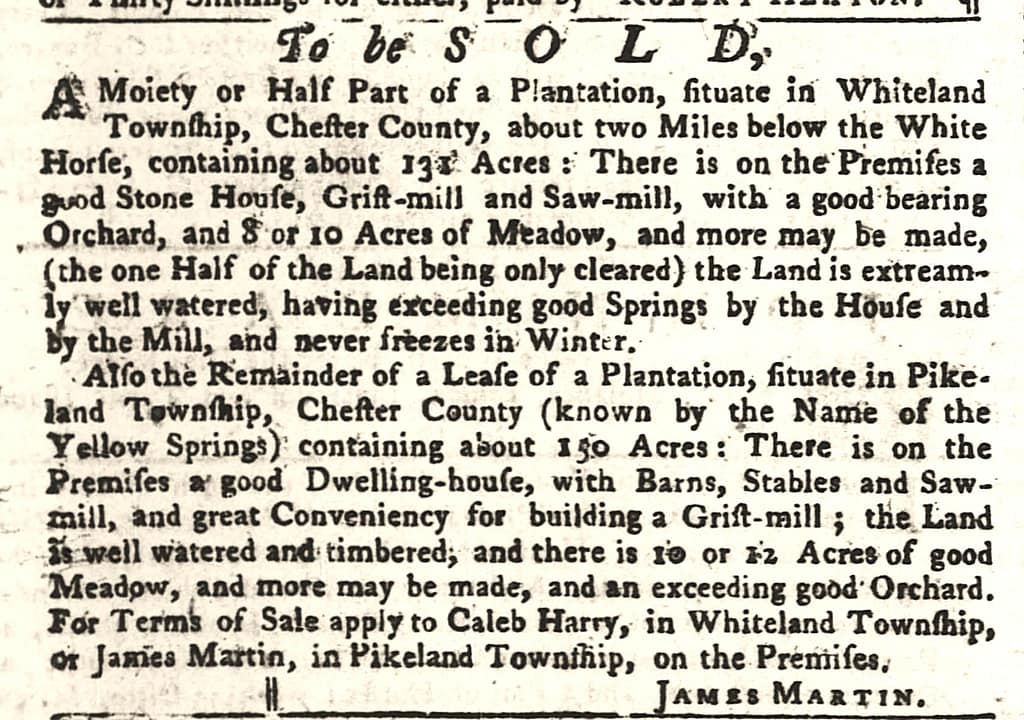
- October 21st, 1762– James Martin and Caleb Harry advertise in the The Pennsylvania Gazette looking to lease the remaining part of the Yellow Springs Plantation.
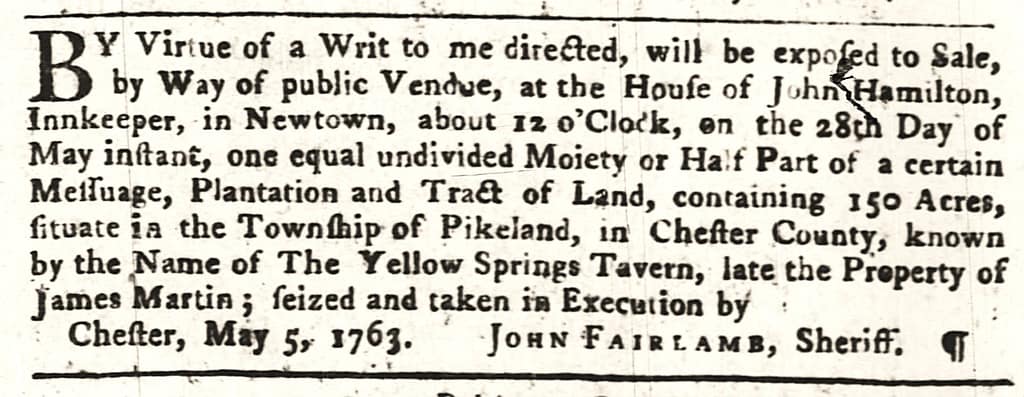
- May 5th, 1763– John Fairlamb, Sheriff, advertises the sale of the Yellow Springs Plantation (and Tavern) that previously belonged to James Martin. Notably, this advertisement indicates that the sheriff’s sale may have been for only half of the original property, though this is unclear. This advertisement ran in The Pennsylvania Gazette until at least May 19th, 1763.
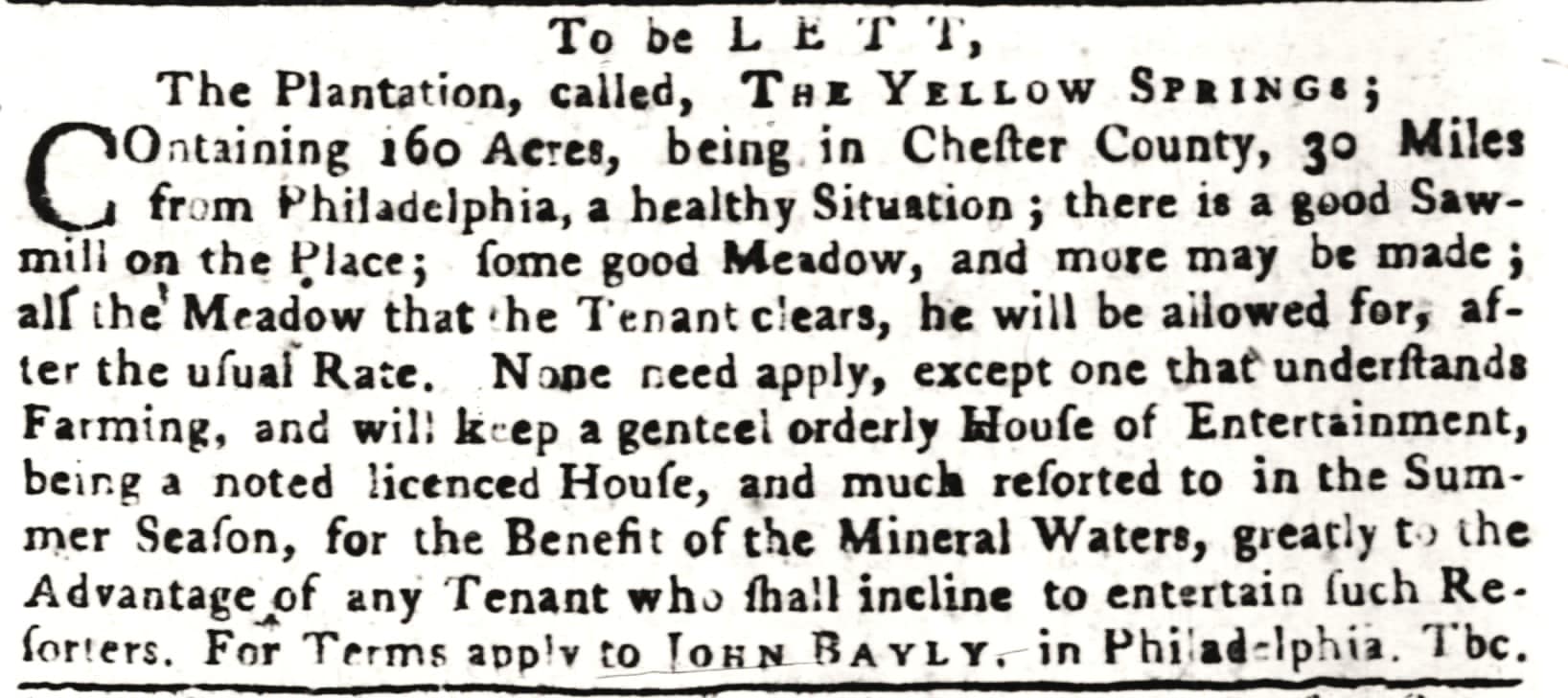
- September 6th, 1764– Philadelphia silversmith John Bayly acquires the village and leases the property. He improves and enlarges the tavern (which is currently known as the Brick Room in the Washington Building). Stagecoach service established to the Springs. The barn that would become the CSS studio is likely part of this purchase.
The American Revolutionary War
1770 – 1781
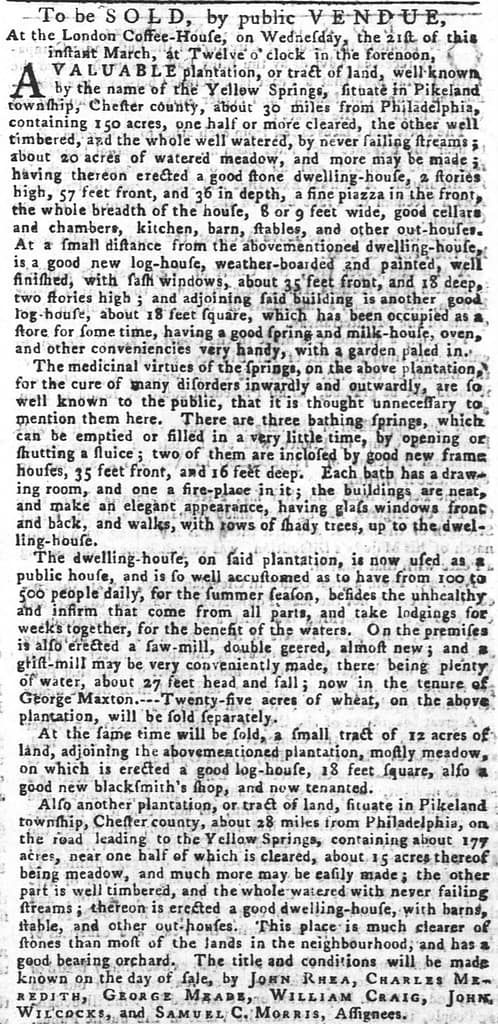
- March 1st, 1770- The Pennsylvania Gazette discusses how the entire Yellow Springs Plantation is to be sold on March 21st of that year. Also discusses tracts of land being sold around Yellow Springs. Possible that this is where Dr. Samuel Kennedy purchased Yellow Springs.
 Originally posted in the newspaper The Pennsylvania Gazette in 1764. Image courtesy of Newspapers.com
 Originally posted in the newspaper The Pennsylvania Gazette in 1764. Image courtesy of
 - May 31st 1770- The Pennsylvania Journal discusses how the Yellow Springs Plantation was to be sold on June 30 of that year? Conflicts with previously mentioned newspaper article that said plantation was to be sold on March 21st. Mentions George Maxton as living in Yellow Springs.
 Originally posted in the newspaper The Pennsylvania Gazette in 1764. Image courtesy of Newspapers.com
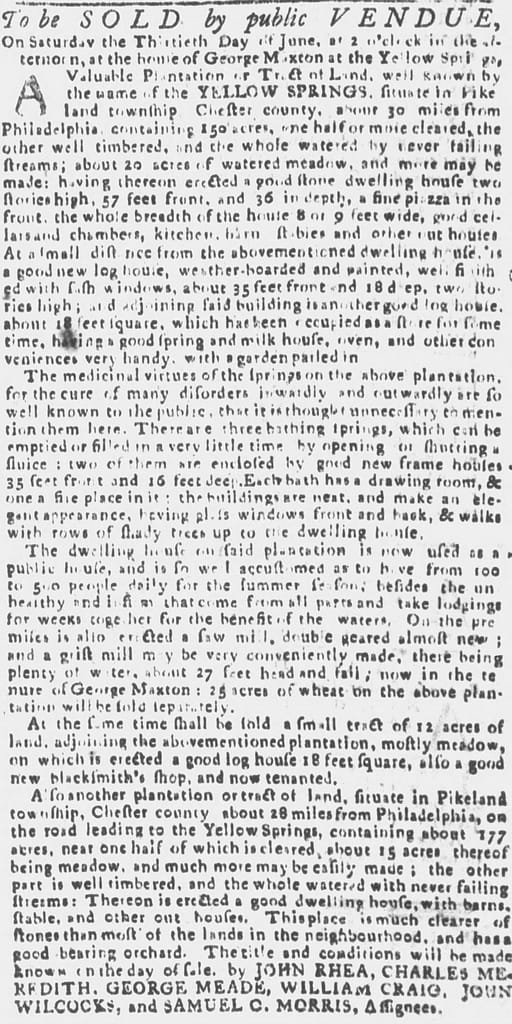 Originally posted in the newspaper The Pennsylvania Gazette in 1764. Image courtesy of
 - 1771– In April of 1771, the entire property of John Bayly is to be sold by the sheriff to pay off Bayly’s debts.
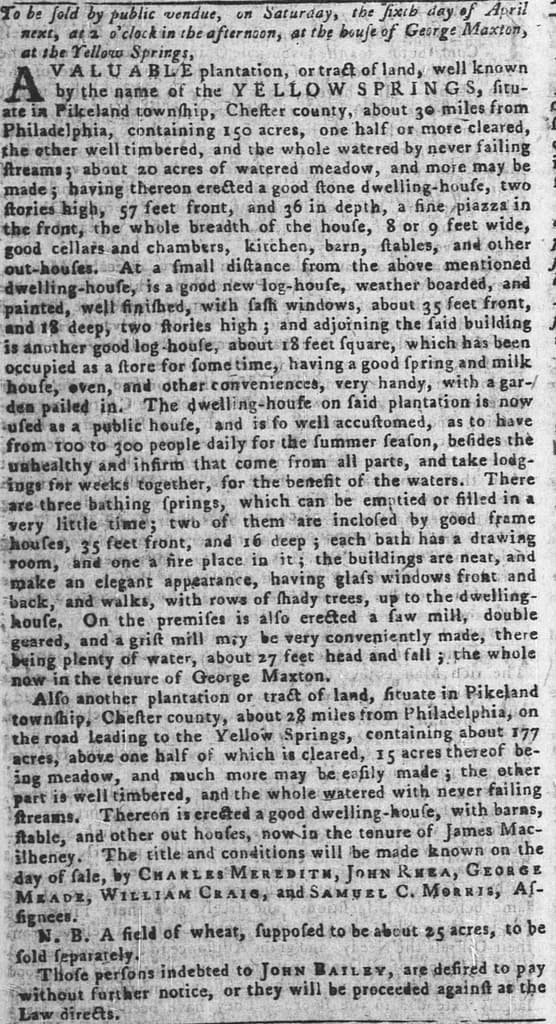
- March 14th, 1771- The Pennsylvania Gazette discusses how the Yellow Springs Plantation is to be sold on April 6th at the house of George Maxton in Yellow Springs. A later date then previously mentioned. Possible that John Bayly is having difficulty finding someone to purchase the estate.
 Originally posted in the newspaper The Pennsylvania Gazette in 1764. Image courtesy of Newspapers.com
 - February 27th, 1772– Dr. Samuel Kennedy and John Bayly advertised for a tenant at a house at Yellow Springs. This notice predates our earliest records of Kennedy’s purchase of the property and may suggest that the Kennedy family acquired Yellow Springs before 1774. Notably, Bayly was still connected to Yellow Springs at this time.
 Originally posted in the newspaper The Pennsylvania Gazette in 1764. Image courtesy of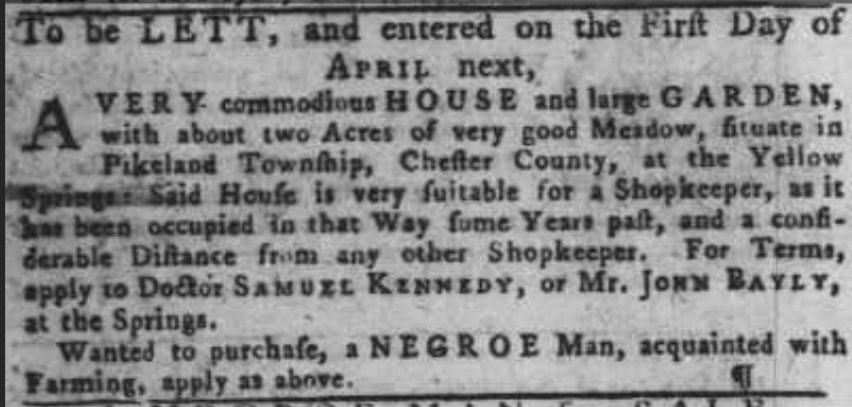
- 1774– Dr. Samuel Kennedy of East Whiteland purchases the Yellow Springs plantation after the property was sold in foreclosure. Though the Lincoln building has not been built yet, the land that it was on would be part of aa hospital complex at Yellow Springs that served the sick and injured soldiers from Valley Forge
- 1776– A Hessian soldier passing through Yellow Springs notes that several “Rebel Hospitals” being operated out of barns in Yellow Springs. One of these is believed to have been the barn that would become the CSS studio.
- September 11th, 1777– Battle of Brandywine
- In the aftermath of the Battle of Brandywine, soldiers fleeing the battlefield are treated and housed by several of the immigrant farmers whose properties neighbored Yellow Springs.
- September 16th, 1777– Battle of the Clouds
- Battle of the Clouds in Frazer is aborted by a nor’easter and the American army marches from Frazer to Yellow Springs to camp in the blinding rainstorm. George Washington stays in the tavern at Yellow Springs while 11,000 troops camp overnight on the Yellow Springs property and leave the next day for Warwick and Redding Furnaces (Elverson)
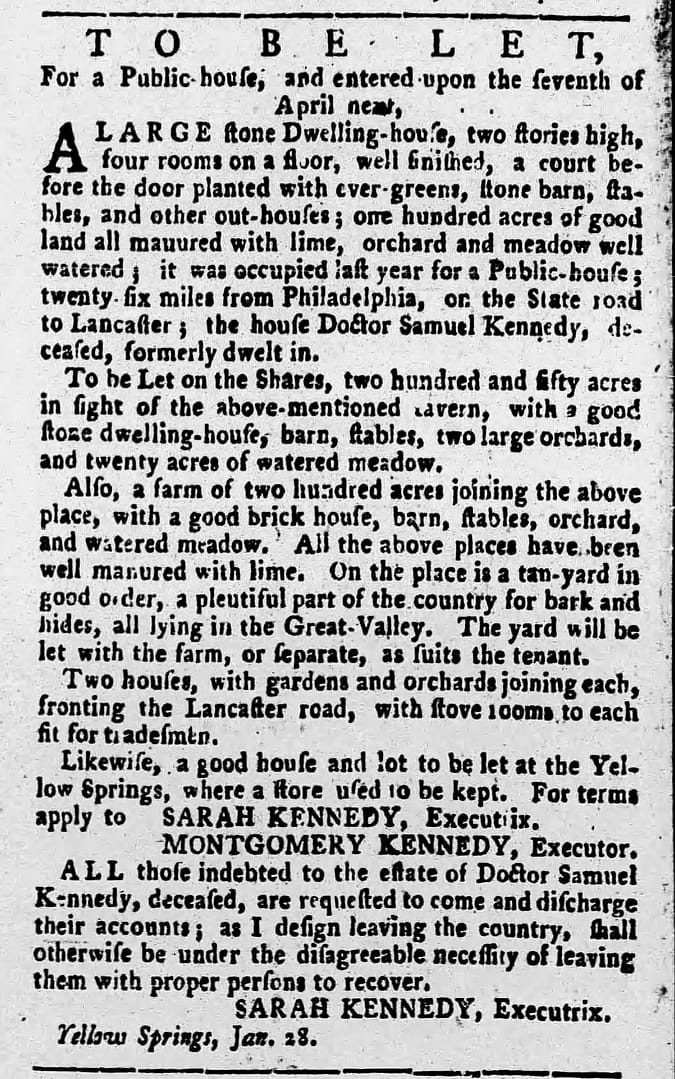
- January 28th, 1779– Advertisement to Let Property by Sarah and Montgomery Kennedy
- The Yellow Springs property has been well-known as a popular spa destination since before the Revolutionary War. During the war, the property belonged to the Kennedy family, and it was used as a hospital complex. After the death of Dr. Samuel Kennedy, Sarah Kennedy (Samuel’s widow and the executrix of his will before their son reached the age of majority) offers the village for lease. In the newspaper the Poulson’s American Daily Advertiser, Sarah Kennedy and Montgomery Kennedy (Dr. Kennedy’s brother) advertise that they are seeking tenants for a number of houses on the Yellow Springs property. The barn mentioned in this advertisement is believed to be the barn that was eventually converted into the CSS studio.
- 1777-1781– Washington Hall and the Hospital Complex
- From 1777 to 1781, the Yellow Springs property served as a major hospital complex for the Continental Army. The complex included Washington Hall, a general hospital built between 1777 and 1778 that also served as the headquarters of the Hospital Department; several “rebel” hospitals that operated from barns throughout the village as flying hospitals; and the supply depot for the hospitals of the Middle Department. If the unofficial hospitals described by the Hessian soldier mentioned earlier are included, medical operations at Yellow Springs date back to 1776.
- September 1781– Washington Hall is closed
- Congress ordered the closure of the hospital complex and Washington Hall at Yellow Springs, despite requests from Dr. Otto, who assumed leadership of the hospital following Dr. Kennedy’s death, that it remain open.
Fashionable Health Spa
1782 – 1867
- 1783– Captain Alexander McCaraher (a family friend of the Kennedy family) reopens the tavern at Yellow Springs (now the Brick Room of the Washington Building) and repairs “the baths and bath houses.”
- 1789– All of Pikeland Township (East & West) to be sold at auction to satisfy the debts of Andrew Allen owed to Samuel Hoare. 115 terre tenants (persons holding titles to the property but who were not the original debtor who incurred the lien) held land at that time.
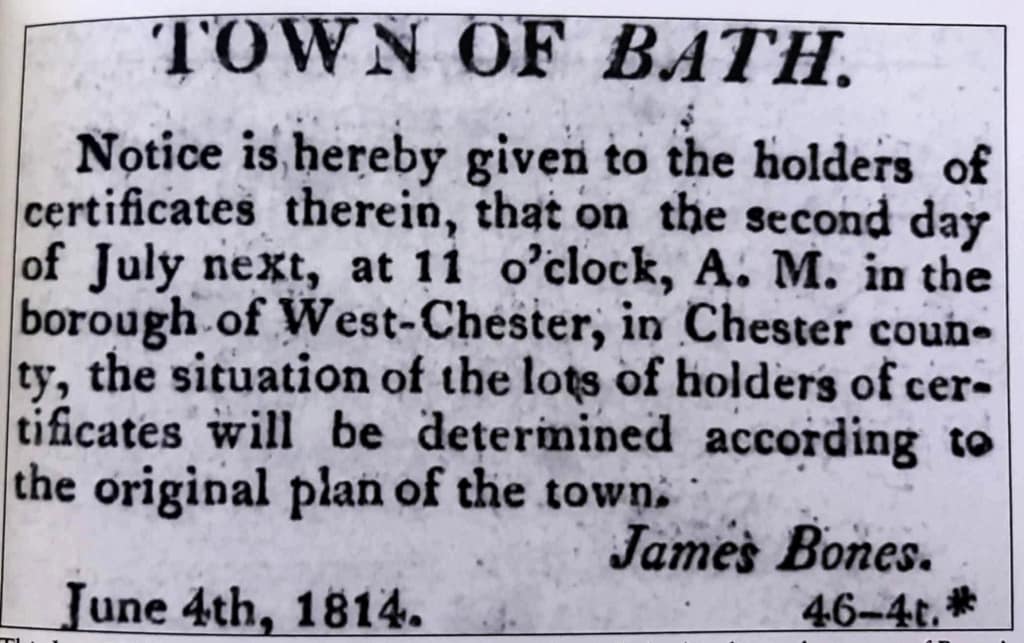
- 1810– Yellow Springs was profiled in The Portfolio, a national magazine. Around this time, Col. James Bones, who owned property in the village since 1806, attempted to sell his holdings at auction as the “Town of Bath”. However, the sale was unsuccessful, with fewer than half of the advertised lots being sold. In 1816, Bones sold the inn that contained the original Yellow Springs tavern to Frederick and Margaret Holman, who had operated the tavern since at least 1793.
- 1846– Dr. George Lingen acquired the Yellow Springs property and uses it as a homeopathic facility.
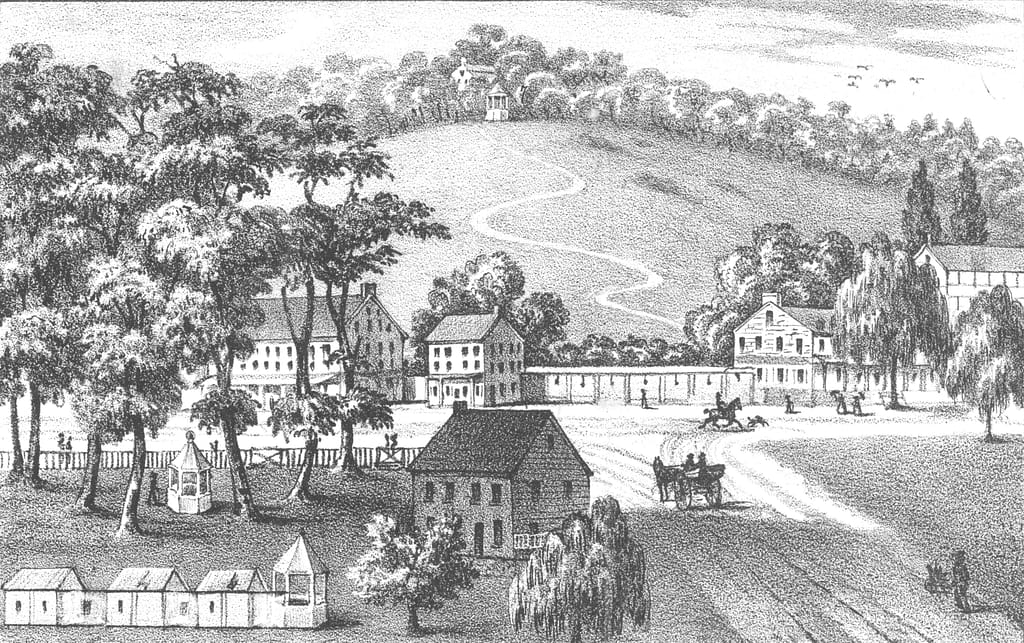
- 1856– Foreclosure sale of Dr. Lingen’s interests in Yellow Springs. August Snyder acquires the Springs.
- 1867– Village and Washington Hall is owned and operated by A. U. Snyder, Esq. It continues to serve as a hotel for visitors to the spa. However, the summer of 1867 was the final season that Yellow Springs served as a resort. After changing hands a number of times, Yellow Springs would eventually be purchased for use as a school for Orphans of the American Civil War.
Pennsylvania Soldiers’ Orphan School
1868 – 1912
- The Yellow Springs property was sold to the Pennsylvania Soldiers’ Orphan School system, including the old barn that is now the CSS Studio. Additional research is ongoing to determine how this structure was used during this time period.

Pennsylvania Academy of the Fine Arts: Country School
1916 – 1951
- 1921- The Small Barn, today the Chester Springs Studio was modified to add its large north facing window. The window and its skylight are designed so that while standing in the middle of the floor, there are very menial shadows, allowing for a “true” expression of color when painting

Good News Productions
1952 – 1965
- Good News Productions, an evangelical film-making studio operated by Shorty Yeaworth, purchases the Yellow Springs Village

- 1965– Yellow Springs Association, a board based community membership organization, is founded to sponsor artistic and cultural programs, and foster interest in the village and its history
Early Years and Formation of the Yellow Springs Foundation
1965 – 1977
- The Yellow Springs Association morphs into the Yellow Springs Foundation. These organizations would later become Historic Yellow Springs
- 1976- Historic Yellow Springs sells the small barn studio to the Chester Springs Studio a new nonprofit offering visual arts classes, artist residencies, and exhibitions

Chester Springs Studio
1978 – 2008
- Additional research is ongoing to determine the specifics of the story of the Chester Springs Studio as an independent organization
Historic Yellow Springs
2008 – today
- 2008– Historic Yellow Springs and the Chester Springs Studio merge
- Historic Yellow Springs continues to offer a robust slate of community art classes in the CSS Studio, engaging curious participants in the art making process.

Further research is ongoing!