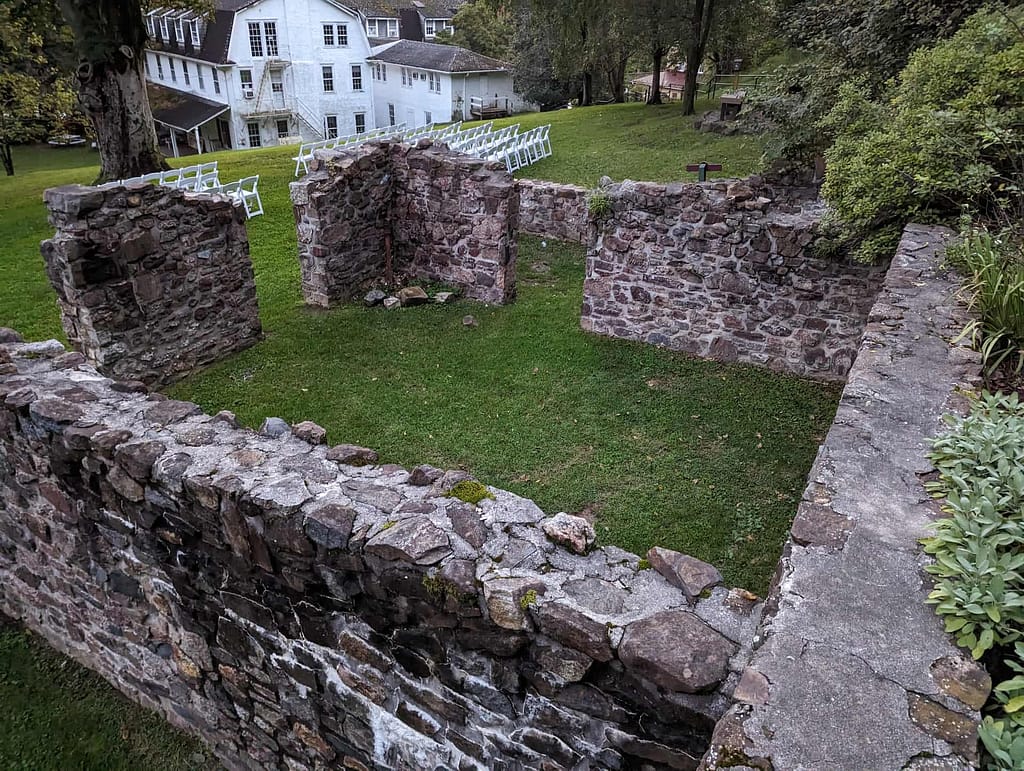
Timeline of the Hospital Ruins (Washington Hall) at Yellow Springs
- Colonization of Yellow Springs
- Colonial Era Tavern and Spa
- The American Revolutionary War
- Fashionable Health Spa
- Pennsylvania Soldiers' Orphan School
- Pennsylvania Academy of the Fine Arts: Country School
- Good News Productions
- Early Years and Formation of the Yellow Springs Foundation
- Historic Yellow Springs
Colonization of Yellow Springs
1600 – 1722
1600s – 1690s
- 1616– Dutch captain Cornelis Hendrickson found a safe channel into Delaware Bay and explored much of the Delaware River. The Dutch named it the “South River”.
- 1620– Thomas Dermer entered Delaware Bay while traveling between Virginia and New England.
- 1624– The Dutch built Fort Nassau, one of the first European trading posts on the Delaware River. They abandoned it the following year.
- 1637– The Swedish West India Company founded the colony of New Sweden under Peter Minuit at present day Wilmington, Delaware. Swedish and Finnish settlers established farms and traded with Indigenous peoples.
- 1638– Peter Minuit renamed Minquas Creek as Christina Creek in honor of Queen Christina of Sweden. Swedish leaders claimed the west side of the Delaware River to Trenton.
- 1638-1664– Swedish and Finnish settlers created small settlements along the Delaware River. They lived alongside Indigenous peoples while Dutch, Swedish, and English governments competed for control.
- In 1649, King Charles I was executed during the English Civil War. Oliver Cromwell ruled England for the next decade. His conquest of Ireland would leave many Irish people destitute and starving while English and other wealthy protestant peoples from the British Isles moved in and took land from the original Irish Catholic population, contributing to the amount of indentured Irish people entering the colonies in the following decades.
- 1660– Back in England, Charles II returned to the English throne after the Restoration.
- 1664– King Charles II granted New Jersey and Delaware to his brother, James II. England secured control of the former Dutch colony of New Amsterdam. Also in 1664, James, Duke of York, granted East New Jersey to John Berkeley, 1st Baron Berkeley of Stratton and George Carteret.
- 1667– The Treaty of Breda officially ended the Second Anglo-Dutch War and confirmed English control of former Dutch lands.
- 1674– Lord Berkeley sold his share of West New Jersey to Edward Byllynge (an English Quaker, London brewer, and colonial proprietor) and John Fenwick (also an English Quaker). West and East New Jersey became separate colonies.
- 1675– William Penn became a trustee for Edward Byllynge’s land. This role gave Penn valuable experience in colonial planning and government.
- Also in 1675, John Fenwick founded Salem, New Jersey, one of the region’s earliest permanent Quaker settlements.
- 1677– Quaker settlers founded Burlington, New Jersey, creating another important settlement along the Delaware River.
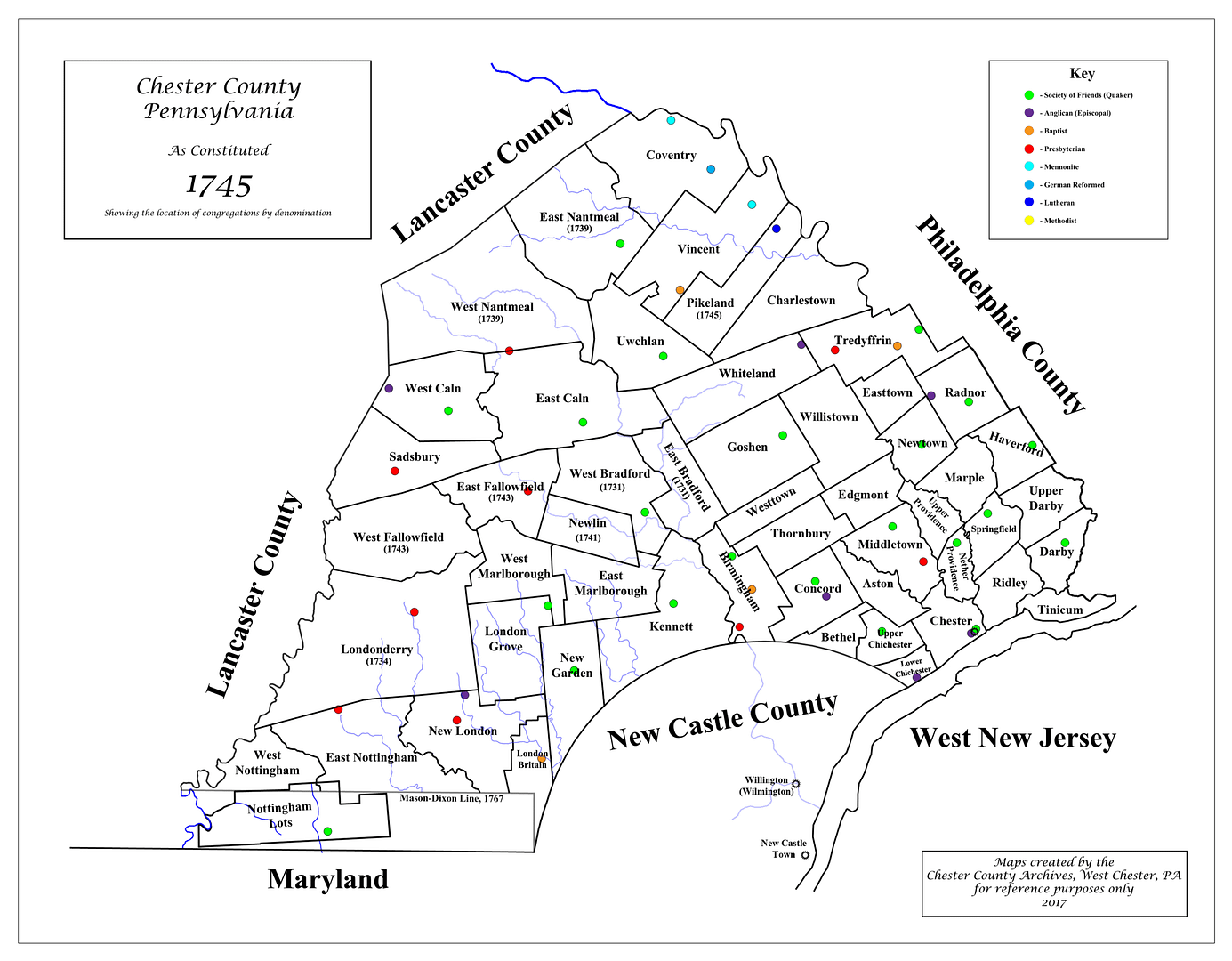
- 1681– King Charles II granted William Penn the land that became Pennsylvania to repay a debt owed to Penn’s father, Admiral Sir William Penn. This grant contained what we now know as Pikeland, which contains Yellow Springs.
- 1682– Quaker leaders hoped Pennsylvania and New Jersey would create a large region where members of the Society of Friends could govern themselves with religious freedom. William Penn and eleven other Quakers purchased East New Jersey after George Carteret’s death. The group later divided ownership among twenty-four proprietors.
- Also in 1682, Dr. Daniel Coxe became one of the twenty-four proprietors of East New Jersey. He was one of the few owners who was not a Quaker.
1680s through the early 1700s
- 1680s– Dr. Daniel Coxe, Sir Matthias Vincent, and Major Robert Thompson became the original landowners whose properties later formed Vincent and Pikeland Townships.
- 1685– Benjamin Chambers, a friend of William Penn, surveys the area between the Delaware River and the Susquehanna River. His map (digitally enhanced by HYS) can be seen below.

- 1690– One of the oldest recorded permanent settlements in the area, now located at 1461 Art School Road, appears in records as early as 1690.
- Today, the site is home to the Fagley homestead, built in 1860 and listed on the National Register of Historic Places. Although outside modern-day Yellow Springs, the property reflects the broader settlement of the Pikeland area and once contained a major iron deposit owned by Phoenix Iron Co.
- 1690s– William Penn’s government attracted settlers from many backgrounds by offering religious freedom, representative government, and generous land policies. These principles shaped the early development of Pennsylvania.
Early 1700s
- 1700s– European settlers (especially German immigrants) began living on this land more permanently. The Hench property, for example, at 1446 Clover Mill Hill just outside modern-day Yellow Springs, is said to date to 1715 and was purchased by the Hench family, German immigrants who were part of a migration from Lehigh, Berks, and Montgomery Counties that began in 1709.
- 1705– William Penn granted a tract of over 30,000 acres to Matthias Vincent, who then leases over 10,000 acres, known as “Pikeland,” to Joseph Pike
- 1721– The “Iron Springs” are first noted on a map of the Township of Pikeland by Isaac Taylor.
- Another house in the neighboring community of Yellow Springs, the Dietrich House (at modern-day 1337 Art School Road, previously known as Arkadia) has an original construction dating back to 1721.
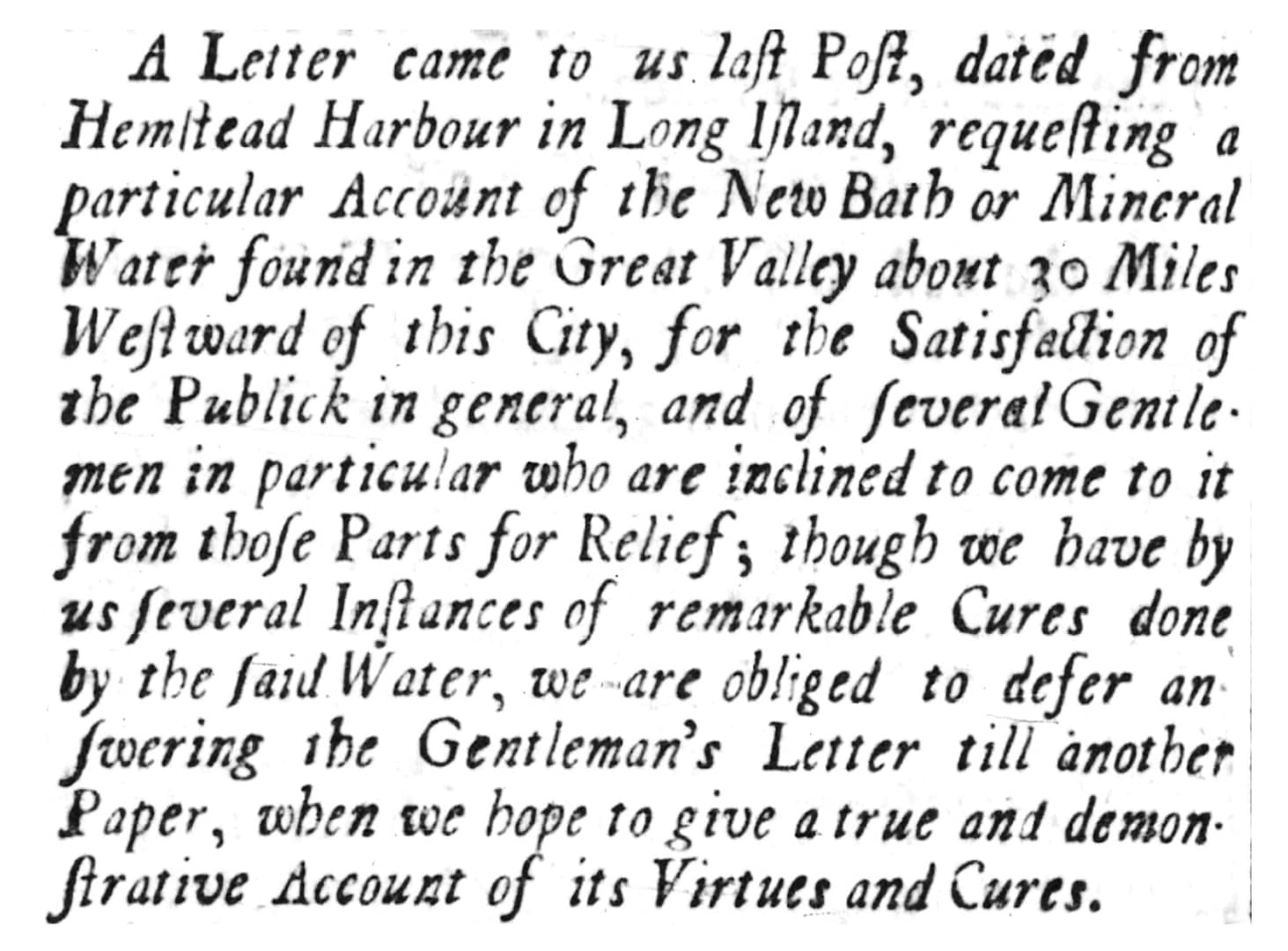
- 1722– the American Weekly Mercury out of Philadelphia reports on a letter from New York about a mineral spring in the Great Valley about 30 miles away from Philadelphia. This mineral spring would later become known as “Yellow Springs”
Colonial Era Tavern and Spa
1722 – 1770
- ~1733- The nearest excavated Contact-period Lenape site is 36CH60 (Montgomery Site) in Wallace Township, dated roughly 1700 to 1733. Marshall Becker’s excavation demonstrates that Lenape communities remained in Chester County after Penn’s arrival rather than disappearing immediately.
- 1737- The “Walking Purchase” dispossessed the Lenape of vast territories in Pennsylvania and forces them out of their ancestral homeland
- 1761– James Martin acquired the license to the tavern and the 160 acres of property surrounding it. The hospital Washington Hall was not yet built at this time, but Martin would have owned the property that it would eventually be built upon.
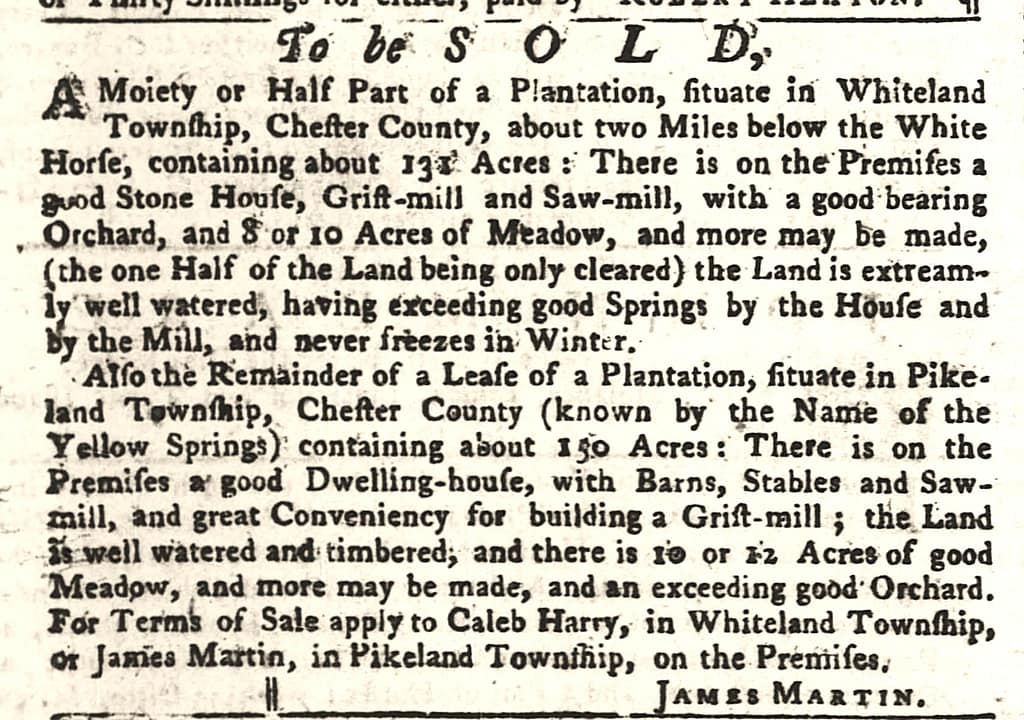
- October 21st, 1762– James Martin and Caleb Harry advertise in the The Pennsylvania Gazette looking to lease the remaining part of the Yellow Springs Plantation.
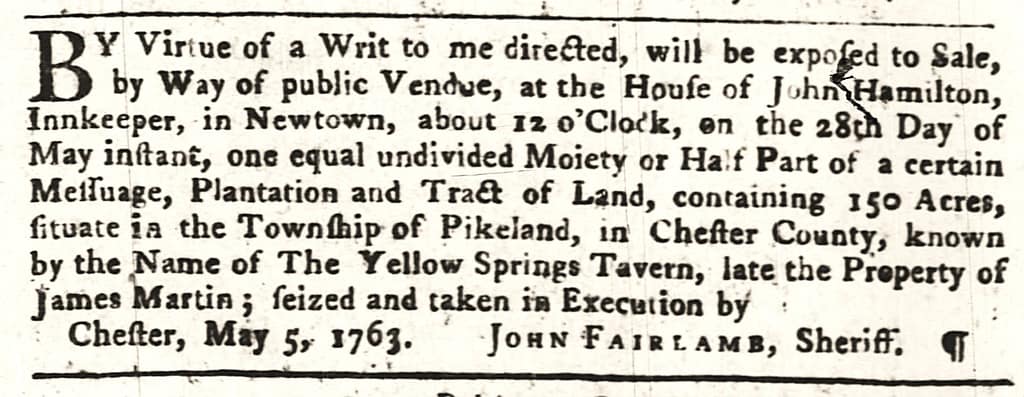
- May 5th, 1763– John Fairlamb, Sheriff, advertises the sale of the Yellow Springs Plantation (and Tavern) that previously belonged to James Martin. Notably, this advertisement indicates that the sheriff’s sale may have been for only half of the original property, though this is unclear. This advertisement ran in The Pennsylvania Gazette until at least May 19th, 1763.
- May 19th, 1763– Despite the Sheriff’s Sale of Yellow Springs being in effect, stage wagons from Philadelphia to Yellow Springs are advertised by John Cobble. These wagons would carry goods and people from Philadelphia to the spa.
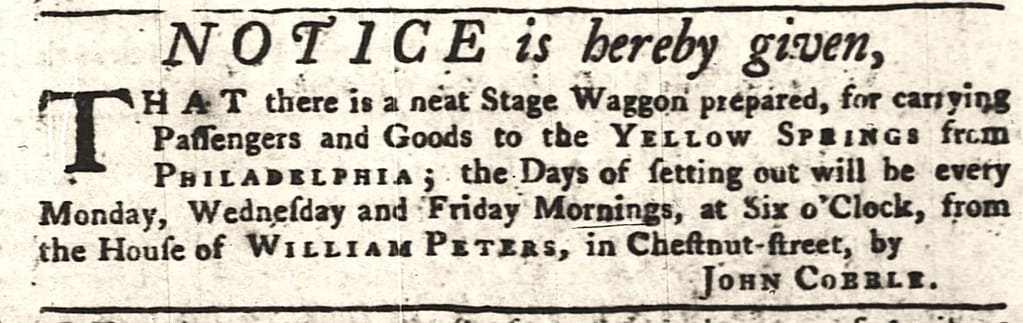
- May 31st, 1764– Advertisements continue for wagon services from Philadelphia to Yellow Springs.

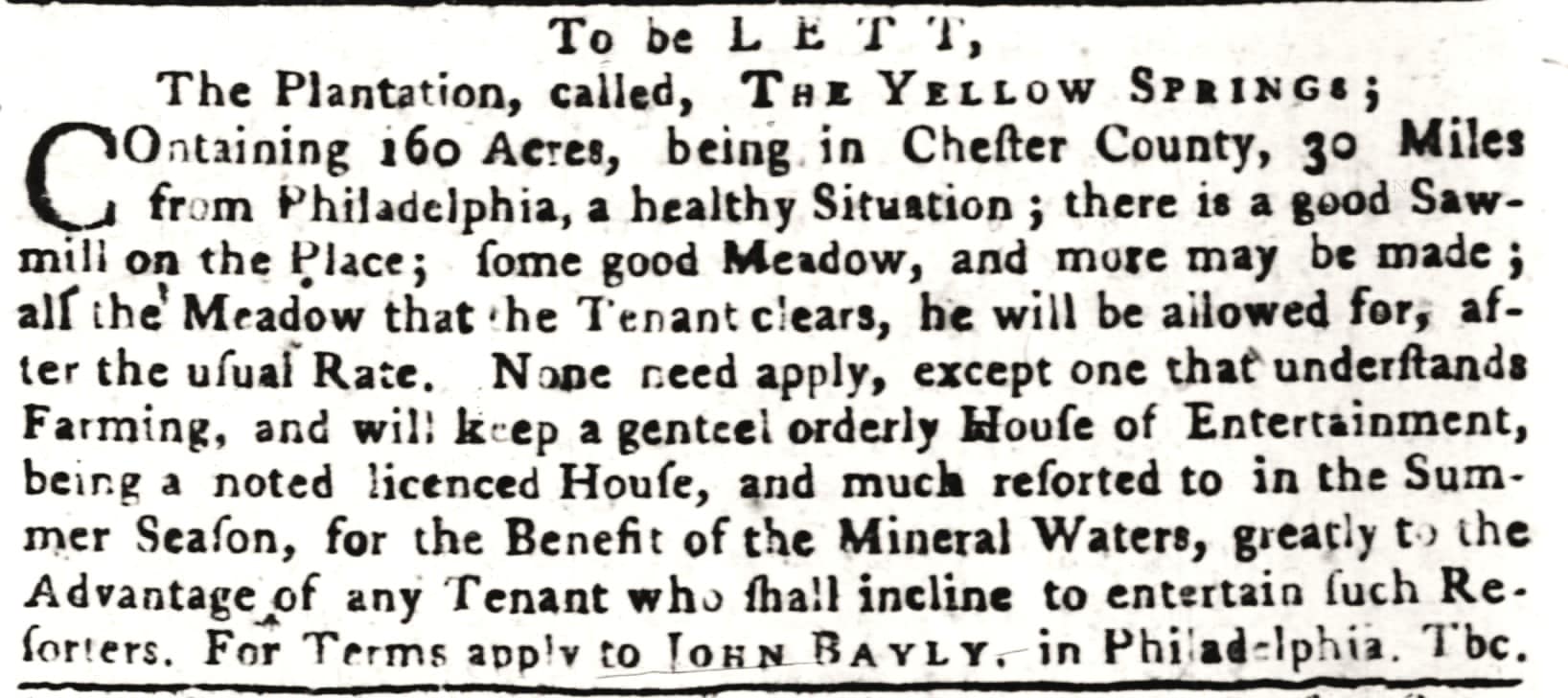
- September 6th, 1764– Philadelphia silversmith John Bayly acquires the village and leases the property. He improves and enlarges the tavern (which is currently known as the Brick Room in the Washington Building). The hospital has not been built yet, but John Bayly owns the property that it would be built upon later.
The American Revolutionary War
1770 – 1781
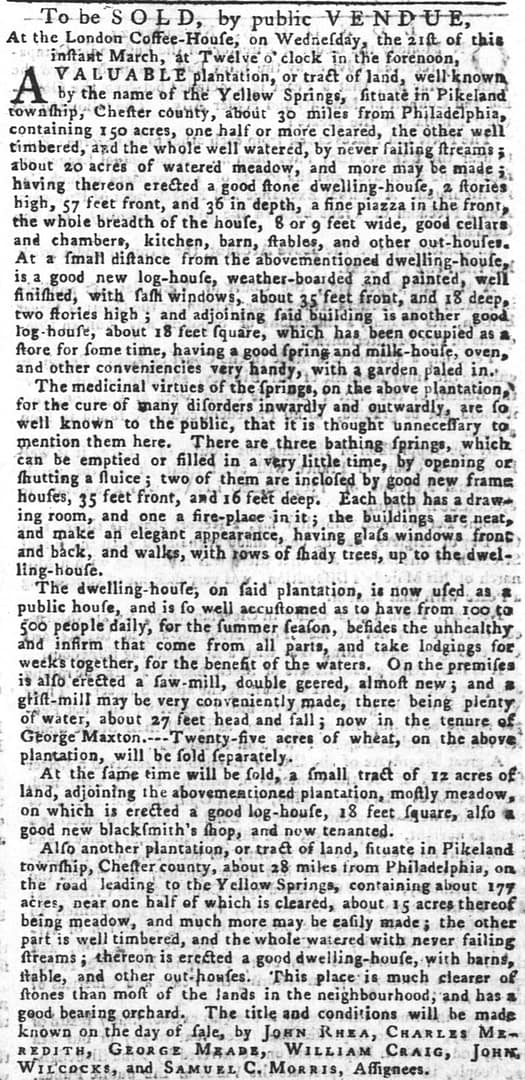
- March 1st, 1770- The Pennsylvania Gazette discusses how the entire Yellow Springs Plantation is to be sold on March 21st of that year. Also discusses tracts of land being sold around Yellow Springs.
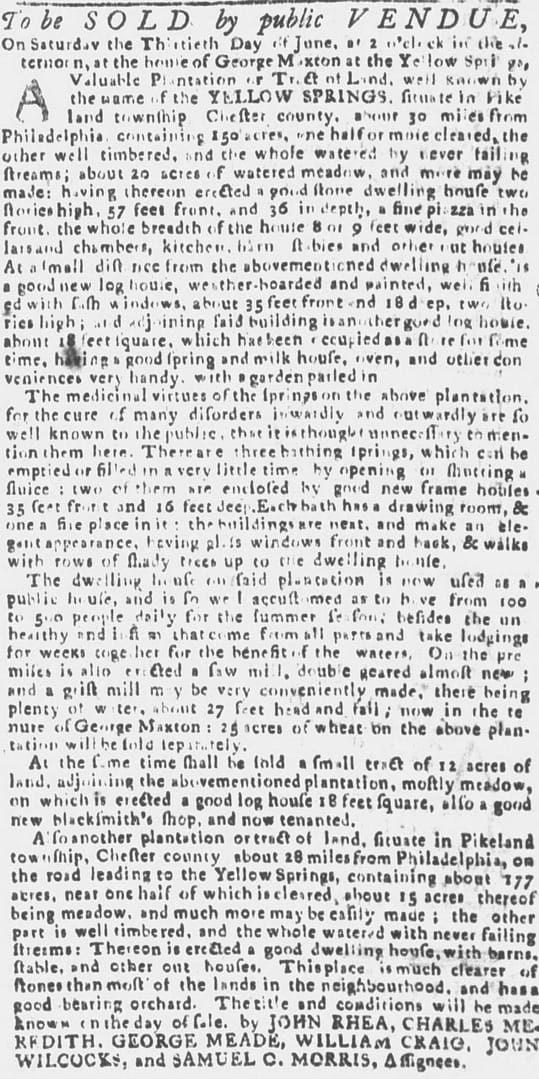
- May 31st 1770- The Pennsylvania Journal discusses how the Yellow Springs Plantation was to be sold on June 30 of that year, which conflicts with previously mentioned newspaper article that said plantation was to be sold on March 21st.
- The advertisement mentions George Maxton as living in Yellow Springs, and the auction is to take place at his home. At this time, Maxton was the tavern keeper who had been hired by John Bayly after his September 1764 advertisement.
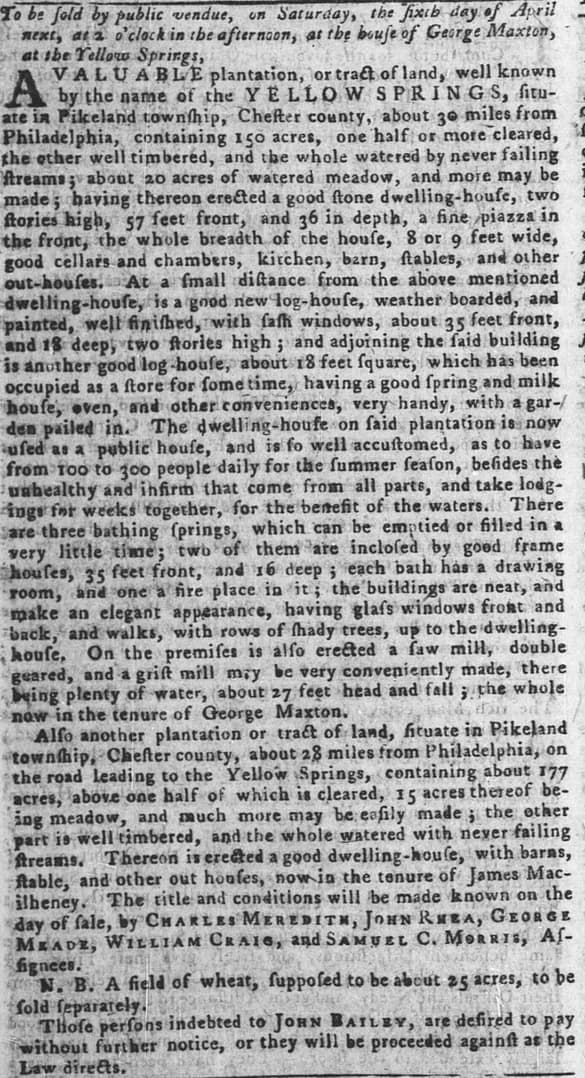
- 1771– In April of 1771, the entire property of John Bayly is to be sold by the sheriff to pay off Bayly’s debts. However, the sale does not appear to have gone through.
- March 14th, 1771- The Pennsylvania Gazette discusses how the Yellow Springs Plantation is to be sold on April 6th at the house of George Maxton in Yellow Springs.
- The relationship between Maxton and Bayly is not well known at this time, but it is possible that the attempt to sell his property through the sheriff’s sale was not something that Bayly had agreed to. Maxton’s role in hosting the auctions at his home while serving as the tavern keeper employed by Bayly may have contributed to animosity between the two men.
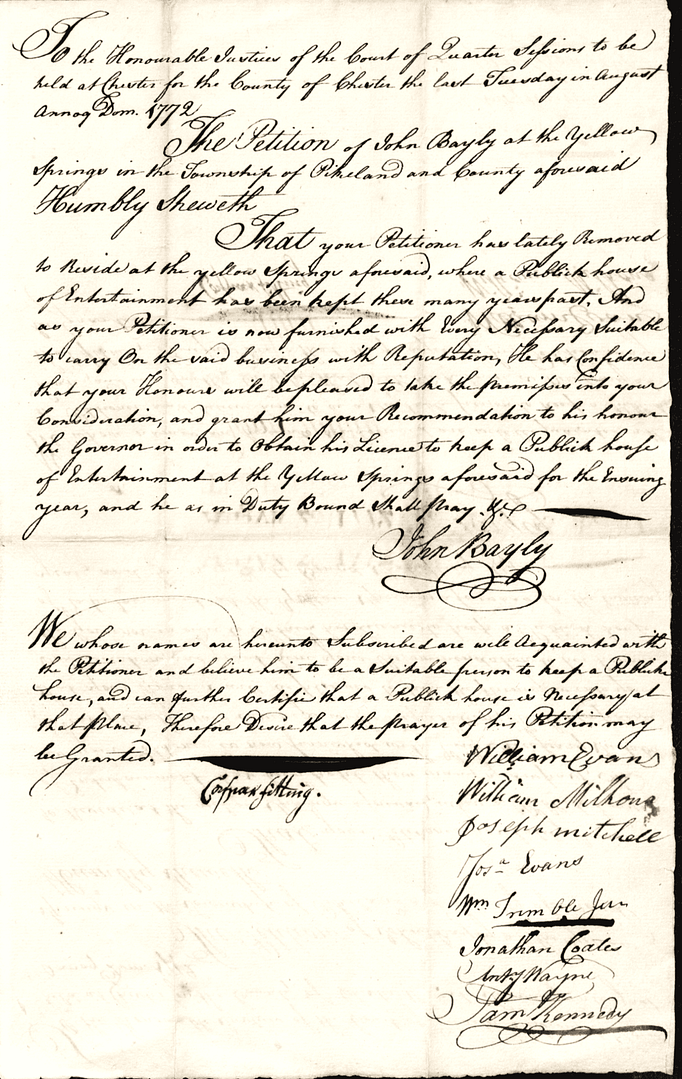
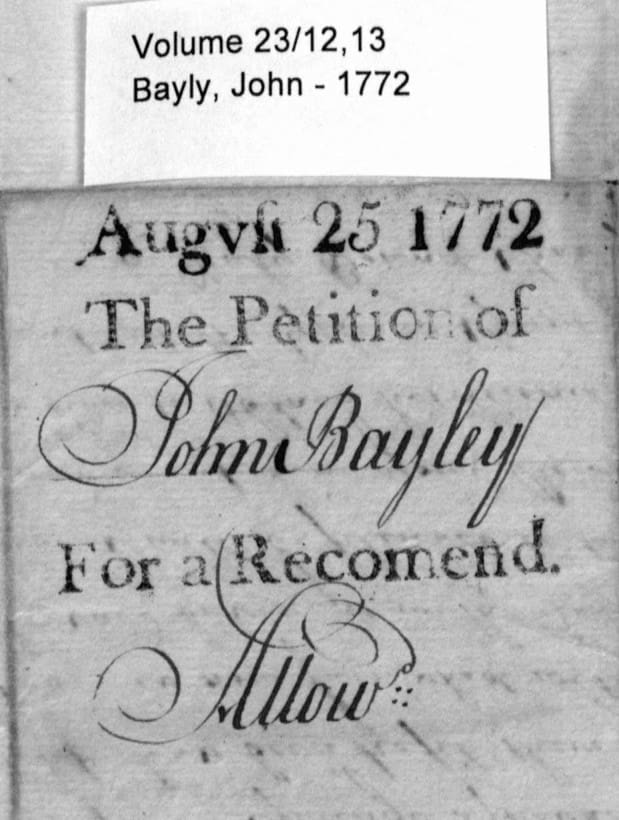
- August 25th, 1772– Despite the ongoing attempt at a Sheriff’s sale for Bayly’s Yellow Springs property, John Bayly applies for, and is granted, the license to continue the operations of the Yellow Springs Tavern
- Notably, Dr. Samuel Kennedy and General “Mad” Anthony Wayne have signed the petition as supporters.
- February 27th, 1772– Dr. Samuel Kennedy and John Bayly advertised for a tenant at a house at Yellow Springs. This notice predates our earliest records of Kennedy’s purchase of the property and may suggest that the Kennedy family acquired Yellow Springs before 1774. Notably, Bayly was still connected to Yellow Springs at this time.

- 1774– Dr. Samuel Kennedy of East Whiteland purchases the Yellow Springs plantation after the property was sold in foreclosure. Though the Lincoln building has not been built yet, the land that it was on would be part of aa hospital complex at Yellow Springs that served the sick and injured soldiers from Valley Forge
- September 11th, 1777– Battle of Brandywine
- In the aftermath of the Battle of Brandywine, soldiers fleeing the battlefield are treated and housed by several of the immigrant farmers whose properties neighbored Yellow Springs. In 1776, Hessian soldiers noted the presence of several “rebel hospitals” operating in the town (out of barns) at this time.
- September 16th, 1777– Battle of the Clouds
- Battle of the Clouds in Frazer is aborted by a nor’easter and the American army marches from Frazer to Yellow Springs to camp in the blinding rainstorm. George Washington stays in the Tavern while 11,000 troops camp overnight on the Yellow Springs property and leave the next day for Warwick and Redding Furnaces (Elverson)
- January 10th, 1778– Congress created a camp committee to visit Washington’s army at Valley Forge. The order to improve hospitals at Valley Forge led to the building of Washington Hall at Yellow Springs
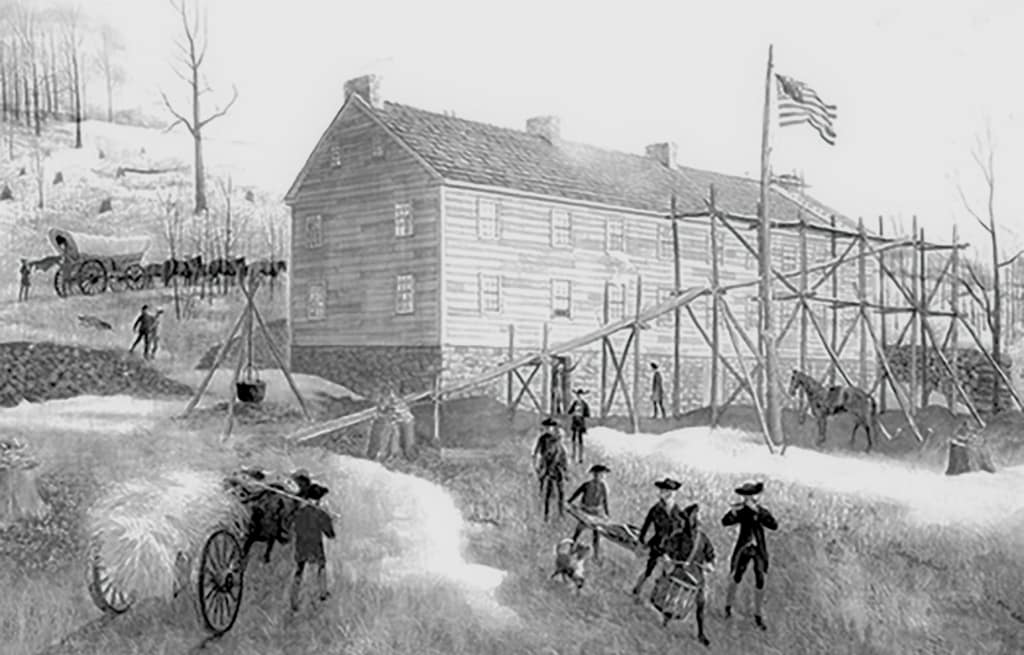
- January 21st, 1778– Dr. John B. Cutting, apothecary General at Yellow Springs, writes the following letter about the conditions of the stocks being stored at Yellow Springs (now the supply depot for the Hospital Department)
“Dear Sir:
Yellow Springs.
Our dispensing store is opened here, and we have begun to supply the regiments in camp, but I am very apprehensive that the several hospitals in this vicinity will render a further reinforcement necessary before we shall be able to complete the whole. Many regiments have no chests, and many who have them are deficient in surgeons. “I have not yet been able to get a return of the number of regiments in the army but suppose at present there are at least eighty, including artillery. Dr. Cochran has given orders to the division on the left to bring their chests first, and we propose going through the entire army in the order in which they now lay. To give only a few of the capital medicines to each will be the work of time and a much more intensive piece of business than I first imagined. The best method that I can think of is to act immediately about preparing new chests at some convenient place for all such battalions that did not get chests from Dr. Craigie in the last campaign. When these new parcels are ready, let us call all the large chests into stores; these are too capacious for field service, so in lieu of them, we will issue smaller ones. By this exchange, the General Hospital will be well supplied with standing chests and acquire a great variety of useful articles which are not essential in camp.”
- February 1778- Baron Friedrich Wilhelm von Steuben arrived at Valley Forge to impose order, discipline, and enforced standards.
- He is not recorded at Yellow Springs proper, but his work was part of a larger push that treated cleanliness and organization as military necessities rather than optional virtues. Dr. Otto and Dr. Kennedy mirrored this emphasis at the hospital: stricter laundering, more deliberate handling of contaminated bedding and clothing, cleaner routines, and tighter discipline in the day-to-day running of wards.
- May 1st 1778 – May 7th 1778- A Revolutionary War-era journal kept by a member of the nearby Hartman family describes German farmers around Yellow Springs gathering food, straw, and clothing for George Washington and his soldiers. The journal also records wagons returning from camp with sick soldiers bound for local hospitals, where smallpox and putrid fever spread through the area. It further notes that Abigail Hartman-Rice, wife of Zachariah Rice, died after contracting a malignant fever while delivering food to patients- though our research into Abigail’s life shows this was at a much later date.
- May 15th 1778 – May 18th 1778- Dr. Craik’s belief that the army would leave camp within three days proved incorrect, and by May 15, 1778, he was writing about the growing problems facing the hospitals serving Valley Forge encampment:
“As I am willing that there should be no cause for complaint against our department, I embrace every opportunity to inform you of our wants. I have just returned from Yellow Springs and that neighborhood where I have given directions that additional hospitals be opened. More stores, of course, will be needed and as the following articles are scarce, a fresh supply is immediately wanted of coffee, tea, chocolate, vinegar, writing paper, pots, kettles, and salt. All of these will be required in large quantities as a number of hospitals must be supplied. The Flying Hospital is in need of vinegar, so I wish you to send a couple of hogs heads directly.
I am sorry Dr. Cutting went away before the regimental chests were finished, for there is great clamor about them, though a Dr. Lugman is as busy as possible. I am afraid there are not enough medicines here to keep the regiments supplied. I hope Dr. Craigie will soon have his chest ready.
I should be glad to know how wagons are to be furnished to the different hospitals. They will require some one constantly with them to supply wood.
Assistant commissaries will be wanted for the new hospitals. Let us be furnished with a quantity of beds, tubs, sheets, and blankets as soon as possible; otherwise, the sick can never be kept clean and comfortable. It will be necessary to send down a quantity of money, as the commissaries are in much distress from lack of cash. The surgeons are likewise anxious to have their pay. The money I brought down will go only a very little way. I think Mr. Morris had best come down as soon as he can and settle with the commissaries, for paying the people punctually will make them more ready to oblige besides keeping our credits good. “I think if you would procure a person of character who can properly keep books, it would not be amiss to do so, for such a person could take charge of the stores at Yellow Springs, enabling Mr. McCarake [Capt. Alexander McCaraher] to better attend to the outside business. When you send down a proper supply stores, the care of them will be of considerable importance. It will be proper to keep us well supplied with vinegar, for there is much demand for it.
His Excellency [George Washington] went out to the Yellow Springs two days ago to visit the hospitals and found them in fine order. He spoke to every person in their bunks, which exceedingly pleased the sick. He was highly pleased to find the hospitals in such order. If we can keep up this character, we shall do very well.
I am sorry that the general store of necessities is at such a distance from the hospitals as it is a long time before they can be received after written for. A little time now will determine whether we shall get into Philadelphia. Various are the opinions at present. By all accounts, it would appear that the enemy is soon going somewhere. Forage and heavy cannons are being put aboard the transports, as well as wood and water.
Many of our soldiers are ordered into tents. They begin to be more sickly than they have been, but wagons cannot be conveniently had to carry the sick to the hospitals.
I wish that Dr. Cochran‘s dispensary chests could be sent soon, for he could then stop the mouths of the noisy.”
— from E. Gibson, James. Dr. Bodo Otto and The Medical Background of the American Revolution (p. 217)
- May 17th, 1778– After Dr. Craik requested funds to help commissaries pay outstanding bills, Dr. Potts sent Dr. Bond to obtain money from Congress. Bond reported:
“I have been to York Town and, by a steady attention to the Lords of the Treasury, received a warrant for $100,000. The cash, however, cannot be obtained until next Saturday. With great difficulty, I procured leave from Blodget, General Greene’s aide, to let Helleges give me $12,000 for present necessities if only to keep the devil out of our pockets. Out of that sum I send you and Sheets $245 cash. I gave Craigie, the Apothecary, $4,000 more.”
–from E. Gibson, James. Dr. Bodo Otto and The Medical Background of the American Revolution (p. 217)
- April 27th, 1778– By the spring of 1778, Dr. Samuel Kennedy’s life revolved almost entirely around Washington Hall and the growing hospital system connected to Valley Forge encampment. What had once seemed like a convenient assignment near his family became an exhausting and isolating responsibility. Later accounts from apothecary John B. Cutting described Kennedy moving from ward to ward late into the night, often without sleep, as he cared for soldiers suffering from dysentery, typhus, pneumonia, and putrid fever.
- Before the war, Kennedy’s work as a country doctor had prepared him for injury, illness, and death, but the scale of disease surrounding Valley Forge surpassed anything he had previously experienced. Crowded camps, hunger, exposure, and poor sanitation overwhelmed the hospital system and placed enormous pressure on physicians and staff.
- As Washington Hall expanded, it also became an administrative center for the Hospital Department. Yellow Springs was designated as a depot for medicines and medical chests, placing Kennedy, John B. Cutting, and others at the center of care, supply distribution, and hospital administration. Meanwhile, Sarah Ruston Kennedy managed the household and hosted the steady flow of military officers, physicians, clergy, and officials connected to the hospital.
- Despite mounting pressure and constant reforms ordered by Congress and senior hospital officials, Kennedy remained deeply involved in every aspect of the work. His dedication helped save lives, improve operations, and establish him as far more than a local country doctor.
- April 27th, 1778– By the time Dr. Bodo Otto arrived to support the hospital system connected to Valley Forge encampment, smallpox had become one of the greatest threats facing the Continental Army. Both Otto and George Washington understood the danger. Washington, who had survived smallpox himself, supported inoculation despite Congressional hesitation over its risks and the temporary weakening of troops.
- Otto believed inoculation was essential preventative medicine, but the process required careful preparation, discipline, and close supervision. Many soldiers at Washington Hall received smallpox inoculations under his oversight, helping limit the spread of disease through the hospital system.
- By 1778, Otto was an experienced physician in his late sixties whose authority extended beyond medicine alone. While Dr. Samuel Kennedy spent much of his time inside the wards caring for patients, Otto often managed hosting duties, administration, and relationships within the broader Hospital Department. He worked within a difficult system shaped by Congress, senior physicians such as William Shippen Jr., John Cochran, and Jonathan Potts, and constant shortages of supplies and manpower.
- Otto also helped strengthen ties between the hospital and the surrounding German farming community. Families such as the Hartmans, Rices, and Henches transported supplies, cared for the sick, washed linens, and even served as nurses despite the danger of contagion. By the spring of 1778, Yellow Springs had become more than a military hospital. It was a cooperative effort between physicians, staff, and the surrounding community that helped save hundreds of lives.
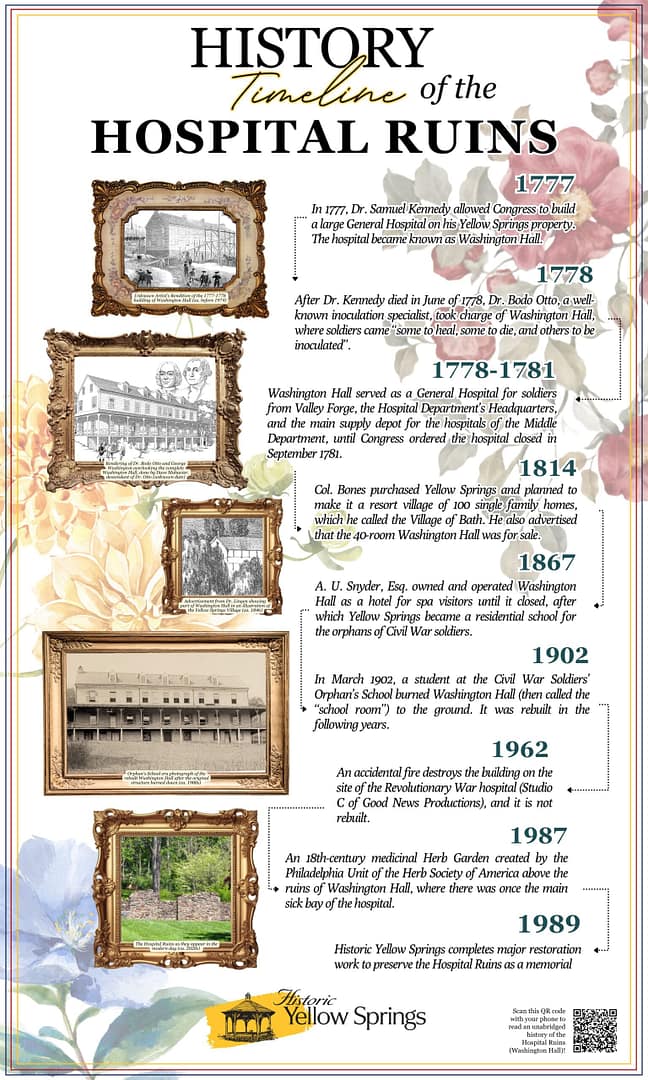
- June 15, 1778- Dr. Samuel Kennedy, sick with a ‘putrid fever’ he contracted while working in the wards of Washington Hall and the other hospitals in the complex at Yellow Springs, writes his will. He will die in the following days. Following his death, Dr. Bodo Otto Sr. would be the primary physician and head of the hospital complex at Yellow Springs
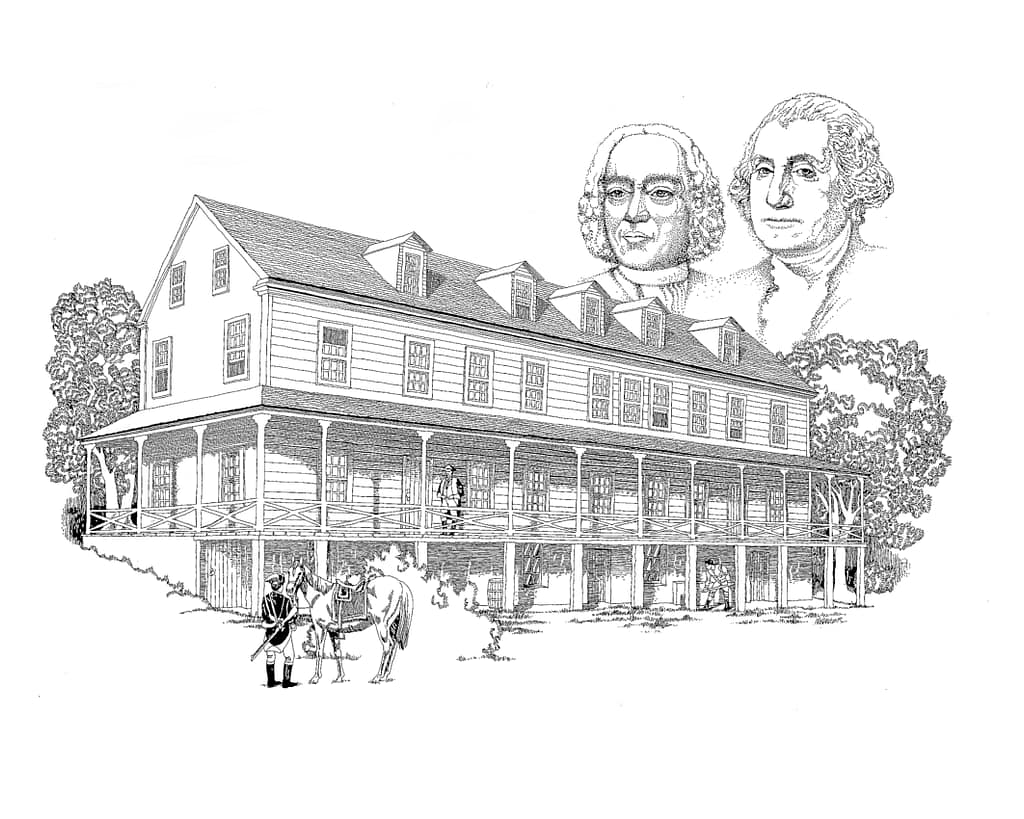
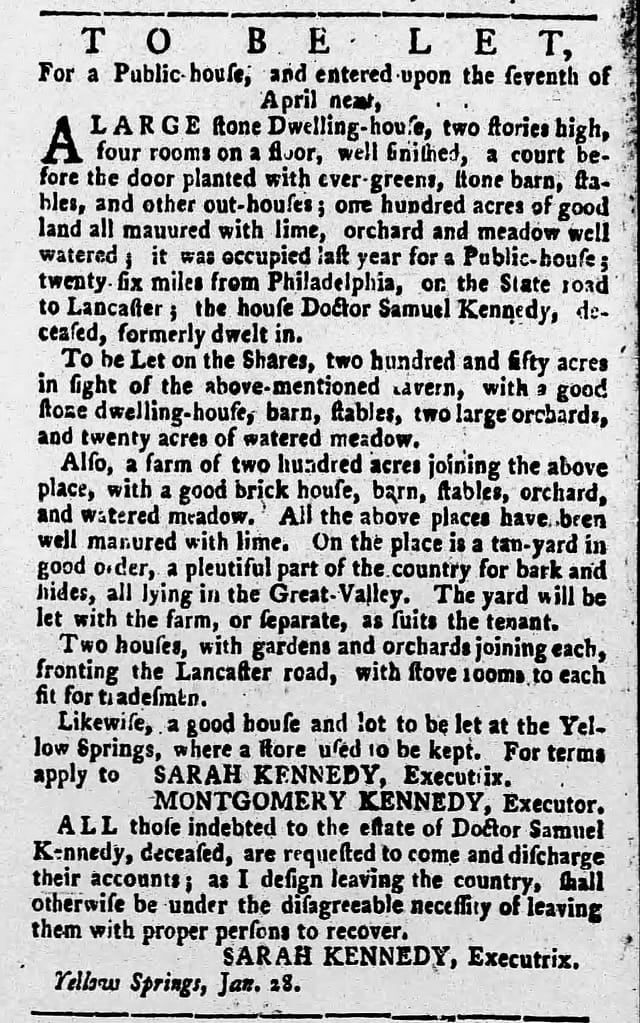
- 1779– The Yellow Springs property has been well-known as a popular spa destination since before the Revolutionary War. During the war, the property belonged to the Kennedy family, and it was used as a hospital complex. After the death of Dr. Samuel Kennedy, Sarah Kennedy (Samuel’s widow and the executrix of his will before their son reached the age of majority) offers the village for lease. Samuel Culbertson, who had leased the tavern from Dr. Kennedy and operated it during the war, advertises that the widow Kennedy does not own the property, but he does.
- May 19th, 1780– Finding himself critically short of supplies, Bodo Otto sent an appeal for relief:
“To the Honorable, the Committee of Congress for Conducting the Medical Department:
The memorial of Bodo Otto, surgeon of the hospital at Yellow Springs, showeth,
That the hospital at the Yellow Springs now, and for some time past, has been maintained for the reception of those afflicted chiefly with chronic disorders, and our necessary stores for the sick are entirely exhausted. There is no money in the hands of the Commissary to purchase fresh provisions, so the sick have been obliged these several past days to eat salt provisions. There is but six days supply of bread on hand, and the gentlemen who have furnished us that article as well as meat for the past two years now refuse to supply us any longer.
Can it be supposed that a physician or surgeon can gain credit for perfect cures under these circumstances?
The assistant physicians complain daily that they have not received any money for their services these past seven months; neither are they furnished with clothing, so it is uncertain how long they will be able to continue in their several capacities. The nurses and orderlies refuse to serve any longer, as they have received no pay. This being the de plorable situation of the hospital at Yellow Springs, your Memorialist entreats your Honors to take the matter into consideration and order some speedy relief, or the sick and wounded must unavoidably suffer. He is loath to complain without cause, but as the hospital has been under his direction for these past two years, supported with credit hitherto, he should be sorry to see it rendered useless and of no importance, His Excellency, General Washington, ordered the officers that if in case the sick are likely to suffer and not be relieved by the department they are to report the same to him.”
— from E. Gibson, James. Dr. Bodo Otto and The Medical Background of the American Revolution (p. 224)
- September 1781– Congress ordered the closure of the hospital complex and Washington Hall at Yellow Springs, despite Dr. Otto’s request that they do not do so.
Fashionable Health Spa
1782 – 1867
- 1783– Captain Alexander McCaraher (a family friend of the Kennedy family) reopens the tavern at Yellow Springs (now the Brick Room of the Washington Building) and repairs “the baths and bath houses.”
- 1789– All of Pikeland Township (East & West) to be sold at auction to satisfy the debts of Andrew Allen owed to Samuel Hoare. 115 terre tenants (persons holding titles to the property but who were not the original debtor who incurred the lien) held land at that time.
- 1810– Yellow Springs profiled in The Portfolio, a national magazine. Bones offers to sell his property at auction but it never goes through.
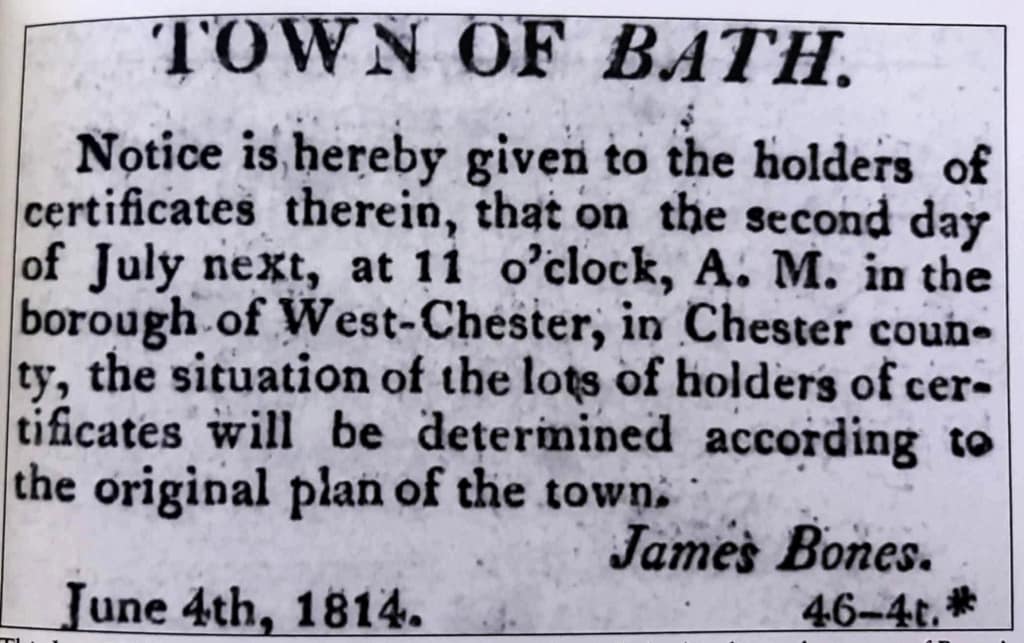
- 1814– Bones conceives of making this a resort village of 100 single family homes, which he calls the “Town of Bath”, and advertises a subdivision. He also advertises that the 40 room Washington Hall is for sale.
- 1829– Town of Bath advertised again by Bones, but now as 30 rather than 100 lots. A newspaper, known as the Literary Casket is published at the Springs. It later moved to West Chester.
- 1830– Anthony Olwine acquires Bones interest in Yellow Springs, buying him out– including what is now the Lincoln Building.
- 1832– Horse drawn rail service was now available from Philadelphia to Malvern. A.W. Olwine advertises rumors of cholera at Yellow Springs are unfounded. At the time New York was reporting more than 100 cholera cases daily with a 30% death rate
- 1837– According to the Chester County Archives’ Tavern Petitions Records (1700-1923) Index, on page 58, a man named William Blackwell petitions for a license to operate Washington Hall as a tavern. His petition is denied.
- 1846– Dr. George Lingen acquired the springs as a homeopathic facility.
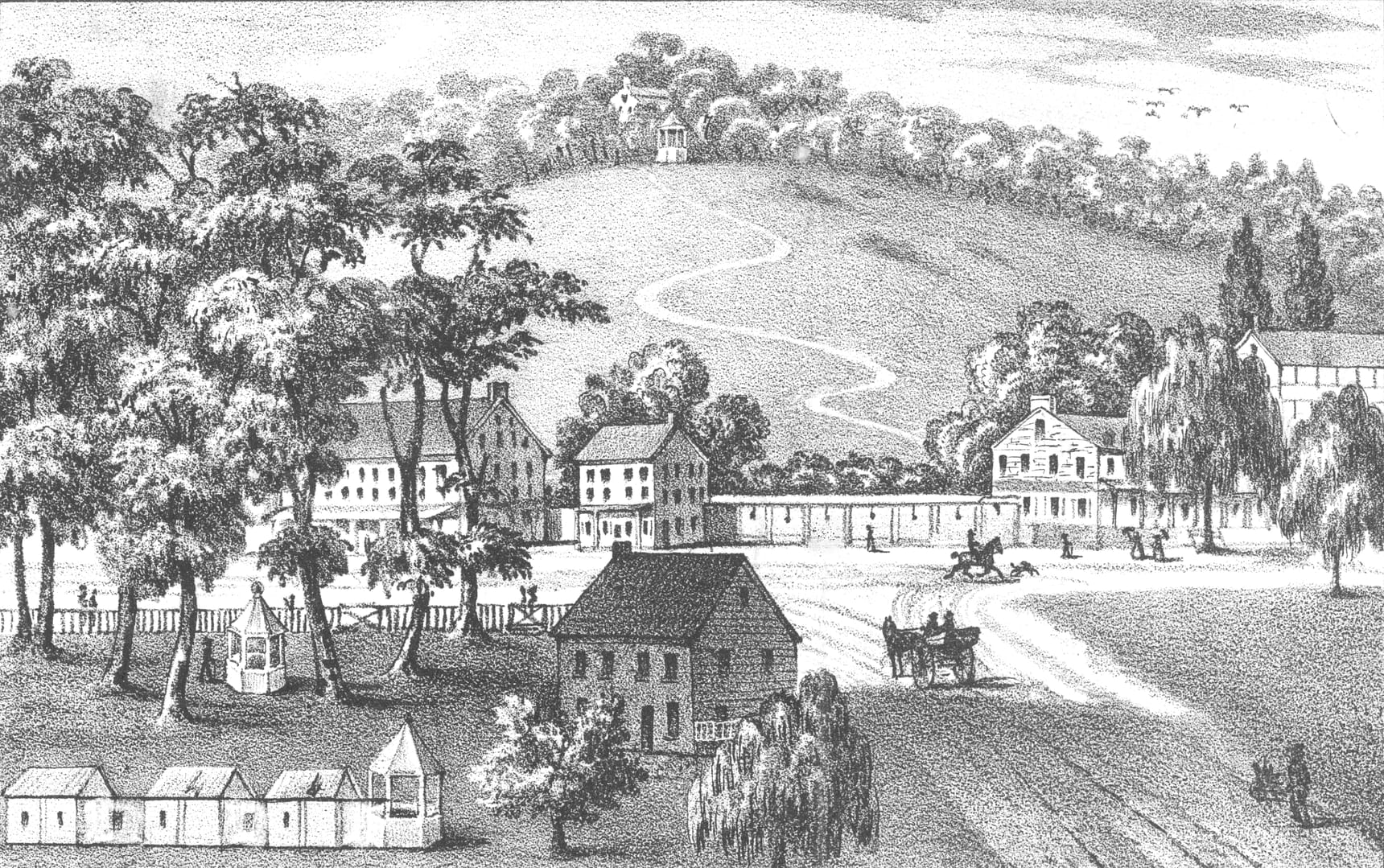
- 1856– Foreclosure sale of Dr. Lingen’s interests in Yellow Springs. August Snyder acquires the Springs.
- 1867– Village and Washington Hall is owned and operated by A. U. Snyder, Esq. It continues to serve as a hotel for visitors to the spa. However, the summer of 1867 was the final season that Yellow Springs served as a resort. After changing hands a number of times, Yellow Springs would eventually be purchased for use as a school for Orphans of the American Civil War.
Pennsylvania Soldiers’ Orphan School
1868 – 1912
- The Yellow Springs property was sold to the Pennsylvania Soldiers’ Orphan School system. Additional research is ongoing to determine how this structure was used during this time period.
Pennsylvania Academy of the Fine Arts: Country School
1916 – 1951
- After 1912, The Yellow Springs property was sold to the Pennsylvania Academy of the Fine Arts, who used the property as a country school for student artists. Additional research is ongoing to determine how this structure was used during this time period.
Good News Productions
1952 – 1965
- Good News Productions, an evangelical film-making studio operated by Shorty Yeaworth, purchases the Yellow Springs Village. Additional research is ongoing to determine how this structure was used during this time period.
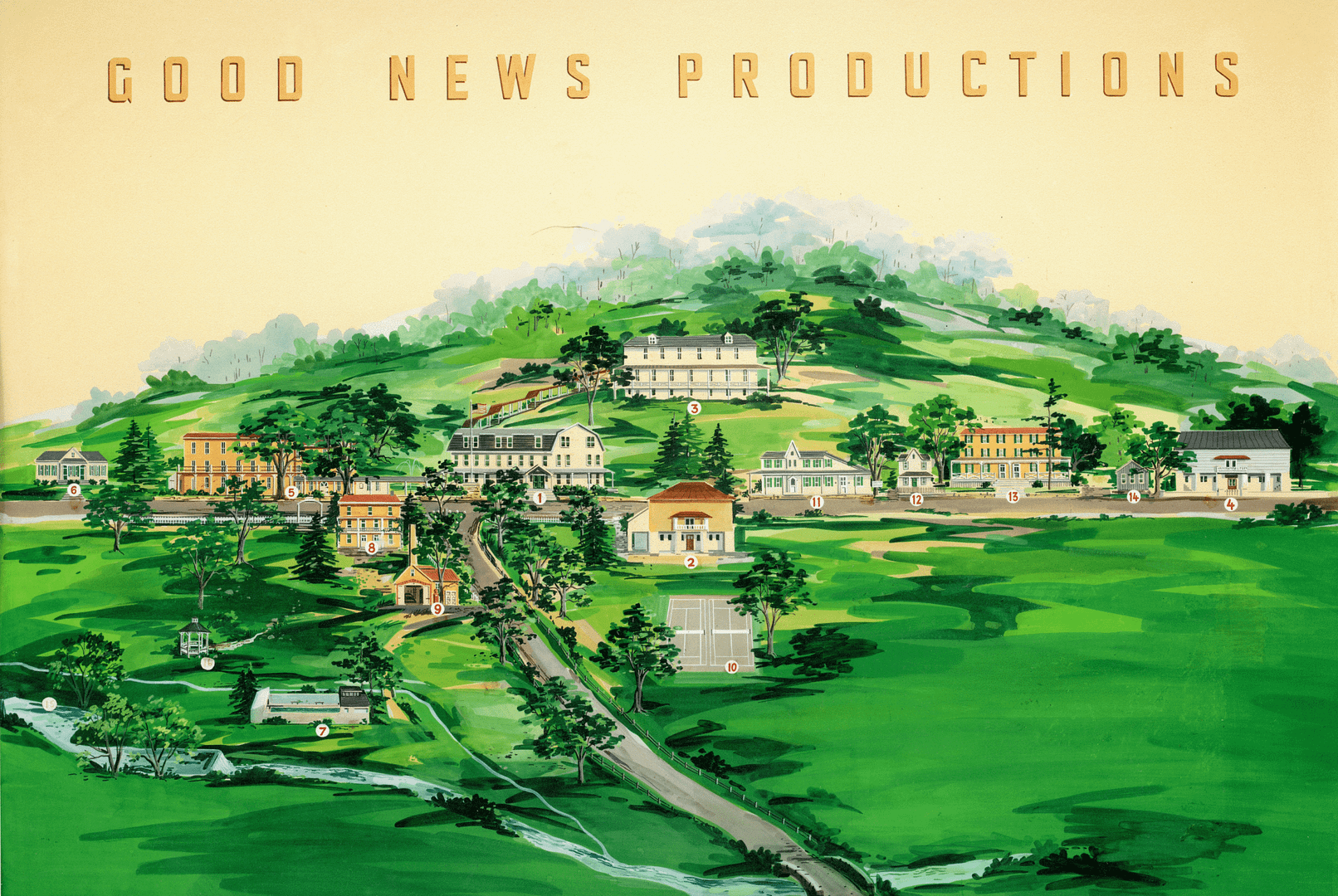
- 1965– Yellow Springs Association, a board based community membership organization, is founded to sponsor artistic and cultural programs, and foster interest in the village and its history
Early Years and Formation of the Yellow Springs Foundation
1965 – 1978
- The Yellow Springs Association morphs into the Yellow Springs Foundation. These organizations would later become Historic Yellow Springs. Additional research is ongoing to determine how this structure was used during this time period.
Historic Yellow Springs
1978 – today
- Additional research is ongoing to determine how this structure was used during this time period.
Further research is ongoing!