Timeline of the Revolutionary War at Yellow Springs
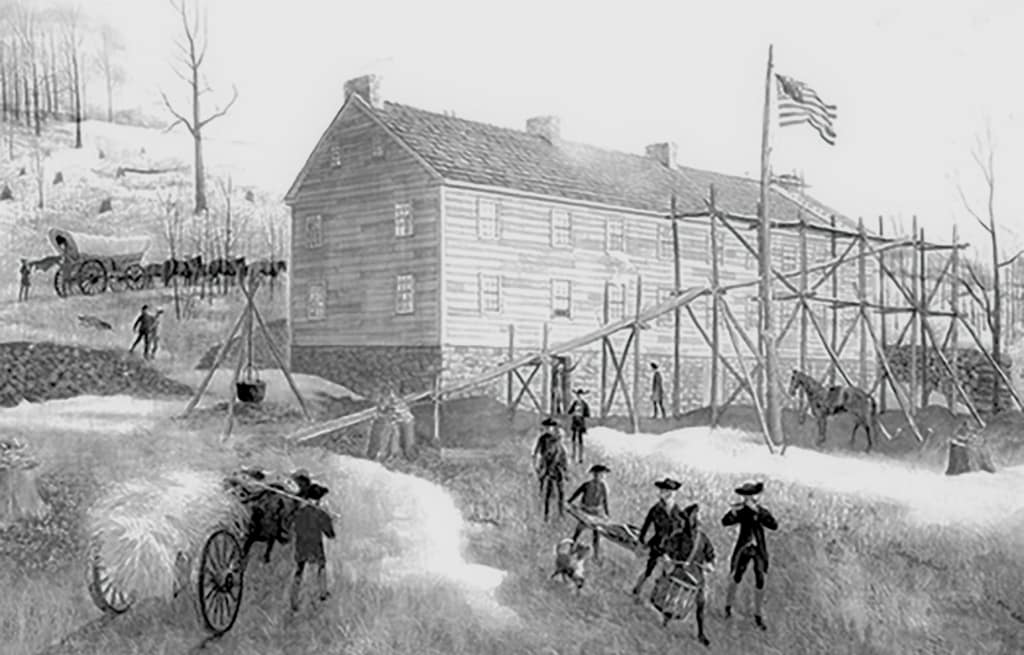
The tavern shown here was first licensed as such in 1751. It was off the beaten path, but it had an iron spring known then as a way to fight illness. In season, from July through September, it was crowded. But three months does not generate much revenue, and it was constantly being sold or “let” in the Philadelhia newspapers. In the 1770s it was owned by a prominent Philadephia silversmith, John Bayly.

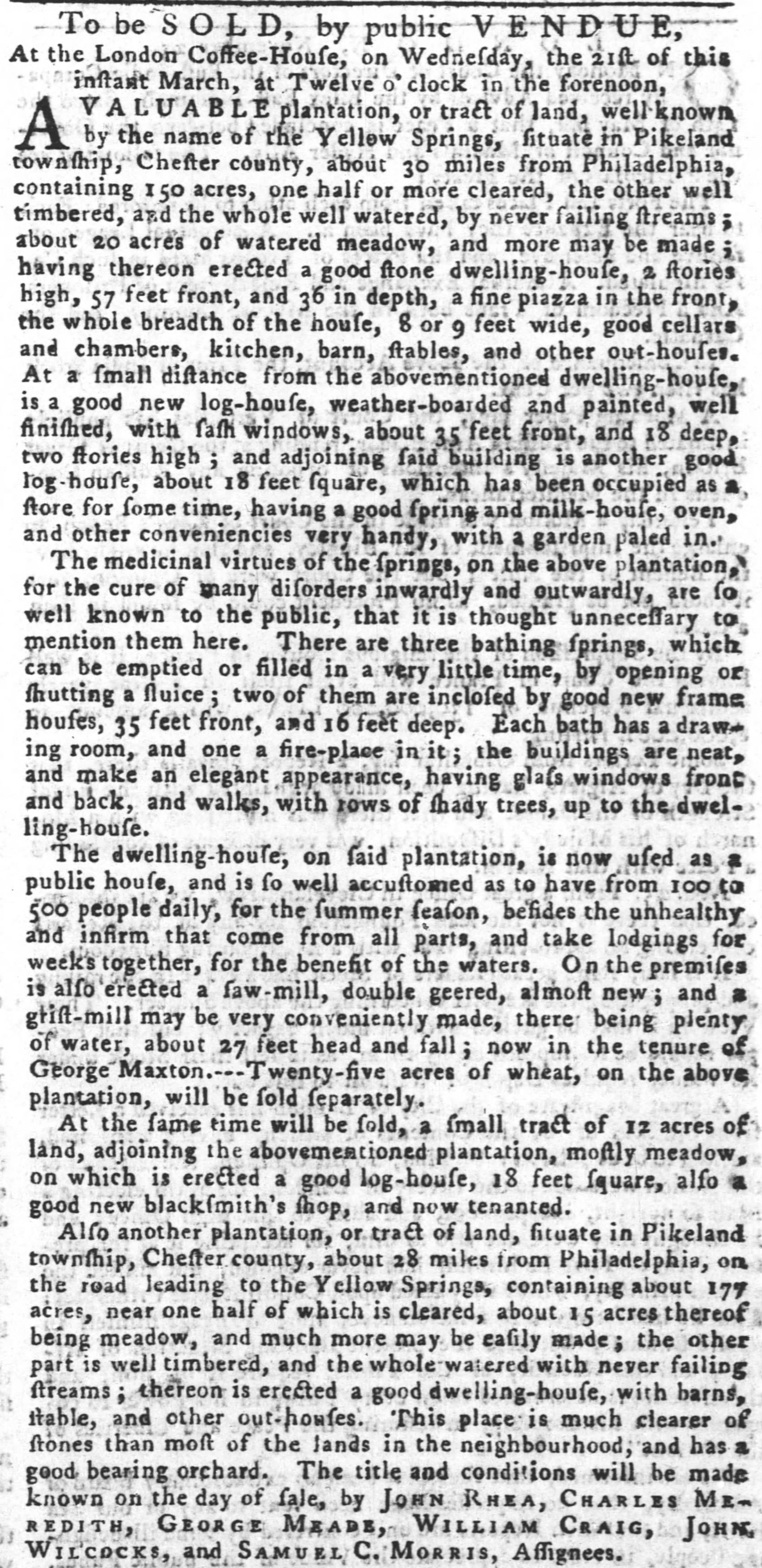
We know what was here from this 1770 auction. The building had the same front as today but was only 36 feet deep and two stories high. The main house across the street was also there, known as the “Red House” at the time. The modern facade was added later, however foundations of the building date to before the war.
The other buildings are lost to time. Most of what you see in the village today dates to the early 1800s.
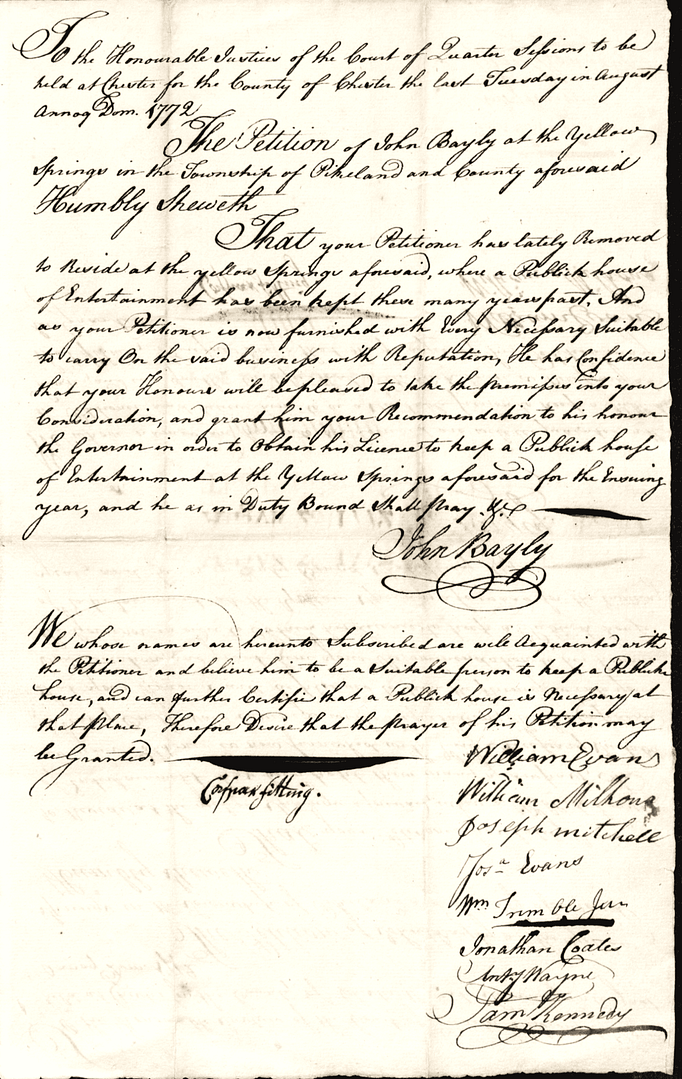
The Springs was acquired by a country physician/gentleman from Whiteland named Samuel Kennedy. He leased the property as we see here below.
The 1777 season was underway when word reached Philadelphia that 200 British ships and 18,000 soldiers were headed up the Chesapeake Bay. The goal appeared to be to capture Philadelphia, the capital of the colonies and seat of Congress.
The British landed at Head of Elk near the Bohemia River on August 25, 1777, and after several days they headed first toward Wilmington. The American army came south through New Jersey and into Philadelphia.
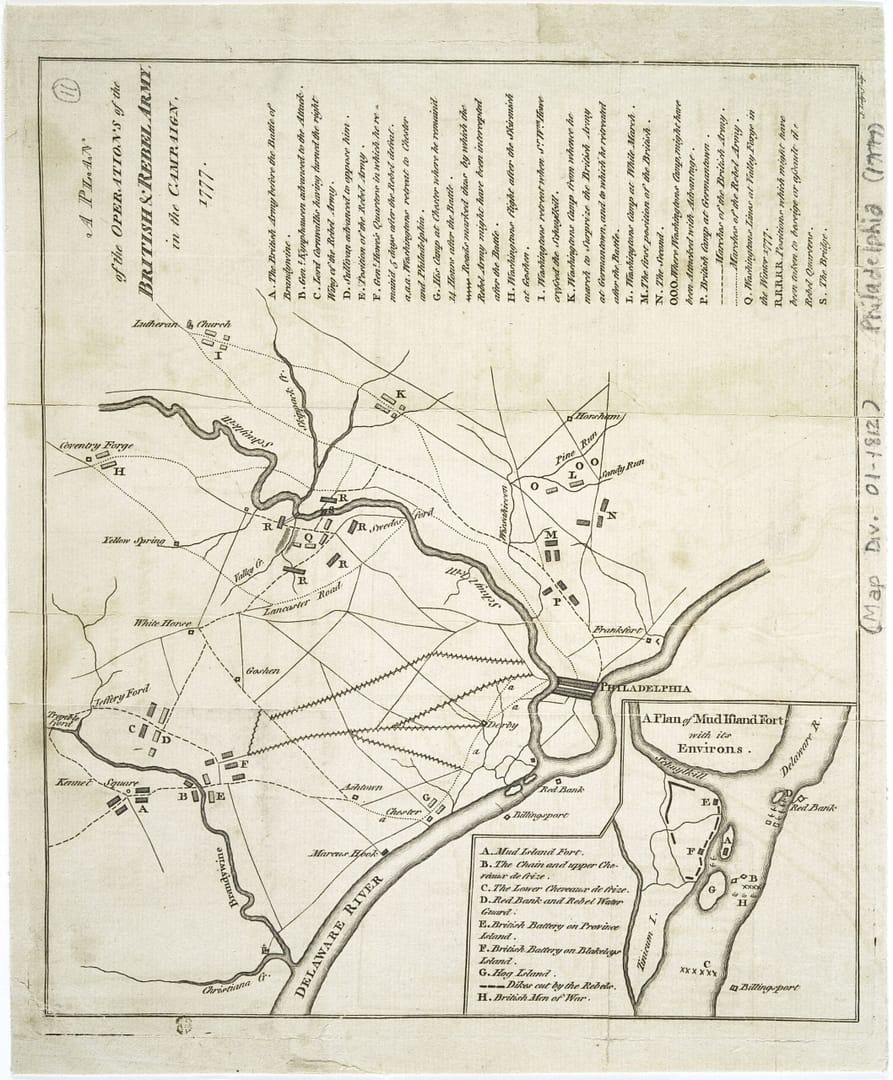

Philadelphia was a difficult place to conduct land operations as either army could end up pinned against a river and suffer heavy losses. Rather than risk that, the Americans marched west out the Baltimore Pike to meet the British in the open farmlands of Chester County. They formed on the east side of the Brandywine River at Chad’s Ford and sent skirmishing parties as far as Kennett Meeting to harass the British. It was September 11, 1777.
This was the battle the Americans expected. A straight assault up Baltimore Pike with the British having to fight their way wading across the river ford. But what the British did is divide their forces. One-third attacked as expected, but the other two-thirds marched from Kennett Square north toward today’s West Chester. They crossed the Brandywine and hit the Americans on their right flank. The maneuver worked and Washington was driven back to Chester and then East Falls.
On September 15 the Americans crossed the Schuylkill and marched through Haverford to Frazer, Pennsylvania, looking for a re-match. The British marched through West Chester (Turk’s Head) and up the Darby Road toward the Great Valley and a small but central hamlet called White Horse Tavern. The eighteenth century tavern is the left part of today’s building.

On September 16 the armies skirmished near today’s Hershey’s Mill on the east and near Phoenixville Pike and Boot Road (the Boot Tavern) on the west. The White Horse is shown on the map below.
The Americans were ordered to march six miles north up the Great Valley Wall on Yellow Springs Road to camp at the village of Yellow Springs. The six mile trek took twelve hours and they arrived at Yellow Springs with no tents to cover them. They slept in the fields surrounding the village.
On the following day Washington ordered Colonel Alexander Hamilton to Valley Forge to destroy supplies there. Anthony Wayne and 2,500 troops were dispatched to Malvern (Paoli Tavern) to monitor British movements from their camp near Chesterbrook.