
Biography of Samuel Culbertson
- The Culbertson Family: From Scotland to Chester County, Pennsylvania (Late 1600sâ1720s)
- The Second Generation: John Culbertson and the French and Indian War (1730sâ1767)
- Early Life and Family of Samuel Culbertson (1744â1776)
- Tavernkeeper at Yellow Springs (1775â1776)
- Revolutionary War Service and Capture at Fort Washington (1776)
- Four Years as a Prisoner of War (1776â1780)
- Return to Yellow Springs and Treatment at Washington Hall (1780â1782)
- Death at Washington Hall (1782)
- Legacy
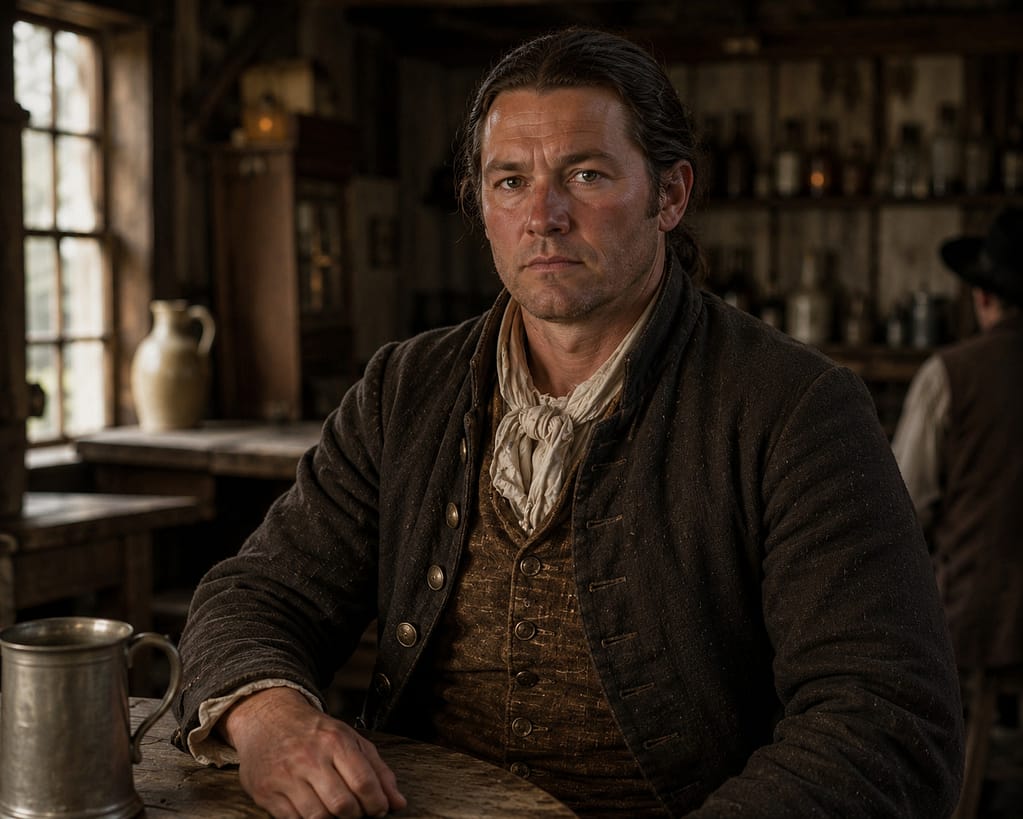
The story of Captain Samuel Culbertson connects the broader history of Scots-Irish immigration in Pennsylvania with the Revolutionary War history of Yellow Springs. Before he became a tavernkeeper, military officer, and patient at Washington Hall, Culbertson belonged to a family whose roots stretched across Scotland, Ulster, and southeastern Pennsylvania.
His life reflects many of the experiences common among eighteenth-century Pennsylvanians: immigrant origins, military service, agricultural communities, religious traditions, and the personal sacrifices demanded by the Revolutionary War.
The Culbertson Family: From Scotland to Chester County, Pennsylvania (Late 1600s–1720s)
The Culbertson family was part of the larger migration of Scots-Irish settlers who arrived in the American colonies during the early eighteenth century. These settlers were primarily descendants of Lowland Scottish families who had moved to Ulster, Ireland, during the seventeenth century before eventually immigrating to North America.
Samuel Culbertson’s earliest known ancestor in America was William Culbertson, born around 1660 in Ayrshire, Scotland. William served as a captain in the army of William III and participated in the conflicts surrounding the Glorious Revolution, including the Siege of Londonderry and the Battle of the Boyne in 1690.
Following his military service, William and other Scottish families settled in Ulster before eventually immigrating to Pennsylvania around 1720. The Culbertsons established themselves in Chester County near Brandywine Manor Presbyterian Church, becoming active members of the Presbyterian community that shaped much of southeastern Pennsylvania’s Scots-Irish settlement.
The family’s presence in the region continued for generations. A nearby road, Culbertson’s Run, still preserves the family name and reflects their long-standing connection to the area.
The Second Generation: John Culbertson and the French and Indian War (1730s–1767)
William Culbertson’s descendants continued the family tradition of military and civic involvement.
Samuel Culbertson’s father was likely Captain John Culbertson, who served during the French and Indian War and was associated with Colonel Moore’s Battalion in 1748. In 1731, John married Eliza Rogers, a woman of Welsh descent. Together, they became part of the established Presbyterian community surrounding Brandywine Manor.
John Culbertson died on November 11, 1767. Both he and Eliza were buried in the cemetery at Brandywine Manor Presbyterian Church, where several generations of Culbertsons remain represented.
Through this family background, Samuel inherited both a military tradition and a strong connection to the Presbyterian communities of Chester County.
Early Life and Family of Samuel Culbertson (1744–1776)
Samuel Culbertson was born in Chester County, Pennsylvania, in 1744.
Like many members of the region’s Scots-Irish communities, he was raised within a Presbyterian cultural tradition shaped by migration, military service, and local religious institutions.
Samuel later married Margaret Cloyd, whose family name also reflected Ulster Scottish heritage. The surname Cloyd is associated with Ulster families and is believed to derive from the Scottish clan Stuart of Bute.
Together, Samuel and Margaret had two children:
- Elizabeth Culbertson, born in 1768
- James Culbertson, born August 3, 1771
By the beginning of the Revolutionary War, Samuel had established himself as a member of the Yellow Springs community.
Tavernkeeper at Yellow Springs (1775–1776)
Samuel Culbertson’s connection to Yellow Springs began before his military imprisonment.
At the time, Yellow Springs was developing as a community centered around Dr. Samuel Kennedy’s property. Dr. Kennedy, a physician and prominent local figure, operated the estate that would later become the Washington Hall military hospital complex.
In 1775, Culbertson petitioned for permission to operate a tavern at Yellow Springs. Records indicate that he may have submitted similar requests multiple times, suggesting that establishing a licensed tavern required repeated approval.
As tavernkeeper, Culbertson occupied an important role within the village. Taverns served as gathering places, communication centers, and economic hubs in eighteenth-century communities. His position placed him directly within the social and political life of Yellow Springs during the early years of the Revolution.
Revolutionary War Service and Capture at Fort Washington (1776)
When the Revolutionary War intensified in the New York campaign, Culbertson joined the Continental cause.
He served as a captain in the Flying Camp, a temporary military force organized in 1776 to reinforce the Continental Army. His service placed him among thousands of American soldiers attempting to defend the region around New York City during the British offensive.
On November 16, 1776, British forces captured Fort Washington on the northern end of Manhattan. The defeat was one of the largest American losses of the war, resulting in the capture of thousands of Continental soldiers.
Among those captured was:
“Captain Samuel Culbertson of Col. Montgomery’s Regiment of Flying Camp.”
Following his capture, Culbertson entered British captivity.
Four Years as a Prisoner of War (1776–1780)
Samuel Culbertson endured nearly four years as a prisoner of war.
British prison conditions during the Revolutionary War were notoriously harsh. American prisoners faced overcrowding, disease, inadequate food, and poor sanitation. Many prisoners died before the war ended.
However, we must note that we have found a record, bearing Samuel Culbertson’s signature, that he signed as a witness on May 28th, 1778 for a tavern petition for a man named George Crisman.

Culbertson’s signature appears alongside other influential men from the Yellow Springs area; including Anthony Pritchard (the father of Captain Alexander McCaraher’s wife Polly) and Major Peter Hartman (Abigail Hartman-Rice’s older brother). This date conflicts with the time that Culbertson is reported to have been captured and predates the time that Culbertson is believed to have been released.
According to Saffell’s Records of the Revolutionary War, Culbertson was initially held as a prisoner “within certain bounds” on Long Island. During this period, he received financial assistance from Lewis Pintard and Colonel Palfrey, who helped provide him with necessary funds during captivity.
On August 16, 1779, British authorities moved Culbertson into the city prisons of New York, where conditions were likely even more difficult.
After years of imprisonment, Culbertson was finally exchanged on November 2, 1780, at Elizabethtown, New Jersey.
The record describes him as possessing:
“fine literary abilities and military talents.”
After his release, he began the long journey home, traveling approximately 100 miles back to Yellow Springs.
Return to Yellow Springs and Treatment at Washington Hall (1780–1782)
When Culbertson returned to Yellow Springs, he came home after years of captivity physically weakened by imprisonment.
Records indicate that after his exchange in 1780, Culbertson received treatment at the Yellow Springs Military Hospital, known as Washington Hall. Although he survived his imprisonment, he never fully recovered from the hardships he endured.
His return also brought him back into the affairs of Yellow Springs. In roughly December 1780, he witnessed documents connected to Dr. Samuel Kennedy’s estate. The following year, he remained involved in the community as tavernkeeper.

In July 1781, when Sarah Kennedy attempted to lease the Yellow Springs property following Dr. Kennedy’s death, Culbertson publicly objected, stating that his agreement regarding the tavern prevented such action. At the time, records suggest that he was seriously ill and recovering at the hospital on the property.

The same location that had served as the center of military medical care for thousands of soldiers became the place where Culbertson spent his final months.
Death at Washington Hall (1782)
Captain Samuel Culbertson died at Washington Hall in Yellow Springs on January 8, 1782.
His estate records later confirmed important details about his family, including that he had only two children, Elizabeth and James. During their childhood, the children were placed under the guardianship of John Culbertson, likely Samuel’s brother, who was married to Sarah Denny.
In 1792, after Sarah Kennedy and Dr. Kennedy’s brother, Montgomery Kennedy, had finalized and settled Dr. Kennedy’s estate, they included a sum of 10 shillings to be paid to “Culbertson and Denny”, which likely references Samuel Culbertson’s brother and sister-in-law. They also indicated that £50 should be left to the estate of Samuel Culbertson, a sum likely intended to help support his heirs.
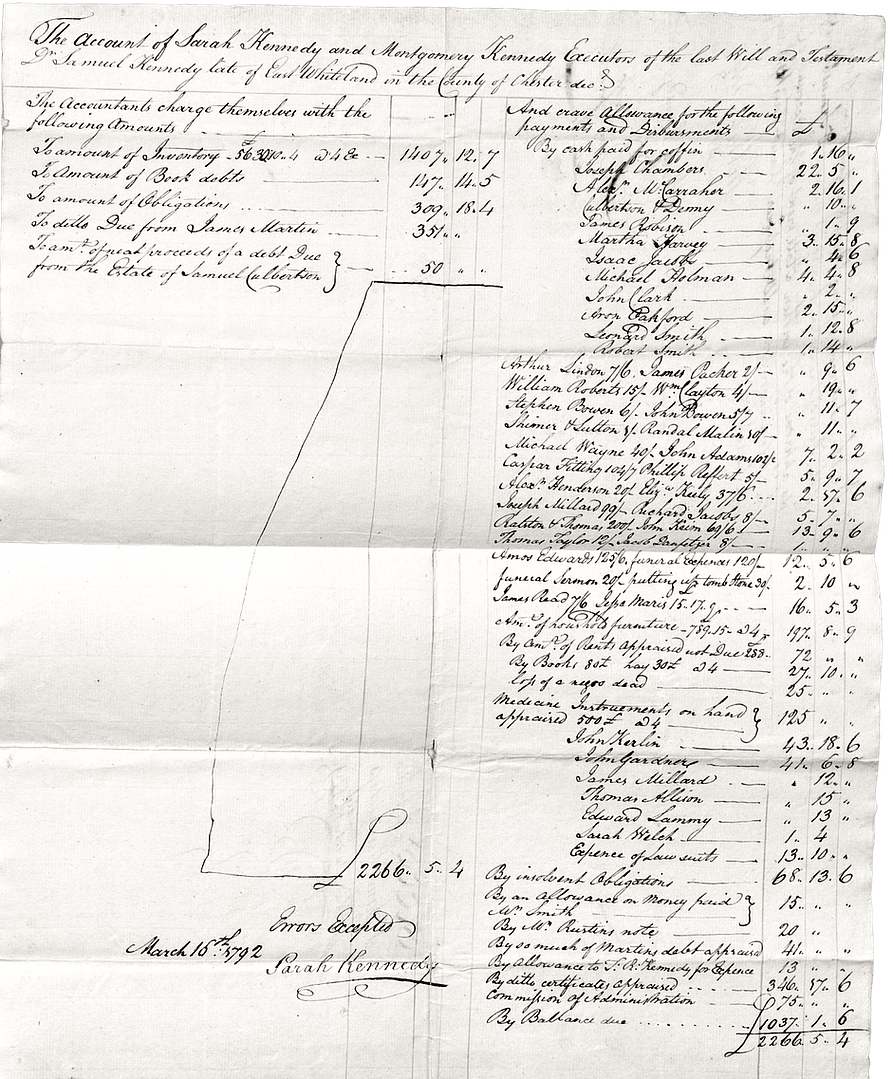
Despite the bad blood that seems to have grew between Sarah Kennedy and Samuel Culbertson in 1781, it seems that the widow Kennedy still wanted to ensure that their obligations to the Culbertson family had been included in the dues they had to pay. Perhaps this was a show of goodwill to Culbertson’s memory, or an attempt to compensate for the damage their public spat had caused. We cannot know for certain, but we can determine that when adjusting for inflation and converting from pounds to USD, that £50 would be worth around $13,000. This was not a small sum for the time, and likely helped Culbertson’s heirs become established following the death of their father.
Margaret Culbertson survived her husband by nearly three decades. She died in West Nantmeal Township, Chester County, in 1811. Her will referenced both of her children, Elizabeth Van Leer and James Culbertson.
Legacy
Samuel Culbertson’s descendants continued to connect the family to prominent Pennsylvania families.
His daughter Elizabeth married Isaac Van Leer, a member of the influential Van Leer family. The Van Leers were a prominent German family that settled in Pennsylvania during the seventeenth century and built their fortune through the iron industry.
Through this marriage, the Culbertson family became connected with another important colonial Pennsylvania family. Isaac Van Leer was also the nephew of Hannah Wayne, making him related by marriage to General “Mad” Anthony Wayne.
Further research ongoing!
See our reconstruction of Samuel Culbertson’s family tree on Ancestry.com here!
Bibliography
Van Leer Archives. “Culbertsons Affiliated Family.” Van Leer Archives. Accessed July 21, 2026. https://vanleerarchives.org/culbertsons-affiliated-family/.
Van Leer Plus. “The Culbertson Will.” Van Leer Plus. Accessed July 21, 2026. https://www.vanleerplus.org/culbertsonwill.htm.
Historic Yellow Springs. “Samuel Culbertson Family Tree Research.” Ancestry.com Family Tree. Research database compiled by Historic Yellow Springs. Accessed July 21, 2026. https://www.ancestry.com/family-tree/person/tree/209292173/person/152762067949/facts.
Poulson’s American Daily Advertiser. Sarah Kennedy’s advertisement seeking tenants and Samuel Culbertson’s published response. Ca. 1781. Accessed August 6, 2026. https://www.newspapers.com/article/poulsons-american-daily-advertiser/127964252/.
Copyright Disclaimer: Under Section 107 of the Copyright Act 1976, allowance is made for ‘fair use’ for purposes such as criticism, comment, news reporting, teaching, scholarship, and research. All materials sourced from sources indicated throughout this post are referenced for the purposes of education for reference purposes.