
Biography of Sarah Ruston Kennedy
- Early Life: The Ruston Family (1737â1762)
- Marriage to Samuel Kennedy (1763)
- Married Life in Whiteland (1763â1771)
- The Kennedy Household Before the Revolution (1771â1775)
- Revolution Comes to Chester County (1775â1777)
- To Yellow Springs and Washington Hall (1777â1778)
- Widowhood and the Kennedy Estate (1778â1792)
- Passing the Estate to Her Children (1792â1815)
- Legacy
- Posts Featuring Sarah
- The Will and Estate of Dr. Samuel Kennedy
- Making History- Winter at Washington Hall
- Letter for Prisoner Exchange from Sarah Kennedy
- Making History- Faces from The Revolution in Chester County
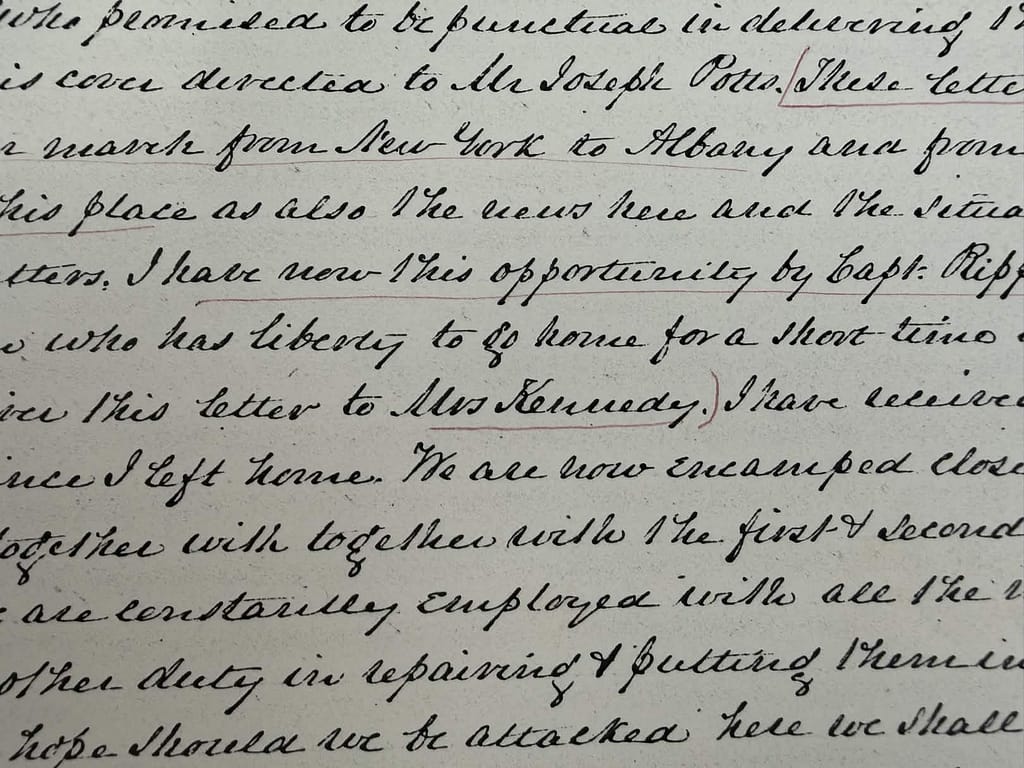
- Letters of Persifor Frazer
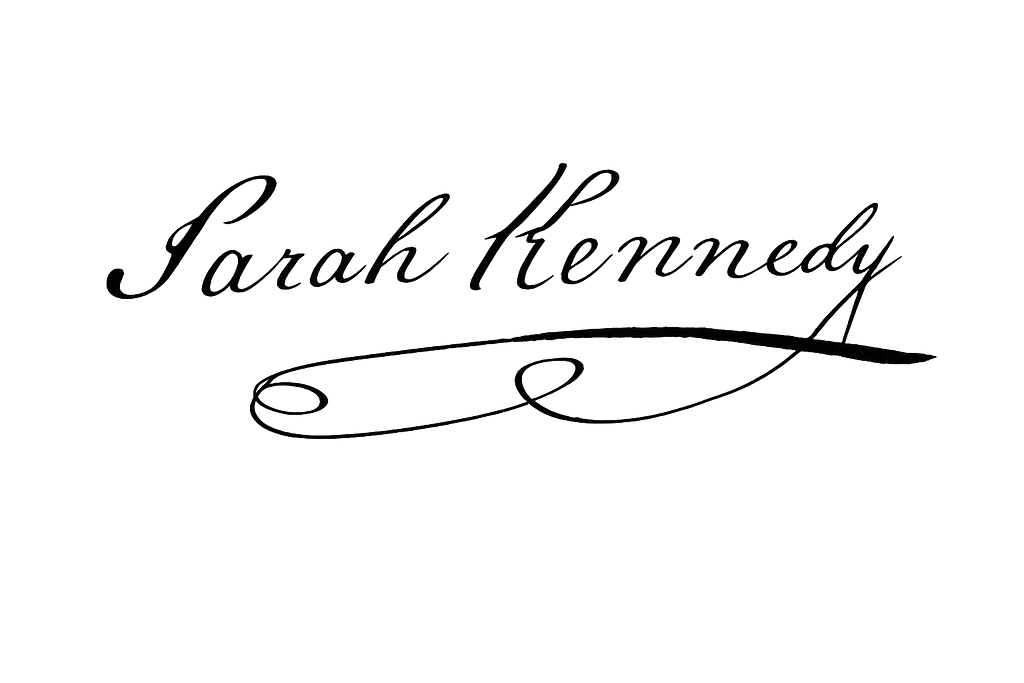
Sarah Ruston Kennedy lived among some of the most important and influential people during the Revolution in Chester County. She was born into the Ruston family and later married into the Kennedy family, and was reportedly friends with Polly and Persifor Frazier, and is recorded to have socialized with George and Martha Washington themselves. Her life connected landownership, Colonial planter-class elite social life, military service, and household responsibilities.
During the American Revolution, she helped steward her family’s estate. Yellow Springs changed from a health resort into a Continental Army hospital during this period. Sarah’s story shows how women faced war, property concerns, and family responsibilities during times of crisis. She never served as a soldier, but she experienced the effects of war in her daily life.
After British troops damaged the Kennedy family home near East Whiteland after the Battle of Brandywine, Sarah and her family moved to Yellow Springs. She lived beside Washington Hall while the Continental Army operated a hospital there. After her husband died in June 1778, Sarah managed her children, property, tenants, and requests for compensation. Her surviving records reveal a woman who protected her family’s interests during a period of uncertainty.
Sarah’s life also reflects the larger social world of eighteenth-century Pennsylvania. Her father, Job Ruston, was a respected Chester County landowner, church founder, and militia leader. His household also relied on enslaved labor, and Sarah grew up within that complex reality. Her story helps explain the people, systems, and experiences that shaped Yellow Springs.
Early Life: The Ruston Family (1737–1762)
Sarah Ruston was born in 1737 in Oxford Township, Chester County, Pennsylvania, into a family that had recently crossed the Atlantic and quickly taken root in the colony. Her father was Job Ruston, a landowner and community leader who emigrated from Berwick, England, and settled in Faggs Manor, Chester County, in 1738 on land purchased from Letitia Penn.
Before immigrating, Job Ruston had served as a burgess while in Wales. In Pennsylvania, he became a prominent local figure and established Faggs Manor Presbyterian Church in Londonderry Township, which served as a central religious institution for the Ruston family and their community.
Job Ruston’s public life combined religious leadership with military service. During the French and Indian War, he commanded a company raised from Chester County. That service gave him a place among the local men who helped defend the region during a major imperial conflict.
His household, however, rested on slave labor. Over the course of his life, Job Ruston is reported to have enslaved more than one hundred people. That fact is essential to understanding the Ruston family’s wealth and standing. Their landholdings, church leadership, and public influence existed within a system that depended on enslaved labor. Any account of Sarah’s family must include that reality, because it shaped the world she inherited.
Sarah was one of twelve recorded children born to Job Ruston and his first wife, Mary Ruston. Among Sarah’s siblings was Dr. Thomas Ruston, born in 1742, who later became a physician of international reputation. The Ruston children grew up in a household where education, land, reputation, and public service all mattered.
Although the surviving sources do not describe Sarah’s childhood in detail, the family context suggests a home where work and status were closely tied together. A daughter in such a household would have been expected to understand household management, family responsibility, and the expectations that came with belonging to a prominent local family. Sarah’s later ability to manage a wartime estate suggests that she had been formed in exactly that kind of environment.
Death, Remarriage, and Changing Household Ties
Sarah’s early adult years were marked by disruption. Her mother, Mary, died on June 19, 1757. Sarah was about twenty years old at the time. No surviving record describes how she responded to the loss, but the death of a mother in a large household would have altered family responsibilities and emotional life in serious ways.
The circumstances surrounding her father’s remarriage are complicated and do not survive in a fully clear form. Records indicate that in May 1757, shortly before Mary’s death, Job Ruston married Elizabeth Budd. Because Mary was still alive at the time, the timing raises certain questions about the nature of Mary’s death, but the evidence does not explain the full sequence. What survives is enough to show that Sarah’s household changed quickly and in a way that would have been difficult for any child or young adult to absorb.
Though Mary Baker Ruston’s physical tombstone has been lost to time, we have remaining records detailing what was once inscribed on it.
“Here Lieth the Body of Mary,
Wife of Job Ruston
Who Died the 19th of June, 1757.Aged 39 Years
She bore onto him 22 years twelve childrenThe dame that lieth underneath this tomb,
Had Rachel’s face, and Leah’s fruitful womb,
Abigail’s wisdom, Lydia’s open heart,
With Martha’s care, and Mary’s better part.”— Inscription on Mary Baker Ruston’s tombstone, recorded by Reverend W. B. Noble in 1876
Mary Baker Ruston’s tombstone compares her to Rachel, Leah, Abigail, Lydia, Martha, and Mary, creating a coded portrait rather than a simple list of virtues. To eighteenth-century readers, these women represented complete biblical narratives, not isolated qualities.
Together they portrayed Mary as beautiful, motherly, wise, hospitable, and spiritually devoted. However, some comparisons, particularly Rachel, Leah, and Abigail, may also subtly allude to complex family dynamics, difficult marriages, or circumstances surrounding her husband, Job Ruston- though these interpretations remain speculative because the inscription’s author is unknown.
Unlike Job’s later wives, Mary received an unusually elaborate epitaph, suggesting her death carried special significance for those who commemorated her. Although the original tombstone has since been lost, its inscription survived through an 1876 transcription by Reverend W. B. Noble, preserving a rare glimpse into how Mary was remembered by her community.
Whatever the truth is behind these implications, we know one thing for certain: the death of Mary Baker Ruston seems to have left a deep mark on her surviving children, Sarah especially.
Job Ruston’s Remarriage and Mary’s Legacy
Elizabeth Budd Ruston became Sarah’s stepmother and later gave birth to a daughter, Elizabeth Ruston, on September 16, 1758. That child became Sarah’s half-sister. The surviving evidence does not tell us Sarah’s personal feelings about these changes. It does, however, show that family life in the Ruston household was marked not only by prominence but also by loss, remarriage, and shifting obligations.
Later in life, Sarah named one of her daughters Mary Kennedy, which may suggest a lasting memory of her mother, though that connection remains interpretive rather than certain.
Marriage to Samuel Kennedy (1763)
Sarah Ruston married Samuel Kennedy in 1763. She was about twenty-six years old at the time, an age that was later than many colonial women (especially women of lower social standing) typically married. Her marriage likely reflected the choices available to a woman of her family’s position in the planter-class elite of the colonial era. As the daughter of a wealthy and influential Chester County landowner, Sarah had greater freedom to wait for a marriage that suited her rather than entering into the first practical arrangement available.
The surviving records do not describe the beginning of Sarah and Samuel’s relationship, but their connection likely developed through the church in Londonderry Township. Both families belonged to the same congregation, and the church served as one of the primary places where prominent families in the region interacted. Unlike many colonial marriages that were strongly shaped by economic or family arrangements, Sarah and Samuel’s relationship appears to have grown from an existing social connection. To be a bit sentimental, it is probable that they were genuinely in love. While it is impossible to know the private emotions behind their courtship, the evidence suggests a relationship based on genuine connection rather than a marriage arranged solely to combine property or status.
As we mentioned above, Sarah’s mother, Mary Baker Ruston, died in 1757 after Job Ruston had already married his second wife under unusual circumstances. Mary’s tombstone provides enough information to estimate that she married Job when she was about seventeen years old. Since they had likely been married for twenty-two years when Mary died, Job would have been about twenty-one at the time of their marriage. Marriages between young couples like this were common in colonial Pennsylvania. Sarah, however, married at about twenty-six, while her husband was in his early thirties. This later marriage may have reflected both the complicated example set by her parents’ relationship and her family’s high social standing.
Sarah’s own marriage to Samuel appears to have offered a different model of family life, one built around companionship and personal partnership. Sarah and Samuel’s later correspondence and Sarah’s writings after his death suggest that their relationship was deeply meaningful to both of them. Sarah would describe Samuel as her “dear consort” and “best of husbands”, and Samuel would refer to Sarah as his “beloved wife” and “partner” almost every time he referenced her in his letters.
After their marriage, the couple settled in East Whiteland Township, where Samuel had purchased land in 1758. That property became the foundation of their household.
Married Life in Whiteland (1763–1771)
In 1763, the same year as Sarah’s and Samuel’s marriage, Sarah gave birth to their first child, Thomas Ruston Kennedy, in Chester County. His name, in honor of Sarah’s brother Thomas, preserved the Ruston family connection and marked the beginning of the next generation. The next year, 1764, Sarah gave birth to another son, John Kennedy, in East Whiteland, and in 1766 she gave birth to twins in Chester County, a daughter named Sarah Kennedy and a son also named John Kennedy. In 1768, Sarah gave birth to Mary “Polly” Kennedy, and in late 1768 or 1769 she gave birth to Samuel Kennedy Jr. Throughout the early years of their marriage, Sarah and Samuel seemed to have been quite focused on laying the groundwork for their growing legacy.
The young couple’s new estate and their household quickly became intertwined with land and labor. The family had advertised the Whiteland plantation for sale in 1763, the same year Sarah and Samuel married, though they continued to maintain a presence there for some time. In 1765, Samuel advertised a missing or stolen horse from the Whiteland property.
In 1768, Samuel Kennedy advertised the estate’s tanyard to be let, demonstrating that their estate included more than farmland. The Kennedys were managing a working property with multiple sources of income, not a simple home farm. The tax records from 1768 for New London township confirm that the Kennedy family had a sizable estate, consisting of over 100 acres, horses and cows, and a servant who worked as a tavernkeeper.


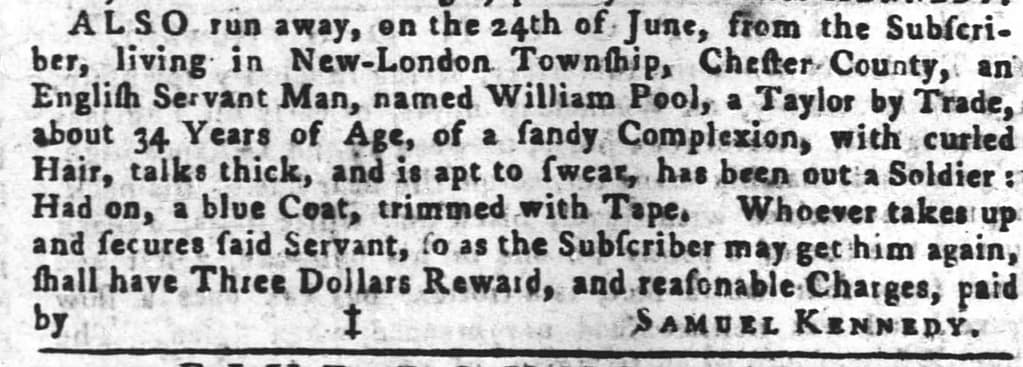
This Whiteland estate, however, also depended on enforced and enslaved laborers. Also in 1768, Samuel advertised for a runaway indentured servant named William Pool, a tailor from England. Pool had run away from the Whiteland plantation on the 24th of June, and by July 7th of that year, he had not returned. In response, Samuel published an advertisement in the newspaper The Pennsylvania Gazette, advertising a $3 reward for his return. In 1768 Pennsylvania, “three dollars” referred to three Spanish milled dollars (silver ‘pieces of eight’), which is equivalent to between $150 and $250 in today’s money. This willingness to pay a substantial amount to ensure Pool’s retrieval demonstrates that the Kennedy household, like many wealthy households of the era, had a significant reliance on the labor of uncompensated servants.
That same pattern of forced labor dependence continued with the Kennedy family into the next decade.
The establishment of the Kennedy estate also linked Sarah to her father in a very direct way. In 1766, Samuel purchased land from Job Ruston for £20. This sale joined the Ruston and Kennedy families not only through marriage but also through property and debt. The surviving evidence later suggests that Samuel may not have fully paid the amount owed. After Job’s death in 1785, Sarah discovered papers showing that Samuel had not “wholly paid,” which means the land sale continued to matter long after the original transaction. That unfinished business may suggest that behind the scenes, relations between Job Ruston, his daughter, and his son-in-law were not as amicable as they may otherwise have appeared.
Additionally, Sarah’s relationship with her father and his family may have been strained due to interpersonal reasons as well. Elizabeth Budd Ruston, Sarah’s first stepmother, died in 1769, after Sarah had already been married for several years and was raising children of her own. In 1770, Job Ruston married Edith Claypoole, who, like Job, had been married twice before. By then, Sarah had already built her own household, but her father’s decisions continued to affect her nonetheless.
Sarah’s brother Thomas Ruston remained an important presence in her life during these years. Born in 1742, he received an education that reflected the Ruston family’s standing. He attended Nottingham Academy, then the College of New Jersey, where he graduated in 1762. He afterward studied medicine with the British Army in Philadelphia, sailed to England, and completed his medical training at the University of Edinburgh in 1765. He became, according to later accounts, one of the first Americans to earn a medical degree there. He later served as head surgeon at Devon and Exeter Hospital in England. He is also recorded as having been a close friend of renowned Philadelphian inventor and future founding father, Benjamin Franklin.
Thomas’s life in Europe created distance between the siblings, but the evidence suggests that they remained in contact and that Sarah valued his judgment. In December 1771, Samuel wrote to Thomas about his purchase of Yellow Springs. He told Thomas that he had fulfilled his request by buying the property, which he described as “the principle bath in North America.” Yellow Springs included about 160 acres and contained a resort, houses, barns, a tavern, a hotel, a mill, and a blacksmith shop. Samuel did not yet intend for the family to live there, but the purchase would soon reshape their lives. Thomas is recorded as having supported the decision, and with that input, the Kennedy family would make the purchase.
The Kennedy Household Before the Revolution (1771–1775)
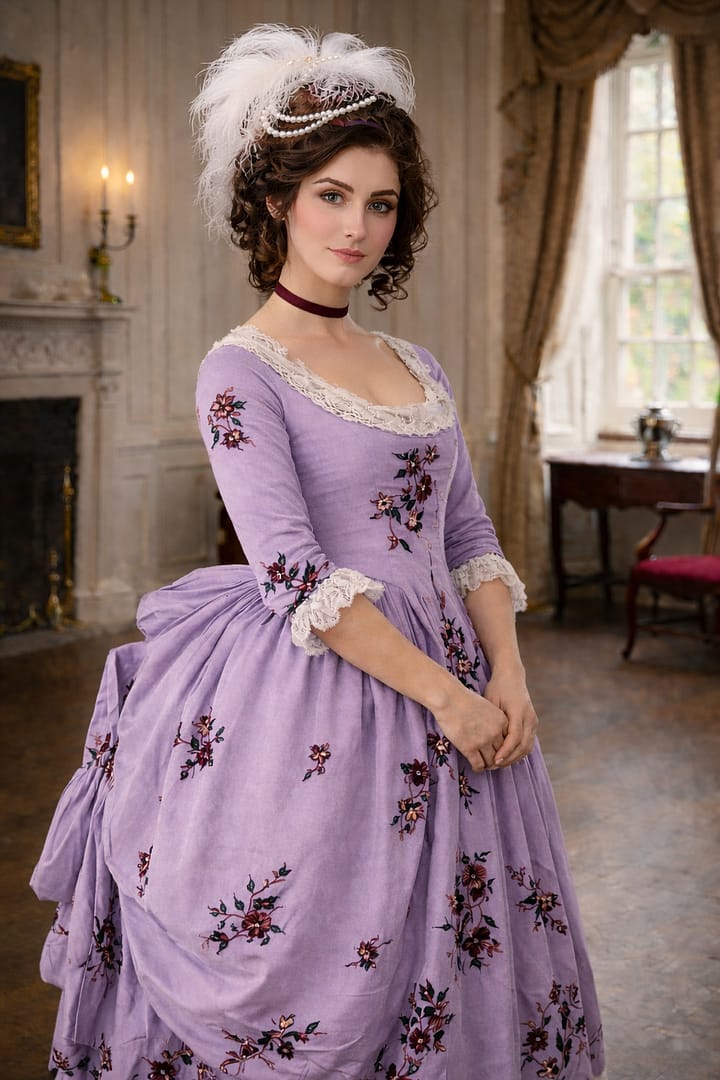
By the early 1770s, Samuel and Sarah Kennedy had established themselves among the more prosperous families of Chester County. Tax records from 1772 show that Samuel owned approximately 200 acres of land together with buildings, livestock, and a tavern. Although the family had acquired some portion of Yellow Springs the previous year, they continued to manage both the East Whiteland estate and the Yellow Springs property simultaneously. In 1771, Samuel advertised the Whiteland plantation to be let, and in 1772 he similarly advertised Yellow Springs for rent (along with John Bayly, a silversmith from Philadelphia that had previously owned the Yellow Springs property).
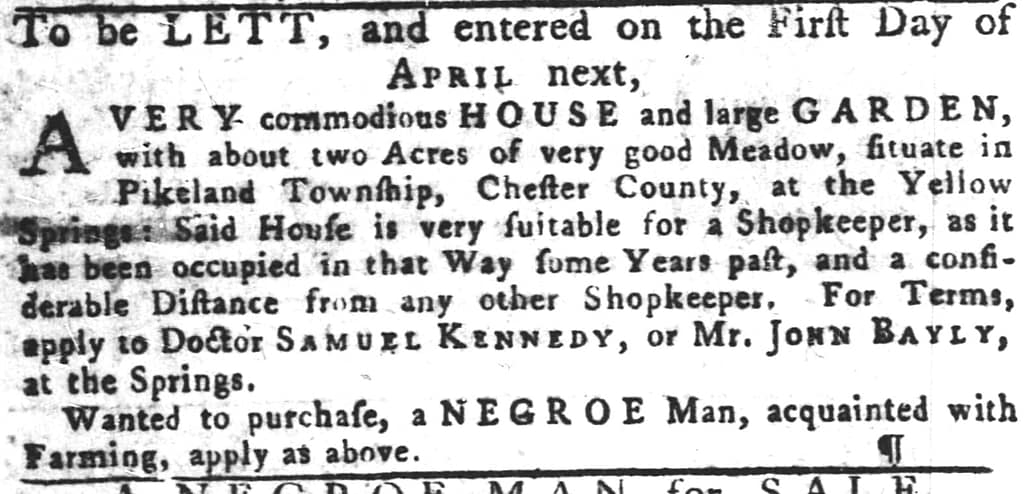
Notably, Samuel is also advertising that he would like to purchase an enslaved man that was familiar with farming, indicating that he sought to continue to operate the property as a plantation even in his absence. Rather than immediately relocating, the Kennedys appear to have viewed both properties as investments capable of generating income while they determined the future of their growing estate.
Despite this financial success, the early 1770s also brought heartbreaking tragedy for the Kennedy family. On December 2, 1772, Sarah and Samuel’s eight-year-old son, John Kennedy, died at their East Whiteland home. Only a year later, in 1773, they lost another son when Samuel Kennedy Jr., then about four or five years old, also died. No causes of death are recorded for these children, but their losses left Thomas Ruston Kennedy, John Kennedy (later known as Judge Kennedy), Sarah Kennedy, and Mary Kennedy as the couple’s only surviving children.
No surviving letters describe Sarah’s grief during these years, but the deaths of two young children in such close succession undoubtedly changed the household. Childhood mortality remained a common reality in eighteenth-century Pennsylvania, even among wealthy families with access to physicians.
Even as the family endured these losses, the Kennedy estate continued to expand.
By 1774, Samuel had became a slaveholder to at least two enslaved people, a man and a woman. Later records strongly suggest that the woman was Rina, who would play a pivotal role during the British occupation by helping save the Kennedy home from destruction and was present at Washington Hall. Rina also is likely to have first been enslaved to Job Ruston, and may have joined the Kennedy family when Sarah and Samuel were married- though this is not directly supported by documentation. The identity of the enslaved man is less certain, though he may have been Prime, who likewise appears in records associated with the Kennedy family.
Back in 1772, an enslaved man named Prime, enslaved to the Kennedy household, was charged with stealing one pair of gold sleeve buttons from Mr. Richard Richison. He is found guilty and punished by whipping, and the Kennedy estate was responsible for paying back the cost of the stolen buttons to Mr. Richison. It is likely this man was the same man who was accounted for when the Kennedy family was reported as owning at least two slaves, though because of the nature of slavery at this time, tracking him further is rather difficult.

Whatever their identities, these purchases demonstrate that the Kennedy family’s prosperity depended not only upon landownership and business ventures, but also upon the institution of slavery. Despicably, though commonly, like many affluent Pennsylvania households, the Kennedys relied upon both indentured and enslaved labor to operate their expanding estates.
By the eve of the American Revolution, Sarah had become an experienced manager of a large and increasingly complicated household. She had given birth to six children, endured the deaths of two sons, overseen servants and enslaved laborers, and helped maintain multiple properties while Samuel expanded the family’s business interests. Without realizing it, these years had prepared her for responsibilities far greater than those expected of most eighteenth-century women. Within only a few years, war would destroy the stability the Kennedys had spent more than a decade building, forcing Sarah to rely upon the resilience and experience she had developed long before the first British soldiers reached Chester County.
Revolution Comes to Chester County (1775–1777)
By 1775, tensions between Great Britain and the American colonies had transformed political disagreements into a growing crisis. Across Pennsylvania, families who had spent generations building farms, businesses, and communities now faced the possibility that war would reach their own homes.
For Sarah Ruston Kennedy, the Revolution did not begin as an abstract political conflict. It quickly became a personal struggle that separated her from her husband, threatened her family’s security, and forced her to take on responsibilities usually shared within a household.
When Dr. Samuel Kennedy volunteered his medical services to the revolutionary cause, Sarah remained responsible for managing their family and property in Chester County. Samuel wrote to the Continental Congress offering to serve as a military physician, requesting that he be appointed “Surgeon to one of the Battalions” being raised for service. The request was accepted, and he became a surgeon in Pennsylvania’s Fourth Battalion. His decision placed the Kennedy family directly within the American war effort.
Samuel’s absence created a difficult situation for Sarah. She was left to manage the household, oversee agricultural work, and care for their four surviving children while Samuel served with the army. Although the Kennedy household included enslaved laborers who assisted with daily work, Sarah still carried the responsibility of directing the estate and ensuring that the family remained financially stable. Samuel recognized the burden she carried. In a letter written in September 1776, he acknowledged that Sarah labored under “such a load of fatigue [and] anxiety” and expressed his hope that she would receive “divine aid” through the difficulties she faced.
The separation weighed heavily on both of them. In June 1776, Samuel wrote to Sarah from New York while stationed with American forces near Long Island. In August, he wrote again from Ticonderoga. His letters revealed his desire to return home, describing his separation from his family as “intolerable” and admitting that he felt “almost ready to resign.” Sarah later remembered that Samuel served under General Horatio Gates as a surgeon during the campaign to Canada, enduring the hardships of military service in harsh conditions.
Although Samuel was away for much of the conflict, he did return to Chester County at times. In June 1776, family friend Mary Worrall “Polly” Frazer recalled that he rode “100 miles in the heat of [summer] to see his wife.” He and General Persifor Frazer also returned home together in December 1776. These brief visits provided moments of reunion, but they could not restore the stability the family had known before the war.
The arrival of British forces in Pennsylvania brought the conflict directly to Sarah’s doorstep. After the Battle of Brandywine in September 1777, British troops moved throughout Chester County, destroying property and taking supplies from local residents. Because Samuel had openly supported the American cause, the Kennedy family faced particular danger. Sarah later recalled that Samuel had joined American light horse troops as a scout because General George Washington requested his knowledge of the local landscape. His involvement with the American military made the family a target.
On September 15, 1777, British troops arrived at the Kennedy property in East Whiteland while Sarah and her children were still at home. In a later letter to her brother Thomas Ruston, Sarah described the destruction that followed. The soldiers left their home “in ruins,” consumed the fences, and scattered their grain. She wrote that they broke the windows, removed furniture, and burned possessions that they carried outside. Sarah and her children fled, leaving behind livestock, crops, furniture, and household goods.
Sarah credited Rina, her lady’s maid, with saving the family home from complete destruction. She later wrote that “had it not been for our Negro wench* Rina … the house would have been consumed.” British soldiers had heard of Samuel’s service and told Rina that they knew of “her rebel master in Canada” and would punish him if they captured him. Rina’s actions preserved the Kennedy family’s safety, even as the family lost much of what they owned.
*(Note here that ‘wench’ in this context means something closer to domestic servant or lady’s maid, not how it is used today)
The destruction was extensive. When Sarah later submitted a claim for British damages, she listed the loss of livestock, grain, household furniture, medical supplies, clothing, tools, and other property. The claim, at the time, totaled £273.7.6. Today, in USD, this would be roughly $77,273 in damages. Among the losses were seven milk cows, six young cattle, horses, sheep, swine, hundreds of bushels of grain, beds and bedding, china, kitchen equipment, window glass, and 2,000 fence rails. The claim demonstrated that the British occupation damaged not only the Kennedy family’s comfort but also their ability to generate income.
With their East Whiteland home damaged beyond immediate repair, Sarah took her children to her father Job Ruston’s home in Oxford Township. The move offered some protection because British destruction had not reached the area as severely. However, Sarah later remembered that this period brought its own difficulties. She wrote to her brother Thomas that she and her children endured the “ill treatment of a drunken stepmother,” whom she described as “one of the worst of women.” Seemingly fed up with the arrangement after approximately three weeks, Sarah returned with her children and servants to her damaged home.
When she came back to East Whiteland, she found a property transformed by war. Livestock, food supplies, furniture, and household possessions were gone or destroyed. The surrounding countryside had suffered similar losses. Many Chester County families faced the same reality as armies moved through the region, turning farms and homes into places of military occupation and supply.
The destruction of their home forced the Kennedys to reconsider their connection to Yellow Springs. Samuel returned to Chester County with sick soldiers and began working at the Continental Army hospital complex that had developed there after the Battle of Brandywine. Rather than remain at their damaged East Whiteland property, Sarah and her children moved to Yellow Springs as well, where they would live alongside the growing general hospital that would become known as Washington Hall.
To Yellow Springs and Washington Hall (1777–1778)
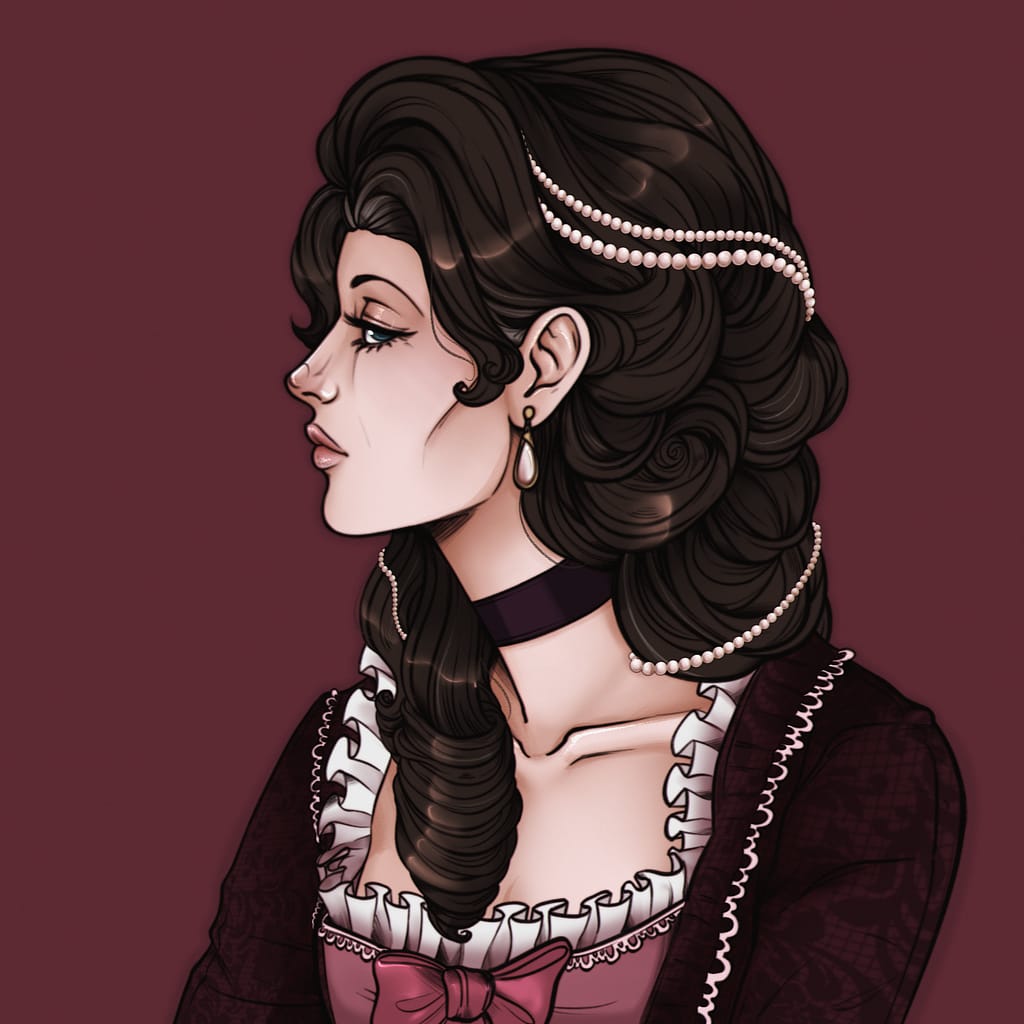
After Samuel Kennedy’s return from Canada and New York, his work continued to follow the needs of the Continental medical department. He was stationed at the hospital at Lititz before receiving authorization to return to Yellow Springs. His return brought him into the developing network of military hospitals that supported the Continental Army after the campaign in southeastern Pennsylvania.
The hospital system faced an urgent need for additional space after the Battle of Brandywine. Yellow Springs offered a practical location. The property already belonged to the Kennedys, and its springs had made it a known health resort. As early as 1776, a Hessian soldier had noted that several barns on the property were being used as “rebel hospitals” already. General Washington had stopped at the tavern on the property and used it as his headquarters during the Battle of the Clouds, so the property was known to him. More importantly, its distance from the immediate fighting made it suitable for soldiers who required care away from the battlefield. Samuel offered Yellow Springs for use by the Continental Army, and the hospital there began operating as a place for sick and injured soldiers.
The government had considered Yellow Springs for military purposes before the hospital building was constructed. The Continental Congress had apparently shown interest in the property as early as July 1777. Congress sought the “title to the ground” so that it could “be retained for public use.” Samuel did not make an official agreement transferring the property to Congress. Instead, the army’s use of Yellow Springs rested upon his permission.
The hospital initially operated without the large building that would later define the site. As winter approached, however, the Continental Army needed a more substantial facility. In early January 1778, General George Washington approved the construction of a new hospital building at Yellow Springs, partially due to the dire situation at Valley Forge. The resulting three-story structure constructed to serve these soldiers became Washington Hall. Sarah later remembered the building for its “broad porches” and its “kitchen and bathing facilities.”
The construction of Washington Hall transformed Yellow Springs into more than a temporary place of refuge for sick soldiers. The hospital became a significant military institution on privately owned land. Not only a large general hospital, it also became the main depot for medical supplies and the headquarters for the Hospital Department. Samuel remained responsible for the medical care of the soldiers there, while the Kennedy family lived alongside the hospital and the people who operated it. Sarah would have been responsible for maintaining their personal estate, but she also would have been hospital for entertaining and hosting the influential men from the Continental army and the Hospital Department that came to discuss business there.
Notable revolutionaries such as George Washington and Alexander Hamilton were known to stop by Yellow Springs, and as the lady of the estate, Sarah would have been responsible for receiving them with the kind of treatment that members of the planter-class expected in colonial America, even as the war was actively raging.
The hospital expanded quickly. By June 1778, Samuel was the chief surgeon, and he cared for “300 sick” soldiers and directed the “second surgeons and Mates under him.” The scale of his responsibilities illustrates how quickly Yellow Springs developed from a place receiving sick soldiers into a substantial Continental hospital.
Historian Richard Blanco later characterized the hospital complex at Yellow Springs as a comparatively “healthy place.” Nearly a year after the hospital’s first use, approximately 1,300 patients had been treated there. Of those, 445 had been discharged, 124 had died, and 725 remained under care.
The hospital also connected Yellow Springs to a wider network of people serving the Continental cause. Sarah’s notes place her at Washington Hall during this period. She likely assumed extensive responsibilities within the household while the hospital operated around her. She also wrote to Dr. Jonathan Potts at Pottsgrove Manor requesting supplies. The surviving notes suggest that the Kennedy and Potts families may have had an earlier connection, although the evidence does not establish the nature of that relationship. Sarah and Samuel also hosted Reverend James Sproat during his early visits to Yellow Springs.
It is noted that Sarah had connections with couples like the Frazers and the Washingtons, and the high social status of the Kennedy family was no doubt helpful when it came to attempting to call in favors. It is reported that Sarah went to visit with George and Martha Washington while they were staying at Valley Forge.
For Sarah, the hospital was therefore part of the household’s physical and social surroundings. The evidence does not provide enough information to reconstruct her daily activities at Washington Hall in detail. What survives does establish that she was there, that she communicated with people connected to the hospital’s supply network, and that she and Samuel received visitors associated with the Continental cause.
The first months of Washington Hall’s operation were also the last months of Samuel’s life. By April 1778, he was ill. His illness came while he was working closely with sick soldiers at Yellow Springs. He is remembered as having worked day and night in the wards, pushing himself beyond what would have been healthy for him. Unfortunately for Sarah and Samuel, that tireless effort took its toll.
Samuel’s condition became fatal. On June 14, while seriously ill at Yellow Springs, he appointed Sarah and his brother Montgomery Kennedy as executors of his will and estate. The document placed Sarah in a position of legal responsibility over the property and family that Samuel would soon leave behind.
Samuel died at Yellow Springs on June 17, 1778. Sarah later remembered his death as occurring after eight days of “putrid fever,” now generally understood as typhus. The surviving notes associate his illness with his work caring for sick soldiers at the hospital.
His death ended Samuel’s role in the hospital but not the Kennedy family’s connection to Washington Hall. Sarah inherited responsibility for an estate already occupied and altered by the Continental medical operation. Samuel had allowed the army to use Yellow Springs, but the property remained part of the family’s estate. Sarah was now responsible for maintaining that estate and supporting their four surviving children.
Widowhood and the Kennedy Estate (1778–1792)
After Samuel Kennedy’s death in June 1778, Sarah became responsible for an estate that had been profoundly altered by the war. Yellow Springs remained occupied by the Continental hospital, while the family’s East Whiteland property had suffered extensive British destruction. Samuel’s will left Sarah and their children dependent upon the income from his estate. As executor with Samuel’s brother Montgomery Kennedy, she now had to manage those properties while providing for her family.
The hospital complex created a difficult problem. Samuel had allowed the Continental Army to use Yellow Springs, but he had already leased the part of property containing the tavern itself to Samuel Culbertson for ten years. Culbertson paid £70 annually. The lease also included provisions governing additions to the property and financial penalties for breaking the agreement. The Revolutionary War and the activities of the hospital complex disrupted those arrangements while neither the Kennedys nor Culbertson surrendered their legal claims. Congress never formally purchased the property. However, Culbertson had been captured during the Revolution, and had not paid his rent since his capture and imprisonment by the British.
Sarah therefore petitioned Congress for compensation. She argued that the hospital’s presence had damaged the property and deprived her family of income. Her appeal emphasized that she and her four children were supposed to live from the profits of Samuel’s estate. She told Congress that she was “really [was] reduced to great difficulty in maintaining [her family]” even though Samuel had died possessed of a “handsome fortune.”
Additionally, on January 28, 1779, in the newspaper the Poulson’s American Daily Advertiser, Sarah and Montgomery Kennedy advertised that they were seeking tenants for a number of houses on the Yellow Springs property. Included in this advertisement is the tavern. It also indicates that the Kennedy family may have been living there during the more harsh periods of the war, and this is where Dr. Kennedy may have died.
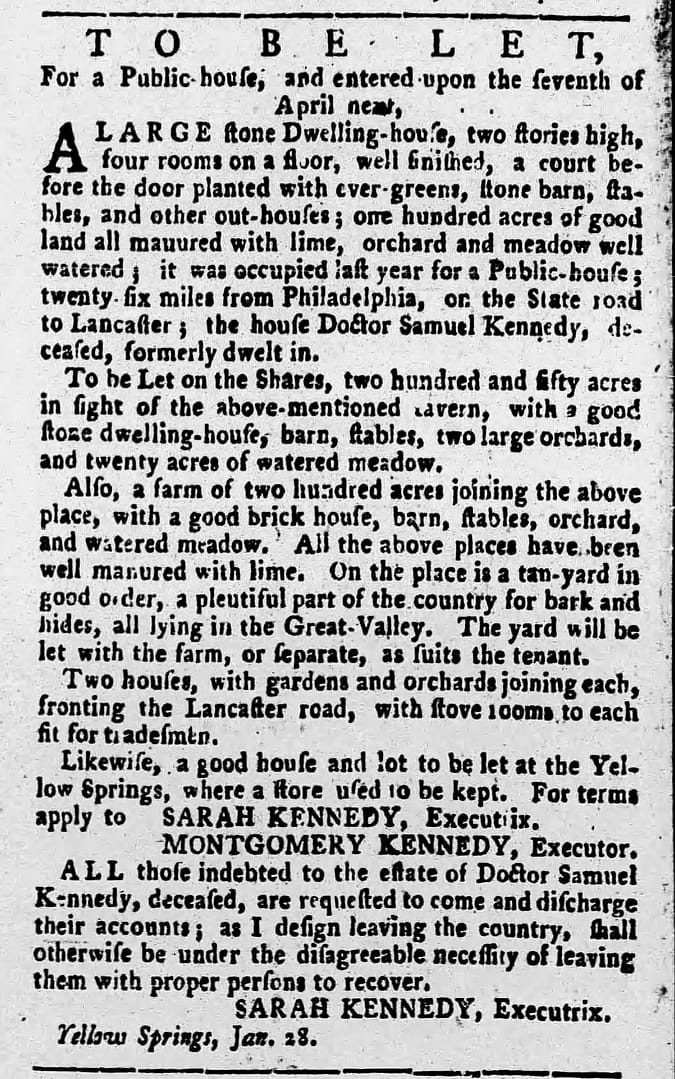
Sarah also wrote directly to John Jay, then president of Congress, on February 17, 1779. She described the hospital as causing “[daily] waste” while producing “no rent or profit” for the family. The Yellow Springs estate, she explained, was the “principal part” of what Samuel had left to support her and their children. She appealed to Congress as a widow whose husband had been “so warmly attached to the interest of America.” She asked for compensation for the damages already suffered or for rent in the future.
Congress eventually responded. In June 1779, it voted to pay Sarah $5,000 “on account of rent for the farm and buildings used for a hospital.” The payment gave her immediate financial support and allowed her to make repairs without selling the estate. The other properties that were supposed to provide income had themselves been damaged during the war. Sarah described them as having been “so ravaged” that their profits did not cover the necessary repairs. However, this sum was not enough to support the family.
It is worth noting a few things about this $5,000 sum. Simply accounting for inflation since 1779, that $5,000 would be roughly $136,850 today. However, this figure is misleading because the Revolutionary War featured extreme hyperinflation of Continental paper currency. The Continental Congress was printing paper money unbacked by gold or silver to pay for the war, causing a significant loss in faith regarding the value of the currency. By 1779, the Continental paper dollars were rapidly losing value against British pounds or physical coins (like Spanish milled dollars and gold escudos) made of real precious medals. By the early 1780s, it took between $40 to $100 (or more) paper dollars to match what a $1 coin would be worth. Because of this, and because we can assume Sarah and her family were paid by Congress with the money that Congress was printing, this $5,000 was worth only a tiny fraction of that amount in reality. In effect, this was nearly worthless to actually try to use.
On February 23, 1780, Sarah again posted an advertisement in the newspaper seeking tenants for the Red House (now known as the Main House) and two hundred acres- the entirety of the Yellow Springs property. It seems that the Red House was where the Kennedy family had been living during their time at Yellow Springs. However, it does not seem that this bid was successful for the Widow Kennedy.

Life at Yellow Springs
The hospital continued operating despite the financial problems surrounding it. In May 1780, Dr. Bodo Otto Sr., who had taken over as the chief surgeon at the hospital following Samuel’s death, reported that the hospital had “no money in the hands of the Commissary to purchase fresh provisions.” Assistant physicians had gone unpaid for seven months, while nurses and orderlies were refusing to continue without payment. Otto warned Congress that without relief, “the sick and wounded must unavoidably suffer.”
These problems affected Sarah because the hospital was also operating on her property. The institution consumed resources that might otherwise have supported the estate. Sarah had to protect the property’s usefulness while the hospital’s directors made decisions about its operation.
In January 1781, Congressman James Lovell visited Yellow Springs to investigate the hospital. Sarah intercepted him and explained her concerns. Lovell later described himself as an “intercessor” for the “not poor” but “very importunate Widow.” Sarah objected to the hospital’s sale of manure produced from the meadows. She believed the manure should remain on the estate to restore its productivity. Instead, hospital officials had arranged its sale for what she called the “pitiful sum” of £30. Lovell ultimately expressed sympathy for her position and argued that Congress should “lighten” the harm caused by the Army.
Despite her feelings about the hospital complex causing her financial and property damage, Sarah seems to have been on fairly good terms with most of her neighbors and the staff that supported Washington Hall.
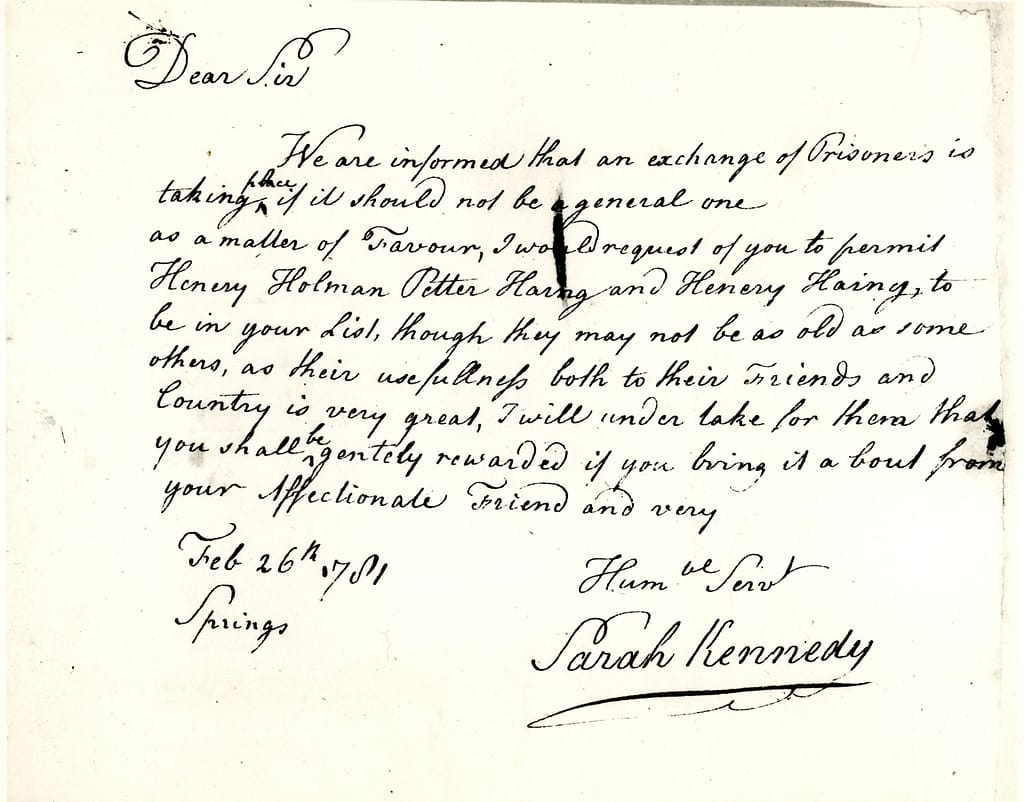
On February 26th, 1781, she wrote to Thomas Bradford, the commissary of prisoner exchange in Philadelphia, asking for assistance in regards to Henry Holman and Peter and Henry Hench, who had been taken prisoner on the Old Jersey prison ship by the British.
These young men were sons of some of the local families who had gone to great lengths to support and build Washington Hall, and coincided with a similar petition written by Dr. Bodo Otto Sr., also pleading for intervention from higher-ups that would result in the release of Henry and the Hench boys.
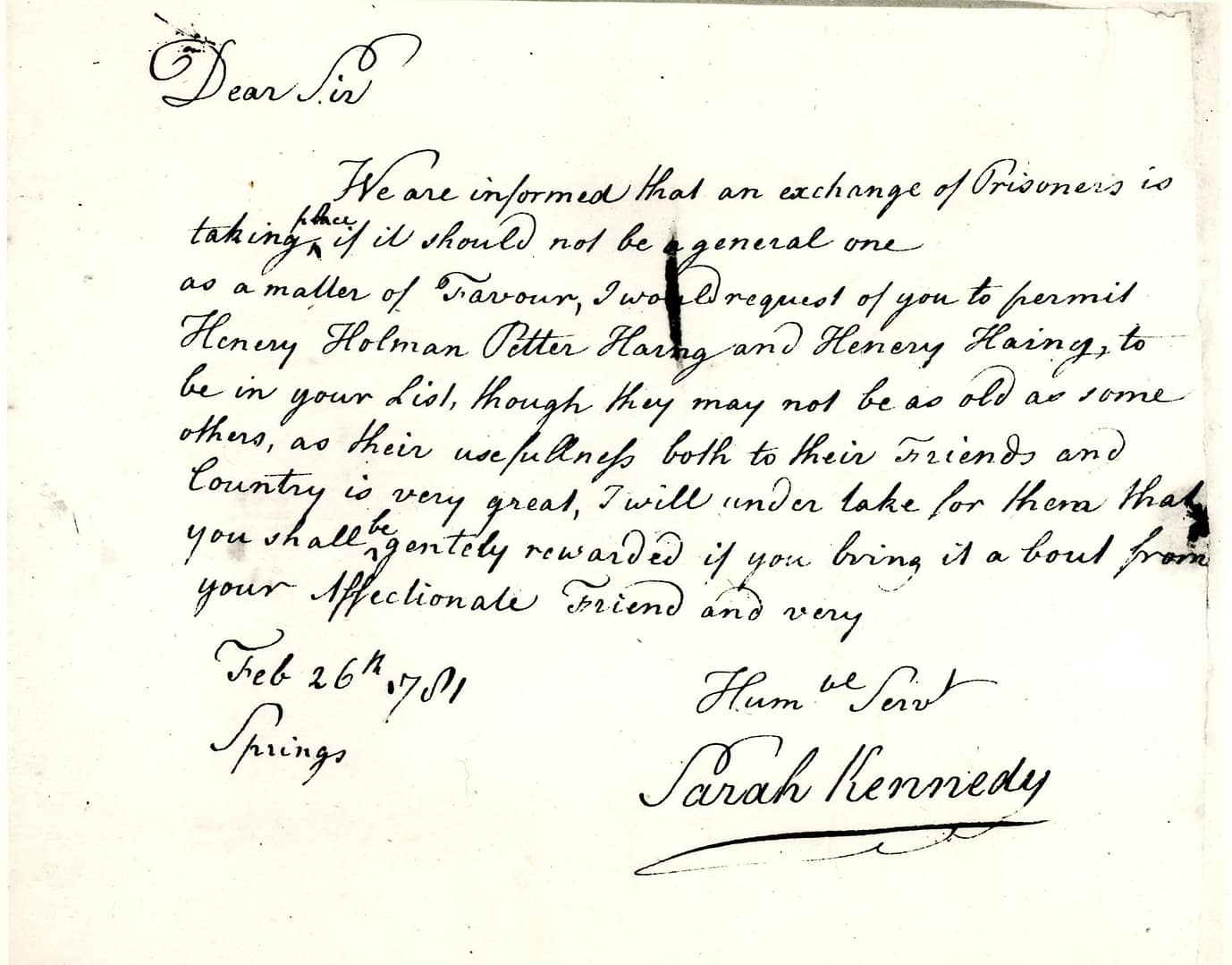
Unfortunately, neither appeal would be successful, and these three young men would die while in British prison ships.
Sarah also continued trying to make the property generate income. By June 1781, she advertised the “noted tavern and farm of Yellow Springs” for a new tenant. She sought someone of “sobriety” who could manage the tavern, which she said had “been badly kept.”

The advertisement provoked a public response from Samuel Culbertson. He still held the ten-year lease he had signed in 1774, which was not due to expire until April 1784. Culbertson claimed that Sarah had obtained the lease “in a base and clandestine manner” after Samuel Kennedy’s death and wrongly believed that she could take possession of the property.
The dispute reflected the competing interests created by the hospital. Culbertson had stopped paying rent due to his capture and imprisonment during the war and had returned to Yellow Springs a very sick man, but he still believed the terms of his lease protected him. Sarah, meanwhile, appears to have regarded his failure to pay and declining health as grounds for recovering the property. The hospital had disrupted the economic arrangements of both the widow and her tenant. Culbertson died a few months after their public dispute, ending the immediate conflict.
Congress voted to close the Yellow Springs hospital in September 1781. The closure did not end Sarah’s financial problems, but it removed the institution that had complicated the management of the property since the war. Sarah remained connected to Yellow Springs while she slowly rebuilt her household and estate.
A Widow’s Life After the War
The years after the hospital’s closure were marked by both economic recovery and personal loss. In 1783, Sarah wrote to her brother Thomas Ruston about her “rural bewidowed estate.” Her letter offers an unusually personal glimpse into her life five years after Samuel’s death. While known as being beautiful as her mother once was, Sarah seems to have considered herself in less-than-glowing terms after the death of her husband: she described herself as “going downhill,” with almost “half of her hair” gray and her eyesight “failing.”
While this could be a glimpse of her vanity, it could also be that Sarah felt herself losing the influence that her looks and station in life had once provided her. In her letter to her brother, she remarked that her principal pleasures were “little amusement but [her] books or [the] letters of [her] absent friends.”
She also continued to mourn Samuel. Sarah wrote of “bemoaning” the loss of her “dear consort,” whom she called the “best of husbands.” Her description reveals that widowhood remained an emotional reality as well as an economic one.
By 1784, Sarah had returned to her former residence in East Whiteland. She supported herself from the rents produced by the estate and planned to repair the property damaged during the war. She explained to Thomas that the land was “the legacy of … [her] youngest children.” The statement captures the central concern that had shaped her widowhood: preserving Samuel’s property for the next generation.
Sarah’s efforts had given her children greater stability by the end of the war. She had enough resources to send them to school, where she “endeavor[ed] to prepare them for serving their generation.” By 1785, her taxable property included 230 acres, two enslaved people, a bound servant, seven sheep, three horses, and two cattle.
The question of Yellow Springs, however, remained unresolved. In July 1787, Sarah’s eldest surviving son, Thomas Kennedy, had reached his majority and began petitioning on behalf of his inheritance. Like his mother, he emphasized Samuel’s patriotism, the damage caused by the hospital, and the conflict surrounding Culbertson’s lease. His concern was particularly focused on his education and inheritance, which depended upon income from the estate.
Thomas’s petition eventually succeeded in part. In February 1788, the Board of Treasury directed that he receive “Six hundred and thirty five Dollars, Eighteen Ninetieths of a Dollar” for Yellow Springs’s wartime use. The report also stated that Thomas was willing to enter an agreement to purchase the buildings erected on his father’s land during the war. The precise outcome of that arrangement is unclear in the surviving evidence.
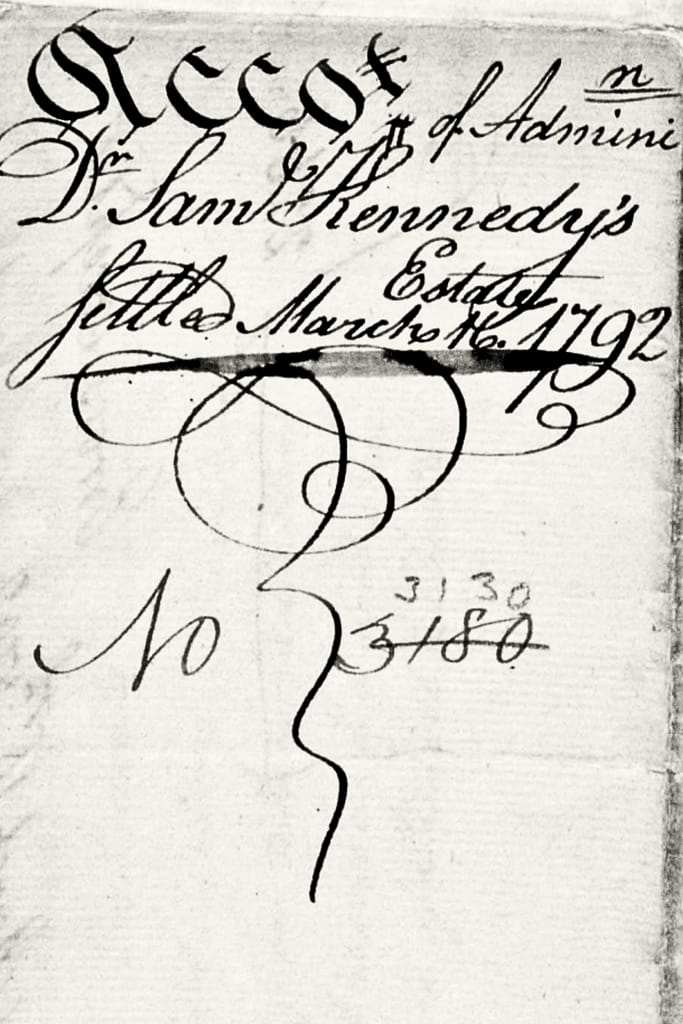
Sarah continued managing the estate with Thomas’s assistance. In 1792, she and Montgomery Kennedy formally settled Samuel’s will and estate. The settlement was signed on March 16.
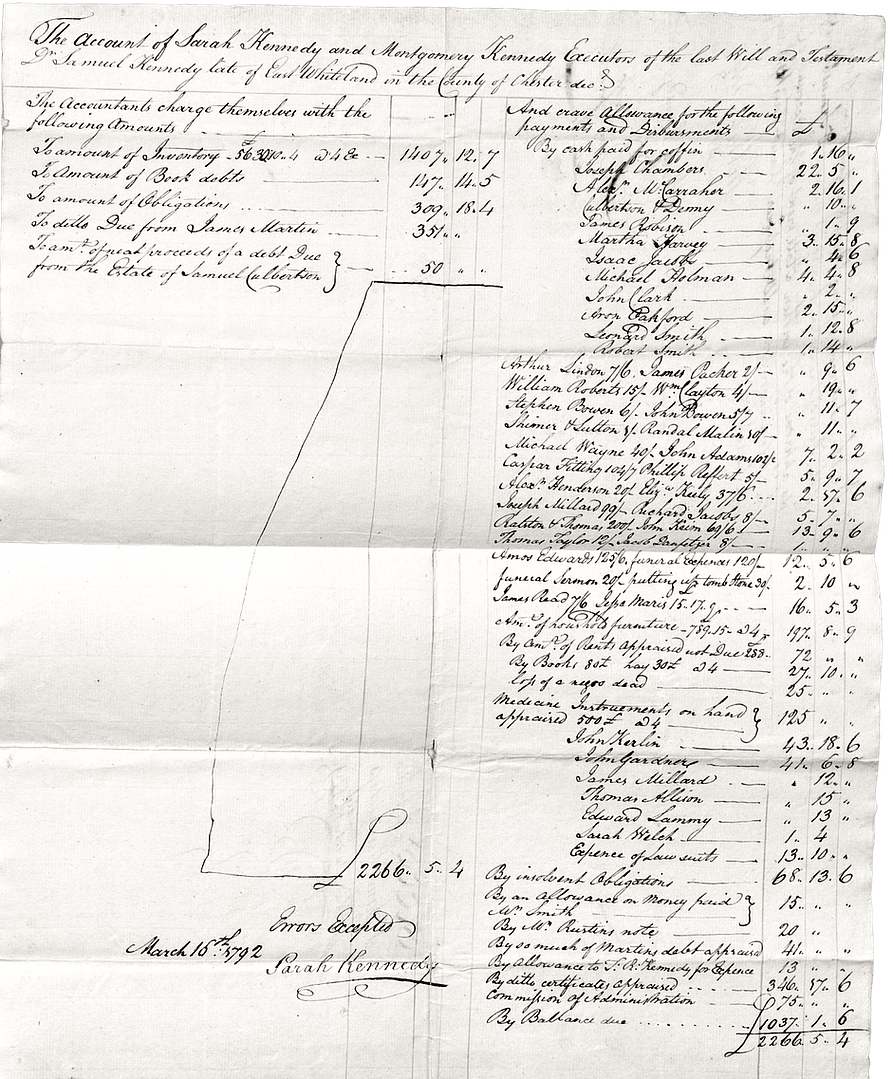
The following year, Sarah advertised for a tenant at Yellow Springs because Thomas, who had been living there, was preparing to move to his own property. She asked her brother to mention the tenancy to anyone “it might suit.” By this point, Sarah had spent nearly fifteen years managing the property after Samuel’s death.
Passing the Estate to Her Children (1792–1815)
By the mid-1790s, Sarah began transferring control of the estate to her sons. In 1795, she released sixty-four acres to Judge John Kennedy. He agreed to pay her £22.10.0 annually for the land during her lifetime. The following year, she made a similar arrangement with Thomas for an annual payment of £25. If either son failed to make the payments, Sarah retained the right to reclaim the land.
These agreements gave Sarah access to part of her children’s inheritance while providing her with continuing income. They also marked a change in her role. After years of managing Samuel’s estate, Sarah was transferring portions of the property to the next generation and securing financial support for herself.
At fifty-nine, Sarah left East Whiteland for West Chester, Pennsylvania. The move marked a significant transition. Her children increasingly assumed responsibility for the estate that she had managed since their father’s death.
Her later years were complicated by the financial troubles of her family. In 1785, her brother Thomas Ruston returned to Pennsylvania with his family. This occurred after the death of their father, Job Ruston, in the same year. Thomas Ruston soon became involved in speculation, debt, and bankruptcy. Sarah and her children became entangled in the consequences of her brother’s actions. Her son John spent six weeks in jail because of Thomas Ruston’s property dealings. Sarah herself was threatened with imprisonment, and her son-in-law (it is unclear which daughters’ husband this was) paid her bail.
Over approximately fifteen years, Sarah faced the consequences of both her brother’s bankruptcy and a property suit brought against her by her son-in-law. The litigation cost her some of her land and the annuity payments that her sons had agreed to provide for her support. Her property and income were reduced while she was still attempting to disentangle herself from her brother’s financial affairs.
Even after the Revolution had ended, Sarah and her children continued to seek compensation connected to Samuel’s service and the military use of Yellow Springs. Thomas Ruston Kennedy petitioned for donation lands in 1796 on behalf of himself and his younger siblings, though the application did not succeed. Sarah also appears to have sought a pension, but the surviving evidence does not preserve the petition or its deliberation.
In February 1804, Sarah and Thomas Ruston Kennedy submitted another petition to Pennsylvania’s House of Representatives seeking donation lands for Samuel’s heirs. Legislators acknowledged that Samuel had been “employed in the public service” at the time of his death. They nevertheless noted uncertainty about his service because he had not continued as the actual surgeon of his former battalion until his death. The committee concluded that his service nevertheless warranted donation lands, but the measure failed in a vote that March.
After that unsuccessful petition, the Kennedy family disappeared from the records as active petitioners for several decades. In 1830, Sarah’s surviving son Judge John Kennedy returned to the issue by asking Pennsylvania’s Secretary of State, Samuel McKean, for copies of the family’s earlier petitions. By then, changes in pension law had created new possibilities for Revolutionary War claims. The surviving notes do not establish whether John’s effort ultimately succeeded.
Sarah’s family also experienced further losses. Her brother Thomas Ruston died in Philadelphia in 1811. Two years later, her eldest surviving son, Dr. Thomas Ruston Kennedy, died in Meadville, Pennsylvania, on March 24, 1813.
Sarah Ruston Kennedy died in 1815. The surviving records identify Charlestown as the place of death. She was seventy-seven or seventy-eight years old. She was buried in Phoenixville, Pennsylvania.
Legacy
Sarah Ruston Kennedy lived through a period that transformed nearly every part of her world. War destroyed her home, separated her family, and took her husband while he served the Continental cause. After Samuel’s death, Sarah faced the difficult work of rebuilding a life for herself and her children. She managed property, pursued compensation, and protected the inheritance that would support the next generation. Her letters reveal the emotional cost of that work as well. She wrote of loneliness, failing health, and the enduring grief of losing a husband with whom she seems to have shared genuine and enduring love. However, through it all, she continued to manage an estate shaped by the same war that had taken so much from her.
Sarah’s story offers a different way to understand the Revolution. Her experience was not defined by a battlefield or a political office, but by the long consequences of war inside a family and a home. At Yellow Springs, she lived beside a Continental hospital and watched her husband devote his final months to caring for sick soldiers. As a widow, she then spent decades dealing with the financial and personal consequences of that service. Her legacy is therefore found not only in her connection to Washington Hall, but in the persistence with which she rebuilt her life and protected her children’s future. Through Sarah, the history of Yellow Springs becomes more personal: it is also the story of a woman who endured the Revolution and then spent the rest of her life living with what it left behind.
Further research ongoing!
Read a more in-depth version of this biography here!
See our reconstruction of the Kennedy’s family tree on Ancestry.com here!
Posts Featuring Sarah

Bibliography
Blanco, Richard L. Physician of the American Revolution: Jonathan Potts. Routledge Library Editions: America–Revolution & Civil War. London: Routledge, 2020. Originally published New York: Garland STPM Press, 1979.
Chester County Archives. Early Court Dockets of Chester County. “Negro Trials” court record featuring Prime and Samuel Kennedy. Page 10. Accessed July 29, 2026. https://portal.laserfiche.com/Portal/DocView.aspx?id=771180&repo=r-24f48cc6.
Chester County Archives. 18th Century Tax Records. New London Township Tax Records, 1768. Accessed July 29, 2026. https://www.chesco.org/1729/18th-Century-Tax-Records.
Coxe Family Papers. “Sarah Kennedy to Thomas Ruston, August 22, 1783.” Series 6a, Thomas Ruston Correspondence and General Papers, Box 184, Folder 2. Historical Society of Pennsylvania, Philadelphia.
Historic Yellow Springs. “Kennedy Family Tree Research.” Ancestry.com Family Tree. Research database compiled by Historic Yellow Springs. Accessed July 29, 2026. https://www.ancestry.com/family-tree/person/tree/207270264/person/182714257066/facts.
Kaszubowski, Camille A. “Chester County, Pennsylvania British Depredation Claims.” Table 1.2 in “Left in Distress”: Women on Their Own in Revolutionary Pennsylvania. PhD diss., University of Delaware, 2022.
Kaszubowski, Camille A. “Left in Distress”: Women on Their Own in Revolutionary Pennsylvania. PhD diss., University of Delaware, 2022.
Kennedy, Sarah. “British Depredations of the Revolutionary War: Dr. Samuel Kennedy.” British depredation claim. Microfilm, frame 220. Chester County Archives, West Chester, PA.
Lovell, James. “James Lovell to Timothy Pickering, January 8, 1781.” In Letters of Delegates to Congress, 1774–1789, vol. 12, 571–72. Washington, DC: Library of Congress, 1978–2000.
Noble, W. B. History of the Presbyterian Church of Fagg’s Manor, Chester Co., Pa., 1730-1876: A Discourse Delivered July 2, 1876. Parkesburg, PA: A. H. Potts & Co., Book and Job Printers, 1876. Page 21. Digitized by Ancestry.com. Accessed July 29, 2026.. https://www.ancestry.com/imageviewer/collections/10718/images/dvm_LocHist000365-00011-1?ssrc=pt&usePUB=true&pId=19
Pennsylvania Gazette. Advertisement by Samuel Kennedy offering to lease Yellow Springs and seeking to purchase an enslaved man experienced in farming. Ca. 1772. Accessed July 29, 2026. https://www.newspapers.com/image/39393822/.
Pennsylvania Gazette. Advertisement by Samuel Kennedy concerning the escape of indentured servant William Pool. July 7, 1768. Accessed July 29, 2026. https://www.newspapers.com/image/39406416/.
Poulson’s American Daily Advertiser. Advertisement by Sarah Kennedy announcing the tavern and several buildings at Yellow Springs to be leased by tenants. Ca. 1779. Accessed July 29, 2026. https://www.newspapers.com/article/poulsons-american-daily-advertiser-to-b/197153984/.
Poulson’s American Daily Advertiser. Sarah Kennedy’s advertisement seeking tenants and Samuel Culbertson’s published response. Ca. 1781. Accessed August 6, 2026. https://www.newspapers.com/article/poulsons-american-daily-advertiser/127964252/.
Copyright Disclaimer: Under Section 107 of the Copyright Act 1976, allowance is made for ‘fair use’ for purposes such as criticism, comment, news reporting, teaching, scholarship, and research. All materials sourced from sources indicated throughout this post are referenced for the purposes of education for reference purposes.