
Biography of Reverend Dr. James Sproat
- A New England Heritage: The Sproat Family of Plymouth County, Massachusetts
- Early Life and the Loss of His Father (1722â1726)
- Education at Yale and the Beginning of Ministry (1741â1743)
- Building a Family and Serving the Presbyterian Church in Connecticut (1744â1765)
- Philadelphia Ministry and the Coming of Revolution (1765â1776)
- A Minister Called to Serve the Continental Hospitals (1778)
- Continuing Service at Yellow Springs and the Final Years of the Revolutionary War (1778â1780)
- Return to Philadelphia and Conclusion of Hospital Service (1780â1789)
- The Yellow Fever Epidemic of and the Death of Reverend James Sproat (1793)
- Legacy
- Posts Featuring Reverend Sproat
- Â Making History- Winter at Washington Hall
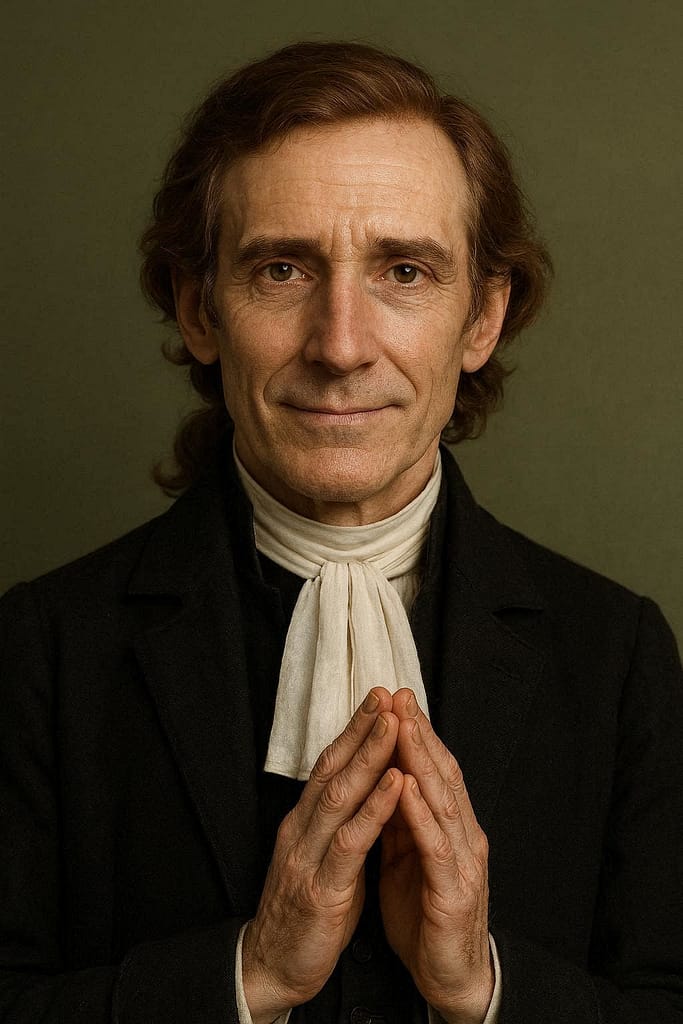
Reverend Dr. James Sproat was a Presbyterian minister whose life connected colonial New England’s religious traditions, the growth of American cities, and the challenges of the Revolutionary War. Born in Scituate, Massachusetts, in 1722, Sproat came from a family shaped by generations of religious devotion and colonial settlement. His ancestry traced back to some of Massachusetts’ earliest English families, including descendants of Mayflower passengers John Howland and Elizabeth Tilley. Through his education, ministry, and public service, Sproat became one of the most respected Presbyterian leaders of his time.
Sproat spent much of his life serving Presbyterian congregations, but the Revolutionary War expanded his role. In 1778, the Continental Congress appointed him Chaplain for the Hospitals in the Middle Department. This position placed him among the civilians who supported the Continental Army during the conflict. While physicians treated soldiers’ injuries and illnesses, Sproat cared for their spiritual needs. He visited hospital wards, preached sermons, prayed with patients, and comforted soldiers facing sickness and death.
Sproat’s wartime duties brought him to Yellow Springs in Chester County, Pennsylvania, many times. During the Revolution, Yellow Springs became home to one of the Continental Army’s largest hospital complexes. Washington Hall and nearby barn hospitals treated hundreds of sick and wounded soldiers. Sproat’s journal recorded the daily operations of the hospital and documented his interactions with physicians, patients, and hospital workers. His writings provide important details about Dr. Samuel Kennedy, the owner of Yellow Springs and chief physician, as well as Dr. Bodo Otto, the senior physician who directed medical care.
Sproat’s story extends beyond his connection to Yellow Springs. He represented the many eighteenth-century ministers who served as religious leaders, educators, community figures, and public servants. His Massachusetts upbringing shaped his faith, his education at Yale prepared him for ministry, and his years as a Presbyterian minister established the reputation that led him into Revolutionary War service.
Through his sermons and journals, Sproat documented the human experiences behind the Revolution. He recorded soldiers’ suffering, medical workers’ dedication, and the struggles of wartime communities. His connection to Yellow Springs remains an important chapter in a life devoted to service.
A New England Heritage: The Sproat Family of Plymouth County, Massachusetts
James Sproat was born on April 11, 1722, in Scituate, Plymouth County, Massachusetts, into a family deeply connected to the religious and social traditions of colonial New England. During the seventeenth and early eighteenth centuries, Plymouth County remained one of the most important regions of English settlement in North America. Families living there often traced their ancestry back to the earliest colonial communities and preserved traditions established by previous generations.
His parents were Lieutenant Ebenezer Sproat and Experience Hawes Sproat. Both families originated in Plymouth County, an area shaped by the religious communities established by English settlers beginning in the seventeenth century. The Sproat family’s identity reflected the continuing influence of Puritan culture, which emphasized religious commitment, education, family responsibility, and community involvement.
Although James Sproat was born nearly a century after the founding of Plymouth Colony, the religious traditions of early New England remained influential during his childhood. Many families continued to preserve connections to earlier generations through naming traditions, family histories, and religious practices.
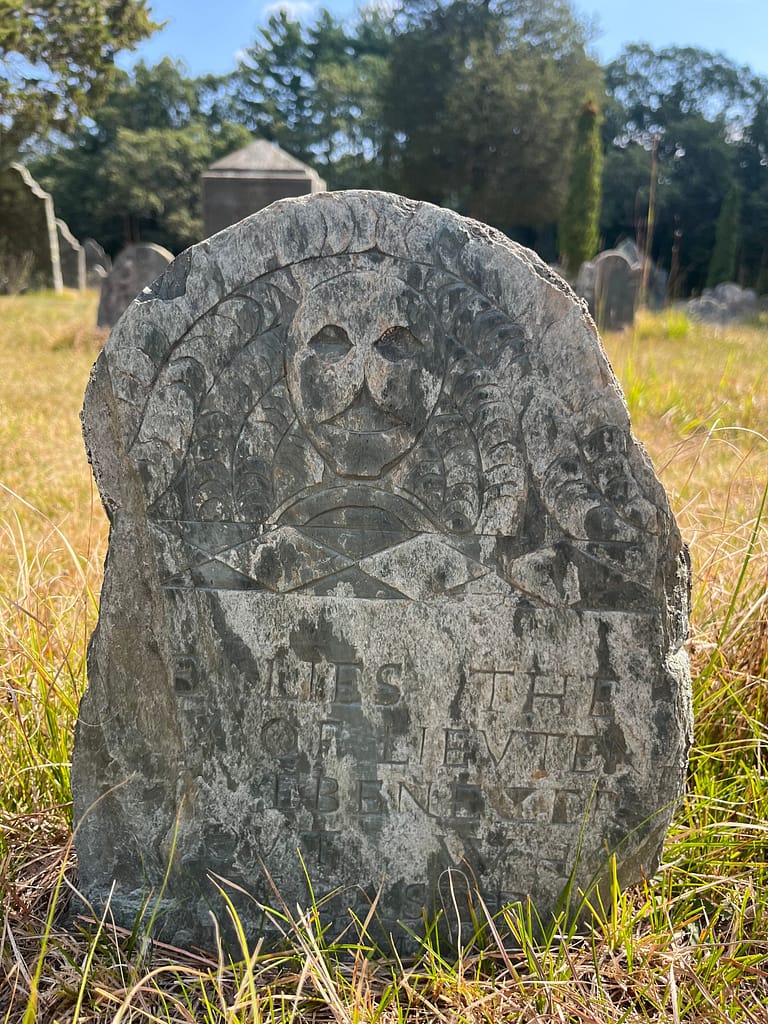
Evidence of this heritage survives through the material culture associated with the Sproat family. Lieutenant Ebenezer Sproat’s gravestone contains a winged death’s-head carving, a symbol commonly found on early New England gravestones. These images represented mortality and reminded viewers of the relationship between earthly life and spiritual preparation. Such imagery reflected the religious worldview that shaped many New England families during the colonial period.
James Sproat’s maternal family also connected him to prominent colonial and English lineages. His maternal grandmother, Desire Gorham Hawes, descended from families that traced their ancestry to English nobility, including a traditional lineage connected to King John of England, the monarch who signed the Magna Carta in 1215.
More directly connected to American colonial history, Desire Gorham Hawes’s mother, also named Desire, was the eldest daughter of John Howland and Elizabeth Tilley. Both John Howland and Elizabeth Tilley arrived in Plymouth Colony aboard the Mayflower in 1620. Through this ancestry, James Sproat belonged to a family network that connected him to some of the earliest English settlers in New England.
These connections placed Sproat within a culture that valued education, religious leadership, and public responsibility. While ancestry alone did not determine his future, the traditions of his family and community created an environment where religious service and intellectual achievement were highly respected.
Early Life and the Loss of His Father (1722–1726)
James Sproat’s childhood was shaped by both family tradition and early loss. His father, Lieutenant Ebenezer Sproat, died on September 28, 1726, when James was only four years old. Ebenezer’s death left Experience Hawes Sproat responsible for raising her children during a period when family survival often depended on strong community networks and extended family relationships.
The loss of a parent at such a young age was a significant experience in eighteenth-century life. Children often faced uncertainty after the death of a father, particularly in families where fathers provided economic support and social standing. Despite this hardship, James grew up within a family environment that emphasized religious commitment and education.
His mother, Experience Hawes Sproat, lived until November 19, 1758, dying in Middleborough, Massachusetts. By that time, James had already established himself as a minister and had built his own family. Her death marked the passing of the generation that shaped his earliest understanding of faith, family, and community.
The religious traditions inherited from his parents remained central throughout Sproat’s life. His later career as a Presbyterian minister reflected the values present in his childhood: dedication to religious service, education, and responsibility toward others.
Education at Yale and the Beginning of Ministry (1741–1743)
In eighteenth-century America, higher education was closely connected to religious leadership. Colleges such as Yale prepared young men for careers in the ministry by providing instruction in theology, classical languages, philosophy, and moral education.
James Sproat attended Yale College and completed his undergraduate education in 1741. His graduation placed him among the educated clergy of colonial America. At this time, ministers often served as some of the most educated individuals within their communities. They were expected not only to preach but also to guide families, educate younger generations, and provide leadership during times of hardship.
Two years after graduating from Yale, Sproat entered the Presbyterian ministry in Connecticut in 1743. This began a religious career that lasted for half a century. His early ministry occurred during a period when Presbyterian communities were expanding throughout the colonies.
As a Presbyterian minister, Sproat became part of a broader network of clergy who served communities experiencing significant social and political changes. The eighteenth century brought debates about religious traditions, personal faith, and the responsibilities of church leaders. These experiences prepared Sproat for the larger public role he would eventually take during the American Revolution.
Building a Family and Serving the Presbyterian Church in Connecticut (1744–1765)
While James Sproat developed his religious career, he also built a family during his years in Connecticut. He married a woman named Sarah Smith, though the exact date of their wedding remains unclear. They were most likely married before May 23, 1746, the date of their first recorded child’s birth. Their daughter, Sarah Sproat, was born on that day in Guilford, Connecticut. Unfortunately, she died later that year on December 24, 1746.
Sproat’s family life reflected both the joys and hardships common during the eighteenth century, a period when childhood illness and early death remained frequent realities. Most of Sproat’s children were born in Guilford, Connecticut, where he served during the early years of his ministry. The experiences of raising a large family while facing the loss of several children shaped his personal life during these decades.
Following the death of their first child, James and Sarah welcomed their second child, a son named Samuel James Sproat, on December 16, 1747, in Guilford. Tragically, Samuel died on July 30, 1751, at only three years old. Their daughter Hannah Sproat followed on June 25, 1749, in Guilford. She survived into adulthood and later died in 1796.
The family continued to grow with the birth of James Samuel Sproat on December 20, 1750, in Guilford. He died on August 11, 1751, less than a year after his older brother Samuel. Next came Olive Sproat, born on August 25, 1752, also in Guilford. Olive survived into adulthood and died in 1836.
Nancy Sproat was born on October 1, 1754, in Guilford. She later died in Philadelphia on September 22, 1793. William Sproat followed on October 6, 1756, in Guilford. During the American Revolution, William served as a Captain in the Fourth Pennsylvania Line, connecting the Sproat family directly to the military struggle for independence.
Clarissa Sproat was born on July 10, 1758, and died on September 5, 1759, at approximately one year old. Ruth Sproat was born on October 21, 1760. Currently, little is known about Ruth. Her twin sister, another little girl named Sarah Sproat was also born on October 21, 1760. This Sarah Sproat would live to adulthood, dying in 1849. After the twins, Sarah and James welcomed their final son, John Sproat, on August 8, 1762. Their final (known) child, Anne “Annie” Sproat. was born on May 6, 1765, in Guilford.
The deaths of several of Sproat’s children reflected the dangers faced by families during the colonial period. Infant and childhood mortality remained common, and many parents experienced the loss of young children. These personal hardships likely influenced Sproat’s later compassion toward sick and suffering soldiers during his Revolutionary War hospital service.
By the late 1760s, James Sproat had spent more than two decades serving as a Presbyterian minister in Connecticut. His education, religious leadership, and reputation eventually brought him to Philadelphia, where he took responsibility for one of the city’s most important Presbyterian congregations and entered a new chapter of his life.
Philadelphia Ministry and the Coming of Revolution (1765–1776)
When James Sproat arrived in Philadelphia’s religious community, he entered one of the most important cities in British North America. During the eighteenth century, Philadelphia served as a center of commerce, politics, intellectual life, and religious activity. The city’s churches reflected the diversity and growth of colonial society, while its leaders increasingly faced the political tensions that would eventually lead to the American Revolution.
In 1768, Sproat succeeded Reverend Gilbert Tennent as pastor of the Second Presbyterian Church in Philadelphia. This appointment marked a major advancement in his career and placed him among the leading Presbyterian ministers in the colonies. After more than two decades of ministry in Connecticut, Sproat now served a congregation located at the center of colonial affairs.
The Second Presbyterian Church had a long history within Philadelphia’s religious community. As pastor, Sproat guided his congregation through a period of increasing uncertainty. The years following his arrival brought growing conflict between Great Britain and the colonies, including disputes over taxation, political authority, and colonial rights. Religious leaders were often called upon to address these changes and provide stability during periods of disruption.
The Revolutionary War transformed Sproat’s role as a minister. Philadelphia became a major center of the American independence movement, but it also became directly affected by military conflict. When British forces occupied the city during the Philadelphia Campaign, many residents experienced displacement, hardship, and uncertainty. The war disrupted families, communities, and religious institutions throughout the region.
Sproat’s own family experienced these challenges. During the war years, his household was separated at times as military movements and political events created uncertainty. His son, Captain William Sproat, served with the Fourth Pennsylvania Line of the Continental Army, placing one of Sproat’s own children directly into the military struggle. As a father and minister, James Sproat understood the personal cost of the war in a way that extended beyond his public responsibilities.
By the time Congress selected him for wartime hospital service, Sproat had already spent decades caring for people during moments of difficulty. His experience as a pastor prepared him for a new responsibility: providing spiritual care to thousands of soldiers suffering from disease, wounds, and the hardships of military life.
A Minister Called to Serve the Continental Hospitals (1778)
During the American Revolution, military hospitals required more than physicians and surgeons. Soldiers recovering from illness and injury also faced fear, isolation, and uncertainty. The Continental Army recognized that religious care played an important role in supporting soldiers during wartime.
On February 10, 1778, Congress elected James Sproat to serve as Chaplain for the Hospitals in the Middle Department. This appointment placed him in charge of providing religious services to military hospitals located throughout Pennsylvania and surrounding regions. His responsibilities extended across Philadelphia, Northampton, Berks, Lancaster, and Chester Counties.
The position required extensive travel. Unlike a traditional parish minister who served one congregation, Sproat traveled between multiple hospitals, often under difficult conditions. He visited patients in different wards, preached sermons to soldiers who were able to attend, prayed with those too sick to leave their beds, and spoke individually with wounded and dying men.
Sproat recorded these journeys in his journal, creating one of the most detailed accounts of Revolutionary War hospital life in Pennsylvania. His writings reveal not only the religious activities he performed but also the conditions of the hospitals themselves. He described the cleanliness of wards, the number of patients being treated, the work of physicians, and the emotional struggles faced by soldiers.
His first major hospital journey in 1778 took him through several military medical centers before he reached Yellow Springs. These travels demonstrated the scale of the Continental Army’s medical system and the importance of chaplains within it.
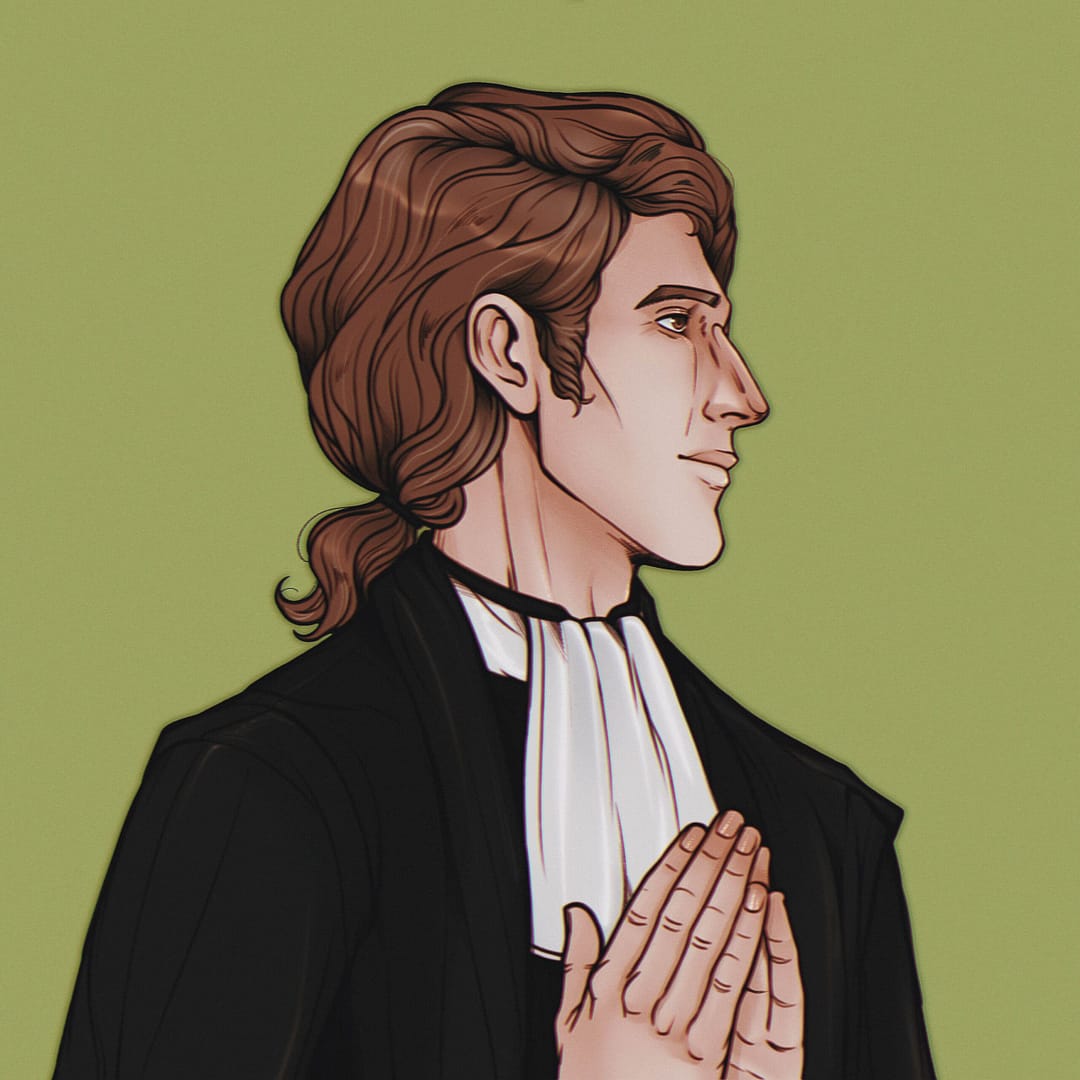
Visiting the Hospitals of the Middle Department
After Congress appointed James Sproat as Chaplain for the Hospitals in the Middle Department on February 10, 1778, he became responsible for providing spiritual care to Continental soldiers receiving treatment throughout Pennsylvania and the surrounding region. His assignment included hospitals located in Philadelphia, Northampton, Berks, Lancaster, and Chester Counties. Unlike his earlier work as a parish minister, Sproat’s wartime ministry required constant travel between scattered military hospitals where soldiers recovered from wounds, disease, and the hardships of army life.
The Continental Army’s hospitals depended on a network of physicians, surgeons, nurses, attendants, and support workers who cared for thousands of soldiers during the Revolution. Chaplains served an equally important role by providing religious services and personal comfort to men facing sickness and death far from their homes. Sproat approached this responsibility through regular preaching, private conversations, and prayer with individual patients.
His journal from 1778 provides one of the most detailed accounts of his work among the Continental hospitals. Although his entries document many locations throughout Pennsylvania, they also reveal the relationships he developed with the physicians and communities connected to these facilities. Among the most important of these connections were Dr. Samuel Kennedy and Dr. Bodo Otto Sr., whose work at Yellow Springs placed them at the center of the region’s wartime medical efforts.
Before arriving at Yellow Springs, Sproat had already encountered a Dr. Otto during his visits to other military hospitals. On April 2, 1778, while visiting the hospital at Bethlehem, Sproat recorded that he “drank tea with Dr. Otto.” However, because there are multiple Dr. Otto’s involved in serving the hospitals for the Continental Army, we are unsure if the ‘Dr. Otto’ Sproat is referring to here is Dr. Bodo Otto Sr. or one of his sons.
As Sproat continued his journey through the Middle Department hospitals, he gained a broader understanding of the challenges facing the Continental Army’s medical system. He witnessed crowded wards, long-distance transfers of patients, and the dedication of physicians who worked under difficult wartime conditions.
These experiences prepared him for his arrival at Yellow Springs, where the hospital complex had become one of the largest military medical facilities in the region.
The Road to Yellow Springs
By late April 1778, Sproat’s hospital visits brought him into Chester County and toward Yellow Springs, a location that had recently been transformed from a colonial health resort into a major Continental Army hospital complex.
Yellow Springs held a unique position within the Revolutionary War medical system. The property, owned by Dr. Samuel Kennedy, contained Washington Hall and additional structures that were adapted for military use. The hospital treated soldiers suffering from illness and injuries connected to the war, while physicians and staff worked to maintain sanitary conditions and provide care during a difficult period.
On April 25, 1778, Sproat arrived at Yellow Springs for the first time. His journal records:
“This day rode to Yellow Springs, visited the hospitals, conversed and prayed with the sick that were not able to attend the sermon. Lodged at Dr. [Samuel] Kennedy’s.”
This entry provides the first direct record of Sproat’s relationship with Yellow Springs and Dr. Kennedy. By lodging at Kennedy’s home, Sproat became closely connected with the physician responsible for overseeing much of the medical care at the site. The entry also demonstrates the nature of Sproat’s work. He did not only preach to large groups of soldiers who could gather together. He specifically sought out those too sick or injured to attend services.
The following day, April 26, 1778, Sproat recorded his impressions of the Yellow Springs hospital:
“This Hospital seems to be very neat, and the sick comfortably provided for, though wickedness, I understand, prevails among the convalescents.”
His observation offers an important glimpse into conditions at Yellow Springs during its first months of operation. Sproat recognized that the hospital provided adequate care for sick soldiers, but he also observed the difficulties that came with housing large numbers of recovering men. His response focused on spiritual guidance. He recorded:
“I endeavored, in my sermon as well as in my private discourses in their department, to show them the obligations they were under to love God, to live to Him and for Him.”
After preaching at Yellow Springs, Sproat continued his work among the surrounding communities. He traveled to visit William Ralston and his family, local residents who supported the military presence in the area. The connection between the hospital and nearby families was essential, as soldiers, physicians, and visitors depended on local residents for lodging, supplies, and assistance.
The following day, April 27, Sproat visited the nearby French Creek hospital before continuing his travels. On April 28, he traveled to Valley Forge, where he met with his son, Captain William Sproat of the Fourth Pennsylvania Line. He recorded that his son was “in health,” an important personal moment during a period when many families faced uncertainty about relatives serving in the Continental Army.
Yellow Springs, Washington Hall, and the Care of Revolutionary War Soldiers
When Sproat returned to Yellow Springs in June 1778, the hospital had grown into a major medical facility serving hundreds of Continental soldiers. The property included Washington Hall, which served as the primary hospital building, as well as nearby barns that had been adapted to provide additional space for patients. These structures allowed the Continental Army to treat large numbers of sick and wounded soldiers while keeping them away from military camps where disease could spread more easily.
During this period, Dr. Samuel Kennedy remained one of the central figures at Yellow Springs. Kennedy owned the property and served as the chief physician connected to the hospital. However, by the summer of 1778, his health had seriously declined. Sproat’s journal provides a personal account of Kennedy’s illness and demonstrates the close relationship that developed between the chaplain and the physician.
On June 9, 1778, Sproat began another journey to visit military hospitals. After traveling through the region, he reached the hospitals connected to Yellow Springs. The following day, June 10, he remained at French Creek before continuing his hospital visits.
On June 12, 1778, Sproat arrived at Yellow Springs. His journal recorded:
“Rode long miles to the Yellow Springs. Lit [alighted] at Dr. Kennedy’s, poor gentleman, very sick. Visited Dr. [Bodo] Otto. Dined at Dr. Kennedy’s.”
This entry provides an important glimpse into the situation at Yellow Springs. Sproat first stopped at Kennedy’s residence, where he found the physician seriously ill. He then visited Dr. Bodo Otto– we assume this is Dr. Bodo Otto Sr.– who had become one of the leading medical figures associated with the hospital. The entry shows the relationship between the medical leadership at Yellow Springs and the chaplain who served the soldiers there.
After dining at Dr. Kennedy’s, Sproat preached to the soldiers receiving treatment at the hospital:
“After dinner preached in the Hospital, which is new and airy but not yet finished. Smoked a pipe, and then preached to a number in an adjacent barn. Many sick here, though clean and airy.”
This description is one of the most valuable accounts of Yellow Springs during the Revolutionary War. Sproat noted that the hospital building was still incomplete but considered it a suitable environment for the soldiers. He also recorded the use of nearby barns as additional hospital spaces. These structures expanded the capacity of Yellow Springs and allowed the Continental Army to care for more patients than Washington Hall alone could accommodate.
That evening, Sproat returned to Dr. Kennedy’s home. He recorded:
“Drank tea with the matron and the doctors. In the evening returned to Dr. Kennedy’s, very much exhausted. The poor doctor is no better. Encouraged him in the things of God, prayed again with him, retired to bed and slept comfortably.”
The following day, June 13, 1778, Sproat continued his work among the patients at Yellow Springs. He recorded:
“Understand that the doctor [Kennedy] is no better.”
After breakfast, Sproat preached in the upper gallery of the hospital, where patients under Dr. Otto’s care received treatment. He then continued preaching among soldiers housed in nearby barns. His journal recorded:
“Went to a barn nearby and preached before dinner. Dined with Dr. Craig, rested a little after dinner, and then went to another barn and preached again. Took a little spirits and rode to a third barn and preached again, much fatigued.”
Sproat’s description shows the scale of the Yellow Springs hospital complex. The hospital was not limited to a single building. Soldiers were distributed among several structures, and Sproat moved between them to reach as many patients as possible.
He recorded:
“In the barns are 182 patients. The barns are clean and airy and in good order.”
He also identified several members of the medical staff:
“Dr. [James] Fallon is the Senior; [Solomon] Halling and [John] Cowell, Juniors; White and Marshall, mates.”
Another source preserved in the journal records a slightly different estimate of the number of patients at Yellow Springs during this visit, stating that the hospital and adjacent barns contained approximately 125 or 130 patients. It also notes that Dr. Otto and his sons served among the physicians, although the source did not preserve their first names. Because the surviving records provide differing numbers and details, the uncertainty remains part of the historical record.
The same account again emphasized Dr. Kennedy’s condition, noting that:
“Dr. Kennedy, whose department was the three barns, was sick.”
This detail is significant because it indicates that Kennedy’s responsibilities had extended beyond medical leadership at Washington Hall. While one might expect him to have claimed the main ward as his department, it seems that he instead has extended it out to include the three additional barns. This corroborates other accounts that Dr. Kennedy may have overextended himself during the first year of Washington Hall’s operation. This act, as time would tell, would be a major factor in the death of Dr. Kennedy.
After his demanding day of preaching and visiting patients, Sproat continued his rounds among the surrounding hospitals. On June 14, he preached at another nearby facility connected with the Yellow Springs area. He recorded that he preached to 127 patients in a Quaker meetinghouse hospital and noted the physicians responsible for their care.
Sproat continued to return to Yellow Springs throughout the remainder of the war. His later visits reveal the continued importance of the hospital after the initial emergency period of 1778. He repeatedly recorded lodging with Dr. Otto, preaching to patients, and observing the conditions of the hospital.
On September 14, 1778, Sproat returned to the area after visiting the French Creek hospital. He recorded:
“In the afternoon rode to the Yellow Springs and preached in the hospital. Old Dr. Otto behaved politely. Then rode to Mrs. Pritchard’s and lodged there.”
This entry demonstrates that Dr. Bodo Otto had become one of the primary figures associated with Yellow Springs after Kennedy’s declining health. Sproat’s reference to “old Dr. Otto” reflects the respect he held for the physician’s leadership and service, but it also confirms that there were several younger Dr. Ottos at Yellow Springs. These younger Dr. Ottos were Dr. Bodo Otto Sr.’s three physician sons; Major Dr. Frederick Otto, Dr. Bodo Otto Jr., and Dr. John A. Otto.
Sproat continued visiting Yellow Springs into the winter of 1778 and throughout 1779 and 1780. His entries repeatedly mention preaching at the hospital, lodging with Dr. Otto, and interacting with the physicians and local families connected to the site. These visits made him one of the most important eyewitnesses to the operation of the Yellow Springs hospital during the Revolutionary War.
Through Sproat’s journal, historians can see Yellow Springs not simply as a military hospital, but as a community of physicians, soldiers, local residents, and religious leaders working together during one of the most difficult periods of American history.
Continuing Service at Yellow Springs and the Final Years of the Revolutionary War (1778–1780)
Although the most detailed portions of James Sproat’s hospital journal come from 1778, his commitment to serving soldiers at Yellow Springs continued for several years. After the British evacuation of Philadelphia, Sproat returned to the city with his family and resumed his duties as pastor of the Second Presbyterian Church. However, he did not abandon the soldiers who remained under medical care. Alongside his responsibilities as a parish minister, he continued visiting the sick and wounded at the Bettering House in Philadelphia and traveling to country hospitals throughout Pennsylvania.
The hospital at Yellow Springs remained one of the last Revolutionary War hospitals still operating in the region. Sproat continued to make regular journeys there, providing sermons, prayers, and personal support for soldiers and patients. His journal entries from 1779 and 1780 show that Yellow Springs remained a central location within his wartime ministry.
By this period, Dr. Bodo Otto Sr. had become the leading medical figure at Yellow Springs. After Dr. Samuel Kennedy’s illness and eventual death, Otto continued overseeing medical care at the hospital. Sproat’s repeated references to lodging with Otto and dining with the Otto family demonstrate the close relationship between the chaplain and the physicians responsible for the hospital.
On January 12, 1779, Sproat traveled to Yellow Springs during harsh winter conditions. The following day, January 13, he arrived at the Springs and recorded:
“Arrived at the Springs about half past three, cold and rainy. Lodged with Dr. Otto. Supper with the Commissary. Baptized his child this evening.”
This entry provides another personal connection between Sproat and the Otto family. His responsibilities extended beyond preaching to soldiers. He also performed religious duties for the families connected to the hospital community. The following morning, he again met with Dr. Otto:
“Breakfasted with Dr. Otto. Preached at the hospital; the people attentive.”
After preaching, Sproat dined with members of the hospital staff before continuing his journey. The entry shows how the hospital operated as both a medical institution and a small wartime community where physicians, staff members, soldiers, and visitors formed lasting relationships.
Sproat returned to Yellow Springs repeatedly throughout 1779. On February 23, he again traveled to the hospital and lodged with Dr. Otto. The following day, February 24, he recorded:
“Preached at the hospital. The hearers very attentive.”
On April 13 and 14, 1779, he again traveled to Yellow Springs. He recorded that he lodged with the Ottos and preached at the hospital:
“Preached at the hospital, from ‘I beseech you not to receive the grace of God in vain.’”
These repeated visits demonstrate the continuing need for spiritual care among soldiers and patients. Even as military circumstances changed, disease remained a constant threat within military hospitals. Sproat continued to view his role as essential, offering religious instruction and comfort to those experiencing illness and uncertainty.
In May 1779, Sproat again faced the challenges of traveling to Yellow Springs. On May 25, he recorded crossing the Schuylkill River and dealing with difficult travel conditions:
“Much trouble in crossing the Schoolkill.”
After reaching the hospital, he preached to the soldiers. The following day, he recorded that approximately seventy patients attended his service.
During the summer of 1779, Sproat continued his hospital visits despite difficult weather and travel conditions. On July 7, he traveled toward Yellow Springs during extreme heat. He stopped at several homes along the way and eventually arrived at the Springs, where he stayed connected with the hospital community. On July 8, he recorded:
“Preached at the hospital; patients attended well. Dined with Dr. Otto and Col. Syrus.”
In September 1779, Sproat again visited Yellow Springs. On September 27, he recorded:
“Rode to Yellow Springs. Dined with Dr. Otto, Sr. Preached in the afternoon. Hospitals well provided for, and the gentlemen take good care of the sick.”
This observation reflects the continued organization of the hospital under Otto’s leadership. Sproat consistently praised the cleanliness of the facilities and the attention given by physicians and staff.
Yellow Springs During the Final Years of Hospital Service
Sproat continued traveling to Yellow Springs into 1780. These later entries show that the hospital remained active even after the most intense period of wartime medical need had passed.
On January 11, 1780, Sproat set out for Yellow Springs during severe winter weather. The following day, January 12, he described the difficult journey:
“This morning there were snow squalls and extreme cold. Mr. Todd accompanied me to the Springs. The lanes filled with snow, traveling bad indeed.”
Despite these conditions, Sproat continued to the hospital and preached to the patients. He recorded that he preached from John 5:40:
“Ye will not come to me that ye might have life.”
The journey demonstrated the dedication required of those who served the military hospitals. Travel in eighteenth-century Pennsylvania was often difficult even in good weather, and Sproat repeatedly endured rain, snow, heat, and poor roads to reach soldiers in need.
On March 29, 1780, Sproat again traveled to Yellow Springs, where he dined with Dr. Otto Jr. before lodging with Dr. Otto the elder. On May 2, he recorded another visit:
“Dined with Dr. Otto, Jr., who preached at the hospital in the afternoon to a very serious congregation. Lodged with old Dr. Otto.”
This entry reveals that the Otto family remained deeply connected to the religious and medical life of the hospital. The younger generation of physicians also participated in the spiritual life of the community surrounding Yellow Springs.
On June 12, 1780, Sproat again traveled from Philadelphia to Yellow Springs. He recorded:
“Rode to Yellow Springs [from Philadelphia]. Mr. Kennedy accompanied me part of the way. Dined with the young Doctors Otto. Lodged with the old doctor.”
The “Mr. Kennedy” that Sproat refers to above is believed to have been Montgomery Kennedy, the brother of the deceased Dr. Samuel Kennedy. We know that Montgomery Kennedy was listed along with Dr. Kennedy’s widow, Sarah Ruston-Kennedy, as one of the executors of Dr. Kennedy’s estate.
The following day, June 13, Sproat preached at the hospital and recorded:
“A child of a soldier has been baptized, and lately they returned from the backwoods. They belonged to Mr. Eakin’s congregation.”
This entry illustrates the broader community connected to Yellow Springs. The hospital served not only soldiers but also families, workers, and civilians whose lives intersected with the military presence in the region.
One of Sproat’s later visits to Yellow Springs also involved Captain Alexander McCaraher, a family friend of the Kennedy family who had taken over duties as the tavernkeeper on the property. On July 10, 1780, Sproat began another journey to the hospital. The following day, July 11, he recorded:
“Rose, rode to McCallas [Capt. Alexander McCaraher]. Crossed the Schoolkill, which was very high, to the Springs.”
After reaching Yellow Springs, Sproat preached to the hospital community despite the difficult journey:
“Preached from Acts 8th, ‘Repent of this, thy wickedness, and pray God.’ Though much fatigued, yet hope I had some assistance. Bless the Lord.”
He then dined with Dr. Otto and the hospital commissary before continuing his travels.
Sproat’s final recorded visits to Yellow Springs demonstrate the lasting importance of the hospital and the relationships formed there. He continued serving soldiers and maintaining connections with physicians, military officials, and local families until the hospital system gradually closed.
Return to Philadelphia and Conclusion of Hospital Service (1780–1789)
After the British evacuation of Philadelphia, James Sproat returned to the city with his family and resumed his duties as pastor of the Second Presbyterian Church. However, his return to his congregation did not end his commitment to the soldiers and patients he had served during the Revolutionary War. The experience of ministering among the sick and wounded had become a defining part of his work, and he continued visiting military hospitals even after Philadelphia was once again under American control.
Sproat resumed weekly visits to the sick and wounded at the Bettering House in Philadelphia while also continuing regular journeys to the remaining country hospitals. His journal demonstrates that his hospital ministry remained active well beyond the immediate crisis of 1777 and 1778. He continued traveling to provide sermons, prayers, and personal encouragement to patients who remained separated from their homes and families.
During this period, Sproat also maintained his personal connection with Dr. Bodo Otto Sr., who remained one of the most important figures associated with Yellow Springs. On November 1, 1780, while in Philadelphia, Sproat recorded:
“Had Dr. Otto to dine with me.”
Although brief, this entry provides valuable insight into their relationship. In eighteenth-century society, dining together was often a meaningful expression of friendship and respect. Sproat’s decision to host Otto in Philadelphia suggests that their relationship extended beyond their shared responsibilities within the hospital system. After years of working within the same wartime network, their connection continued even when separated from the daily operations of Yellow Springs.
The future of Washington Hall became increasingly uncertain as a lack funding, scandal, and the end of the active Revolutionary War lead to the complex becoming neglected. In September 1781, Congress ordered the closure of the Yellow Springs hospital complex, including Washington Hall. Dr. Bodo Otto Sr. opposed the decision and petitioned Congress to allow the hospital to remain open. His efforts would be in vain.
We cannot know what Sproat’s personal opinion on the closing of the complex were, as he did not record them. However, his actions following the closure of Washington Hall can offer us some insight. On March 1, 1782, Sproat recorded that he attended to “some necessary business with Col. Bayard in the Auditor’s Office, relating to my hospital affairs.” The following day, March 2, he wrote that he “wrote a letter to the Executive Council, relating to my affairs in the hospitals.”
It would seem that after years of service among military hospitals, he continued handling matters connected to his official responsibilities and the operation of the wartime medical system. Perhaps he was aware of the mismanagement of funds that left the hospital complex at Yellow Springs without support from those higher in the chain of command, but we cannot know this with certainty. His letter writing and friendship with Dr. Otto Sr., however, provide some insight into this matter.
The closure of Washington Hall marked the end of Yellow Springs’ role as one of the Continental Army’s most important medical facilities. For Sproat, it represented the conclusion of years spent traveling between hospitals, preaching to soldiers, and supporting the physicians and staff responsible for their care. His journal preserved the daily experiences of the hospital community, including the work of physicians, the challenges faced by patients, and the relationships formed among those who served during the Revolution.
We know that Sproat returned to his duties as the pastor of the Second Presbyterian Church and was a fixture in religious life in Philadelphia for a number of years following his duties in the Hospital Department.
It is recorded that by 1787, Sproat had concluded his formal service as the pastor of the church, but it seems that he continued to serve there despite his advancing age. On May 15, 1787, Sproat preached part of the sermon during the ceremony to ordain and install Reverend Ashbel Green as a minister in the Second Presbyterian Church. Our records also indicate that on November 8th, 1789, Sproat himself officiated the wedding of his daughter, Hannah Sproat, to her new husband, Reverend Isaac Stockton Keith.
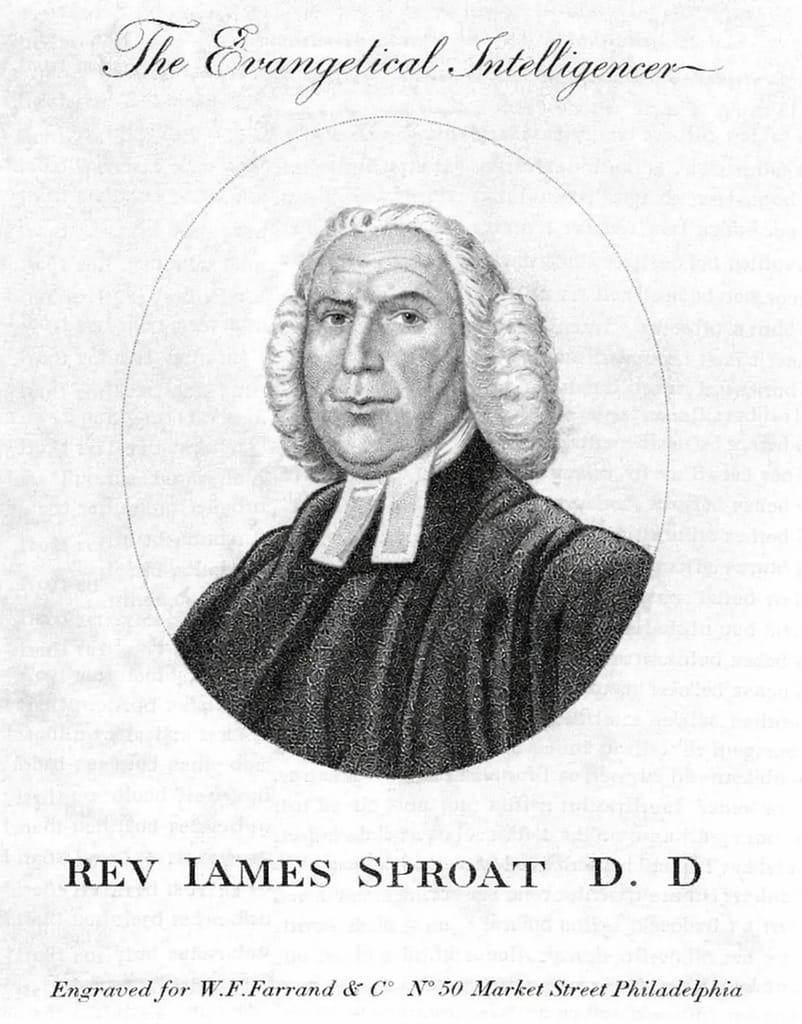
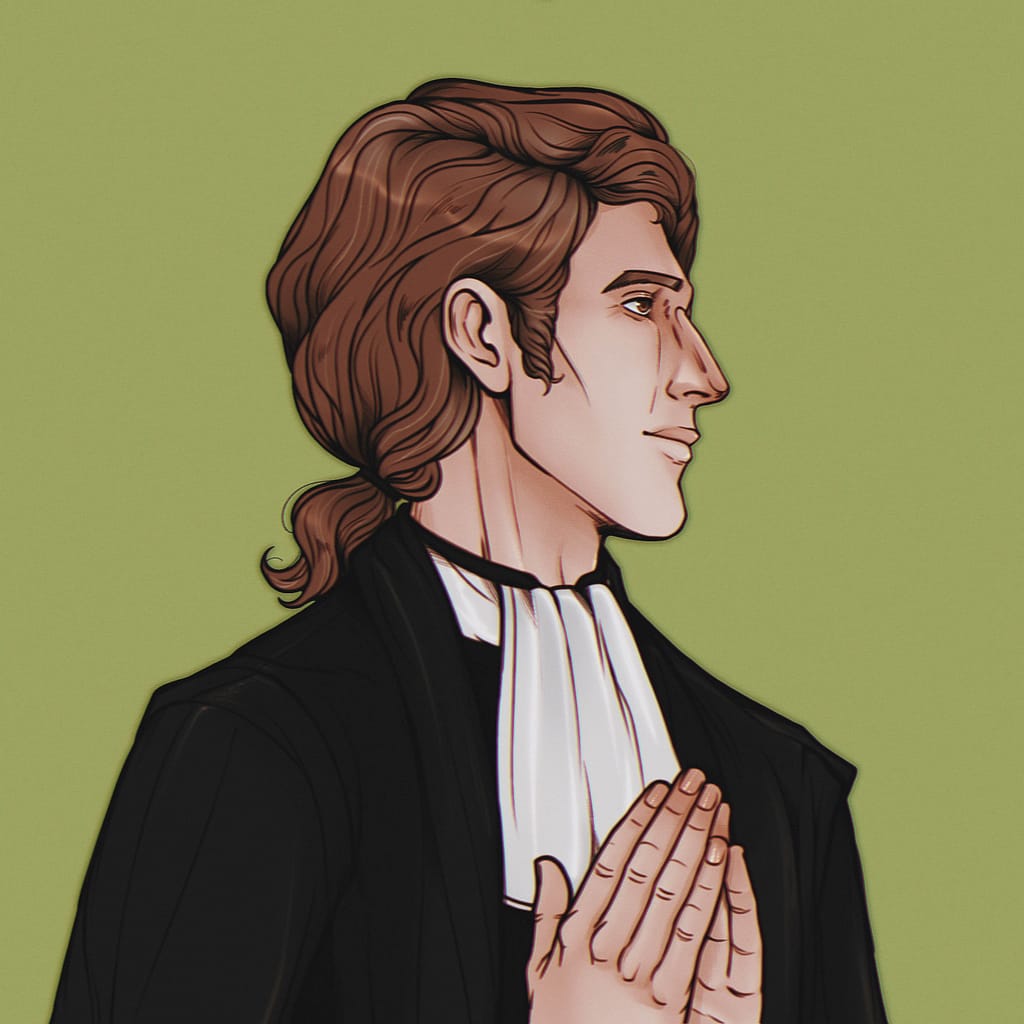
By 1793 at the latest, Sproat was influential enough to have been included in a series of illustrations done by Thackara & Vallance, which can be seen above. This series, whose publication rights were eventually bought out by W.P. Farrand & Co, also included famous Philadelphians of the era such as Benjamin Franklin and John Howard.
The Yellow Fever Epidemic of and the Death of Reverend James Sproat (1793)
By the early 1790s, James Sproat had spent nearly fifty years in the Presbyterian ministry. His life had carried him from colonial New England, through the religious revivals of the eighteenth century, into the leadership of one of Philadelphia’s most prominent congregations, and finally into service among the sick and wounded of the Revolutionary War. However, the final months of his life were shaped by one of the greatest public health disasters in early American history: the yellow fever epidemic that struck Philadelphia in 1793.
In 1793, Philadelphia was the largest city in the United States and served as the nation’s temporary capital. During the summer, a devastating outbreak of yellow fever spread throughout the city. The disease caused severe fever, vomiting, jaundice, and death, and because physicians had not yet discovered that mosquitoes transmitted the illness, many residents did not understand how it spread. Fear and uncertainty affected every part of Philadelphia society. Thousands of residents fled the city, while those who remained faced overcrowded hospitals, overwhelmed physicians, and the constant loss of family members, friends, and neighbors.
The epidemic was especially devastating among Philadelphia’s clergy, public figures, and long-established families. For Reverend James Sproat, the outbreak became a personal tragedy that affected nearly his entire household. Over the course of approximately three months, from September through November 1793, Sproat lost several members of his immediate family to the disease.
His daughter Nancy Sproat died in Philadelphia on September 22, 1793. Nancy was about 39 at the time of her death, but very little is known about her life. His daughter Anne Sproat followed soon after, dying on September 22, 1793, aged about 28 years old. His son, Captain William Sproat, died on October 18, 1793. William’s death was particularly significant because he had followed his father’s Revolutionary-era path of service as an officer in the Fourth Pennsylvania Line during the American Revolution.
The deaths within his family occurred within a remarkably short period of time. Reverend Ashbel Green, who later delivered a funeral sermon honoring Sproat, described the devastating losses that surrounded the final months of the minister’s life:
“His eldest son, with his wife and youngest daughter, died within the space of a month. The doctor himself and Mrs. Sproat, were added to the number in less than a month afterwards.”
The exact order of every death within the family remains difficult to reconstruct from surviving records, but the scale of the tragedy is clear. Within a short period, Sproat lost his children, his wife Sarah Smith Sproat, and eventually his own life to the same epidemic.
Despite these losses, Green emphasized Sproat’s religious devotion and personal character during his final illness. According to Green, Sproat endured the deaths around him “without the least repining.” When he followed the body of his son to the grave, weakened by age and illness, he reportedly stood leaning on his staff and spoke only the words:
“The Lord gave, and the Lord hath taken away, blessed be the name of the Lord.”
These words reflected the faith that had defined Sproat’s entire life and ministry. Green explained that, even while suffering from the loss of his family, Sproat remained patient and resigned, viewing his final days through the religious beliefs that had guided him since his youth. On October 18th, the same day as the death of his son William, Reverend James Sproat died of yellow fever.
Legacy
Although the epidemic claimed thousands of lives, the death of Reverend Sproat received particular attention because of his long public service. In November 1793, Reverend Ashbel Green published the funeral sermon he had delivered following Sproat’s death. Green’s remarks provide one of the most detailed contemporary assessments of Sproat’s life and character.
Green explained that he could not provide “so full a sketch of the life and character of Dr. Sproat” as he wished, because those who knew him personally already understood his virtues. He described Sproat as a man of patience, kindness, and humility, stating:
“Meekness and affection distinguished him highly.”
Green also emphasized Sproat’s devotion to education and theology. He noted that Sproat had been well educated at Yale and had developed a deep understanding of religious scholarship. According to Green, Sproat had “made deep researches into systematic, casuistic, and polemic divinity,” and had devoted much of his later life to continued study.
Green’s description also highlighted Sproat’s abilities as a preacher. He wrote that Sproat’s sermons were characterized by seriousness, clarity, and compassion, and that his prayers reflected a deep personal faith. His ministry, Green argued, was not simply a public role but an expression of his own religious convictions.
One of Green’s most personal observations concerned his own relationship with Sproat. Green described their friendship as one built upon mutual respect and affection, writing that Sproat treated him “like a father.” This testimony reveals the esteem in which Sproat was held by younger ministers and members of the Presbyterian community.
Following his death, Sproat’s memory continued through both written and visual representations. The engraving of Reverend James Sproat created by Thackara & Vallance was published after his death, preserving his likeness for later generations. Such posthumous portraits served not only as memorial images but also as reminders of respected religious and civic figures whose lives had shaped their communities.
Reverend Dr. James Sproat was buried at Laurel Hill Cemetery in Philadelphia. His death brought an end to a life that had witnessed some of the most significant transformations in early American history: the decline of colonial society, the growth of religious communities, the Revolutionary War, the creation of the United States, and the challenges faced by the young nation during moments of crisis.
For Yellow Springs, his passing marked the loss of one of the most important witnesses to the Revolutionary War hospital community. Through his journal, Sproat preserved the experiences of Washington Hall, the physicians who served there, and the soldiers who received care within its walls. His final years revealed the same qualities that defined his wartime ministry: devotion, endurance, and service to others.
Further research ongoing!
Read a more in-depth version of this biography here!
See our reconstruction of Reverend Sproat’s family tree on Ancestry.com here!
Read Reverend Sproat’s journal here!
Posts Featuring Reverend Sproat
Bibliography
“Grave Marker of Ebenezer Sproat.” Photograph by Heather P, Find-A-Grave user. Cemetery at The Green, Plymouth, Massachusetts. Accessed August 6, 2026. https://www.findagrave.com/memorial/10965430/ebenezer-sproat.
Green, Ashbel. A Sermon, Occasioned by the Death of the Rev. James Sproat, D.D., Late the Senior Pastor of the Second Presbyterian Congregation in the City of Philadelphia: Who Died October 18, 1793. Philadelphia: Printed by William Young, 1794. Reproduced online by The Confessional. Accessed July 28, 2026. https://confessional.org/archives/18th-century/green-1794-a-sermon-occasioned-by-the-death-of-the-rev-james-sproat-d-d-late-the-senior-pastor-of-the-second-presbyterian-congregation-in-the-city-of-philadelphia.
Green, Ashbel. Funeral Sermon for Dr. James Sproat. 1849. Reproduced online by The Confessional. Accessed July 28, 2026. https://confessional.org/archives/19th-century/green-1849-funeral-sermon-for-dr-james-sproat-1793.
Gibson, James E. Dr. Bodo Otto and the Medical Background of the American Revolution. Springfield, IL: Charles C. Thomas, 1937.
Historic Yellow Springs. “Reverend Dr. James Sproat Family Tree Research.” Ancestry.com Family Tree. Research database compiled by Historic Yellow Springs. Accessed July 28, 2026. https://www.ancestry.com/family-tree/person/tree/209291343/person/352757805972/facts.
Sproat, James. “Extracts from the Journal of Rev. James Sproat, Hospital Chaplain of the Middle Department, 1778.” Edited by John W. Jordan. The Pennsylvania Magazine of History and Biography 27 (1903): 441–45. Reproduced online by The Confessional. Accessed July 28, 2026. https://confessional.org/archives/20th-century/sproat-1903-extracts-from-the-journal-of-rev-james-sproat-hospital-chaplain-of-the-middle-department-1778
Copyright Disclaimer: Under Section 107 of the Copyright Act 1976, allowance is made for ‘fair use’ for purposes such as criticism, comment, news reporting, teaching, scholarship, and research. All materials sourced from sources indicated throughout this post are referenced for the purposes of education for reference purposes.