
Biography of Rina
- Rinaâs Early Life (1730sâ1763)
- The Kennedy Household Before the Revolution (1763â1771)
- Revolution, War, and the Kennedy Household at Yellow Springs (1774â1778)
- The British Loot Whiteland (1777)
- After Dr. Kennedyâs Death: Rina, the Kennedy Estate, and a Changing Household (1778â1780)
- Primus, Separation, and the Strain of Family Loss (1782)
- The Final Documentary Record (1792)
- Legacy
- Posts Featuring Rina
- The Will and Estate of Dr. Samuel Kennedy
- Making History- Winter at Washington Hall
- Making History- Forgotten Faces from Washington Hall
- Prime, Rina, and Primus

The history of Revolutionary-era Yellow Springs often focuses on physicians, military officers, and wealthy landowners. However, the village also depended on people whose labor supported these households and institutions. Their stories are equally important. One of those individuals was a woman named Rina.
Rina was an enslaved woman who lived and worked in the household of Dr. Samuel Kennedy and his wife, Sarah Ruston Kennedy. She was at Yellow Springs during the Revolutionary War when the village had become a center of military medical activity. While continental surgeons treated wounded soldiers at Washington Hall, enslaved workers like Rina continued the domestic labor that supported the Kennedy household and the surrounding community.
Unlike many members of the Kennedy family, Rina left no letters or personal writings. No recorded testimony preserves her own voice. Historians must instead piece together her life from legal and estate records, newspaper advertisements, and the person writings of her enslavers. These sources reveal a woman who endured decades of bondage, but who went through great personal risk to protect the same people who enslaved her.
Rina’s life reflects the contradictions of eighteenth-century Pennsylvania. Revolutionary ideas promoted liberty and independence across the colonies, but Rina remained legally enslaved throughout her lifetime. Her story places enslaved people within the larger history of Yellow Springs. It reminds us that the Revolutionary era affected more than soldiers and political leaders. It also shaped the lives of people whose labor sustained the communities around them.
Rina’s Early Life (1730s–1763)
Rina was likely born in the late 1730s or early 1740s. No record gives her birth date, birthplace, or parentage. Like many enslaved people, her early life went largely undocumented because records treated enslaved people as mere property.
Slavery was widespread across southeastern Pennsylvania, including Chester County. Enslaved labor supported farms, businesses, and wealthy households. Enslaved women cooked, cleaned, cared for children, made textiles, and performed other domestic work.
The strongest evidence we have places Rina originating in the household of Job Ruston, father of Sarah Ruston Kennedy. Ruston was a prominent Chester County resident. He commanded a county company during the French and Indian War. He also helped establish Faggs Manor Presbyterian Church, a New Light congregation shaped by the Great Awakening. Its teachings stressed conversion, moral responsibility, and the equal spiritual value of all people.
Those ideals existed alongside Rina’s possible enslavement in Ruston’s household. Enslaved people could attend the same churches as enslavers while remaining legally and socially separate. They heard that God valued every soul while living under forced labor, exploitation, and little control over their lives. This contradiction was common among prominent religious figures who also owned enslaved people.
Ruston reportedly enslaved more than one hundred people during his lifetime- though it is important to note that this figure covers decades, not who was present in his household at one time. After Pennsylvania’s 1780 Gradual Abolition Act, slaveholders had to register the names, ages, and racial classifications of the people they enslaved. They could also choose gradual freedom or lifetime enslavement for these people. Ruston registered all ten people who remained enslaved in his household as “slaves for life”: Will, Bess, Nell, George, Flora, Bell, Bill, Jim, Pegg, and Jacob. Eight were recorded as “mulatto” and two as “negro.” Their ages ranged from children to older adults. The record gives no family relationships, but their ages and repeated classifications suggest possible connections. The high proportion of these people specifically recorded as having mixed ancestry raises troubling questions about how that population formed.
Parentage
Following the 1780 Gradual Abolition Act, officials classified a now-adult Rina as “mulatto,” meaning they believed she had African and European ancestry. In eighteenth-century Pennsylvania, white record keepers based these classifications on their own perceptions. However, the repeated presence of mixed-race enslaved people in the Ruston household provides important context for Rina’s possible background.
Rina may have been the biological child of Job Ruston or another white Ruston family member. Enslaved women faced vulnerability to reproductive exploitation by their enslavers. Children born from these relationships inherited their mother’s enslaved status and often remained within the same household. No surviving document identifies Rina’s mother or father, but her later classification, likely connection to the Rustons, and the many mixed-race people enslaved in Job Ruston’s household make this possibility significant.
No direct evidence confirms that Job Ruston or another family member was Rina’s biological parent. This is to be expected. Enslaved people lived within a system that minimized their identities and obscured family connections, especially when those connections might have revealed what we now recognize as abuse. Historical records also often hid these relationships because they exposed slavery’s inherit flaws and contradictions. White families could hold authority over their own descendants while denying them legal recognition, inheritance rights, and freedom. Missing records do not rule out the possibility of Rina’s potential parentage- they reflect the deliberately limited documentation of enslaved people’s lives.
If Rina was born enslaved within the Ruston household, she would have grown up among other enslaved people. She would have learned domestic duties expected in elite households. She would have witnessed wealth and status while living under restrictions. She lived close to the family she served without sharing their legal rights, planter-class prestige, or genteel social position.
Childhood Circumstances
This interpretation also changes how historians understand Rina’s relationship with Sarah Ruston Kennedy. Sarah was born in 1737, placing her close in age to Rina, who was born in the 1730s or early 1740s.
If Rina was born into slavery in Job Ruston’s household and if two girls grew up in the same physical environment, they would have felt worlds apart. Sarah was the estate owner’s daughter. Rina was legally owned by that same household.
Their shared childhood environment may have shaped their relationship later in life. By adulthood, Rina had become one of Sarah’s closest household attendants. We cannot know whether their relationship grew from childhood familiarity, forced dependence under slavery, a possible family connection, or some combination of these factors. What is clear is that Rina’s life became closely connected with Sarah’s whenever she appears in surviving records.
As Rina grew older, she likely moved from childhood into domestic labor within the Ruston household. Enslaved women in elite homes often performed intimate work that kept them in constant contact with enslavers and their families. They helped manage the household, cared for children, prepared food, handled clothing, and performed other daily tasks.
Death, Remarriage, and Changing Household Ties
Rina’s transition into adulthood likely came during major changes in the Ruston household. Like many eighteenth-century families, it was shaped by death, remarriage, inheritance, and shifting relationships. These changes affected both the immediate Ruston household and the enslaved people tied to their estate.
Mary Barker Ruston, Sarah’s mother, died in 1757. For enslaved young women like Rina, Mary’s death may have disrupted the stability of domestic life. Enslaved women who worked as domestic servants worked closely with the women they served. Daily routines depended on the female head of the household. Mary’s death would have destabilized that familiar structure.
The circumstances of her death were also unusual. Job Ruston married Elizabeth Budd in May 1757, about one month before Mary died on June 19. The records do not explain what happened. Job’s later burial record is sure to report that his remarriage to Elizabeth occurred after June 19, but records from Mary’s tombstone and other more contemporary records support the May marriage date. Even Elizabeth’s later burial records report that she and Job got married about a month before Mary died.
We have no surviving details cataloguing any questions or critiques Job may have received for this action, nor do we have documentation from Job himself that would help clarify these cloudy circumstances.
Regardless, the death of Mary Baker Ruston would have caused a significant change for the Ruston family.
The household also showed repeated reliance upon slavery. During the 1750s, Job repeatedly advertised for enslaved people who escaped from his estate. These notices show that enslaved people resisted bondage and sought control over their lives. They may also suggest especially harsh conditions in the Ruston household. The amount of people fleeing the Ruston estate suggests that, in this case, both options may have been true.
By Sarah’s marriage to Dr. Samuel Kennedy in 1763, she and Rina had likely known each other for years. Their connection may have involved childhood experiences, family ties, or dependence created by slavery. We cannot know. However, Rina’s later role in the Kennedy household as one of Sarah’s most trusted and important servants suggests a deep and longstanding awareness of what Sarah needed and expected from her attendants.
The Kennedy Household Before the Revolution (1763–1771)

In May 1763, Sarah Ruston married Dr. Samuel Kennedy. This marriage likely marked the beginning of a major transition in Rina’s life. Our research strongly suggests that Rina entered the Kennedy household through Sarah’s marriage, although no surviving document records a formal transfer.
Enslaved women who served as personal attendants were often transferred through marriage arrangements, dowries, inheritance, or family agreements, particularly when they had spent years serving the women of elite households. If Rina had indeed belonged to the Ruston household before this point, her movement into the Kennedy household would have followed a pattern common in eighteenth-century Pennsylvania.
However, it is important to recognize that the picture we are painting of Rina’s early life remains speculation rather than a documented fact. The surviving records do not tell us exactly when Rina entered Samuel Kennedy’s possession or the circumstances of her transfer, and we are presenting this information based on what is most reasonable, considering the information that we do have. As we go through Rina’s story and continue to research, that fact is important to keep in mind.
What we know for certain often concerns the documented movement of the Kennedy family.
After their marriage, Samuel and Sarah established their household in Whiteland. For Rina, this likely meant adapting to a new household structure and new responsibilities.
Sarah and Samuel’s young family grew quickly after their marriage. In 1763, Sarah gave birth to their first child, Thomas Ruston Kennedy, named in honor of her brother Thomas Ruston. In 1764, John Kennedy was born, followed in 1766, by twins: a daughter Sarah Kennedy and another son also named John Kennedy. This younger John Kennedy was known later in life as Judge John Kennedy. In 1768, Sarah gave birth to Mary “Polly” Kennedy, and in late 1768 or early 1769, she gave birth to Samuel Kennedy Jr.
These children were central to Rina’s life within the Kennedy household. As a domestic servant, Rina probably assisted with childcare in addition to her other responsibilities. Enslaved women often performed intimate forms of labor: caring for children, maintaining clothing, preparing meals, and managing the daily routines of the family. This work brought Rina into close contact with the Kennedy children throughout their earliest years and into their adolescence.
Or research suggests that this period was when Rina also became a mother herself.
Primus
In 1782, an enslaved young man named Primus was reported missing after escaping his enslaver’s property. He was suspected of attempting to travel toward Yellow Springs to reunite with his mother and Sarah Kennedy. At the time, the only enslaved woman of the correct age to be his mother and who was also living with Sarah Kennedy would have been Rina.
Primus was approximately eighteen years old at the time, meaning he was presumably born around 1764. This places his birth shortly after Sarah and Samuel’s marriage and during the period when Rina was probably already a member of the Kennedy household.
Additionally, when he is physically described, Primus is identified as “negro.” This means it is likely that his father was also an enslaved man.
If so, Rina would have spent these years caring for both the young Kennedy children and her own infant son while also being responsible for ensuring the comfortable lifestyle that Kennedy family expected was maintained.
Rina Was Not Alone
Before his marriage to Sarah, Samuel Kennedy appears to have been familiar with indentured labor, but there is no clear evidence that he owned enslaved people before becoming connected to the Ruston family.
After his marriage, though, enslaved people became part of the young Dr. Kennedy’s daily life and routine. By 1774, records indicate that Samuel owned at least three enslaved individuals. Rina was almost certainly among them.
Other, older records provide glimpses into the enslaved community surrounding Rina.
Unnamed Young Woman
In 1770, an unnamed eighteen-year-old enslaved woman who had previously belonged to the Kennedy household ran away from Samuel Martin.
Although this woman is too young to have been Rina herself, their time in the Kennedy household together presumably overlapped. Regardless of Rina’s relationship with this young woman, the fact that she was simply sold off to Mr. Martin would most certainly have impacted Rina deeply.
Unnamed Man (or Prime)
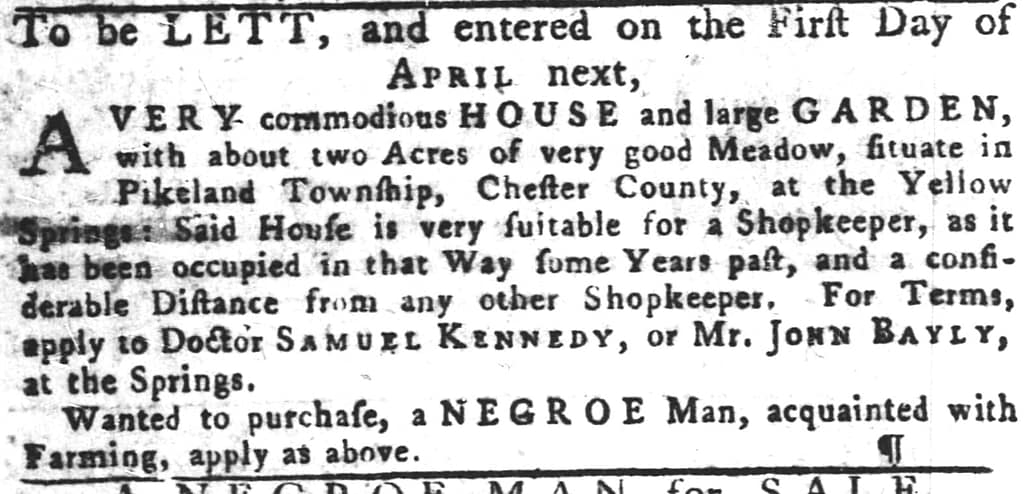
In February of 1772, Samuel Kennedy advertised that he wished to purchase an enslaved man who was “acquainted with farming” after he became intertwined with John Bayly and Yellow Springs.
Prime
Later in December of the same year, a man named Prime, who was enslaved to the Kennedy household, was charged with stealing a pair of gold sleeve buttons from Richard Richison.

Prime was convicted and punished by whipping, while the Kennedy estate was responsible for reimbursing Richison for the stolen property.
It is possible that Prime was the same enslaved man that Dr. Kennedy sought to purchase in February. It is also possible that Prime was already enslaved within the Kennedy household and that Dr. Kennedy was simply seeking additional laborers after purchasing the Yellow Springs property.
However, the similarity between Prime’s name and the name of Rina’s son Primus suggests that the enslaved man Dr. Kennedy presumably purchased after 1772 was actually not Prime. As mentioned earlier, Prime may have been Primus’s father, or the resemblance may have been a simple coincidence. Until further documentation is discovered, the reality of this situation remains unclear.
The records surrounding Prime provide one of the few concrete glimpses into the enslaved community that surrounded Rina before the Revolution.
We know there was Rina, we know there was Prime, and we know there was Primus. We also know there was another woman, but now she is lost to history. Beyond reports of their value, their attempts to escape, their sale, or their punishment, we know almost nothing about them as individuals. Tragically, all we can do for the time being is speculate.
Death at the Whiteland Plantation
The Kennedy household themselves also experienced personal tragedies during these years. John Kennedy, born in 1764, died in 1772. Samuel Kennedy Jr., born in 1768, died in 1773.
No cause of death for either boy has been recorded, but due to the harsh nature of childhood in the eighteenth century, even wealthy families often experienced devastating losses to illness and disease.
These deaths would have affected everyone within the household, including Rina, who was likely the Kennedy children’s primary caregiver during their early lives.
By the early 1770s, Rina’s life had become closely tied to the Kennedy household. She had probably spent years serving Sarah, caring for children, and maintaining the daily operation of the home. She was also raising her own child within a system that denied enslaved families security and freedom.
As political tensions escalated and Samuel Kennedy entered the Revolutionary cause, the household Rina served would soon become directly involved in the war that transformed Chester County.
Revolution, War, and the Kennedy Household at Yellow Springs (1774–1778)
By the mid-1770s, the political conflict between Great Britain and the American colonies had reached Chester County. For wealthy white families like the Kennedys, the Revolution threatened property, financial security, and family stability.
For enslaved people like Rina, the war created a different kind of uncertainty. While colonial leaders spoke of liberty and independence, enslaved people continued to live under a system that denied them freedom, separated families, and treated their labor as property.
When Samuel Kennedy joined the American military effort, the effects of the Revolution immediately reached the Kennedy household.
In 1776, Samuel offered his medical services to the Continental cause and became a surgeon in Pennsylvania’s Fourth Battalion. His absence transformed the responsibilities within the household. Sarah Kennedy remained in Chester County managing the family’s property, overseeing agricultural work, and caring for their children.
Behind the Scenes of War
Rina would have experienced this period differently from Sarah. Although Sarah carried the burden of managing an estate during wartime, she did so as the legal head of a wealthy household.
Rina, by contrast, performed the labor that allowed that household to continue functioning while having no authority over her own circumstances. Her responsibilities likely increased as Samuel’s absence placed additional pressure on the Kennedy household. She would have continued caring for the children, maintaining domestic routines, and assisting Sarah while the family navigated the uncertainty of war.
The danger of the Revolution reached the Kennedy family directly after the Battle of Brandywine in September 1777. British forces moved through Chester County, destroying homes and taking supplies from families connected to the American cause. Because Samuel had openly supported the Revolution and served as a military physician, the Kennedy household became a target.
The British Loot Whiteland (1777)
When British soldiers arrived at the Kennedy property in East Whiteland on September 15, 1777, Rina played a crucial role in protecting the home.
Sarah later recalled that “had it not been for our Negro wench* Rina … the house would have been consumed.” According to Sarah’s account, British soldiers confronted Rina and told her that they knew of “her rebel master in Canada.”
*(Note here that ‘wench’ in this context means something closer to domestic servant or lady’s maid, not how it is used today)
Despite the danger, Rina prevented the destruction of the Kennedy home. This is a small note from Sarah, but it provides us crucial glimpses into Rina’s character and gives us evidence of Rina’s courage, judgment, and her ability to navigate dangerous situations.
She protected the household that enslaved her while facing a military force that threatened both the Kennedys and herself.
Rina’s actions also reveal the complicated relationships that existed within enslaved households. Enslaved domestic workers often developed close relationships with the families they served because they lived alongside them, cared for their children, and managed intimate aspects of their daily lives. However, these relationships existed within a system of forced labor and unequal power. Rina’s loyalty to Sarah and the Kennedy children did not change the fact that she remained legally enslaved.
Following the destruction of their East Whiteland property, the Kennedy family relocated to Yellow Springs, where Samuel resumed his medical work with the Continental Army. The move placed Rina at the center of one of the most significant military medical sites in Revolutionary Pennsylvania.
To Yellow Springs
At Yellow Springs, Rina lived alongside Washington Hall as it developed into a major Continental hospital. The construction of Washington Hall in early 1778 transformed the landscape around her. Physicians, surgeons, soldiers, nurses, orderlies, and military officials entered the village. While these individuals created the hospital system that treated wounded and sick soldiers, enslaved workers continued performing the domestic labor that supported the households connected to the site.
For Rina, Yellow Springs was both a home and a place of continued bondage. She likely assisted Sarah with managing the Kennedy household while also adapting to the constant presence of soldiers, important Revolutionaries and officers, and medical personnel. The household changed dramatically as the hospital expanded. Visitors associated with the Continental cause arrived at Yellow Springs, supplies moved through the property, and hundreds of soldiers received treatment nearby.
The surviving records do not tell us exactly what Rina’s daily routine looked like at Washington Hall. However, her position within the Kennedy household allows historians to make reasonable interpretations. She presumably continued caring for children, maintaining household spaces, preparing food, and assisting Sarah as she managed a wartime estate. Her labor helped sustain not only the Kennedy family but also the broader community that developed around the hospital.
The year 1778 brought further change when Dr. Samuel Kennedy died at Yellow Springs on June 17 after becoming ill while caring for soldiers. His death transformed the Kennedy household once again. Sarah became responsible for managing the estate, raising their surviving children, and navigating the complicated financial consequences of wartime use of Yellow Springs.
For Rina, Samuel’s death created a different kind of uncertainty. The person who had legally controlled her life was gone, but his death did not result in freedom. Instead, her future became tied to the decisions of his heirs.
After Dr. Kennedy’s Death: Rina, the Kennedy Estate, and a Changing Household (1778–1780)
After Dr. Samuel Kennedy’s death in June of 1778, Rina remained within the Kennedy household, but the structure of that household had fundamentally changed. Sarah Kennedy now managed an estate altered by war, a plantation property occupied by the hospital complex that Congress had commissioned, and a family that had lost its central provider. At the same time, the people who had been enslaved by Samuel Kennedy were transferred into the legal ownership of his heirs.
For Rina, this transition likely created a period of uncertainty. She had spent years serving within Samuel and Sarah Kennedy’s household, first in East Whiteland and later at Yellow Springs. She had witnessed the family’s wartime hardships, protected their home during the British advance, and helped maintain the household while it became connected to Washington Hall. After Samuel’s death, however, the person who had controlled her legal status was replaced by his heirs, who had not yet reached the age of majority. In addition to this, the “heirs of Samuel Kennedy” were children that Rina had helped raise. The records do not reveal how this transition affected her personally, but the change would have altered the circumstances under which she lived and worked.
The Index of Dr. Kennedy’s Estate
The documents created during the settlement of Dr. Samuel Kennedy’s estate provide some of the clearest evidence of Rina’s continued presence within the household. Though Dr. Kennedy died in 1778 and we once thought that this meant his estate’s index was compiled around the same time, we now have documentary evidence that places the estate being indexed sometime during 1780.
Samuel Culbertson, the tavernkeeper who had been in charge of the Yellow Springs tavern and was a tenant of Dr. Kennedy, had been captured during the war on Nov. 16, 1776, while away at Fort Washington. Culbertson was a prisoner of war until he was exchanged, sometime after November of 1780. Afterwards, Culbertson returned to Yellow Springs, where his signature appears on the index of Samuel Kennedy’s estate. This means that this document, which lists Rina as around 40 years old, must have been signed sometime after November of 1780 but sometime before January 8, 1782, when Samuel Culbertson died.


It is also likely that Samuel Culbertson signed this index before his public falling out with Sarah Kennedy, which occurred around June of 1781. In all probability, he would not have signed the index as a witness after he and Dr. Kennedy’s widow had engaged in a public feud.
Regardless, the estate index identifies Rina among the enslaved people connected to Dr. Kennedy’s property. However, this document does not describe Rina’s work, personality, or relationships. It records only that she remained part of the estate being transferred after Samuel’s death. It lists her only as a “negro wench” that was approximately forty years old, and disturbingly, assigns her a monetary value of £220.
Adjusting for inflation and translating to USD, this means that Rina’s entire life was worth only $60,335, according to the person who had indexed Dr. Kennedy’s property. Grimly, the following pages of the index also allow us to compare this figure to the combined worth of Dr. Kennedy’s medicines and medical instruments. In 1780, these objects were appraised to be worth around £500 ($138,550 USD today), meaning that through the eyes of the law and the appraisers, a woman’s life was worth significantly less than medicines and surgical tools.
There is, of course, the important caveat that medicines were expensive and difficult to access and that surgical tools were often in high demand and difficult to obtain as well. That being said, the reality expressed through these appraisals and what they represent is a key feature in understanding just how dehumanizing the experience of being enslaved was. Earlier in the war, Rina had risked her own safety to ensure that the Whiteland plantation and the Kennedy family would be shielded from the havoc the British were wrecking, and now her entire life had been reduced to being less valuable than a collection of medicine and a case full of tools.
Rina, Lucia, and Kitte
However, the same record provides important information about who was enslaved alongside Rina. Two younger enslaved girls, named Lucia and Kitte, appear within the same household index. Their presence confirms that Rina was not the only person enslaved in the Kennedy household, but it also demonstrates that people such as Primus and Prime had gone missing from the record. Nonetheless, Rina still remained connected to the young girls through their shared service in the Kennedy household, a small community of enslaved people whose lives depended on the decisions that the heirs of Dr. Samuel Kennedy would eventually make.

Lucia appears in the estate index as an enslaved girl, approximately eight years old. However, the 1780 slave register recorded her as a ten-year-old “mulatto girl” enslaved “for life” to the heirs of Dr. Samuel Kennedy. The age discrepancy here is, sadly, to be expected.
Although we know that the recorded ages of enslaved people in these documents were not always consistent, the approximate age that the records include indicate that Lucia would have still been considered a child living during the Revolution and after Dr. Kennedy’s death. However, this does not mean that Lucia was not expected to work as well. In elite households in colonial Pennsylvania, enslaved children often began performing domestic work at very young ages. By the age of 10, Lucia most certainly would have assisted with childcare, cleaning, laundry, carrying water, sewing tasks, serving food, or attending to the needs of wealthier household members.

Kitte also appears in both the estate index and the 1780 slave register. In both records, she is identified as approximately twelve years old and described as a “mulatto girl.” Her age places her at an important stage of transition. She was old enough that she may have begun taking on more household responsibilities, but she was still young enough that she likely remained dependent upon Rina as the eldest enslaved woman within the household. Kitte probably would have “shadowed” Rina during her duties, and she was at an important, transitionary age where she would have been expected to preform more complicated domestic tasks than she had when she was younger. She was also considered to be entering adulthood, which is why she was also appraised at the same monetary value as Rina in the index of Dr. Kennedy’s estate.
Rina’s Daughters?
Further, it should be noted here that there is a high possibility that Lucia and Kitte may have been Rina’s daughters. Though, like with Primus, there are no records that would confirm this– their close age, legal status, racial identification as “mulatto”, and the fact that all three people were decided to be “slaves for life” by Dr. Kennedy’s heirs in 1780 makes this a possibility that must be considered.
As mentioned, all three were officially identified as “mulatto” when they were recorded in 1780. Though the term “negro” was occasionally colloquially applied to refer to all enslaved people, when these people were documented more officially, the terms “negro” or “mulatto” carried more weight and stronger implications. In the context of the index of Dr. Kennedy’s estate, Rina being identified as a “negro wench” simply meant that she was an enslaved domestic servant. Contrastingly, when she was recorded as “mulatto” in the index of enslaved people in Chester County, her physical appearance (and presumed parentage) was recorded more carefully because it held carried a heavier implication for her status as an enslaved woman.
Like we discussed above when examining Rina’s early life, officially recording Lucia and Kitte as “mulatto” could imply that they were fathered by a white man– potentially someone from inside the Kennedy household. Alternatively, if Rina is their mother and they were fathered another enslaved man, it is possible that they physically resembled her more closely and were classified accordingly.
However, because of the lack of documentation regarding this, we cannot make conclusive assumptions about how (or even if) Kitte, Lucia, and Rina were related. It is equally possible that Lucia and Kitte were not related to her and were simply purchased by the Kennedy household from elsewhere– though again, there is no available record of this purchase occurring.
Regardless of if they were Rina’s daughters or relatives, as members of the same enslaved community, their lives would have been closely connected to hers. If they were her biological daughters or not, it is highly probable that Rina cared for and looked after Lucia and Kitte like daughters regardless. Whether through biological motherhood, extended family connections, or the caregiving relationships that often developed within enslaved communities, Rina would have been an important source of knowledge and support for younger people living under the same system of bondage.
Act for the Gradual Abolition of Slavery
What can be established for certain is that by 1780, Rina, Lucia, and Kitte were formally recorded as enslaved to the heirs of Dr. Samuel Kennedy. Rina was listed here as as a 45 year old “mulatto” woman. This record conflicts with Dr. Kennedy estate’s index and documentation, which indicates that she was closer to 40 years old. Rina’s cited age in each piece of documentation contradicts the other, as she cannot be both 40 and 45 years old at the same time.
This discrepancy demonstrates the limitations of the surviving documents and the difficulty of reconstructing the lives of enslaved people, whose histories were recorded primarily through systems of ownership. It is plausible that she was around 45 years old when she was recorded in 1780, and that the earlier compilation of the estate’s index listed her at a younger age in order to make her appear “more valuable” as property. It is equally possible (and arguably most likely) that she was truly closer to 50 years old, but that this age would have devalued her considerably when it came to evaluating Dr. Kennedy’s remaining property.
In a larger sense, the 1780 register also reveals the continued contradiction between Pennsylvania’s changing legal attitudes toward slavery and the realities experienced by enslaved people. Pennsylvania passed the Act for the Gradual Abolition of Slavery on March 1, 1780, which stopped the future growth of slavery in the new state rather than ending it right away. This act freed no currently enslaved people, but it gave slaveholders the opportunity to allow their enslaved people to become freed once they had reached 31 years of age. However, it also allowed them the opportunity to designate the people they had enslaved as “slaves for life”. Rina, Lucia, and Kitte were designated as the latter.
Despite the service Rina had provided to the Kennedy household, the heirs of Dr. Kennedy denied her a chance at any sort of freedom even after being given the opportunity. While the state had begun moving toward gradual abolition, Rina remained enslaved. The political language surrounding liberty that had defined the Revolutionary era did not change her daily circumstances. She continued living within the Kennedy household, serving the family that controlled her future.
Primus, Separation, and the Strain of Family Loss (1782)
By October 1782, the documentary record shows that the Kennedy household was no longer in the same comfortable position that they had existed in before the war. Dr. Samuel Kennedy was dead, Sarah was struggling to preserve the estate as his widow, and Rina remained bound to the same family that had outright denied her any chance of possibly living life as a freed woman. It was in this fractured postwar world that Primus appeared in the newspapers.
On October 12, 1782, the Independent Gazetteer printed an advertisement placed by Robert M. Malcolm, offering a reward if the escaped Primus was captured and returned to him.

| Issued in the Independent Gazetteer. Public Domain Image, sourced from Newspapers.com
The fact that Primus is not listed on the index of Dr. Kennedy’s estate indicates that he was sold off sometime before 1780. Malcolm’s later advertisement does not tell us exactly when Primus was sold, where that sale took place, or how long he had been under Malcolm’s ownership. It does, however, show that by 1782 he had been transferred away from the Kennedy household and into another one. That sale and separation would surely have been devastating for Rina.
Enslaved mothers had little protection against the sale of their children, and the records surrounding Rina show how fragile family bonds could be under slavery. Primus’s attempt to leave Malcolm and return toward Yellow Springs suggests that whenever that separation had occurred, Yellow Springs was not merely a geographic destination for him. It appears to have represented the only familiar connection he was sure he could count on.
For Rina, this advertisement would have told her that her son remained alive, mobile, and aware of her whereabouts after years of separation. Even though the surviving records do not preserve Rina’s response, it is difficult to imagine that news of Primus’s sale and then his later escape would not have affected her deeply. The fact that his new slaveholder reported that he expected Primus to attempt to return to her at Yellow Springs must have been hollow comfort. It proved that her son was alive and that he wanted to return to her, but it also reminded her that they were both subjected to a system that could simply pull families apart whenever it saw fit to do so.
The Final Documentary Record (1792)
After 1782, Rina disappears from the surviving historical record. No additional newspaper advertisements, court records, estate inventories, or family correspondence have yet been identified that can be confidently connected to her. Whether she lived for many years after the Revolution or died shortly thereafter remains unknown. Like countless enslaved people in eighteenth-century Pennsylvania, the documentary trail that briefly illuminates her life eventually falls silent.
One final record, however, deserves careful examination.
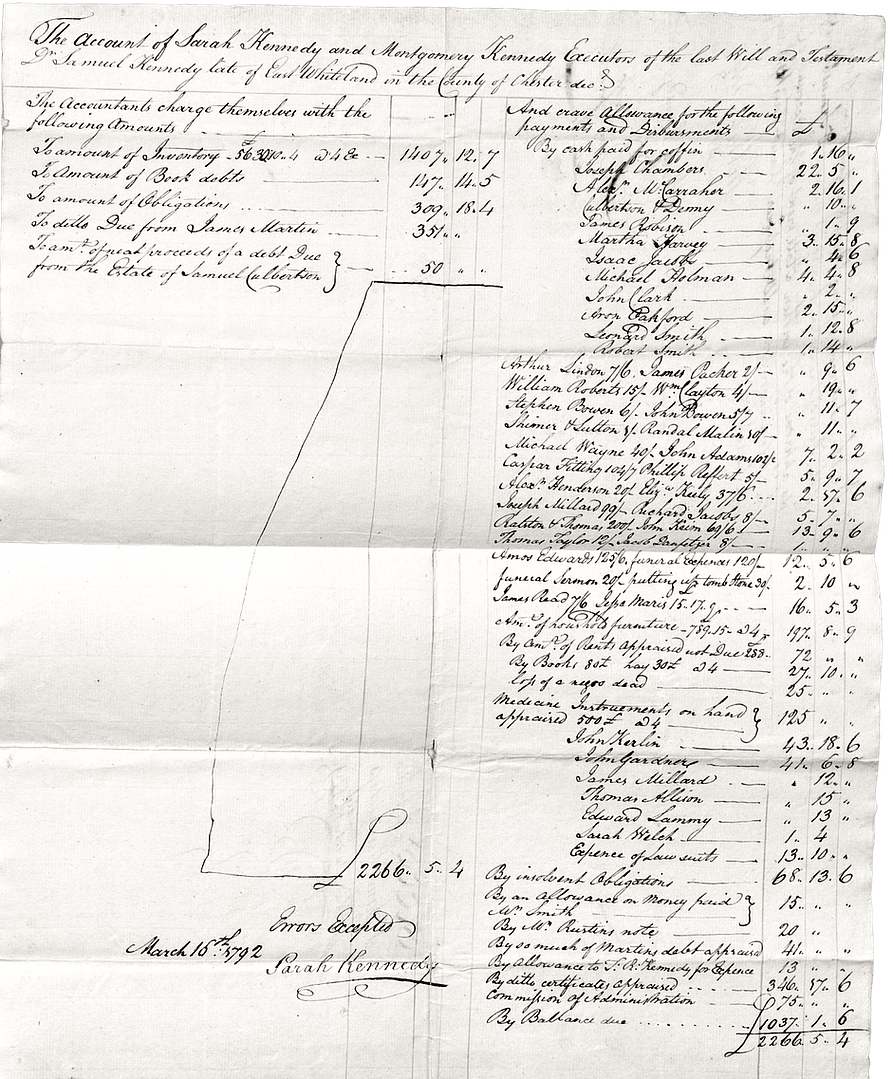

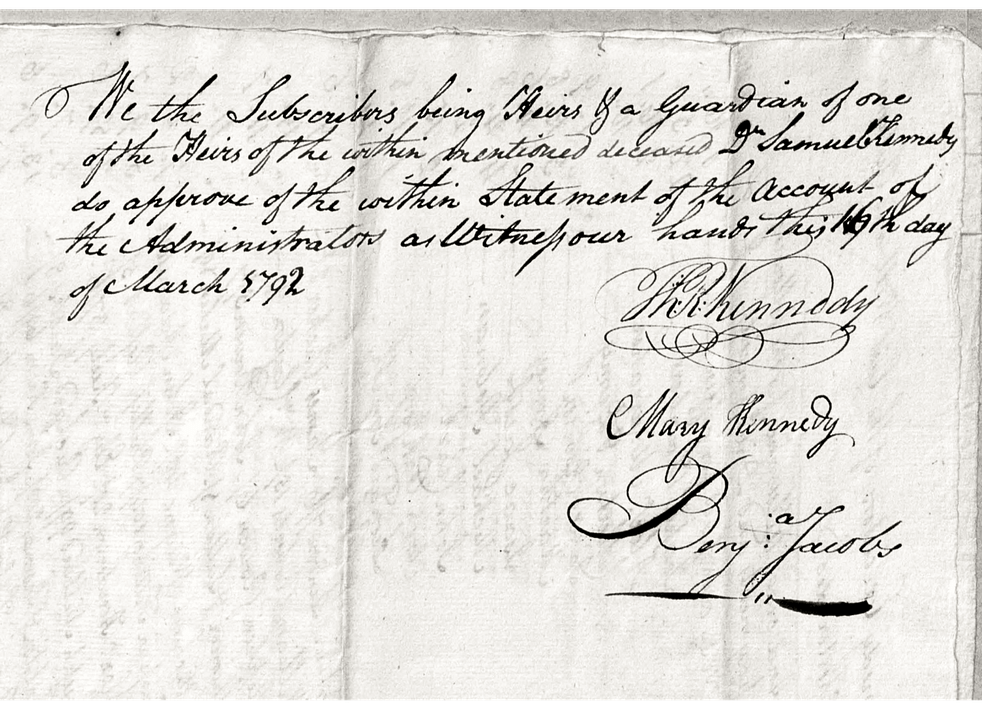
On March 16, 1792, Sarah Kennedy and Montgomery Kennedy completed the settlement of Dr. Samuel Kennedy’s estate, nearly fourteen years after his death. This document was signed and approved by two of their children, Thomas Ruston and Mary, and includes a payment made to the estate of Samuel Culbertson to help support his heirs. This settlement did far more than document Dr. Kennedy’s reburial, though payments to the people that built his new coffin and delivered his funeral sermon were also included. It finalized debts owed by the estate, payments made on its behalf, legal expenses, and numerous financial obligations that had accumulated during the long administration of the estate. Among these otherwise routine financial accounts appears a brief and striking entry recording the expense associated with the “loss of a negro dead,” valued at £22.
The record provides no additional information. The deceased person’s name was not recorded. Neither their age, gender, cause of death, nor relationship to the Kennedy household was considered important enough to preserve. Unlike Dr. Kennedy himself, whose remains were reinterred with a new coffin, funeral expenses, religious services, and numerous associated costs carefully documented in the same settlement, this individual appears only as a financial loss recorded among the estate’s accounts.
Because Rina, Lucia, and Kitte all disappear from the documentary record after 1780, it is reasonable to consider whether this unnamed individual may have been one of them. Of those three, Rina is perhaps the strongest candidate simply because she was the oldest member of the enslaved community and would have been approaching her late 50’s or early 60’s by 1792. However, the evidence falls well short of proving this conclusion.
The wording of the entry introduces additional uncertainty. Throughout the surviving Kennedy records, enslaved women were generally described as “wenches” or identified as “mulatto women,” while the word “negro” was more commonly used by itself when referring to enslaved men. The omission of any identifying language in the 1792 account makes it impossible to determine whether the deceased individual was a man or a woman. It is entirely possible that the entry references a person who was enslaved to another wealthy family associated with Yellow Springs, such as Captain Alexander McCarraher, who is also recorded as owning slaves and who became the tavern keeper after Samuel Culbertson. We cannot say for certain if this person was even associated with the Kennedy household, or if the Kennedy estate was paying for their death because somehow, during the process of reburying Dr. Kennedy, they received injuries resulting in their death.
For that reason, historians cannot identify this person as Rina. At the same time, we cannot dismiss the possibility. Until additional evidence is discovered, this brief accounting entry remains the final surviving document that may (even remotely) relate to her.
Regardless of the deceased person’s identity, the entry reveals something profoundly important about the nature of slavery itself. Dr. Samuel Kennedy’s death generated pages of documentation preserving his memory and honoring his service. Fourteen years after his death, his family still possessed the means to commission a new coffin, arrange a formal funeral, settle his estate, and preserve his reputation as a Revolutionary patriot. The unnamed enslaved individual received no recorded funeral, no marked grave, no memorial, and not even the dignity of a name. Their entire existence survives only because their death represented a financial expense within the estate’s accounts.
That contrast may be one of the clearest surviving illustrations of how slavery stripped people not only of their freedom during life, but also of their identity in death.
Legacy
Rina’s life remains significant because she represents the many enslaved people whose labor shaped the history of places like Yellow Springs, yet whose voices were rarely preserved in the historical record. The surviving documents do not provide her own words, thoughts, or memories. Instead, they preserve fragments created by the people who enslaved her, including estate inventories, tax records, and advertisements. However, by carefully examining those fragments together, it becomes possible to recognize Rina as more than a name attached to a list of property. She was a woman who protected the Kennedy household during the Revolution, cared for children, maintained a household connected to Washington Hall, and navigated a world that denied her control over her own life.
Rina’s story also reveals the contradictions of the Revolutionary era. She lived during a period when ideas of liberty and independence became central to American identity, yet those ideals did not extend to enslaved people like her. While the Kennedy family’s contributions to the Revolutionary cause were remembered through military service, medical care, and public recognition, Rina’s contributions survived only through the records created by the system that oppressed her. Her courage during the British advance, her continued labor at Yellow Springs, and the uncertainty surrounding her family demonstrate the complicated reality of freedom during the founding era.
Remembering Rina today allows historians and visitors to understand Yellow Springs as a place shaped not only by physicians, soldiers, and patriots, but also by enslaved people whose work made those histories possible. Although the details of her life remain incomplete, the evidence that survives is enough to show that Rina was not simply part of the Kennedy estate. She was a person who endured war, separation, and enslavement while creating relationships and protecting the community around her. Her story challenges us to examine whose lives are preserved in history and whose stories must be carefully recovered from the records left behind.
Further research ongoing!
Read a more in-depth version of this biography here!
Read more about the Chester County Slave Register Here
Posts Featuring Rina


Bibliography
Block, Sharon. Colonial Complexions: Race and Bodies in Eighteenth-Century America. Philadelphia: University of Pennsylvania Press, 2018. https://dokumen.pub/colonial-complexions-race-and-bodies-in-eighteenth-century-america-9780812294934.html
Chester County Archives and Record Services. “1780 Chester County Slave Register – Slave Index.” West Chester, PA: Chester County Archives, 2011. https://www.chesco.org/DocumentCenter/View/59090/1780-Chester-County-Slave-Register—Slave-Index?bidId=
Chester County Archives and Record Services. “1780 Chester County Slave Register – Township Index.” West Chester, PA: Chester County Archives, 2011. https://www.chesco.org/DocumentCenter/View/59092/1780-Chester-County-Slave-Register—Township-Index?bidId=
Colonial Pennsylvania Farmstead. “History and Research.” Edgemont, PA: Colonial Pennsylvania Farmstead. https://colonialfarmstead.org/about/history-and-research/
Encyclopedia Virginia. “Enslaved House Servants.” Charlottesville: Virginia Humanities. https://encyclopediavirginia.org/entries/enslaved-house-servants/
Faggs Manor Presbyterian Church. “Manor History – Manor Presbyterian Church.” Cochranville, PA: Faggs Manor Presbyterian Church. https://manorpresbyterian.com/manor-history/
Justia US Supreme Court Center. “Ruston’s Executors v. Ruston, 2 U.S. 243 (1796).” Justia. https://supreme.justia.com/cases/federal/us/2/243/
Malcolm, Robert M. “Advertisement for the Return of Primus.” Independent Gazetteer, October 12, 1782. Public domain image. Accessed through Newspapers.com. Accessed August 6, 2026. https://www.newspapers.com/article/the-independent-gazetteer-independent-ga/47037389/.
National Park Service. “PA Gradual Abolition of Slavery Act – March 1, 1780.” Washington, DC: U.S. Department of the Interior. https://www.nps.gov/articles/000/inde-pa-gradual-abolition-act-1780.htm
New London Township. “History – New London Township.” West Grove, PA: New London Township Historical Commission. https://newlondontwp.net/history/
Copyright Disclaimer: Under Section 107 of the Copyright Act 1976, allowance is made for ‘fair use’ for purposes such as criticism, comment, news reporting, teaching, scholarship, and research. All materials sourced from sources indicated throughout this post are referenced for the purposes of education for reference purposes.