
Throwback Thursday: Making History- Forgotten Faces from Washington Hall
We Continue to Use Historical Research to Return Imagery to Lost Revolutionary Figures
Setting the Scene
For the past few weeks, we have been exhibiting a small ‘mini-series’ where we have been using new technology that has recently become available to us in order to restore visuals to figures from the Revolutionary History of Yellow Springs. Thus far, we have explored what Persifor Frazer and Dr. Samuel Kennedy most likely would have looked like, and then have applied the same photomanipulation and research process to Polly Frazer and Sarah Kennedy, and then to the several Doctors Otto and the Surgeon’s Mate, John Rose.
This week, we are turning our attention to Rina, Lucia, and Kitte, an enslaved woman and two young enslaved girls who worked as servants in the Kennedy household.
Tools of the Trade
To distinguish these representations from the stylized portraits we created earlier, we will use digital photomanipulation to produce unified images of the individuals we are portraying.
We will create these images with the Procreate digital art program, stock photographs from sources such as Pexels, and public domain reference images. Afterward, we will process the photomanipulations through a Picsart filter to give them a consistent visual style. However, it is important to note that the filter that we use on Picsart has an AI image generation aspect to it that cannot be removed. This process may result in incorrect details and “AI artifacts” that have been added to the final image, though we have taken steps to limit that as much as possible.
We will also draw on materials from the Moore Archives to provide greater historical context for these representations.
Rina
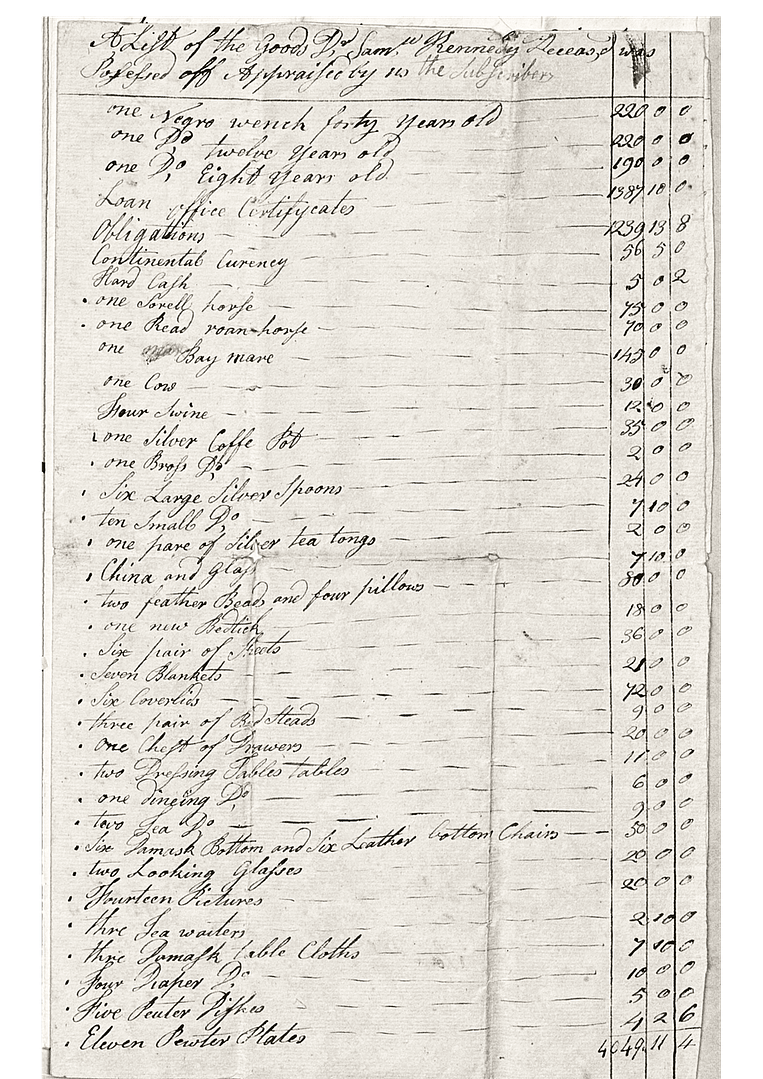
When we began conducting research in preparation for America 250 around this time last year, one of the most important figures we wanted to include was a woman named Rina. Rina, whose surname we do not know, appears in historical records only through the Pennsylvania slave records and in the index of Dr. Samuel Kennedy’s estate.
Rina is almost undoubtedly the 40-year-old “mulatto wench” who is listed as the first item of property included in Dr. Kennedy’s Estate. It is important to note here that “wench”, during this era, was not used the same way we use it today— during this era, it would have meant something similar to “lady’s maid” or “domestic servant”. Like the six “playable characters” from our Living History exhibition, we created a reconstruction of Rina earlier this year.
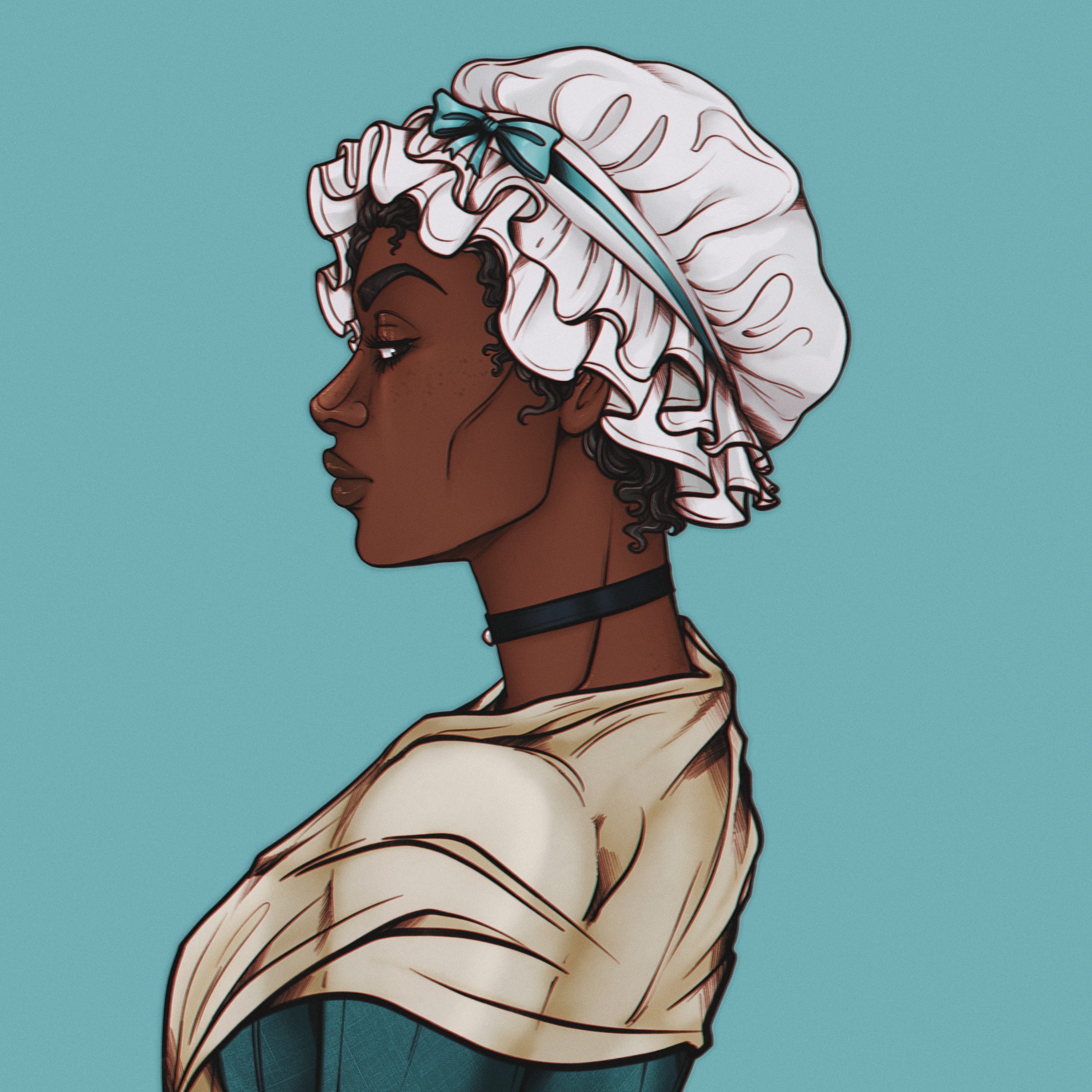
You can read more about the research behind that reconstruction, and the reasoning we used to portray her in that way, here. You can also read through the exhibit experience through Rina’s eyes, as it has been archived online here.
For centuries, Rina’s life was overlooked and nearly forgotten, an almost added insult to the suffering she endured as an enslaved woman.
While nothing we can do today can undo the cruelty and harm that Rina experienced, we can, as historians and history enthusiasts, remember her with accuracy and fidelity. We can also preserve the understanding that even though her name appears only once in our surviving records, her personhood deserves to be recognized every time we reflect on what life was like at Washington Hall.
The same is true for Lucia and Kitte, about whom we tragically know even less.
We discussed the attire that we chose for Rina at length in our previous post about how and why we chose to depict her artistically for our exhibition, though we will go a bit further into her attire here.
Rina, Reimagined

Lucia
In the 1780 Slave Register, Lucia is listed as a “mulatto girl” who was 10 years old. In the 1778 Samuel Kennedy estate index, we likely identify her as the younger enslaved girl aged 8. These recorded ages are inconsistent across documents. Rina’s age shifts from 40 in 1778 to 45 in 1780. Because of this, we treat the 1778 estate index as the main source for Lucia’s reconstruction.
In 1778, Lucia likely lived under labor, surveillance, and dependence at Washington Hall. Enslaved children in elite Pennsylvania households often started domestic work very young. Girls assisted with childcare, cleaning, laundry, water carrying, sewing, and serving meals.
The Kennedy household likely held high social status and elite connections. Lucia probably worked inside the main house rather than in field labor. Historians note that enslaved labor in Pennsylvania often focused on domestic service in wealthy homes. Enslaved children still remained legal property under strict control. The 1780 Gradual Abolition Act allowed existing slavery to continue in Pennsylvania (1).
Wealthier households sometimes dressed enslaved domestic servants in cleaner or more fashionable clothing to reflect the household’s status, although these garments were still controlled by enslavers and were usually made from inexpensive materials. Research from Colonial Virginia- such as published in Encyclopedia Virginia in an article contributed by Katherine Egner Gruber- notes that enslaved women and girls often wore combinations of shifts, petticoats, jackets, kerchiefs, and caps, while children sometimes went barefoot, especially when young (2).
In an aristocratic household influenced by British and French fashion culture, a young domestic servant like Lucia may also have worn clothing styled after elite servant attire on a simpler scale, particularly if she worked closely with the household’s women or guests.


However, few records survive that describe the exact clothing worn by enslaved girls in eighteenth-century Pennsylvania households, so historians must rely on broader evidence from Mid-Atlantic and colonial domestic slavery to make careful interpretations.
Lucia, Reimagined

Kitte
In the 1780 Slave Index, Kitte is listed as a 12 years old “mulatto girl”. Contrastingly, in Dr. Kennedy’s estate index, she is also listed as 12 years old, further shedding light on how the ages of the women who were enslaved in the Kennedy household were dubiously recorded and may have been reduced for the disturbing thought that it would make them appear more “valuable”. Regardless, in 1778, Kitte appears in the same household record context as Lucia and Rina, but her slightly older age- about 12- would have placed her in a transitional stage between childhood dependency and more sustained domestic labor within the Kennedy household at Yellow Springs.
Rather than primarily assisting or shadowing adult women, Kitte would likely have been expected to carry out assigned duties with greater independence, such as extended cleaning routines across multiple rooms, more regular laundry work, kitchen assistance, and possibly serving or attending household guests during meals or gatherings. Research on Mid-Atlantic slavery, such as the publication by Encyclopedia Virginia and Leni Sorensen on Enslaved House Servants, emphasizes that domestic labor systems in elite households were structured to train enslaved children into permanent service roles, with increasing responsibility assigned as they approached adolescence (3).
Within this same household structure, Rina, Lucia, and Kitte would have existed within a closely interconnected domestic community, though the exact nature of their relationships cannot be confirmed from surviving records.
It is also highly likely that Rina was the mother of one or both girls. This cannot be confirmed by records, but since enslaved family structures in Pennsylvania were matrilineal under the legal principle- partus sequitur ventrem – that children inherited the status of their mother. In Sasha Turner’s 2015 online article “The Invisible Threads of Gender, Race, and Slavery,” we learn about how this system structured enslaved women’s reproductive lives and determined the inherited condition of slavery across British North America (4).
This legal rule made children follow their mother’s enslaved status. In this system, relationships like those between Rina, Lucia, and Kitte cannot appear as simple gaps in the record. Slavery shaped how people recorded, hid, or erased kinship ties. Turner explains that enslaved women’s reproductive lives sit at the center of history. At the same time, archives make those ties hard to prove. Household records often reduce people to ages, labels, and property lists.
Because of this, we cannot confirm family relationships between Rina, Lucia, and Kitte. Turner’s framework still requires us to consider that they may have shared kinship. Slavery’s recordkeeping system never aimed to preserve those bonds clearly. We must accept that uncertainty comes from the system itself, not from missing research.
Even without confirmation, we treat a possible family connection as historically plausible. That possibility also informed how we aligned their reconstructed faces.
Kitte, Reimagined

To Us, Today
The reconstructions of Rina, Lucia, and Kitte extend our understanding of life at Washington Hall. They push us beyond the limits of surviving records. Archives often reduce people to short entries, ages, or property lists. Still, historical evidence allows us to rebuild patterns of labor, clothing, age, and household structure. This process restores individuality and presence to people long made invisible by record systems.
This work does not claim full certainty. It uses responsible interpretation instead. It respects the limits of what sources can prove. It also refuses to let silence replace erased lives. By combining archives, scholarship, and visual reconstruction, we better understand enslaved women and children in Revolutionary-era elite households in the Mid-Atlantic.
We must also recognize the role of modern tools in this work. Digital platforms, stock images, and AI-assisted editing shape these reconstructions. These tools help visualize people who were never drawn or photographed. They also introduce uncertainty and possible distortion. Careful transparency about those limits remains essential.
This project connects past and present. Rina, Lucia, and Kitte reveal systems of slavery, gender, and childhood in early America. Those systems still shape how we understand history today. Remembering them requires responsibility. It forces us to ask how history gets recorded, who gets preserved, and who gets left out.

🧺🪣🌿
Learn more about the history of Yellow Springs
You can read the more in-depth version of this post here
Follow us on Substack, Instagram, and Facebook
🧺🪣🌿
Works Cited
- Chester County Archives and Records Services. “1780 Slave Register.” Chester County, Pennsylvania. Accessed April 23, 2026. https://www.chesco.org/4572/1780-Slave-Register.
- Gruber, Katherine Egner. “Clothing and Adornment of Enslaved People in Virginia.” Encyclopedia Virginia. Accessed April 23, 2026. https://encyclopediavirginia.org/entries/slave-clothing-and-adornment-in-virginia/.
- Sorensen, Leni. “Enslaved House Servants.” Encyclopedia Virginia. Virginia Humanities, December 7, 2020. https://encyclopediavirginia.org/entries/enslaved-house-servants/
- Turner, Sasha. “The Invisible Threads of Gender, Race, and Slavery.” African American Intellectual History Society (AAIHS), April 13, 2017. https://www.aaihs.org/the-invisible-threads-of-gender-race-and-slavery/