
Reverend James Sproat (Character Details)
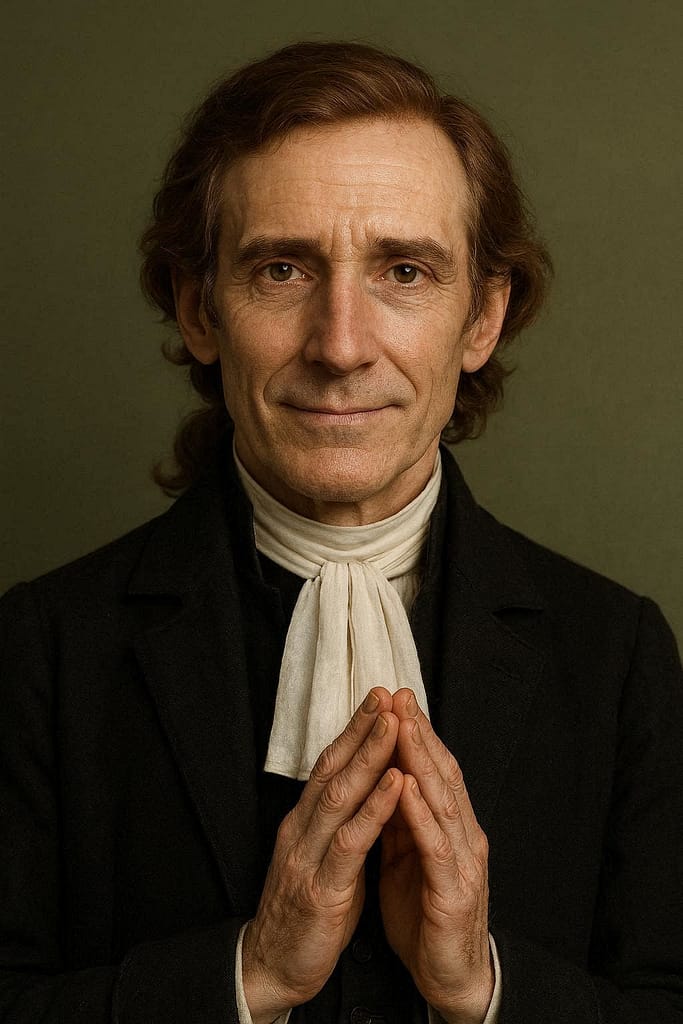
Brief Character Description
Reverend Dr. James Sproat was a Presbyterian minister from Massachusetts who became the Chaplain for the Hospitals in the Middle Department during the Revolutionary War. By the winter of 1777–1778, Sproat was about 56 years old and had spent more than three decades in the ministry. He had served Presbyterian congregations in Connecticut before becoming pastor of the Second Presbyterian Church in Philadelphia in 1768. His education at Yale and long career as a minister gave him the standing expected of a learned eighteenth-century clergyman.
During the Revolutionary War, Sproat traveled between Continental Army hospitals throughout Pennsylvania and the surrounding region. He preached to soldiers, prayed with patients who were too sick to attend services, and visited men who were dying. His journal shows that he regularly traveled to Yellow Springs, where he worked alongside physicians and hospital staff. He also developed close relationships with Dr. Samuel Kennedy and Dr. Bodo Otto Sr. For our purposes, Sproat should be portrayed as a middle-aged man in his mid-fifties. An actor in his fifties or sixties would be appropriate for the role.
Character Background in the Summer of 1778
By the summer of 1778, James Sproat was an established Presbyterian minister with more than thirty years of experience in religious leadership. He was born in Scituate, Massachusetts, on April 11, 1722, to Lieutenant Ebenezer Sproat and Experience Hawes Sproat. His family came from the religious communities of Plymouth County, and his maternal ancestry connected him to some of the earliest English settlers in New England. Through his maternal grandmother, Desire Gorham Hawes, Sproat descended from John Howland and Elizabeth Tilley, both passengers on the Mayflower in 1620.
Sproat lost his father when he was only four years old. His mother raised him within a family and community that placed a strong value on religious education. He later attended Yale College and graduated in 1741. His education prepared him for the ministry at a time when ministers were among the most highly educated members of colonial communities. He entered the ministry in 1743 and spent the next two decades serving Presbyterian communities in Connecticut.
Sproat also experienced significant personal loss during these years. He and his wife, Sarah Smith, had a large family, but several of their children died in infancy or childhood. Their son William later served as a captain in the Fourth Pennsylvania Line during the Revolutionary War. Sproat therefore understood the fear and uncertainty faced by families whose sons entered military service.
In 1768, Sproat succeeded Reverend Gilbert Tennent as pastor of the Second Presbyterian Church in Philadelphia. His new position placed him in one of the most important religious communities in British North America. By the time the Revolutionary War began, he had spent decades as a minister and had established a reputation as an educated and respected Presbyterian leader.
On February 10, 1778, Congress elected Sproat as Chaplain for the Hospitals in the Middle Department. The Middle Department, at this time, consisted of the territories that would later become the states of Pennsylvania, New Jersey, Delaware, and Maryland. His assignment covered military hospitals throughout Pennsylvania and surrounding areas, including Philadelphia, Northampton, Berks, Lancaster, and Chester Counties. Unlike a parish minister who served one congregation, Sproat traveled between hospitals to provide spiritual care to Continental soldiers.
Sproat’s journal provides a detailed record of this work. He visited hospital wards, preached sermons, prayed with individual patients, and spoke with men who were too sick to leave their beds. His entries also record the conditions of the hospitals and his interactions with physicians, nurses, attendants, and local families.
Sproat first reached Yellow Springs on April 25, 1778. He recorded that he visited the hospitals, spoke and prayed with patients who could not attend his sermon, and then lodged at Dr. Samuel Kennedy’s home. The next day, he described the hospital as “very neat” and said that the sick were “comfortably provided for.” His observations show that his ministry involved more than preaching to groups. He actively sought out patients who could not attend services because of their condition.
Sproat continued visiting Yellow Springs throughout 1778, 1779, and 1780. He was present for the decline of Dr. Kennedy’s health that would result in his death. He repeatedly preached to patients, lodged with Dr. Otto, and maintained relationships with the physicians and local families connected to the hospital. His journal makes him one of the most important eyewitnesses to the Yellow Springs hospital community during the Revolutionary War.
His role also connected him personally to the families affected by the war. During his April 1778 travels, he visited his son William at Valley Forge and recorded that he was in good health. At Yellow Springs, Sproat also performed religious duties for members of the hospital community, including baptizing a soldier’s child.
Sproat’s work required constant travel under difficult conditions. His journal records snow, rain, extreme heat, poor roads, swollen rivers, and long rides between hospitals. Even when exhausted, he continued preaching and visiting patients. His work at Yellow Springs therefore reflected both his formal responsibility as a hospital chaplain and his personal commitment to caring for sick and wounded soldiers.
Character Physical Description
Reverend James Sproat was about 56 years old during the winter of 1777–1778 and the summer of 1778. At 56, he would not have been considered a young man, but he would still have been capable of making long journeys on horseback and spending hours moving between hospital wards and nearby barns. His appearance should suggest an experienced clergyman who had spent decades preaching and studying rather than a wealthy civilian dressed for a formal portrait.
Sproat’s clothing should also communicate his position as a learned Presbyterian minister. His black clothing would distinguish him from soldiers and from many of the civilians he encountered during his travels. Presbyterian ministers belonged to a Reformed tradition that associated black clerical dress with seriousness, scholarship, and preaching. The Geneva gown became an established symbol of learned preaching within the Reformed tradition, while preaching bands served as a recognizable form of clerical neckwear.
Sproat should have a mature appearance appropriate for a man in his mid-fifties and his attire should be mostly black. On the road, he would wear a lightweight black linen or thin worsted wool frock coat, a matching waistcoat, and knee-breeches (often referred to as a “ditto suit”) layered over a breathable white linen shirt and paired with a Presbyterian-stye clerical collar. Because flour and starch were desperately rationed for the army, a powdered wig would be out of the question, even if other Presbyterian ministers (including Sproat himself, later in life) wore them in more comfortable circumstances. Instead, he would wear his hair natural and unpowered, tied back at the nape of his neck with a plain black ribbon. He may also have shielded his face from the summer sun with a simple tricorne hat.
Costume Details
- Black or very dark wool frock coat suitable for a Presbyterian minister traveling between hospitals.
- Matching dark waistcoat worn beneath the coat.
- Knee-breeches in black or another very dark, subdued color. A matching coat and breeches would give Sproat the appearance of an educated gentleman while remaining appropriate for a clergyman.
- Plain black linen shirt worn beneath the waistcoat.
- White linen preaching bands or a simple clerical neckband to identify Sproat as an ordained Presbyterian minister.
- An example of the correct sort of clerical collar / preaching band can be seen here
- Black wool stockings or other plain dark stockings.
- Plain leather shoes with period buckles. His shoes should be practical enough for frequent travel but appropriate to his position as an educated professional.
- A plain, black tricorne hat was suitable for travel and outdoor hospital visits. It would not have embellishments on it.
- Natural hair worn long enough to tie back neatly at the nape with a plain dark ribbon.
- TLDR: His black coat, dark waistcoat, knee-breeches, black linen shirt, and white preaching bands should establish Sproat’s position as a clergyman. His clothing should be neat and respectable, but it should also reflect the difficult conditions under which he traveled between Continental hospitals.
.jpg)
We can assist with costuming depending on sizing. Regardless of sizing, we have accessories available for Sproat.
Full character biography (research ongoing!) can be found here
Interested in acting as Reverend Sproat in our Town Tours and Village Walks Event in 2026?
Please click through to this form, select Sproat from the dropdown menu, and fill out the rest of the form! We will be in contact with you shortly!
(You can also scan the QR code below with your mobile phone to be brought to the same form for more details)