
Throwback Thursday: Letter to Johnathan Potts from John B. Cutting
Examining Our Archives Uncovers a Scan of John B. Cutting’s Original Letter to Jonathan Potts
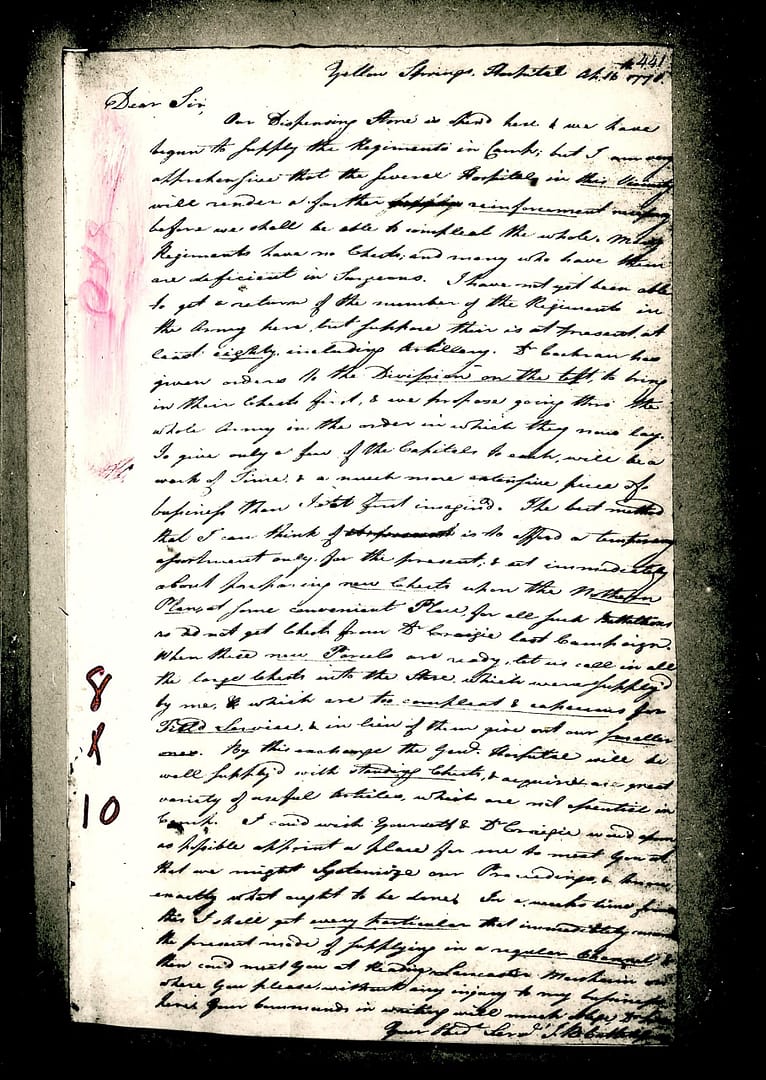
What Is This?
This is a photographic scan of a letter that Dr. John B. Cutting, the Apothecary General for the Hospital Department during the American Revolutionary War, sent while he was at Yellow Springs to Dr. Jonathan Potts. This photographic scan is a copy from the original document, and included a scan of the address to the letter that Cutting included.
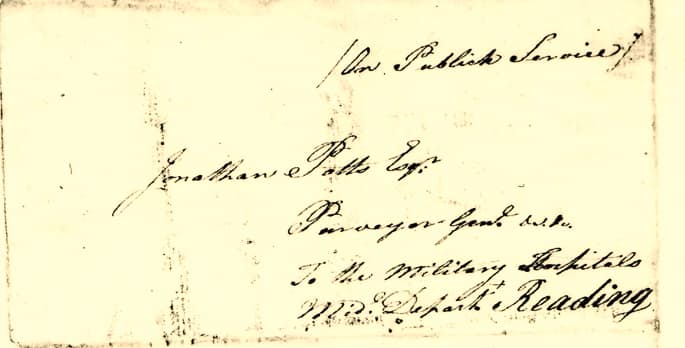
This letter was written on April 16th, 1778.
A transcription of the letter in full reads as follows:
“[From] Yellow Springs.
Dear Sir:
Our dispensing store is opened here, and we have begun to supply the regiments in camp, but I am very apprehensive that the several hospitals in this vicinity will render a further reinforcement necessary before we shall be able to complete the whole. Many regiments have no chests, and many who have them are deficient in surgeons.
I have not yet been able to get a return of the number of regiments in the army but suppose at present there are at least eighty, including artillery. Dr. Cochran has given orders to the division on the left to bring their chests first, and we propose going through the entire army in the order in which they now lay. To give only a few of the capital medicines to each will be the work of time and a much more intensive piece of business than I first imagined. The best method that I can think of is to act immediately about preparing new chests at some convenient place for all such battalions that did not get chests from Dr. Craigie in the last campaign. When these new parcels are ready, let us call all the large chests into stores; these are too capacious for field service, so in lieu of them, we will issue smaller ones. By this exchange, the General Hospital will be well supplied with standing chests and acquire a great variety of useful articles which are not essential in camp.”
This transcription of the letter above comes from the book Dr. Bodo Otto and The Medical Background of the American Revolution, written by James E. Gibson (1). The book was first published in 1937 and later re-released in Kindle format. It provides valuable information about the context of the Hospital Department. It also includes several other details that help us better understand and build the historical world surrounding Washington Hall.
What Did This Mean At The Time?
To set the scene, we will take a broader look at the Hospital Department during the Revolutionary War. From what we have already learned about Washington Hall, we know that it often lacked the supplies it needed to operate fully. This happened even though it served as the main supply depot for the department and even though George Washington visited it himself. Washington Hall and the hospital complex at Yellow Springs frequently struggled to get enough resources. The medical staff and members of the surrounding community stepped in to fill these gaps in infrastructure. Because of their dedication and hard work, the soldiers sent there were able to recover.
By 1781, Dr. Otto Sr. asked Congress not to close Washington Hall. At that time, the medical staff had gone unpaid for a long period, and food rations had dropped to dangerously low levels. This problem was not new. It happened again and again. We see clear evidence of it in a letter dated April 16, 1778, written by Dr. Cutting. In that letter, he described the serious shortages facing the hospital. Another letter, dated April 27, 1778, came from Dr. Kennedy. He also wrote to Dr. Potts and asked for help in getting much needed supplies. Together, these letters show that supply shortages and lack of support remained ongoing and serious challenges for the hospital department.
Who is Purveyor Potts?
Dr. Potts refers to Dr. Jonathan Potts. Dr. Cutting and Dr. Kennedy wrote to him. He served as Purveyor General for the Hospital Department.
During the American Revolutionary War, the Purveyor General managed hospital supplies. The Continental Congress appointed him. He purchased and distributed medicines, instruments, bedding, food, furniture, tents, and clothing. He provided all materials needed to treat sick and wounded soldiers.
Dr. Potts controlled where supplies went. Staff at Yellow Springs wrote to him for help. Yellow Springs also served as the main supply depot. This makes the 1778 shortages especially troubling.
The flying hospitals at Valley Forge also lacked supplies. These hospitals treated soldiers too sick to move. They faced constant shortages. On December 17, 1777, George Washington urged Congress to address major supply failures.
Congress formed the Committee at Valley Forge. This Committee of Conference arrived in January 1778. Members met directly with Washington. He described troop suffering and supply breakdowns. The committee reviewed leadership and supply systems. They recommended reforms to improve distribution, including medical supplies. Some reorganization followed. Shortages and transport problems continued.
Leaders then chose Yellow Springs as a central depot. Washington Hall became the main supply hub. Dr. Potts supported this choice for better oversight. James Craik preferred Carlisle, Pennsylvania, because of supply routes. Potts’ authority prevailed.
Washington Hall became Middle Department headquarters. It also operated at least four hospitals. It served as the central supply hub.
If Yellow Springs lacked supplies, other hospitals suffered too. On May 15, 1778, Dr. Craik wrote to Dr. Jonathan Potts. He described problems at Valley Forge. He also mentioned Dr. Cutting and Yellow Springs.
“As I am willing that there should be no cause for complaint against our department, I embrace every opportunity to inform you of our wants.
I have just returned from Yellow Springs and that neighborhood where I have given directions that additional hospitals be opened.
More stores, of course, will be needed and as the following articles are scarce, a fresh supply is immediately wanted of coffee, tea, chocolate, vinegar, writing paper, pots, kettles, and salt. All of these will be required in large quantities as a number of hospitals must be supplied. The Flying Hospital is in need of vinegar, so I wish you to send a couple of hogs heads directly.
I am sorry Dr. Cutting went away before the regimental chests were finished, for there is great clamor about them, though a Dr. Lugman is as busy as possible. I am afraid there are not enough medicines here to keep the regiments supplied. I hope Dr. Craigie will soon have his chest ready. I should be glad to know how wagons are to be furnished to the different hospitals. They will require some one constantly with them to supply wood.
Assistant commissaries will be wanted for the new hospitals. Let us be furnished with a quantity of beds, tubs, sheets, and blankets as soon as possible; otherwise, the sick can never be kept clean and comfortable. It will be necessary to send down a quantity of money, as the commissaries are in much distress from lack of cash. The surgeons are likewise anxious to have their pay. The money I brought down will go only a very little way. I think Mr. Morris had best come down as soon as he can and settle with the commissaries, for paying the people punctually will make them more ready to oblige besides keeping our credits good. I think if you would procure a person of character who can properly keep books, it would not be amiss to do so, for such a person could take charge of the stores at Yellow Springs, enabling Mr. McCarake to better attend to the outside business. When you send down a proper supply of stores, the care of them will be of considerable importance. It will be proper to keep us well supplied with vinegar, for there is much demand for it. “His Excellency went out to the Yellow Springs two days ago to visit the hospitals and found them in fine order. He spoke to every person in their bunks, which exceedingly pleased the sick. He was highly pleased to find the hospitals in such order. If we can keep up this character, we shall do very well. I am sorry that the general store of necessities is at such a distance from the hospitals as it is a long time before they can be received after written for. A little time now will determine whether we shall get into Philadelphia. Various are the opinions at present. By all accounts, it would appear that the enemy is soon going somewhere. Forage and heavy cannons are being put aboard the transports, as well as wood and water.
Many of our soldiers are ordered into tents. They begin to be more sickly than they have been, but wagons cannot be conveniently had to carry the sick to the hospitals.
I wish that Dr. Cochran’s dispensary chests could be sent soon, for he could then stop the mouths of the noisy.”
Like the transcription of the letter that we have a copy of in our archives above, we have sourced this information from Gibson’s book as well (2).
Dr. Craik and Dr. Potts
In his letter to Potts above, Craik reports the urgent needs of the Hospital Department. He requests immediate support to keep the hospitals running smoothly.
He explains that officials have opened additional hospitals around Yellow Springs. He stresses that many supplies remain scarce. These include coffee, tea, chocolate, vinegar, writing paper, pots, kettles, salt, beds, tubs, sheets, blankets, and medicines for the regiments.
He calls for wagons and workers to manage supplies and firewood. Neighbors such as Zachariah Rice likely began helping with this work instead. He also asks for assistant commissaries. He requests a trustworthy person to keep accurate records at Yellow Springs.
Craik states that the department urgently needs cash. They must pay commissaries and surgeons on time. He argues that prompt payment will protect morale and ensure cooperation. He praises the hospitals at Yellow Springs for their order and cleanliness. He notes that even Washington felt pleased with their condition. However, he warns that delays in receiving stores create serious problems.
He reports that many soldiers grow increasingly sick. He explains that transporting them to hospitals remains difficult. He stresses that dispensary chests must arrive on time. Without them, complaints will rise and operations will suffer.
However, events after this letter suggest that Potts secured little helpful aid. That being said, we know the support he obtained did not greatly improve the situation.
So Who Was Dr. Cutting?
Unfortunately, we cannot easily find well-sourced information about Dr. John B. Cutting’s personal life. We are conducting additional research to learn more about his full biography. Our archives and research, along with Gibson’s well-researched book, provide key details. These sources confirm that Dr. Cutting served as Apothecary General for the Hospital Department. During the brutal winter at Valley Forge, he was stationed at Yellow Springs.
As Apothecary General, he oversaw the procurement, preparation, and distribution of medicines and medical supplies. He managed supplies for the Middle Department hospitals. He tracked inventories and coordinated with the Purveyor General. He ensured surgeons and regimental hospitals received dispensary chests on time.
He supervised assistants who stored and transported medicines. He maintained records of supplies received and dispensed. He made sure workers used scarce resources efficiently. During the winter of 1777 to 1778, hospitals were overcrowded and supplies were very limited. Cutting’s role was critical in preventing medicine shortages. He maintained proper storage to prevent spoilage. He supported medical operations under extremely difficult conditions. His work directly affected care for soldiers at Yellow Springs and nearby hospitals. This occurred during one of the harshest periods of the Revolutionary War.
We do not know his exact birth date. Before Yellow Springs, he worked around Long Island in New York. After the British attacked Long Island, Washington ordered supplies sent to Newark, New Jersey. Dr. Cutting took charge of those supplies (3). This happened around 1776.
By 1778, Cutting served as apothecary for the entire Hospital Department. This likely explains his assignment at Yellow Springs.
Gibson’s book mentions Cutting several more times. It describes a public exchange of open letters between Cutting and Dr. Morgan. Newspapers published these letters. The letters increasingly included personal attacks (4).
In these letters, Cutting claimed Morgan planned to leave for the West Indies. He said Morgan changed his plans after Dr. Rush promised support against Dr. Shippen (4). To understand this accusation, we must examine the conflict among Morgan, Shippen, and Rush.
Crisis With the Doctors
Who Was Dr. Shippen?
Dr. William Shippen Jr. was a leading Philadelphia physician, born in 1736. He became a key figure in medical education and military medicine. In 1765, he co-founded America’s first medical school at the College of Philadelphia with Dr. John Morgan (5). The school trained colonial physicians and later became the University of Pennsylvania. Sources show that early graduates included Dr. Jonathan Potts and two of Dr. Bodo Otto’s sons, Frederick Otto and Bodo Otto Jr.
Shippen later used his academic and political ties to replace Dr. Morgan as Director of Hospitals for the Continental Army (6). Many accounts claim he acted unfairly to gain the position. On April 11, 1777, Congress reorganized the hospital system and appointed Shippen Director General (7). This role gave him control over all medical services.
In office, he faced charges of mismanaging supplies and diverting resources. Critics said he underreported soldier deaths (8). Dr. Morgan and Dr. Rush supported these claims. A court-martial followed in 1780, but officials acquitted him on a technicality (8). He resigned on January 3, 1781 (8). His leadership remained controversial and likely harmed the supply chain at Yellow Springs and beyond.
Who Was Dr. Morgan?
Dr. John Morgan, born in 1735, was also a Philadelphia physician. He co-founded the College of Philadelphia’s medical school with Shippen. At the start of the American Revolution, he organized the Continental Army’s Hospital Department (9).
As Director General, he tried to centralize care and standardize reports (9). Many surgeons and political rivals resisted him (10). He lost control over subordinates, including Shippen. Shippen influenced Congress to limit Morgan’s power in 1776. Congress replaced Morgan in early 1777 (10).
Morgan defended his name and joined Dr. Benjamin Rush in accusing Shippen. Their actions led to the 1780 court-martial (10).
Who Was Dr. Rush?
Dr. Benjamin Rush was a Philadelphia physician and public thinker. He signed the Declaration of Independence and pushed for medical reform (11).
In 1777, leaders appointed him Surgeon General of the Middle Department. He worried about hospital conditions, especially after Valley Forge (11). He believed combining supply and medical roles harmed care. He publicly criticized Shippen’s control of both duties (12).
In 1777 and 1778, Rush wrote to Congress and General Washington. He demanded reform, accountability, and clear death reports (12). When Congress failed to act, he resigned in 1778. He continued pushing reforms and supported charges against Shippen (12).
So What Happened Here?
During this time, Dr. Morgan tried to oversee and standardize medical care. Officials removed him from his position. He later challenged Dr. Shippen’s administration. Dr. Shippen took control of the Continental Army hospitals and centralized authority. This move created tension over management and accountability. People accused him of using his position for personal gain. Dr. Rush called for structural reforms. He criticized Shippen’s mismanagement and the concentration of supply and medical authority in one office. These conflicts caused ongoing problems in the hospital department. Supplies were misallocated. Officials underreported needs. Shortages continued and harmed patient care.
It is intriguing that Dr. Cutting seems to have sided with Dr. Shippen over Dr. Morgan and Dr. Rush. Dr. Cutting would have seen supplies dwindling. He also would have seen that administrators did not manage operations correctly or on time.
Gibson’s book includes some of Shippen’s writings in his own defense. In these writings, Shippen directly references Dr. Cutting (13).
“That the sugar was also purchased with my own money and for my own use, will appear from the following declaration: Dr. Cutting, late Apothecary General of the Hospitals, was asked whether I had not sent him to Boston in the Fall of 1777, to look for medicines, instruments, and such stores as could be purchased cheaply, and at the same time, if I had given him a sum of my own money to lay out in sugar or any other article that would be worth bringing to Philadelphia. He answered, ‘You did.’
I then asked whether he did not purchase sugar for me and transport it to Bethlehem at my expense? His reply was, I did; I cannot collect the exact quantity but believe it was 2800 weight, contained in 3 tierces.’
I next asked; instead of laying out all my money for my din vantage, did you not use the greater part of it to purchase and pay for medicine for the hospital? Things that you could not get and transport into Pennsylvania without cash?
Dr. Cutting answered, “‘I did; the public {Government} wanted many medicines which at that time could not be obtained without a prompt payment.’ Hence it appears that my money not only purchased and transported 3 tierces of sugar for me, but a majority of it was laid out for public use.
Gibson also notes that someone used a false name on bills for sugar and wine that Shippen sold. Gibson calls this regrettable. Morgan strongly criticized this action. However, sworn testimony from Shippen’s trial stated that this occurred without Shippen’s knowledge (13).
To Us, Today
When we study history, we must remember that victors often shape the story. The conflict among Shippen, Morgan, and Rush appears messy today. It was likely just as messy at the time. Dr. Cutting seems to defend Dr. Shippen. He also appears to hold a personal grudge against Dr. Morgan. This complicates how we view him in the story of Washington Hall.
Many sources show that officials did not maintain supply lines properly. Records from Shippen’s court-martial add more detail. They show that people under him signed for items like the wine mentioned earlier. Because of this, we cannot place all the blame on Shippen. However, history often treats him as responsible.
Dr. Cutting’s letter to Dr. Potts reflects this breakdown in the supply chain. War often disrupts even careful planning. In this war, British forces purposely sabotaged supply lines. Plans made on paper did not always work in practice. Still, evidence suggests shady actions within the Hospital Department. Those with the least power paid the price. Soldiers, nurses, and physicians at Washington Hall suffered. Leaders often made decisions based on personal loyalties and grudges.
When we reflect on this situation and Cutting’s letter, we see that actions carry consequences. Leaders who mismanage supplies harm vulnerable people. Leaders who act on grudges create real damage. Leaders who fail to enforce accountability weaken the system. At Washington Hall, unclear authority and personal loyalties shaped outcomes. Soldiers, nurses, and physicians bore the consequences.
We do not know Cutting’s private views about the Department. We know he tried to secure needed supplies. However, his loyalty to Shippen may have limited his judgment.
This lesson still matters today. Organizations need transparency, oversight, and clear responsibility. Careful planning alone is not enough. Leaders must follow through and act ethically. Decisions must consider their impact on those they serve.
📦🍷⚖️
Learn more about the history of Yellow Springs
You can read the more in-depth version of this post here
Follow us on Substack, Instagram, and Facebook
📦🍷⚖️
Works Cited
- E. Gibson, James. Dr. Bodo Otto and The Medical Background of the American Revolution (p. 203).
- E. Gibson, James. Dr. Bodo Otto and The Medical Background of the American Revolution (p. 217-218).
- The Army Medical Department 1775-1818, by Mary C. Gillett, Center of Military History, United States Army, p. 67
- E. Gibson, James. Dr. Bodo Otto and The Medical Background of the American Revolution (p. 339).
- University of Pennsylvania Archives. “Medical School.” Accessed March 2026. https://archives.upenn.edu/exhibits/penn-history/18th-century/medical-school/
- Shippen, William Jr., to George Washington, October 29, 1776. Founders Online, National Archives. Accessed March 2026. https://founders.archives.gov/documents/Washington/03-07-02-0039.
- University of Pennsylvania Archives. “William Shippen Jr.” Accessed March 2026. https://archives.upenn.edu/exhibits/penn-people/biography/william-shippen-jr/
- Army Medical Department Center of History and Heritage. “History of the Army Medical Department, Chapter 2: The Continental Army Medical Service.” Accessed March 2026. https://achh.army.mil/history/book-rev-gillett1-ch2.
- “John Morgan.” Encyclopædia Britannica. Accessed March 2026. https://www.britannica.com/biography/John-Morgan-American-physician-and-educator.
- American Medical Biographies: John Morgan. Wikisource. Accessed March 2026. https://en.wikisource.org/wiki/American_Medical_Biographies/Morgan%2C_John.
- American Battlefield Trust. “Benjamin Rush.” Accessed March 2026. https://www.battlefields.org/learn/biographies/benjamin-rush.
- Redd, N. “The Continental Army’s Medical Crisis: Benjamin Rush’s Whistleblowing in 1778.” Military.com, November 22, 2025. Accessed March 2026. https://www.military.com/feature/2025/11/22/continental-armys-medical-crisis-benjamin-rushs-whistleblowing-1778.html.
- E. Gibson, James. Dr. Bodo Otto and The Medical Background of the American Revolution (p. 370).