
Throwback Thursday: Letters of Persifor Frazer
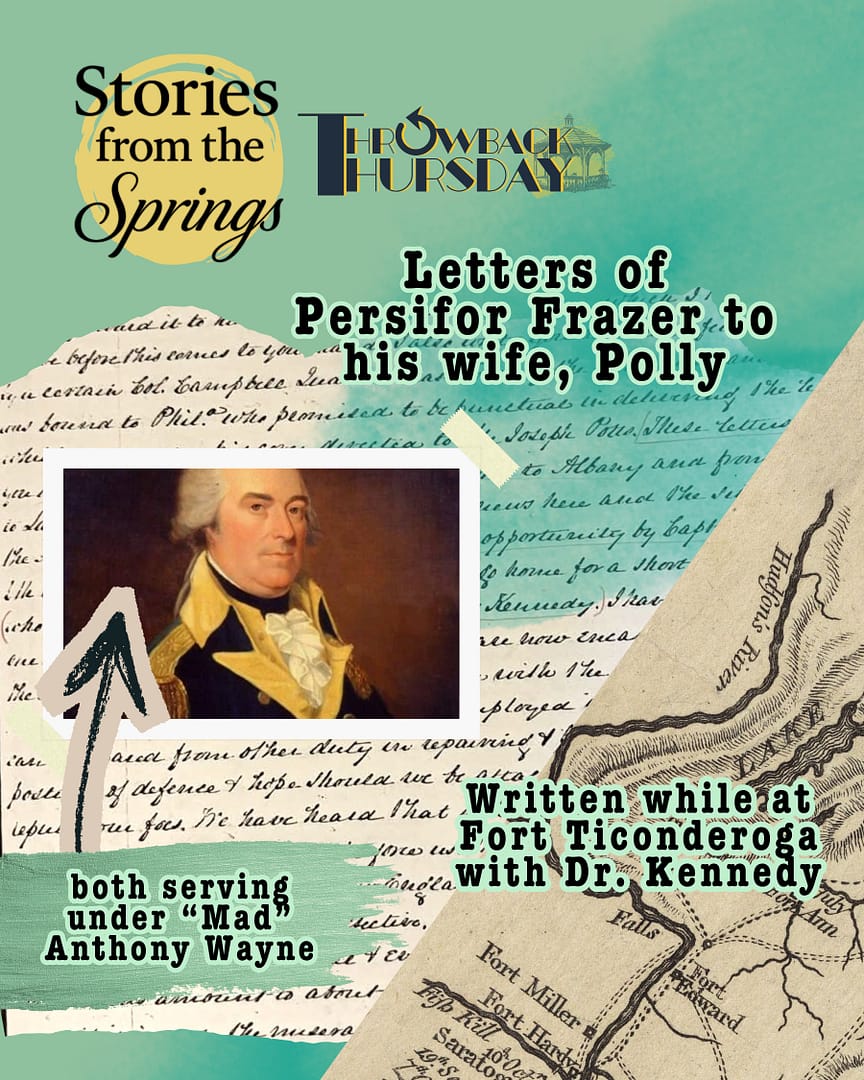
While Stationed at Fort Ticonderoga, Persifor Frazer wrote to his wife Polly, and mentioned the Kennedys of Yellow Springs
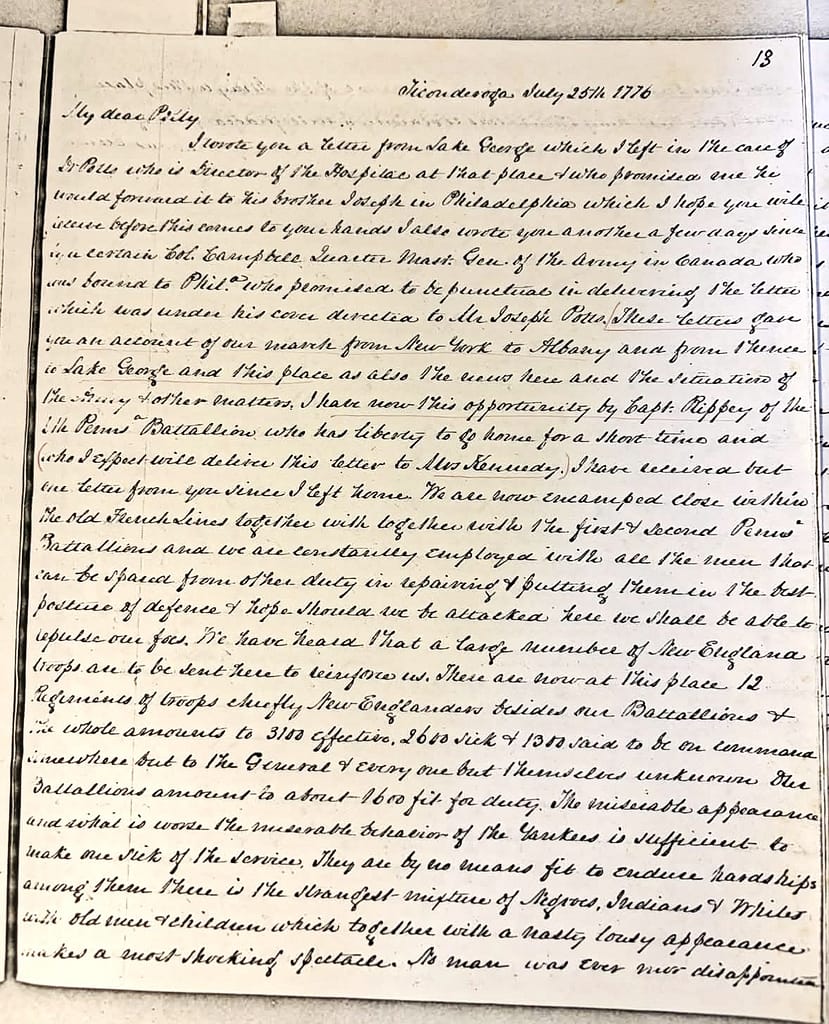
What Is This?
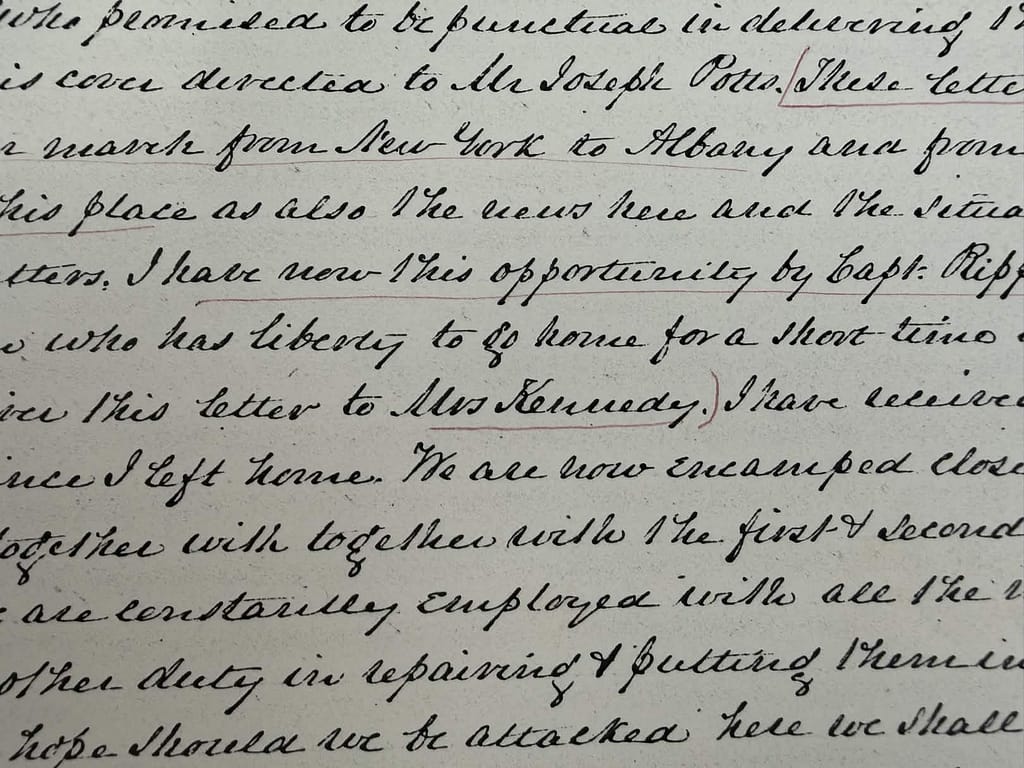
This scan shows part of a series of letters Persifor Frazer wrote to his wife Polly while stationed at Fort Ticonderoga in 1776. In the featured segment, he mentions Mrs. Kennedy, the wife of Samuel Kennedy, who owned Yellow Springs at that time. Our research shows that the Frazer and Kennedy families knew each other. This letter provides supporting evidence for that claim.
The item in our archives is an electroprint copy ordered by Carol Roark, a research historian at Historic Yellow Springs, then known as the Historic Yellow Springs Foundation Inc. The scans include Persifor’s original letters to Polly and a card indicating that Roark ordered the materials in the 1970s from the Harvard University Library, which held the original letters at that time.
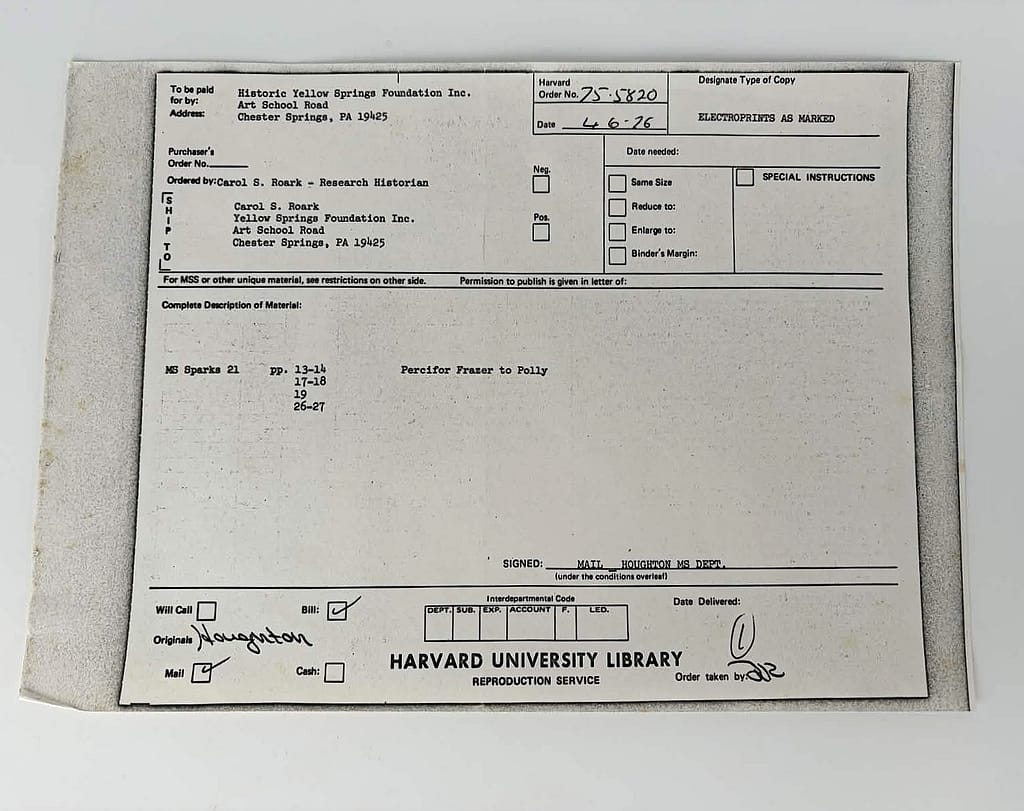
This folder in our archives contains a number of letters that Persifor sent to Polly during his time at Ticonderoga, though we are choosing to highlight the part of the letters most relevant to Yellow Springs for this post.
The Letters
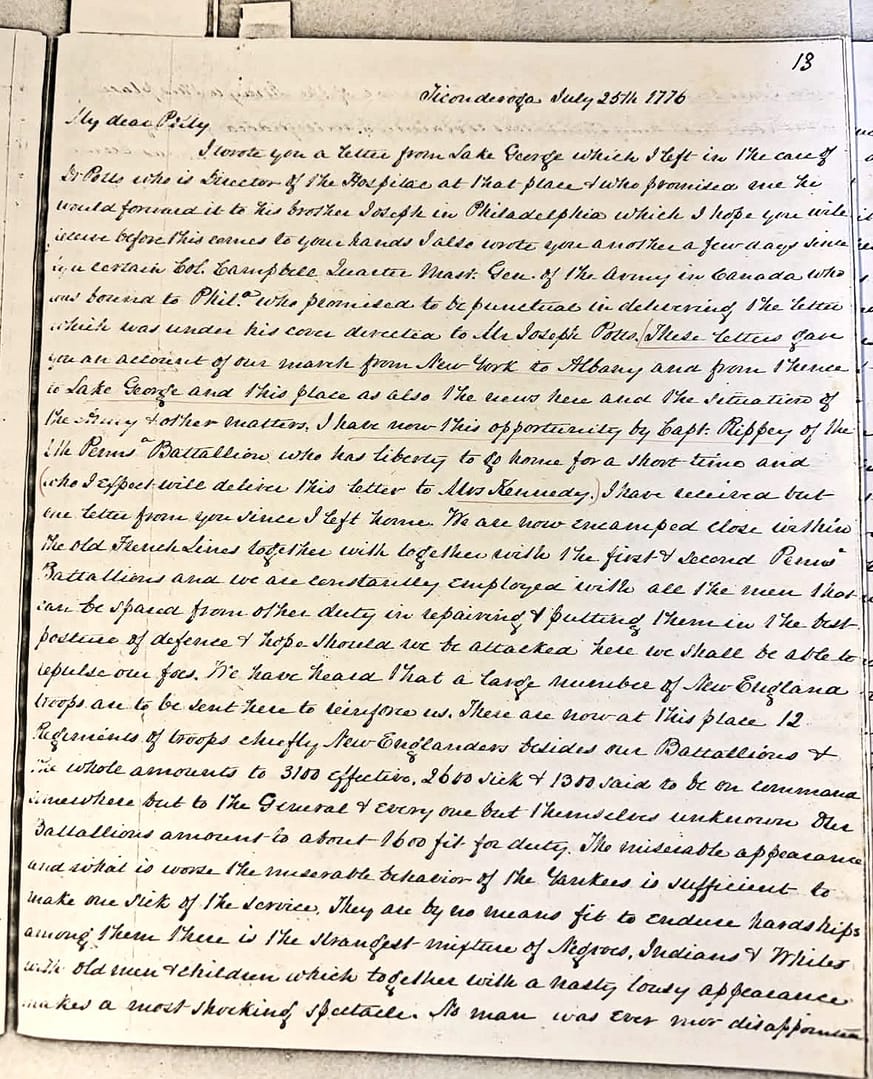
A transcription of the above letter reads as follows:
Ticonderoga, July 25th 1776
“My dear Polly
I wrote you a letter from Lake George which I left in the care of Lt. Ellis who is Director of the Hospital at that place & who promised me he would forward it to his brother Joseph in Philadelphia which I hope you will receive before this comes to your hands I also wrote you another a few days since in a certain Col. {Gansevoort/Gansevoets?} Quarter Master Genl. of the Army in Canada who was bound to Phila. who promised to be punctual in delivering the letter which was under his care directed to Mr. Joseph Pott.
These letters gave you an account of our march from New York to Albany and from thence to Lake George and this place as also the events here and the situation of the Army & other matters. I have now this opportunity by Capt. Rippey of the 11th Penna. Battalion who has liberty to go home for a short time and who I expect will deliver this letter to Mrs Kennedy. I have received but one letter from you since I left home. We are now encamped close within the old French Lines log’d lies with logs together with the first & second Penna. Battalions and we are constantly employed with all the men that can be spared from other duty in repairing & putting them in the best posture of defense & hope should we be attacked here we shall be able to repulse our foe.
We have heard that a large number of New England troops are to be sent here to reinforce us. There are now at this place 12 Regiments of troops chiefly New Englanders besides our Battalions & in whole amounts to 3100 effective, 2600 sick & 1300 said to be on command somewhere but to the General & every one but themselves unknown. Our Battalions amount to about 1600 fit for duty. The miserable appearance and what is worse the miserable behavior of the Yankees is sufficient to make me sick of the service. They are by no means fit to endure hardships among them there is the strangest mixture of Negroes, Indians & Whites with old men & children which together with a nasty lousy appearance makes a most shocking spectacle. No man was ever more disappointed.”
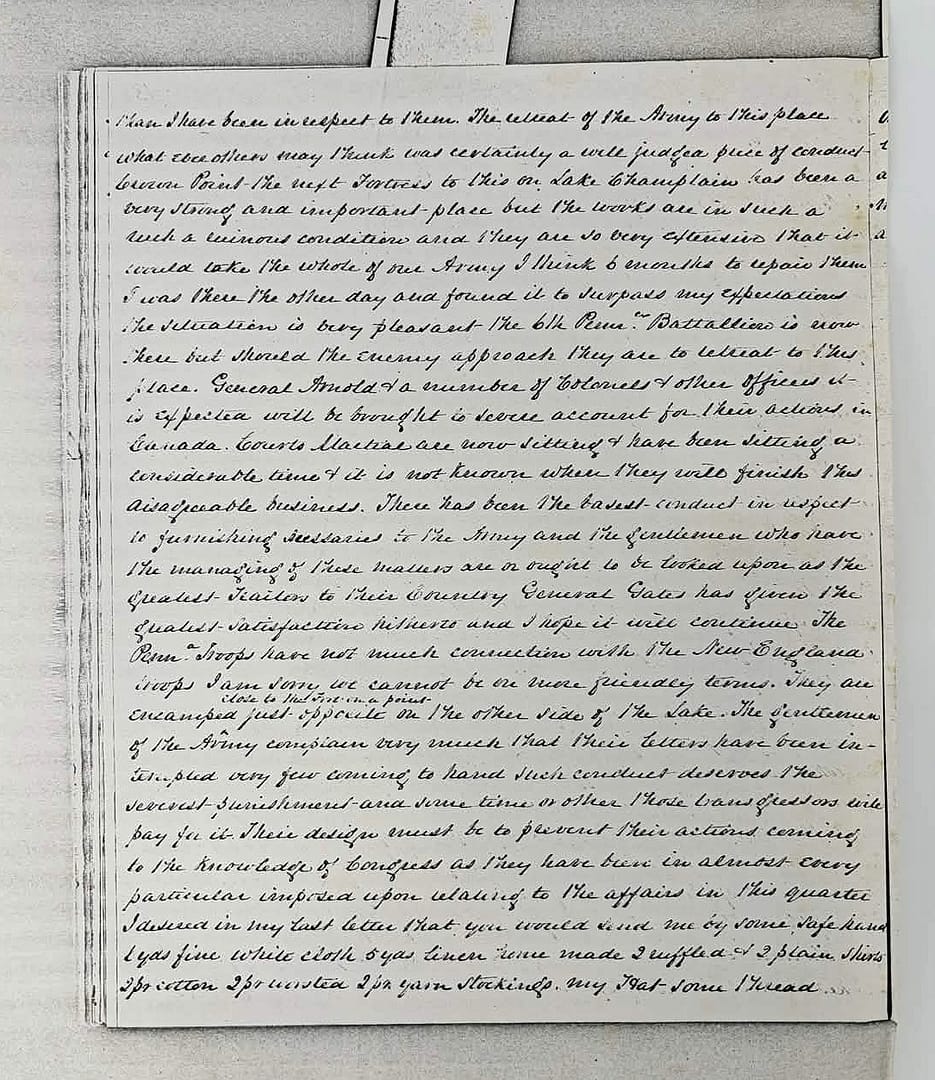
A continued transcription of the above letter reads as follows:
“I have said here in respect to them. The removal of the Army to this place what ever others may think was certainly a well judged piece of conduct between Point. The next Fortress to this on Lake Champlain has been a very strong and important place but the works are in such a ruinous condition and they are so very extensive that it would take the whole of our Army I think 6 months to repair them. I was there the other day and found it to surpass my expectations.
The situation is very pleasant. The 6th Penn. Battalion is now here but alarmed the enemy approach they are to retreat to this place. General Arnold & a number of Colonels & other officers are expected will be brought to severe account for their actions in Canada. Courts Martial are now sitting & have been sitting a considerable time & it is not known when they will finish this disagreeable business.
There has been the basest conduct in respect to furnishing necessaries to the Army and the gentlemen who have the managing of these matters are or ought to be looked upon as the greatest Traitors to their country. General Gates has given the greatest satisfaction hitherto and I hope it will continue. The Pennᵃ troops have not much connection with the New England troops I am sorry we cannot be on more friendly terms. They are encamped just opposite us on the other side of the Lake close to Ticonderoga point.
The gentlemen of the Army complain very much that their letters have been intercepted very few coming to hand such conduct deserved the severest punishment and some time or other those transgressors will pay for it. Their design must be to prevent their actions coming to the knowledge of Congress as they have been in almost every particular imposed upon relating to the affairs in this quarter. I desired in my last letter that you would send me by some safe hand 4 yds fine white cloth 6 yds linen thread made 2 ruffles & 2 plain shirts 2 pr cotton 2 pr worsted 2 pr yarn stockings, my Hat some thread {…}”
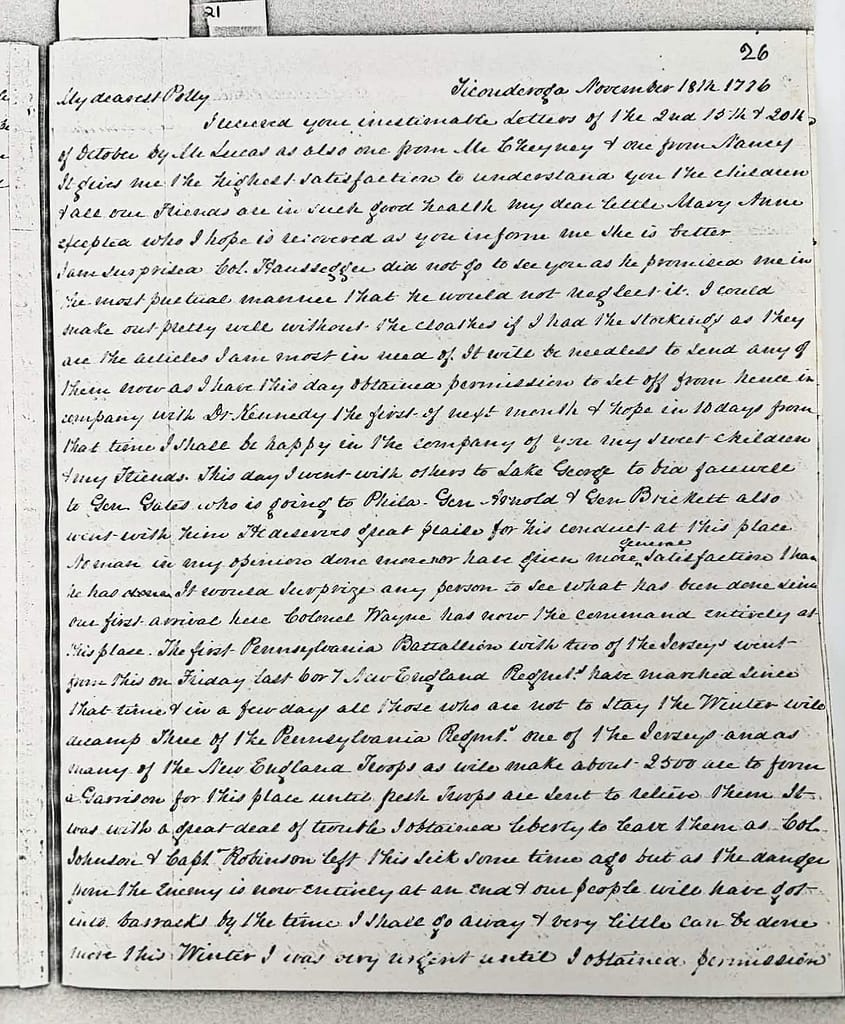
A transcription of the above letter reads as follows:
Ticonderoga, November 18th 1776
My dearest Polly,
I received your inestimable letters of the 2nd, 15th, & 20th of October by the Lucas, as also one from Mr. Cheyney & one from {…} (text unclear, possibly ‘Davey’ or ‘Nancy’ or ‘Naney’)
It gives me the highest satisfaction to understand you, the children, & all our friends are in such good health, my dear little Mary Anne excepted, who I hope is recovered as you inform me she is better.
I am surprised Col. Haussegger did not to to see you as he promised me in the most punctual manner that he would not neglect it. I could make out pretty well without the clothes if I had the stockings as they are the articles I am most in need of. It will be needless to send any of them now, as I have this day obtained permission to set off from hence in company with Dr. Kennedy the first of next month & hope in 10 days from that time I shall be happy in the company of you my dear sweet children & my friends. This day I went with others to Lake George to bid farewell to Gen. Gates who is going to Phila. Gen. Arnold & Gen. Brickett also went with him. He deserves great praise for his conduct at this place.
St. Clair in my opinion done more nor have given more satisfaction than he had reason to expect. It would surprise any person to see what has been done since our first arrival here. Colonel Wayne has now the command entirely at this place. The first Pennsylvania Battalion with two of the Jerseys went from this on Friday last but I hear New England Regiment have marched since that time & in a few days all those who are not to stay the Winter will encamp. Three of the Pennsylvania Regt., one of the Jersey and as many of the New England Troops as will make about 2500 are to form a Garrison for this place until fresh troops are sent to relieve them.
It was with a great deal of trouble I obtained liberty to leave them as Col. Johnson & Capt. Robinson left this a long time ago, but as the danger from the enemy is now entirely at an end our people will have got into barracks by the time I shall go away & very little can be done more this Winter. I was very urgent until I obtained permission…
What did this Mean at the Time?
These letters from Persifor Frazer to his wife, Polly Frazer, offer a vivid window into his character and lived experience during the American Revolutionary War while stationed at Ticonderoga in 1776.
They show a man deeply tied to his family despite military duties. Persifor repeatedly worries whether Polly receives his letters and often sends duplicates through trusted individuals, reflecting unreliable wartime communication. He relies on Sarah Kennedy to carry letters and plans to travel home in November with Samuel Kennedy. He requests clothing, stockings, and sewing materials, highlighting officers’ dependence on families for basic necessities since the army often fails to supply them.
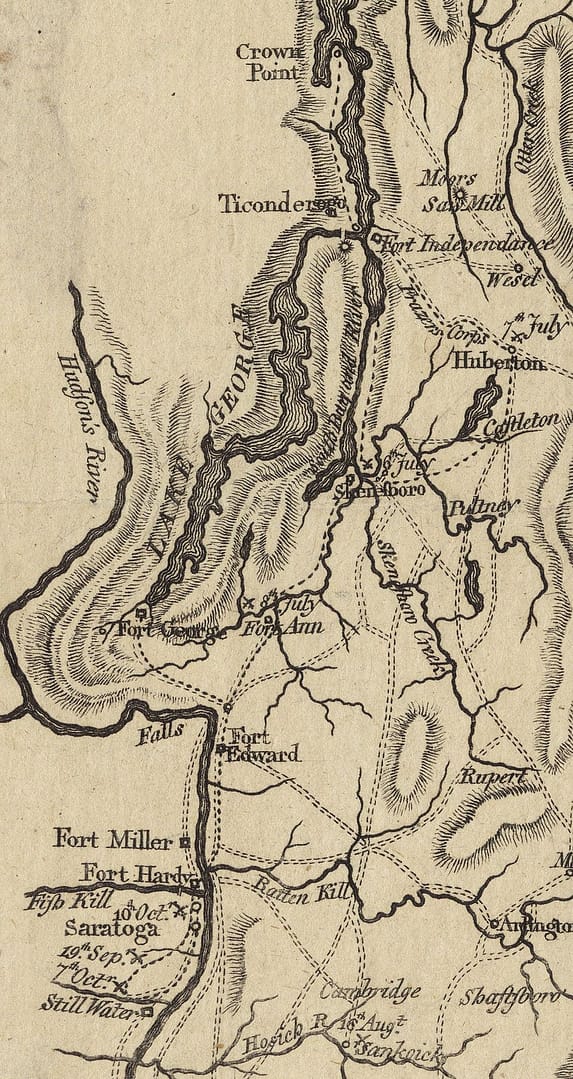
At Ticonderoga he describes a strategic but strained position. Fortifications sit in disrepair and require heavy labor to restore. His troop counts show disease as a major factor, with thousands sick and many absent, leaving only a portion fit for duty; illness and poor conditions weaken forces more than combat.
He criticizes morale and organization describing corruption and incompetence in supply systems and calling some responsible traitors Courts martial proceed and officers from the failed Canadian campaign face consequences He reports intercepted letters signaling broken communication and growing suspicion
Expresses tension with New England troops noting Pennsylvania soldiers remain unfriendly toward them He describes them as a mixture of Negroes Indians Whites with old men children revealing racial and class prejudice
As a prosperous Pennsylvania planter and officer he expects a uniform disciplined force but encounters diverse uneven army that he views negatively reflecting regional divisions within a loose coalition
He praises General Gates while demanding accountability for failures. His letters return home, and by November he feels relief and anticipation as he looks forward to Polly, his children, and friends, grounding his identity in family life.

Taken together, these letters reveal a complex picture of both the man and the moment.
Persifor appears as a committed but frustrated officer who navigates the challenges of war while maintaining strong personal ties to Polly and their family. His experiences at Ticonderoga reflect the difficulties of the early Continental Army, including poor supply, disease, internal divisions, and uneven discipline.
At the same time, his words expose the social attitudes of his era, including racial prejudice and class expectations. Together, these elements provide a deeply human perspective on the Revolutionary War, grounded not in idealized narratives but in the everyday realities faced by those who lived through it.
Who were Polly and Persifor Frazier?
The analysis of his letters tells us a great deal about what occurred in Persifor’s life at Ticonderoga, but this section expands the scope to examine who Persifor and Polly were at that time.
From publicly accessible sources that remain easily available online, such as Wikipedia, Persifor Frazer appears as a Pennsylvania farmer, soldier, and industrialist who belonged to the prosperous planter and landholding class of colonial Pennsylvania. He managed a successful farm near Brandywine Creek and later operated an ironworks at Sarum Forge while also serving as an officer in the Pennsylvania Line during the American Revolution (1).
He married Mary “Polly” Taylor on October 2, 1766, and together they built a large household with ten children, which situated them firmly within the rural elite whose economic stability depended on land, agriculture, and wartime service (1).
In this sense, Persifor functioned not as a marginal soldier but as part of a socially connected officer class that combined agriculture, local political influence, and military leadership. This placement situates the Frazers and the Kennedys within a similar social circle, making it very possible that they knew each other even before the war began.
During the Revolution, he served under General “Mad Anthony” Wayne and rose to lieutenant colonel. He also experienced capture at the Battle of Brandywine and held status as a prisoner of war, a trajectory that placed him directly within the central military crises of the Pennsylvania campaigns (1).
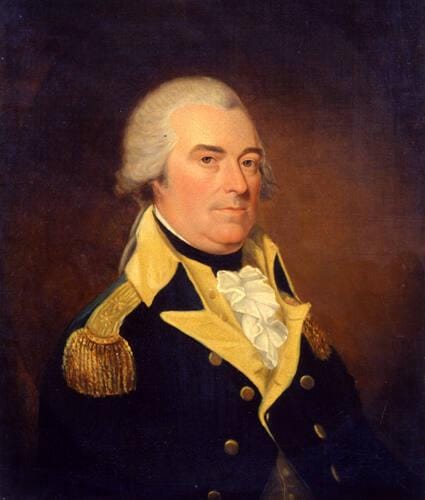
.jpg)
Polly Frazer
Polly Frazer actively participates in wartime logistics and communication rather than remaining in a purely domestic role. Due to how women were treated at this time, Polly’s voice remains poorly recorded, despite her wealthy planter-class status. However, a virtual exhibit from the American Revolution Museum at Yorktown, in its Spies and Saboteurs section, mentions her.
In the description of a 1776 military chest, we learn a bit more about Polly’s direct role in the story of the Revolution.(2)
According to that account, Polly delivers supplies to Persifor at Brandywine and afterward while he remains imprisoned. She conceals and smuggles a letter out of confinement, crosses British lines, and delivers intelligence on prisoner conditions directly to General Washington at Valley Forge (2).
Persifor’s letters reinforce this picture. At Ticonderoga he depends on unreliable communication, trusts messengers such as Mrs. Kennedy, relies on Dr. Kennedy and officers within the 4th Pennsylvania Battalion, and requests basic supplies from home. Even commissioned officers depend on personal and familial networks.
Taken with relief sites such as Yellow Springs, rebel hospitals, and care at the Hench farm during Brandywine, plus later efforts like Washington Hall after Valley Forge, Persifor and Polly fit into a larger system linking officers, physicians like Dr. Samuel Kennedy, and civilian caregivers such as Sarah Kennedy. This system moves supplies, letters, and information across unstable front lines.
The Revolutionary War in Pennsylvania functioned less as rigid hierarchy and more as a web of trust relationships. Persifor represents an officer dependent on formal command and informal supply chains, while Polly represents an essential female agent sustaining communication and intelligence flow.
To Us, Today
What we can learn today from examining this artifact is that it forces us to rethink what “war” meant to people living through the American Revolution, especially in 1776 at a place like Ticonderoga. In that culture, war did not exist as a separate sphere of professional soldiers operating apart from civilian life. Instead, it functioned as a shared condition that blurred the boundaries between home, camp, hospital, and battlefield.
Persifor Frazer’s letters make this visible in a very human way. Even as a Continental Army officer, he writes not from control but from dependence: on messengers like Mrs. Kennedy to physically carry his words, on other gentlemen like Dr. Samuel Kennedy to connect him to home and movement, and on Polly to supply the basic material things the army cannot reliably provide. In this sense, his letters show a world where communication moves slowly, remains fragile, and depends on personal relationships as much as rank.
Polly Frazer’s documented actions further reinforce this system. She crosses British lines, carries hidden correspondence, and delivers intelligence to Washington (2). Women like Polly and Sarah Kennedy move between spaces that men in uniform cannot always safely access, becoming couriers, supply agents, and informal intelligence links. From this perspective, trust outweighs institutions, and households extend military infrastructure.
This artifact also reveals the reach and scale of interconnected systems that made places like Washington Hall possible. Nothing occurs in a vacuum, and events at Yellow Springs reflect reactions within a larger system in which individuals play only partial roles. Polly’s effort to smuggle a note from her husband connects, in this narrative, to the death of Dr. Kennedy and the broader importance of Yellow Springs during the Revolution.
As explored last week with Dr. Cutting and Dr. Shippen, individual actions never occur in isolation and always ripple through their time and place. The world of Persifor, Polly, and the Kennedys shows that resilience comes not from formal authority alone, but from people who move between systems, sustain relationships, and carry information when official channels fail.
The same remains true today, even when we look back across centuries of the Revolutionary War.
📜 🪶 🏕️
Learn more about the history of Yellow Springs
You can read the more in-depth version of this post here
Follow us on Substack, Instagram, and Facebook
📜 🪶 🏕️
Works Cited
- Wikipedia contributors, “Persifor Frazer,” Wikipedia, https://en.wikipedia.org/wiki/Persifor_Frazer.
- American Revolution Museum at Yorktown, “Spies and Saboteurs,” When Women Lost the Vote: A Revolutionary Story, https://www.amrevmuseum.org/virtualexhibits/when-women-lost-the-vote-a-revolutionary-story/pages/spies-and-saboteurs.