
Throwback Thursday: Who Is George Maxton?
A Recurring Name in our Records and Research Leads Us on a Journey of Discovery
Setting the Scene
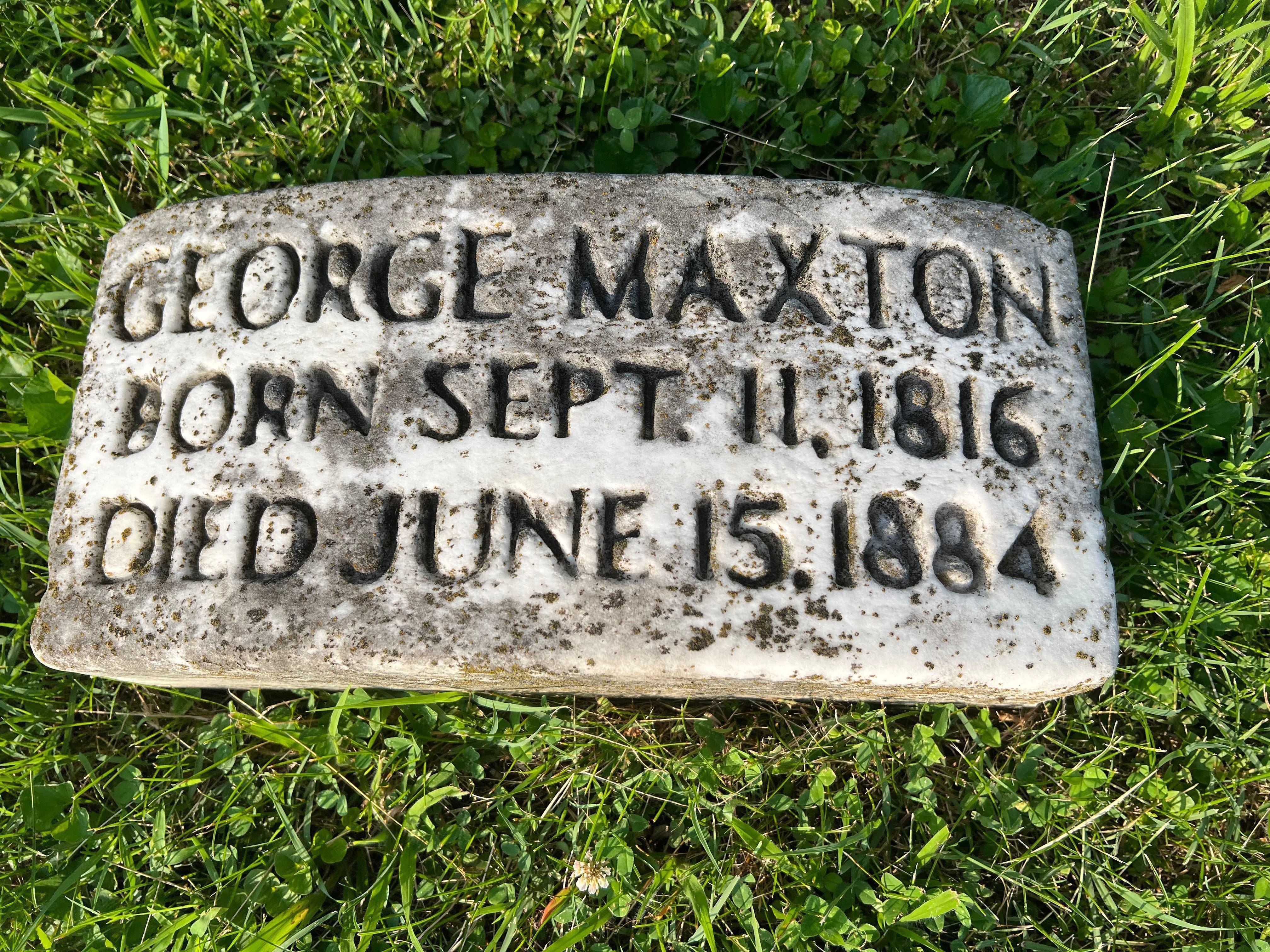
As we were doing research to better understand what Yellow Springs was like during (and just prior to) the American Revolutionary War, we came across the name “George Maxton” a number of times. We were intrigued, especially since we had seen that name at least once in our records and on our property timeline, and reconstructing who owned what land has been important for us in determining more about the nebulous early spa era of Yellow Springs. Doing a bit of research online, we found a Find-A-Grave posting for a George Maxton, whose son was a blacksmith, but he was born far too late to be the same George Maxton that shows up in newspaper clippings from before the Revolutionary War.
Entering the Rabbit Hole
The George Maxton born in 1816 left behind very little documentation. However, a Find-A-Grave entry for his son, William Maxton, offers an important clue. William, born in 1852, worked as a blacksmith in Marshallton, Chester County. His profession suggests that the Maxton family remained in Chester County for generations. During this period, trade skills often passed from father to son. While the evidence remains circumstantial, we can tentatively hypothesize that George Maxton may have also worked as a blacksmith.
The Find-A-Grave trail ends with George Maxton (b. 1816) and his wife, Ruth B. Nichols Maxton, who was born in 1829. Even so, this information provided a starting point for further research. By building a family tree on Ancestry.com, it became possible to connect existing records and draw upon the work of other researchers. That process identified this George Maxton’s parents as William Maxton and Elizabeth Lewis.
Continuing backward through the Maxton family line revealed that William Maxton, born before 1785, was the son of a man named George Maxton and a woman named Ann. Little is known about Ann. This George Maxton, however, was born in June 1743. He would have been the grandfather of George Maxton (b. 1816) and is also recorded as living in Chester County. George Maxton’s 1743 birth date places him at the right age to be the same George Maxton who appears in newspaper references from the years just before the Revolutionary War.
This George Maxton
We then turned to Newspapers.com, a helpful website archiving a number of newspapers that were published as far back as the early 1700s. Using this process, we found several mentions of George Maxton- which is actually what made us interested to look into him in the first place when we doing research on another topic.
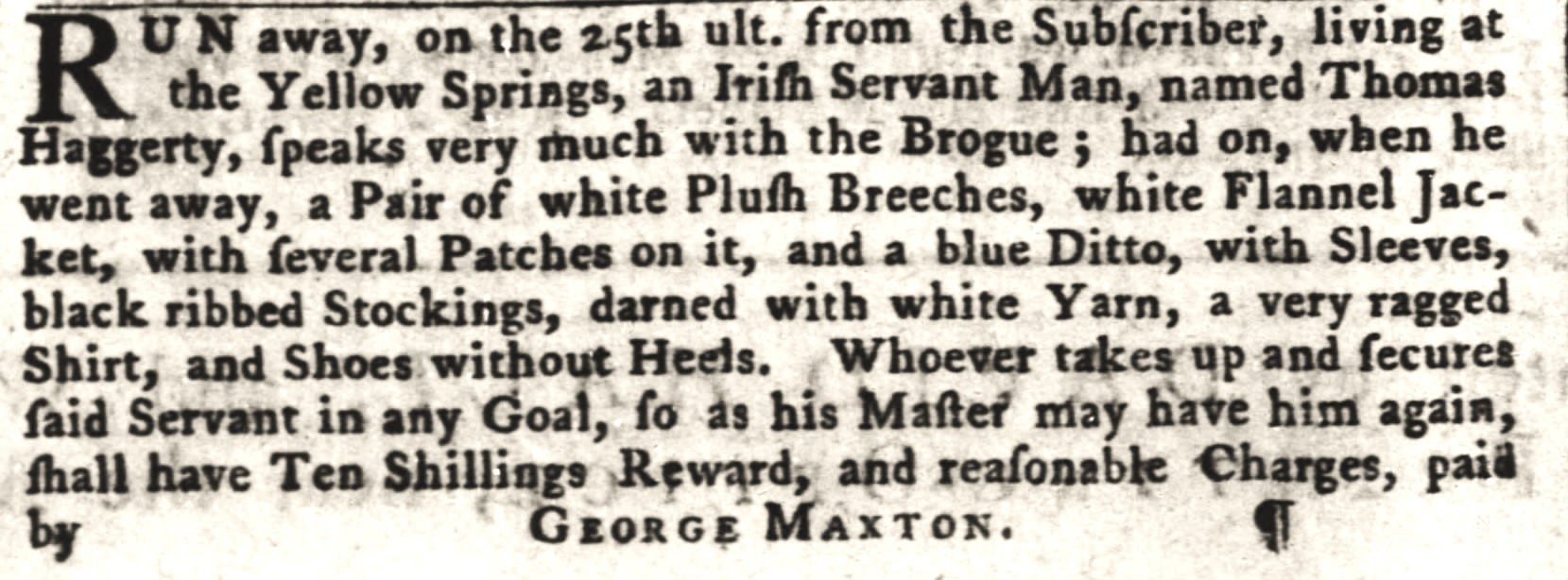
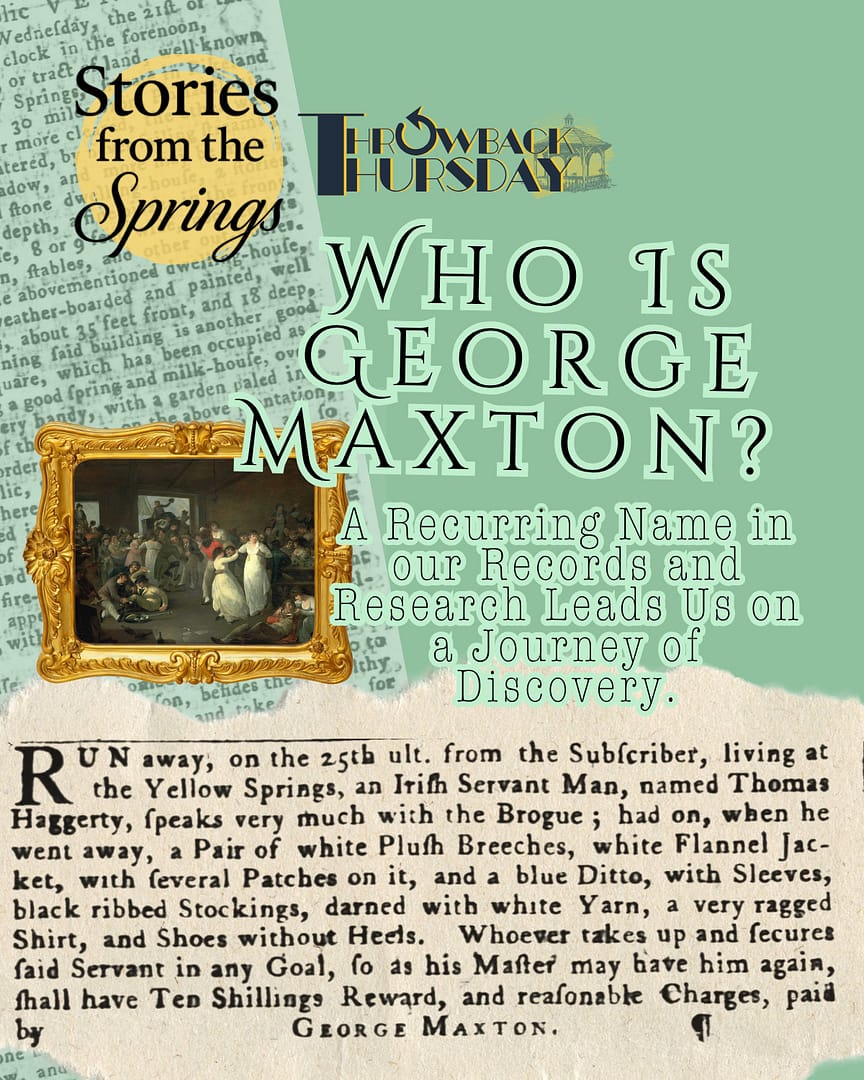
Our earliest mention of him occurs on December 3, 1767, in the newspaper The Pennsylvania Gazette. This post advertises a message from George Maxton of Yellow Springs, seeking the capture and return of an indentured servant, an Irishman named Thomas Haggerty, who ran away from Maxton on November 25.
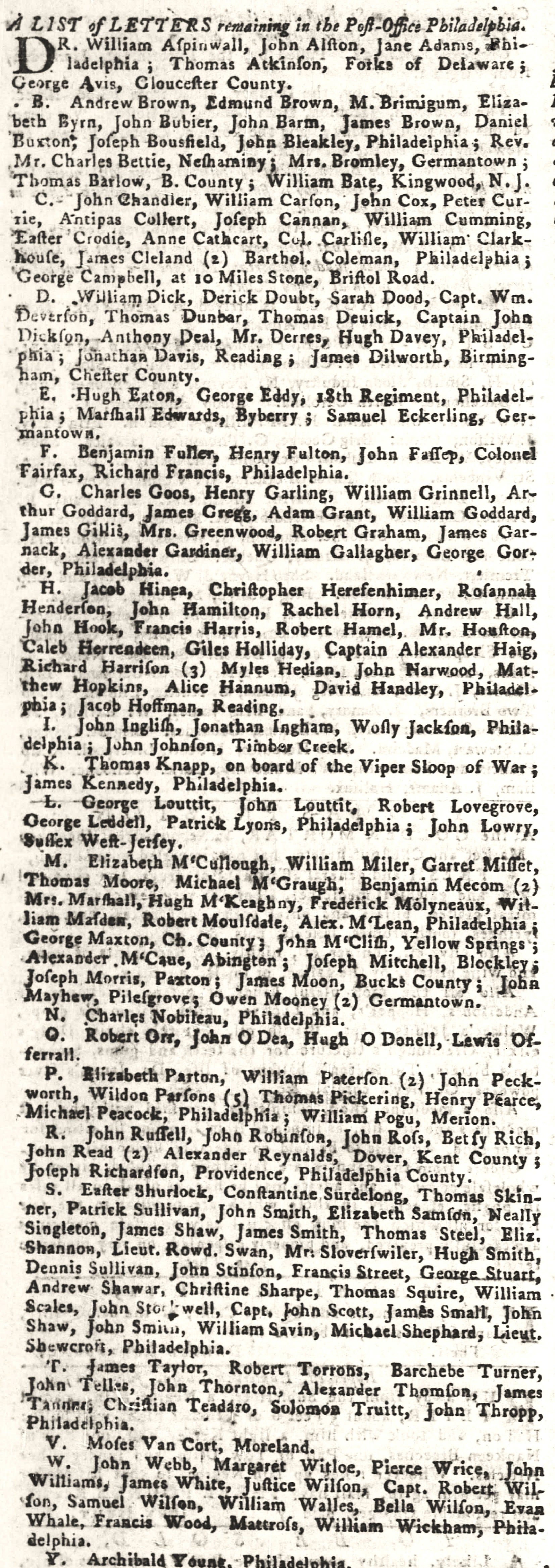
Also in The Pennsylvania Gazette on July 20, 1769, a George Maxton of Chester County is informed that he has letters waiting for him at the post office in Philadelphia. He is mentioned alongside a man named John McClifh, who is noted to be of Yellow Springs. However, Maxton’s residence here is listed simply as “Chester County,” so we cannot know for certain whether he was near what would be considered Yellow Springs proper or whether he moved there after this time and was based elsewhere in the county. The 1767 clipping above demonstrates that George himself identified as a resident of Yellow Springs. Based on that, we can tentatively conclude that he was likely living in or near the village. At the time, the actual plantation that was Yellow Springs may have been what was considered “Yellow Springs” proper. Alternatively, he could have moved around, though this is less likely.
Again featured in The Pennsylvania Gazette, on March 1, 1770, George Maxton is referenced in the public sale of the Yellow Springs plantation, previously held by Philadelphia silversmith John Bayly. This advertisement indicates that George Maxton is the current tenant of the saw mill on the property.
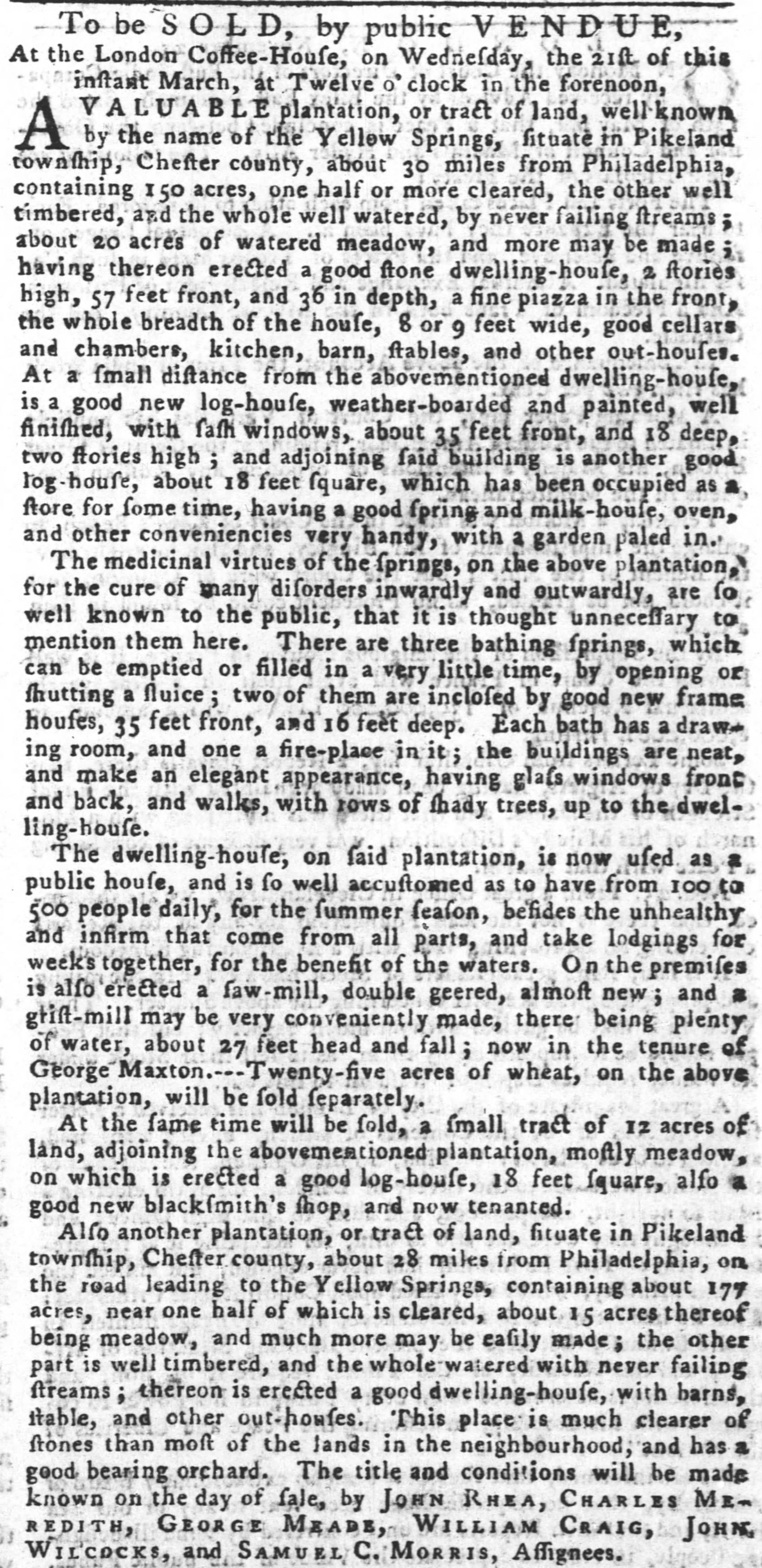
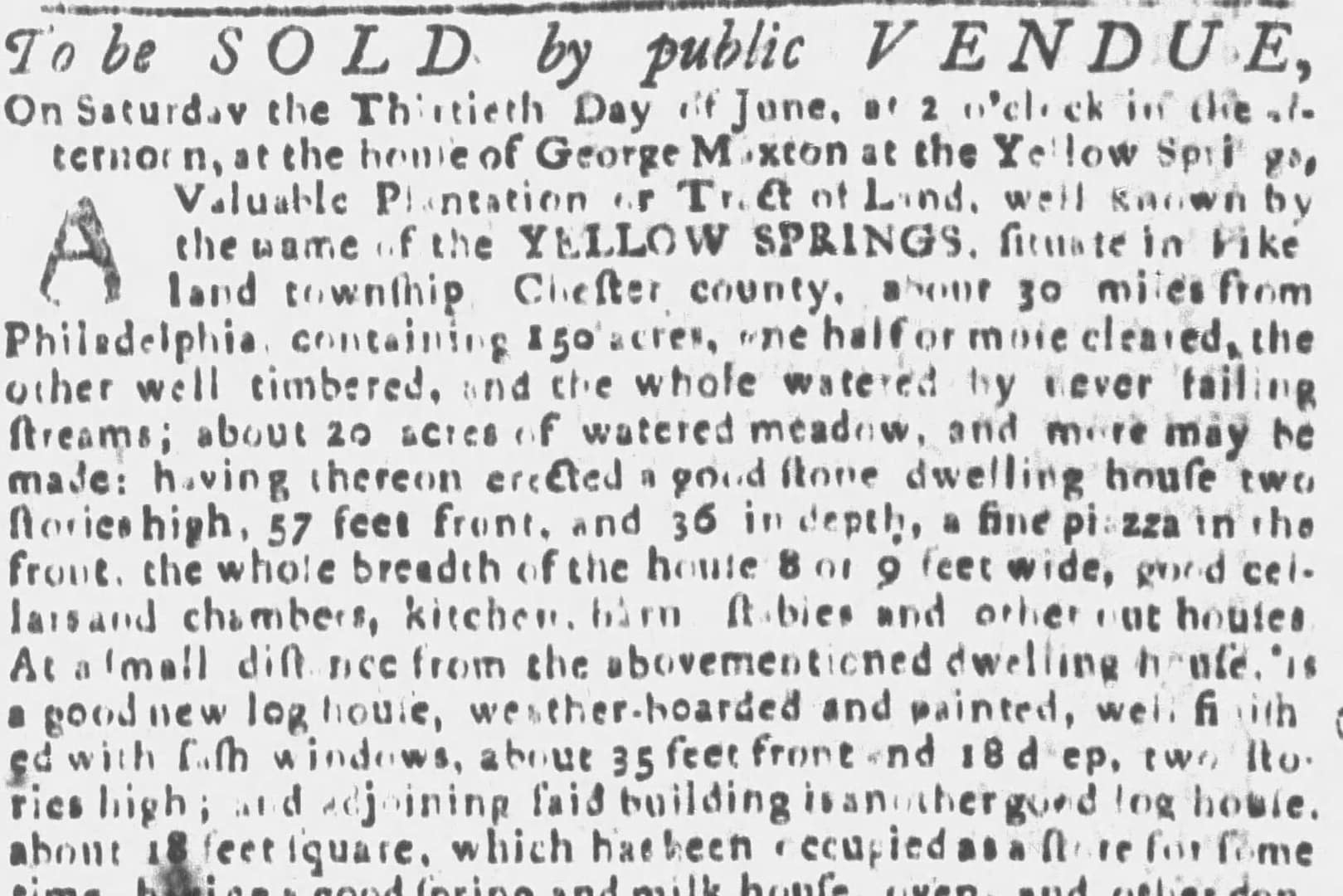
By June 7, 1770, The Pennsylvania Gazette continues to advertise the sale of the Yellow Springs plantation, but the place where bidding for the plantation would occur has been moved from Philadelphia to Maxton’s house in Yellow Springs. This confirms that George Maxton had a house in the village, or possibly even on the plantation itself, though the exact placement of his home is unclear. This advertisement continued to be posted in The Pennsylvania Gazette until March 14, 1771, when it was also published in another newspaper, the Pennsylvania Journal, or Weekly Advertiser.
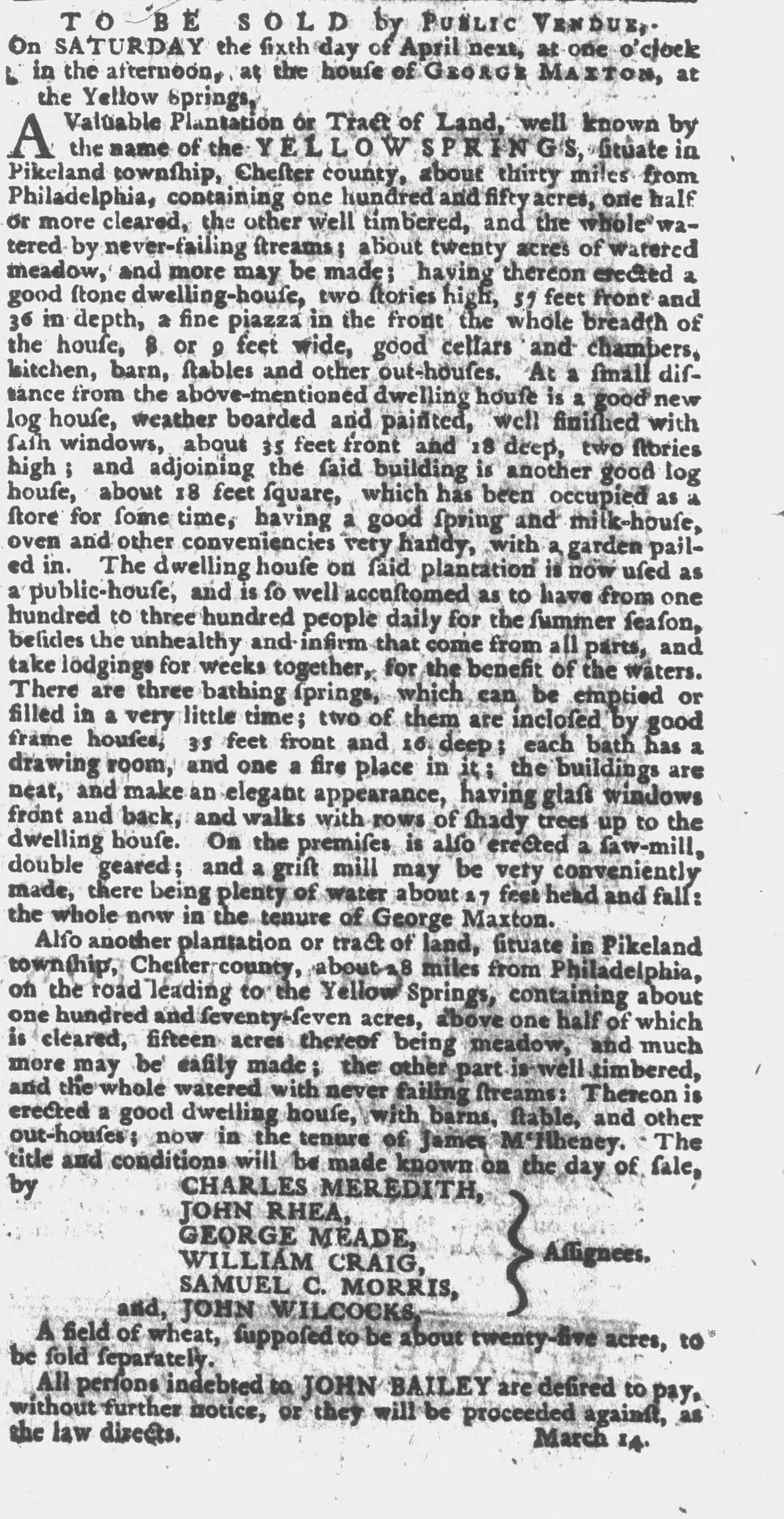
After this, though, Maxton’s name does not appear in papers until 1815, when he is mentioned in the newspaper the Record, under a section called ‘The Chester and Delaware Federalist’. Notably, records of Maxton during the Revolutionary war are missing.
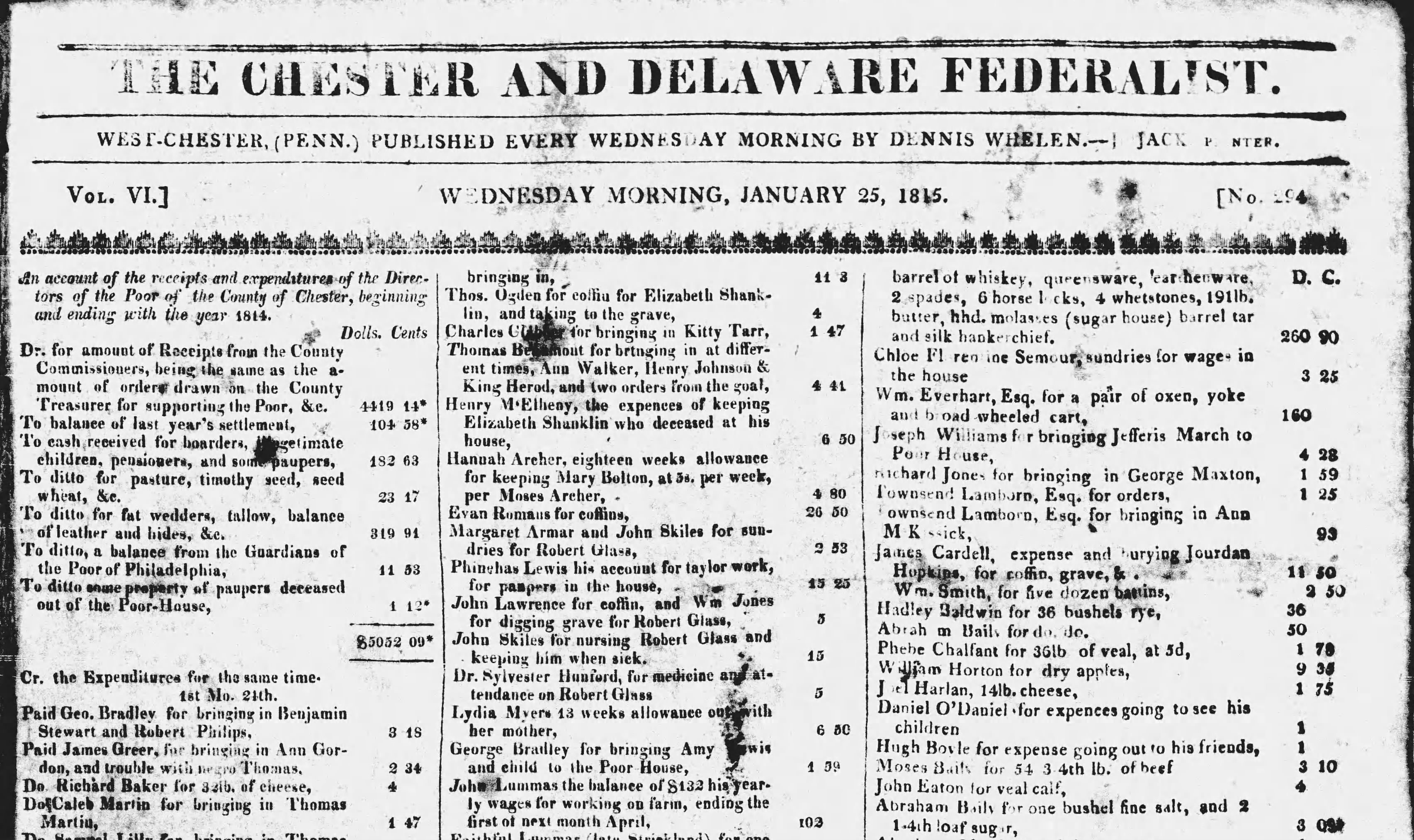
Here, a man named Richard Jones is given a reward for bringing in George Maxton. This seems to be associated with the Directors of the Poor of Chester County, but it is unclear if Maxton is being assisted here or is receiving orders from the organization on how to best assist others. It is worth noting here that by 1815, having being born in 1743, Maxton would have been a very old man for the time.
We know this cannot be his grandson, George Maxton (b. 1816), because he was born in 1816, one year later— and even if that date is a bit fuzzy in the records, an infant would not be receiving orders from the Directors of the Poor of Chester County.
To discover what this means for Maxton’s life, we have to compare these clippings with other sources to fill in the gaps.
Following More Tunnels
We then turned to the Chester County archives, who have a wonderful collection of digitized records from as far back as the early 1700s. For the records that have not yet been digitized, they have an extensive and well-put-together series of indexes describing what can be found in their records. Helpfully for us, these indexes can be searched by surname.
In the indexes of Tax Discounts from 1785-1865, we found a George Maxton mentioned several times. Also indicating that we are correct that this is the same George Maxton that we have been tracking is the inclusion of a James Maxton, of the same county, who in 1791 is underage. George and Ann Maxton had a son named James, who was born in or around 1771.
In late eighteenth- and early nineteenth-century Pennsylvania, being “of age” in a legal sense meant that a young man had reached at least 21 years of age. Borrowed from English common law, this “age of majority” granted men full legal capacity to buy and sell land, vote, marry without parental consent, and sue or be sued in their own names.
If we assume that the estimated birth date for James Maxton is roughly accurate, we must also acknowledge an important caveat: the source for that date is based on crowdsourced genealogical records. Even so, this estimate would place James at 20 years old in 1791, one year short of the age of majority. The contemporary records from this period are primary sources and can therefore be considered more reliable. Based on these records, the oldest James could have been in 1791 is 20 years old, meaning he could not have been born earlier than 1771. Had he been born before that year, he would have reached the age of majority and would not have qualified for a tax exemption. With this established, we can reasonably conclude that this is the same George Maxton and his son James whom we have been tracking.
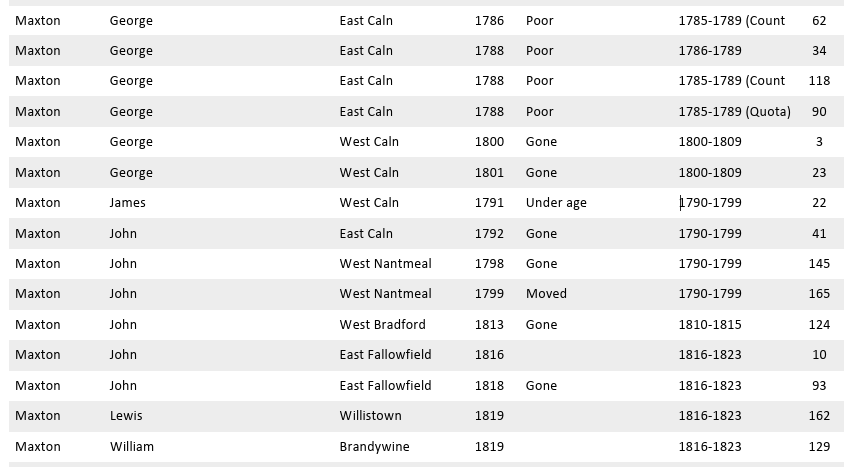
Interestingly, we can see that from at least 1786, George Maxton is listed as “poor”, an he is noted as living in East Caln Township, not Pikeland where Yellow Springs was located during this time. By 1791-1800, the Maxton family seems to have moved to West Caln, but notably, George himself is listed as “gone” in both 1800 and 1801.
Turning back to the Chester County Archives records indexes, we found George Maxton mentioned in the admissions to the poor house in 1815, at the age of 69 years old.

This means that the article published in the Record in 1815 that mentions George Maxton is definitely referencing Maxton being brought into the poor house. Why someone is being given a reward for bringing him to be admitted is currently unclear, and we will have to do additional research on the poor house in Chester County to determine why this may occurred.
Back to Maxton himself, though, we can now conclude that no matter who he was or what he was doing in Yellow Springs during the Colonial Era and the Revolutionary War, he seems more likely than not to have become destitute and ended his life in the local poor house.
To understand why that happened, we took to scouring the Chester County archives digital records and indexes for any combination of the names George and Maxton. Using this process, we found several leads. The first of which can be found in the Chester County Archives index for the Pennsylvania Septennial Census Returns 1793-1856, in Index M.
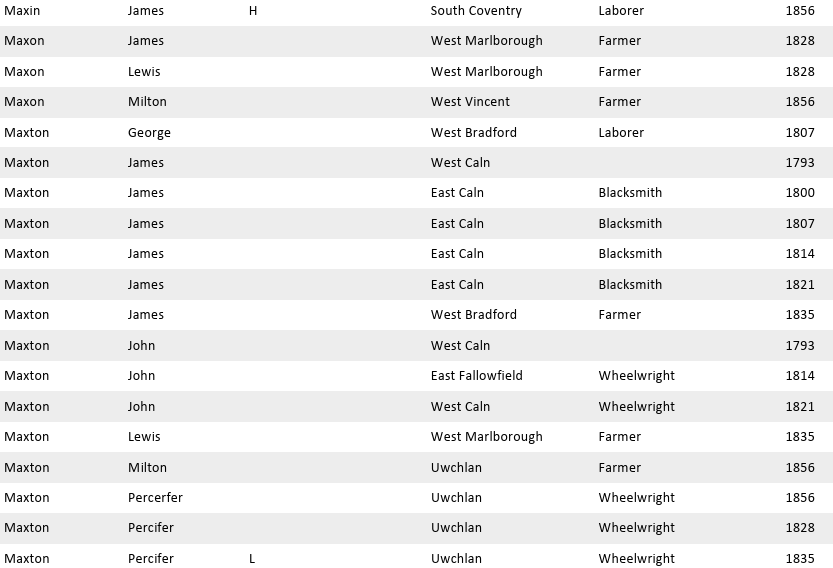
This index lists George Maxton as a laborer in 1807 and provides new information about his son, James Maxton. It also explains why George does not appear in earlier records for West or East Caln Townships. By 1807, he had moved to West Bradford. This move occurred before he entered the poorhouse and may suggest that he faced financial or personal difficulties.
We also found George Maxton in Chester County’s tavern license petitions. During this period, anyone who wanted to operate a tavern or public house had to apply for a yearly license. An “A” in the index means officials approved the application, while a “D” means they denied it.
These records help us trace the history of the Yellow Springs tavern, now part of the Washington Building and known as the Brick Room. Our research suggests that Yellow Springs had only one tavern.
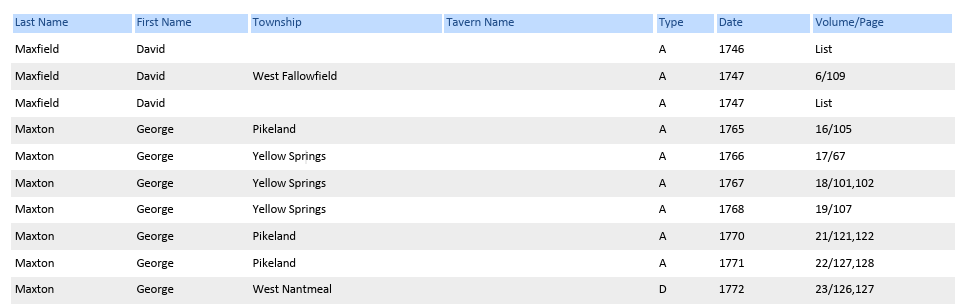
The records confirm that Maxton served as Yellow Springs’ tavernkeeper for several years. In 1767, when he advertised for the return of his indentured servant, Thomas Haggerty, he had already operated the tavern for about two years. By 1772, Maxton had applied to run a different tavern in West Nantmeal Township, which does not border Yellow Springs. This evidence shows that 1771 marked his final year at Yellow Springs and suggests that something caused his tenancy to end.


What Happened to George?
By piecing together this research and what we know about the timeline of the Washington Building at Yellow Springs, we can create a more nuanced understanding of the events surrounding George Maxton while he was the tavernkeeper here.
We know that on September 6, 1764, Philadelphia silversmith John Bayly acquired the village of Yellow Springs and began leasing the property. After acquiring the village, Bayly improved and enlarged the tavern and placed an advertisement in The Pennsylvania Gazette seeking a tenant to operate it. George Maxton became that tenant, with his first year as tavernkeeper beginning in 1765.
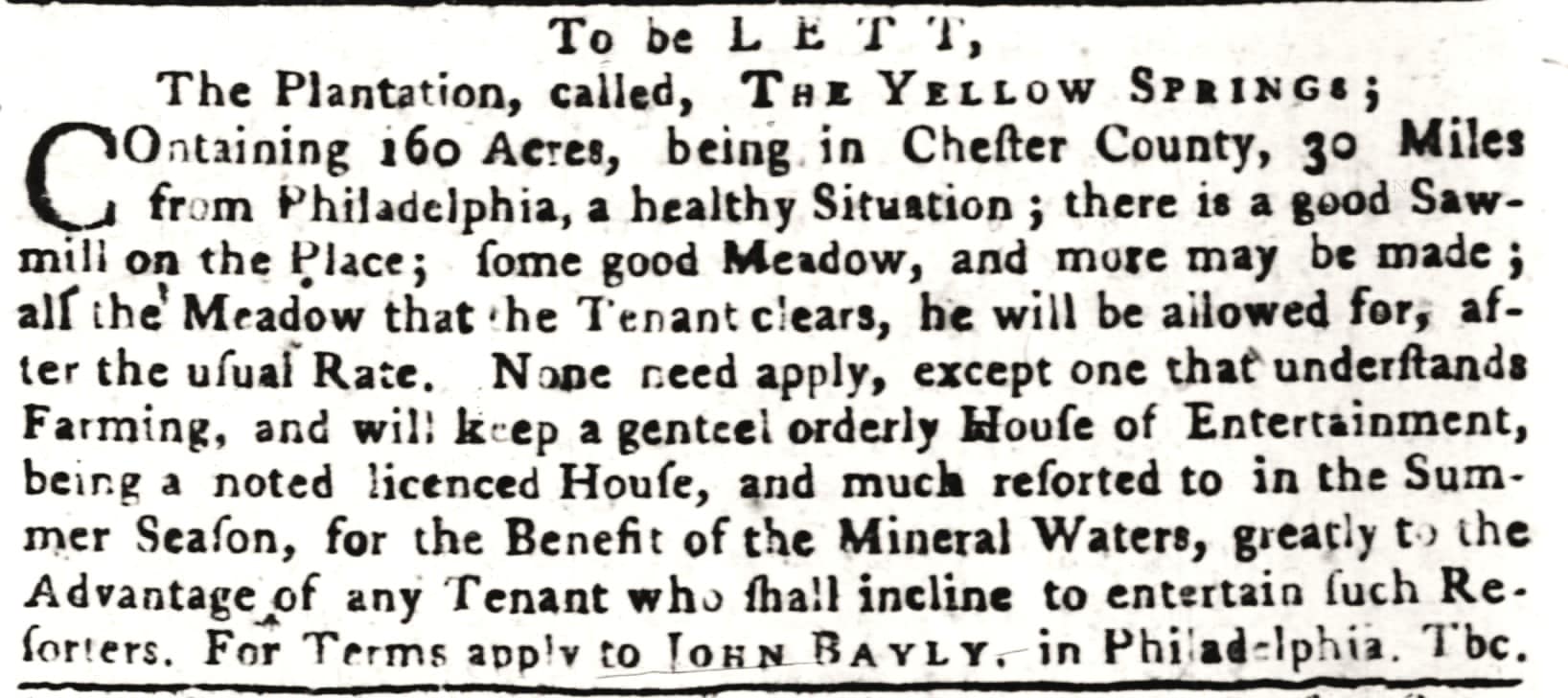
Maxton operated the tavern at Yellow Springs for several years. On March 1, 1770, The Pennsylvania Gazette announced that the entire Yellow Springs Plantation would be sold on March 21. However, a notice published in The Pennsylvania Journal on May 31, 1770, listed a different sale date of June 30, creating a discrepancy between the two advertisements. This later notice also confirms that Maxton lived at Yellow Springs at the time.
On March 14, 1771, The Pennsylvania Gazette advertised that the Yellow Springs Plantation would be sold on April 6 at George Maxton’s house in Yellow Springs, further confirming his role as the village’s tavernkeeper. Evidence suggests that Maxton continued operating the tavern through 1771 before he either left or was replaced.
By 1772, Maxton had applied to operate a different tavern in West Nantmeal Township, Chester County, but officials denied his application. On February 27, 1772, Dr. Samuel Kennedy and John Bayly jointly advertised for a tenant at a house in Yellow Springs, although we cannot yet determine whether the notice referred to the tavern or the main house.
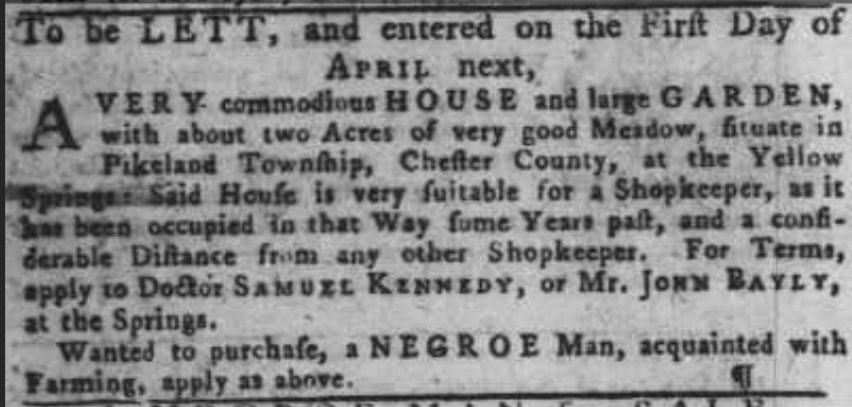
This notice predates our earliest records documenting Kennedy’s purchase of the property and may indicate that the Kennedy family acquired Yellow Springs before 1774. Despite reports that a sheriff’s sale had disposed of most of John Bayly’s interests in 1771, Bayly remained connected to Yellow Springs. The notice shows that Bayly and Dr. Kennedy maintained a relationship and shared control of the property after Maxton left. We know that Kennedy later hired Samuel Culbertson as the new tavernkeeper.
After leaving Yellow Springs and briefly attempting to establish a tavern in West Nantmeal, Maxton and his family appear in East Caln Township by 1786. By then, tax records show that he was too poor to pay taxes. Eventually, he entered the poorhouse nearly destitute.

Later property records show that Maxton’s son owned land of his own and that George Maxton’s descendants continued as skilled laborers. Yet something seems to have happened to George after his time at Yellow Springs that left him with few prospects.
We do not know what caused this change. The Revolutionary War may have played a role, or the transfer of the property itself may have altered the course of his life. It could also have been personal issues.
To Us, Today
When we look back at George Maxton and the missing pieces of his life, we should remember the “small” people in history whom we often overlook. We knew Maxton’s name and suspected that he had served as one of Yellow Springs’ tavern keepers, but we did not know that he eventually ended up in the poorhouse.
Maxton attended the attempted sales of John Bayly’s plantation in 1770 and 1771, and the auctions even took place at his home. These facts make his position clear. He seems to have supported the sale of Bayly’s land, a choice that may have cost him his job in the years that followed. We cannot know exactly why this happened. The surviving records suggest that Bayly and Dr. Kennedy, the next owner of the Yellow Springs plantation, remained on good terms and even placed a newspaper advertisement together.
Dr. Kennedy hired Samuel Culbertson to run the tavern, and officials denied Maxton’s petition to open a tavern in another township. Eventually, Maxton became destitute.
At first glance, the outcome may seem clear. Yet Dr. Kennedy later died because of his work caring for the sick at Washington Hall, the hospital he built at Yellow Springs during the war. Samuel Culbertson was captured during the Revolutionary War, became seriously ill, and likely died while receiving care at Washington Hall. Although Maxton lived in poverty and paid no taxes, he outlived them both.
We cannot know exactly who George Maxton was, but we can remember his humanity and continue unraveling the story of Yellow Springs, one person at a time.
Copyright Disclaimer: Under Section 107 of the Copyright Act 1976, allowance is made for ‘fair use’ for purposes such as criticism, comment, news reporting, teaching, scholarship, and research. All materials sourced from sources indicated throughout this post are referenced for the purposes of education for reference purposes.
📰🍻👤
Learn more about the history of Yellow Springs
You can read the more in-depth version of this post here
Follow us on Substack, Instagram, and Facebook
📰🍻👤