Throwback Thursday: Tavern Troubles (Part I)
Join Us as We Research The Murky History of the Tavern at Yellow Springs

Setting the Scene
In one of our previous posts, we explored the mysterious George Maxton, the tavernkeeper at Yellow Springs. Maxton seems to have had a troubled relationship with John Bayly, a Philadelphia silversmith who owned the Yellow Springs property before Dr. Samuel Kennedy and his family. Our research shows that Maxton lost his position around 1772. Samuel Culbertson then replaced him as tavernkeeper.
We wanted to look more closely at what happened around the original tavern at Yellow Springs. The tavern now forms part of the Washington Building and is known as the Brick Room. To investigate its history, we are using an index of tavern applications and their digitized records. The Chester County Archives created this valuable research tool.
This index helped us identify every documented tavern petition connected to Yellow Springs around the Revolutionary War. These petitions tell us a great deal about the tavern and its activities. They provide a year-by-year look at what happened there during this period. By examining these records, we can begin to make larger connections about what was happening at the Yellow Springs property during this important time.
What is a Tavern Petition?
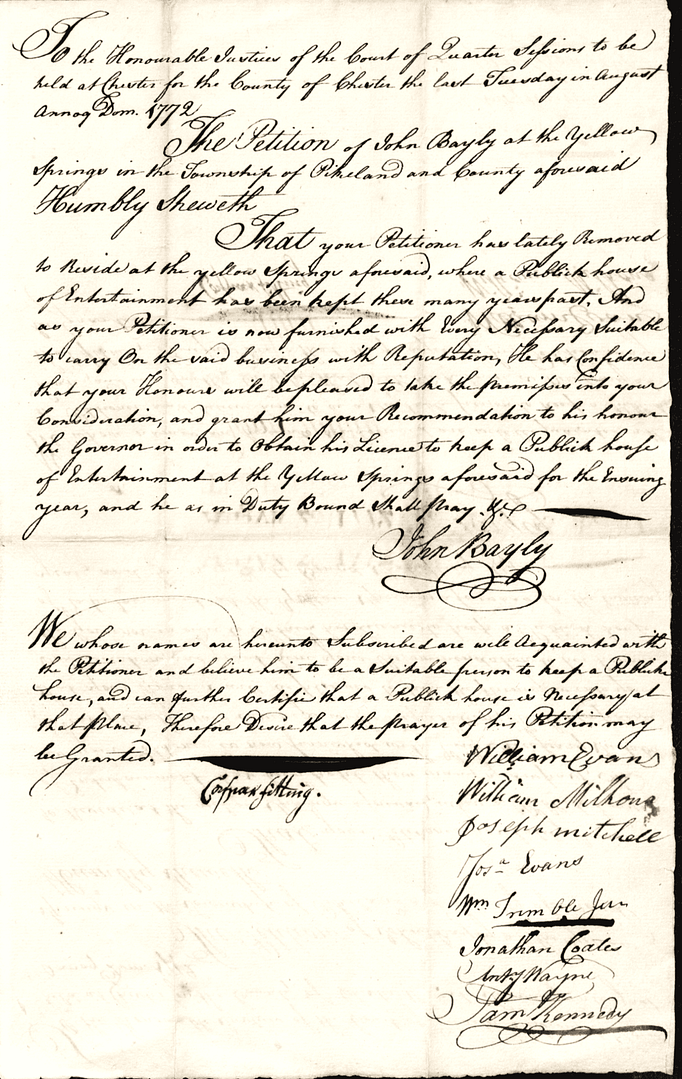
For those unfamiliar with tavern petitions, it helps to understand what they were and why these records matter today.
In 18th-century Pennsylvania, especially during the first half of the century, taverns played an important role in everyday life. Pennsylvania law classified any “public house” as a tavern. This included inns, pubs, and eventually coffeehouses. The term originally described places where travelers could stay, escape bad weather, and get food and drink.
In many early Pennsylvania communities, the local tavern became a center of public life. The colonial government, especially in Pennsylvania, viewed these businesses with some suspicion. Officials often worried that drinking among the middle and lower classes could lead to fights, disorder, and other disturbances. Authorities also closely regulated upper-class gathering places when they served alcohol.

From the finest coffeehouse to the most basic wilderness pub, taverns served many of the same purposes. People gathered there, shared news, and discussed ideas. Some of that information could be seen as disruptive or even treasonous.
Because of these concerns, tavern owners had to follow a formal licensing process. Local officials needed to know who operated these establishments. Under Pennsylvania’s colonial laws, including the Charter of Privileges of 1701, the governor held the final authority to issue tavern licenses.
Applicants first appeared before their county’s Court of Quarter Sessions. They needed the justices to recommend them in open court. A “tavern petition” was the written request that a new or returning tavernkeeper submitted during this process.
Reading A Tavern Petition Index
Reaching the court did not mean the court would approve a tavern petition. Neighbors could file a formal remonstrance, which objected to the proposed license. Receipts also recorded the required fees paid to court clerks and colonial officials. Unpaid or delayed fees could slow the court’s handling of the petition. No matter what happened, the court recorded every application that was submitted.
The Chester County Archives created an index for these records. The index uses letters to show what happened with each petition. A means the court allowed the application. D means the court disallowed it. B means the records include a bond. R means someone filed a remonstrance against the license. The letters P and N also appear sometimes. P means the court postponed the petition. N means the petition concerned a new tavern that had not yet opened.
The people who supported an applicant also mattered. A tavernkeeper could not simply apply alone and expect approval. Well-known and respected local residents signed petitions to support the applicant. Their signatures showed that community members trusted the applicant’s character and abilities. They also showed the court that local residents supported the tavern.
Tavern licenses did not last forever. Most licenses lasted only one year. Tavernkeepers had to return to court and repeat the process each year if they wanted to continue.
By the middle of the 18th century, some parts of Pennsylvania had about one tavern for every 100 people. The demand for these gathering places, along with the profits from alcohol sales, made tavern petitions common and important legal records.
Methods and Research

We began our research by searching the Tavern Petitions index created by the Chester County Archives. The index includes the township where each petition was submitted. This detail lets us search by township and location for taverns connected to the Yellow Springs area.
Today, the village of Yellow Springs sits in West Pikeland Township. Before 1838, West and East Pikeland formed one township called Pikeland. However, in the 1690s, this land belonged to Sir Matthias Vincent & Company.

In 1705, William Penn granted Matthias Vincent more than 30,000 acres. Vincent later leased more than 10,000 acres, called “Pikeland,” to Joseph Pike.
At that time, the area had not yet gained separate official county names for Vincent and Pikeland. By the 1720s, Dr. Daniel Coxe & Company owned the land. By the 1730s, people called the tract Vincent Township. By 1776, officials had carved Pikeland Township out of Vincent Township. Yellow Springs remained just south of the boundary between them.

Later, officials divided Vincent and Pikeland into East Vincent, West Vincent, East Pikeland, and West Pikeland. Yellow Springs then became part of West Pikeland.

Because these boundaries changed, we must consider taverns listed under either Vincent or Pikeland Township as possible matches for the Yellow Springs Tavern.
We also include records labeled “Chester Township.”
Pennsylvania officials sometimes used this name as a catch-all during the early 1700s. Township boundaries remained unclear in parts of Chester County while settlers developed the area.

Because these boundaries changed, we must consider taverns listed under either Vincent or Pikeland as possible matches for the Yellow Springs Tavern. We also include records labeled “Chester Township”, since records from the early 1700s through the 1740s sometimes used this name as a catch-all.
You can find all of the data from our research in the extended version of this post on our Substack!
Analysis

We organized the data in chronological order as carefully as our available information allowed. The raw data also revealed many familiar names and families from the People in the History of Yellow Springs.
Our main focus is Yellow Springs during the Revolutionary War and the years around it. A brief look at the Second Spa Era, from the 1780s to the 1860s, also revealed familiar names. These include Mrs. Margaret Holman, Col. James Bones, A.W. Olwine, and others.
Looking further back, before John Bayly and Dr. Samuel Kennedy, we find familiar surnames like Rice and Holman. The history of the Washington Building identifies Robert Pritchard and Samuel Lewis as early Yellow Springs tavern operators.
We also know that David Rittenhouse visited Yellow Springs in 1753 for treatment of his ulcers. By then, the spa was already well established. The pub had grown beyond a simple tavern into a larger, hotel-like space. It served visitors who held stronger social connections. The establishment could also host someone like Rittenhouse for an extended stay. His account shows that Yellow Springs had become fairly well known.
Using these names, we can work backward through the records to identify earlier tavernkeepers. We can also compare the petitions with dates we already know. Accepted tavern petitions were submitted once each year.
Consider the 1751 records:
- Garrat Brownback: Township not recorded, tavern name not recorded, A, “List,” 1751
- Samuel Lewis: Pikeland, tavern name not recorded, A, 9/28–30, 1751
Samuel Lewis’s Pikeland petition was for the Yellow Springs tavern. He purchased it from Robert Pritchard, who received approval for a tavern in 1750.
Garrat Brownback creates a different problem. He had received tavern licenses as early as 1739. Most of his records lack a township or tavern name. We included him because nothing we found allowed us to rule him out.
Brownback and Lewis could not both hold the Yellow Springs license in 1751. Brownback also appears to have operated a tavern for many years. That raises an important question: Who was Garrat Brownback?
Removing Candidates: Mr. Brownback
Our data contains many entries for Garrat, Garratt, and Garret Brownback, including approvals in 1739, 1741, 1742, 1743, 1744, 1745, 1748, and 1751. Two 1742 and 1743 records place his tavern in Vincent Township, Volume 4, pages 8 and 66. We also found Benjamin Brownback in Vincent Township from 1757 through 1769, with approvals in 1757 to 1768 and a bond in 1769. The similar names may show a family connection. Tavernkeeping often became a trade that parents taught their children. Widows could also continue the business after a husband’s death or illness. Benjamin and Garret may have shared a family, possibly even a father and son relationship.

The Chester County Archives “List” records show that Garret first appeared as a community member who supported a proposed tavern and gave money toward it. His 1742 record says he had operated a tavern for years and had received earlier approvals. This suggests he later became responsible for running the tavern, though its location remained unclear.

The American Local History Network describes “Garrett Brombach (now Brownback)” as a German who ran the first tavern north of Lancaster Road in a rough building. It also says he became wealthy. Lancaster Road, now Conestoga Road and Pennsylvania Route 401 in places, began as a Lenape trail and became a King’s highway in 1721. Yellow Springs also lies north of that road, so this clue alone does not identify the tavern.

Estelle Creamer’s 1989 30,000 Acres identifies Garret as “Gerhard” and traces the Bromback, Brumbaugh, and Brownback family tavern through later generations. The business became known as Brownback’s Inn and continued until about 1809. Creamer’s records place it in Phoenixville, separate from Yellow Springs. The building now survives as the Historic Seven Stars Inn on Ridge Road.


We can therefore remove Garret, Benjamin, later Brombacks, and taverns named Indian Queen, General Washington, Washington Inn, Brumback’s, or Brownback’s. We also remove Creamer’s listed operators: Jacob Vanderslice, John Benjamin, Lawrence Hipple, Samuel Martin, Joseph Trunkenmiller, Joseph T. Miller, John Brownback, William Whitby, Elizabeth Whitby, Gotlieb Keplar, Peter Henry, and anyone named Brumback or Brumbaugh.
Our remaining candidates appear below.
Revised Candidates List
The earliest records begin with Ruth Hoskins in 1718. She continued to appear through 1730, with several approved and postponed petitions. Other early names include Richard Woodworth, Jonathan Ogden, Edward Smout, Pearson Abele, John Rice, Robert Wilkins, James Trego, Samuel Ogden, John Hampton, Martin Harnist, Andrew Cornish, Jacob Bane, Edward Doherty, Michael Bowman, Peter Allen, William Frehorin, Adam Archer, and William Weldon.
John Rice appears in Chester Township in 1724. Edward Smout appears there in 1725. Later records add more names from Vincent and Pikeland townships.
By 1750, Robert Prichard appears in both the “List” records and Pikeland Township. Samuel Lewis followed him in Pikeland in 1751. Daniel Prichard appears there in 1752 and 1753. Adam Ramsower, also called Adam Rumsour, appears in Pikeland from 1754 through 1761.
From the late 1750s, the records show George David in Vincent. Other possible candidates appear in Pikeland. These include Yoste Evards, Peter Stegar, James Martin, Jonathan Durell, George Maxton, Edward Parker, John Bayly, Michael Holman, Samuel Culbertson, and Zachariah Rice.
The records give us a clearer link to Yellow Springs in the 1760s. James Martin applied for the Yellow Springs tavern in 1762. Jonathan Durell followed in 1763. George Maxton appears with Yellow Springs in 1766, 1767, and 1768. John Bayly appears in 1772 and 1773. Samuel Culbertson appears in 1775 and later records.
After the Revolutionary War, Alexander McCarraher, Mary McCarraher, John Harper, Robert Patton, and Frederick Holman appear. Holman appears often from the 1790s into the early 1800s. Aaron Allison and James Bones later appear, along with other operators through the 1820s.
The tavern also used names such as Yellow Springs Hotel, Yellow Spring, General Washington, Washington Inn, and Washington Hall. Margaret Holman became a major name during the 1820s and 1830s. A.W. Olwine also appears during those years.
After Pikeland split into East and West Pikeland, the records place Margaret Holman in West Pikeland. George Lingen, Henry Neef, and Maria L. Neef later appear. The records continue with Charles Williams, Augustus U. Snyder, Theodore Snyder, and John S. Clawges.
The complete entries and exact record details are available in the extended version on our Substack, as mentioned above.
To Next Week…
We have already narrowed the list through our research into Blackburn’s tavern. Even so, the list remains fairly long, and this post is getting lengthy.
We will keep narrowing the list using the method described above. Join us next week as we explain why this research matters to Yellow Springs. We will also explore what these records can tell us about Yellow Springs during the Revolutionary War.
Copyright Disclaimer: Under Section 107 of the Copyright Act 1976, allowance is made for ‘fair use’ for purposes such as criticism, comment, news reporting, teaching, scholarship, and research. All materials sourced from sources indicated throughout this post are referenced for the purposes of education for reference purposes.
📖🔍📜
Featured History Event at Historic Yellow Springs
Historic Yellow Springs is thrilled to host William Peck, expert on the Orphan School System, at the CSS Studio on September 13th at 1:30 PM!
We hope you stop by!

Interested in learning more? Check out the course listing here!
More upcoming speaker events can be seen here!
📖🔍📜

Learn more about the history of Yellow Springs
You can read the more in-depth version of this post here
Follow us on Substack, Instagram, and Facebook
📖🔍📜