
Throwback Thursday: A Pledge of Allegiance
Our Archives Preserves Dr. Bodo Otto and Dr. Kennedy Signing an Official Pledge to the New United States of America
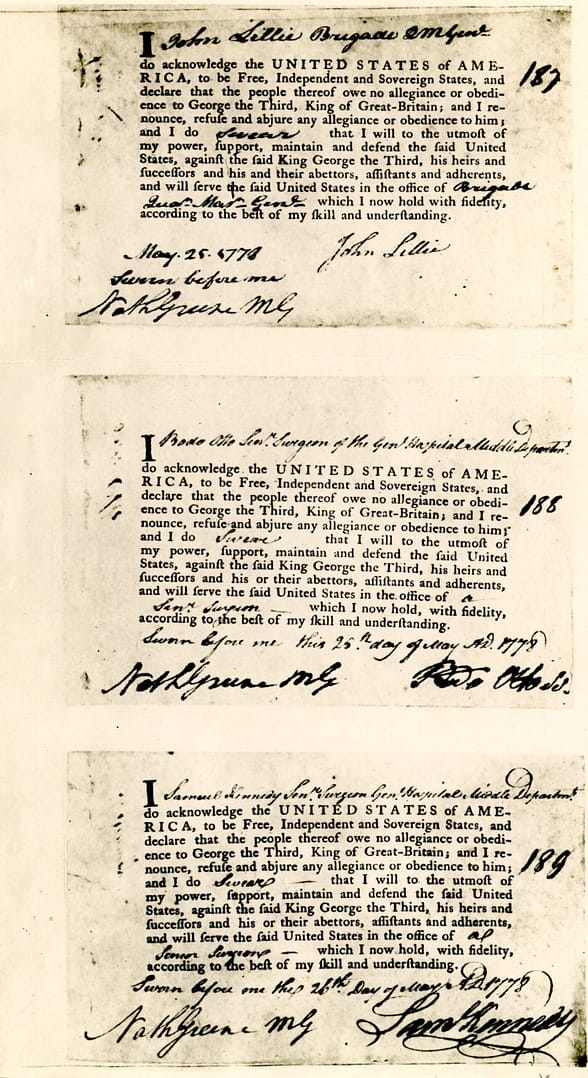
What Is This?
Found in the Moore Archives, this image has been photocopied from the original documents from the day. It features the signed and sworn pledges of John Lillie, Dr. Bodo Otto Sr., and Dr. Samuel Kennedy.
They were sworn in the presence of Nathanial Greene, Major General. Lillie and Otto Sr. both signed on May 25th, 1778, and Kennedy signed on May 26th, 1778.
In effect, these are pledges that have been previously typed out with a space for the signers to write that they swear to what the pledges say, as well as to sign their station and name.
John Lillie
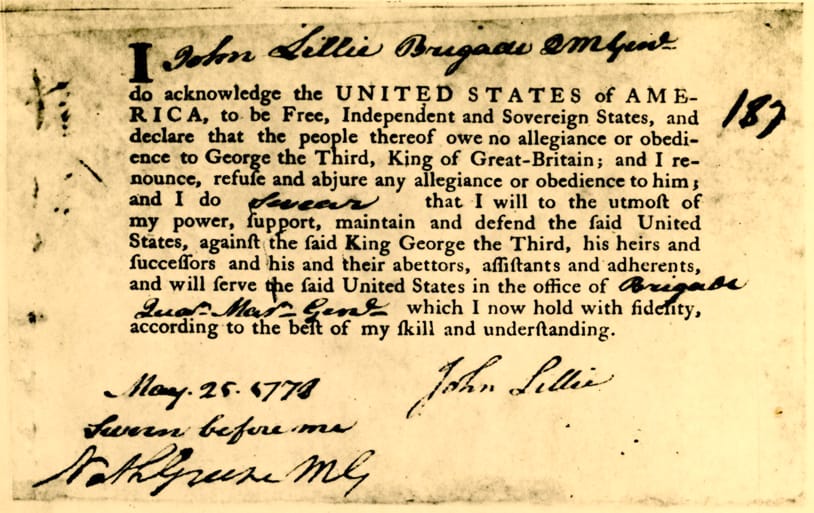
John Lillie signs here and he swears his allegiance to defend the said United States. Unfortunately, the rank he gives himself is unclear. We can make out the word ‘brigade’, but past that the abbreviations and ink are uncommon.
Additionally, John Lillie is a new name to our cast of Revolutionary War figures, so we have to do a little digging to see who he is. However, because he is signing on the same day as Dr. Bodo Otto Sr., who we know was at Yellow Springs at this time, we can safely assume that he was here as well.
Quick research online shows us that George Washington was in correspondence with a John Lillie on December 1, 1783. This letter tells us that that in 1777, John Lillie was promoted to Captain Lieutenancy in his brigade. Perhaps he is identifying his rank here as “brigade lieutenant of the major general”. This would put him under Greene himself, who is the Major General at this time.
According to Washington’s correspondence, in August 1780, he was made Captain. Following that, he was he was appointed an Aid de Camp to Major General Henry Knox in 1782.
According to George Washington’s account, Lillie “hath conducted himself on all occasions with dignity, bravery & intelligence”.
Dr. Bodo Otto Sr.
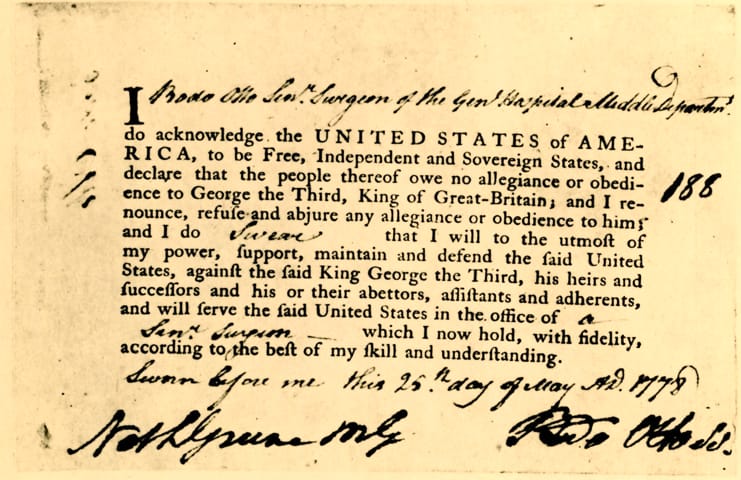
Dr. Bodo Otto Sr. is a well-known name from the Revolutionary era at Yellow Springs. Unlike John Lillie above, we know a good deal about what Dr. Bodo Otto was doing in late May of 1778. Interestingly, his rank here is Senior Surgeon of the General Hospital, just like Dr. Kennedy is listed as below.
His signature is a bit blotchy, but we can make out clearly that it is Dr. Otto signing here. Intriguingly, he also adds ‘Sr.’ to differentiate between himself and Dr. Bodo Otto Jr. He does not always do this, based on the letters that we have from him.
You can read more about Dr. Otto and his time at Yellow Springs here!
Dr. Samuel Kennedy
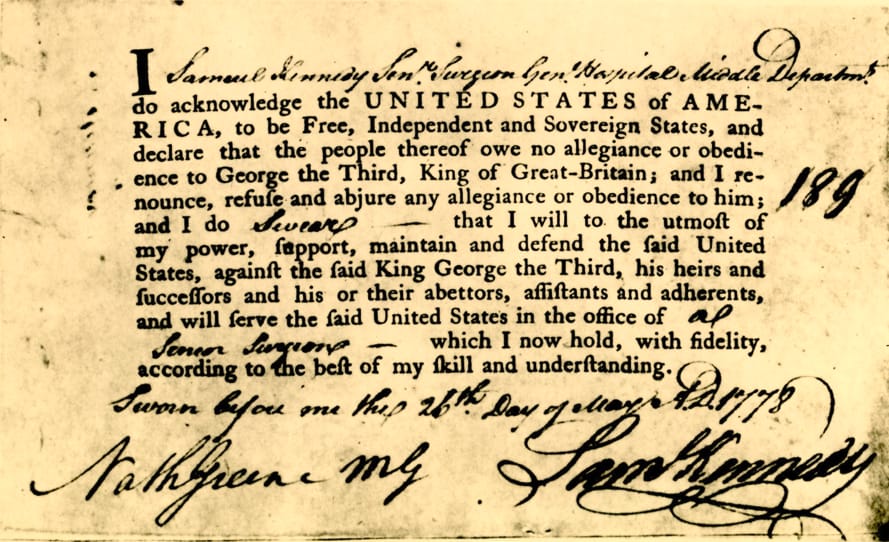
Readers may also know Samuel Kennedy well by now. He played an important role during the first year that Washington Hall operated. Leaders chose him to serve as Chief Physician, and he held that position until he died.
In June 1778, Reverend James Sproat wrote in his journal that Dr. Kennedy had become very sick. Earlier that spring, in April and May, Dr. Bodo Otto took over much of the hospital’s administrative work. Kennedy often worked through the night in the hospital wards, caring for patients. Because of this heavy workload, Otto handled many of the office duties.
Their shared responsibilities may explain why records list both Kennedy and Otto as senior surgeons at the hospital. They likely shared the same rank. Kennedy’s demanding schedule may also explain why he signed the pledge one day after Otto and Lillie.
You can read more about Dr. Kennedy and his time at Yellow Springs here!
Nathanael Greene

Major General Nathanael Greene served as an American military officer and planter during the Revolutionary War. He fought in the Continental Army and earned respect as one of George Washington’s most skilled and trusted officers. Greene gained fame for leading American forces in the Southern part of the war, where he helped turn the tide against the British.
Greene was born into a wealthy Quaker family in Warwick, Rhode Island. In the early 1770s, he joined other colonists in protesting British tax laws. When fighting broke out at the Battles of Lexington and Concord in April 1775, Rhode Island leaders quickly formed an army. They chose Greene to lead it.
Later that year, leaders created the Continental Army and made Greene one of its generals. He served under Washington in several major campaigns. He helped lead troops during the Boston campaign, the New York and New Jersey campaign, and the Philadelphia campaign. In 1778, the army appointed Greene as quartermaster general. In this role, he managed supplies and worked to keep the army organized and prepared for battle. It is this role that Greene was most likely preforming when he stopped at Yellow Springs to have these pledges signed.
Through strong leadership and steady service, Greene became one of the most important American generals of the Revolutionary War.
What Does This Mean For Us, Today?
In May 1778, these men stood just some thirty miles outside Philadelphia and signed a pledge to the new United States.
By doing this, they openly rejected King George III and British rule. At that time, the British still controlled Philadelphia. The city had fallen to the British during the Philadelphia campaign, and the war’s outcome was still uncertain.
When these men signed their names, they took a real risk. If British forces had captured them, the Crown could have charged them with treason against George III. The punishment for treason was death. If the new nation had lost the war, they likely would have faced trial and possibly execution. They knew this. They understood that writing their names on that pledge could cost them their lives, their property, and their families’ safety.
Their signatures meant more than simple words of loyalty. They made a public stand. They declared that they believed British rule had become tyranny. They chose to support independence even though the future looked unclear. They tied their fate to a cause that could have failed.
Their actions still matter today in 2026. We live in a country shaped by people who risked everything for their beliefs. These men remind us that freedom did not come without danger. They show us that standing up for what we believe in often requires courage. Even now, when we speak out or take part in civic life, we follow their example of taking responsibility for the future.

🖊️🎖️📝
Learn more about the history of Yellow Springs
You can read the more in-depth version of this post here
Follow us on Substack, Instagram, and Facebook
🖊️🎖️📝