
Throwback Thursday: The Old Jersey Prison Ship
Inside the Old Jersey: The Brutal Prison Ship That Held Three Young Men from Yellow Springs
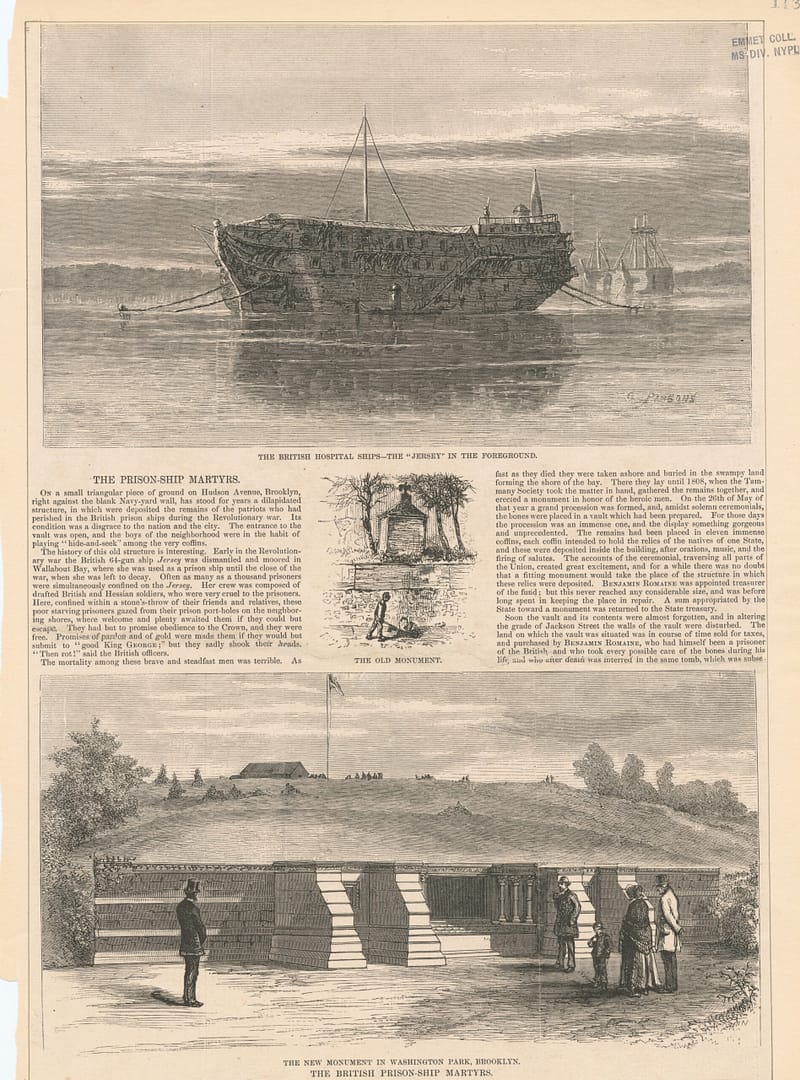
Last week, in our Throwback Thursday post, we examined one of Sarah Kennedy’s letters. In this letter, she pleaded for the release of Henry Holman, Peter Hench, and Henry Hench from the Revolutionary-Era British prison ship, the HMS Jersey.
The HMS Jersey, also called the Old Jersey, gained grave notoriety among the Continental forces. Soldiers considered it a filthy and terrible place, even by the harsh standards of prisons at that time.
This week, we will examine the ship’s history as a prison during the Revolutionary War. Doing so helps us understand the harsh conditions these three young men from Yellow Springs endured.
What Was This?
.jpg)
According to public sources like Wikipedia, the HMS Jersey began as a sixty-gun “ship of the line”¹. This type of large naval warship fought within the formal battle formations used by European navies in the eighteenth century. Ships of the line formed the backbone of Britain’s naval system. That system supported the country’s political economy and imperial expansion¹.
The Royal Navy used vessels like the Jersey to protect trade routes, escort merchant ships, and defend colonies across the Atlantic. During this period, the British focused heavily on Empire Building. Having ships like the Jersey proved vital for maintaining the British Empire².
Looking back at the time the Jersey was built, the ship reflects the late Colonial era. Even in its earliest days, the Jersey carried a complicated legacy.
When the Old Jersey was New
The Jersey launched in 1736³, when Britain was not officially in a major continental war. Still, Britain invested heavily in naval construction.
During the early eighteenth century, Britain solidified its status as a commercial and maritime empire. Its economy increasingly depended on overseas trade, especially the Atlantic Triangle Trade connecting Britain, Africa, the Caribbean, and North America.
Maintaining a large navy during peacetime remained essential. Warships like the Jersey required enormous resources and years to build. Naval planners continued constructing them even without open conflict. The Jersey also served as an escort for merchant ships. Britain built it in preparation for future wars or conflicts that could involve the empire. Shipbuilding sustained dockyard communities and supporting industries, embedding naval infrastructure into British society and economy.

_RMG_J3495.jpg)
The Jersey later served during the Seven Years’ War, fought from 1756 to 1763, which reshaped Atlantic power. Unlike earlier wars in the Western World, focused mainly in Europe– this conflict spanned multiple continents, including North America, the Caribbean, West Africa, and South Asia.
The war’s global scope reflected the vast British Empire, famously remembered as an empire on which the “sun never set.”
Historians often call the Seven Years’ War the first truly global war. Rival European empires competed simultaneously across oceans and colonies. Naval power proved central to this imperial competition. Fleets transported troops, protected commerce, and blockaded enemy ports.
Ships like the Jersey functioned as critical pieces in this wider imperial network. Maritime strength directly influenced economic and political power across the Atlantic world.
The Jersey Gets Old
By the early 1770s, the aging Jersey no longer suited front-line naval combat. In March 1771, Britain converted it into a hospital ship⁴. The practice of repurposing old warships was common, as their hulls remained useful despite outdated designs.
For Yellow Springs, this fact carries a grim irony. The Old Jersey imprisoned three young men whose families had helped the local hospital complex thrive. Before becoming a prison, the ship had briefly served as a hospital itself.
Hospital ships of this era treated sailors suffering from wounds, disease, or infection, keeping them off crowded warships. Disease posed a constant threat to eighteenth-century navies, as sailors lived in cramped spaces and spent months at sea.
In Colonial times, disease often killed more than combat. Hospital ships included wards, medical supplies, and space for naval surgeons, reflecting Britain’s growing institutional medical care.
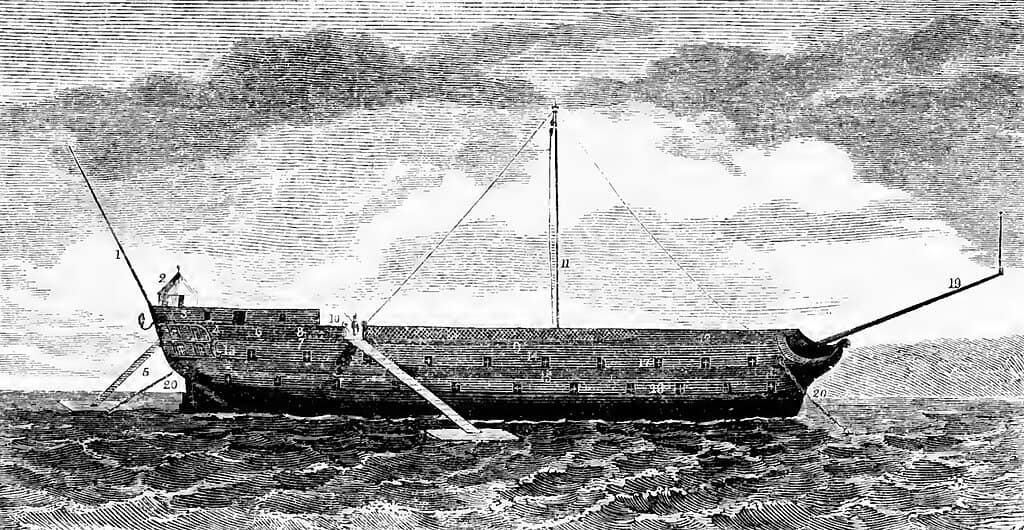
The Jersey transformed again during the Revolutionary War. In winter 1779, British forces “hulked” the ship– removing its masts, rigging, and sailing equipment, and anchoring it permanently. They stationed it in Wallabout Bay, New York Harbor, later the Brooklyn Navy Yard, converting it into a prison ship⁵.
British crews altered the ship for confinement: they sealed gun ports, cut large circular holes with heavy bars for ventilation, and built a tall wooden barricade on the quarterdeck. Guards could fire muskets through openings if needed⁵.
After capturing New York City in 1776, British forces used it as their main North American base. As the war progressed, they imprisoned captured soldiers, sailors, privateers, and civilians refusing loyalty to the Crown⁶. Prisoners crowded older ships like the Jersey when land prisons proved insufficient. Nearly 11,000 captives died aboard these floating prisons⁶.
Although several prison ships existed near New York, the Jersey gained notorious fame. Colonial forces remembered it for its brutal guards, overcrowding, disease, and horrific conditions.
Aboard the Old Jersey
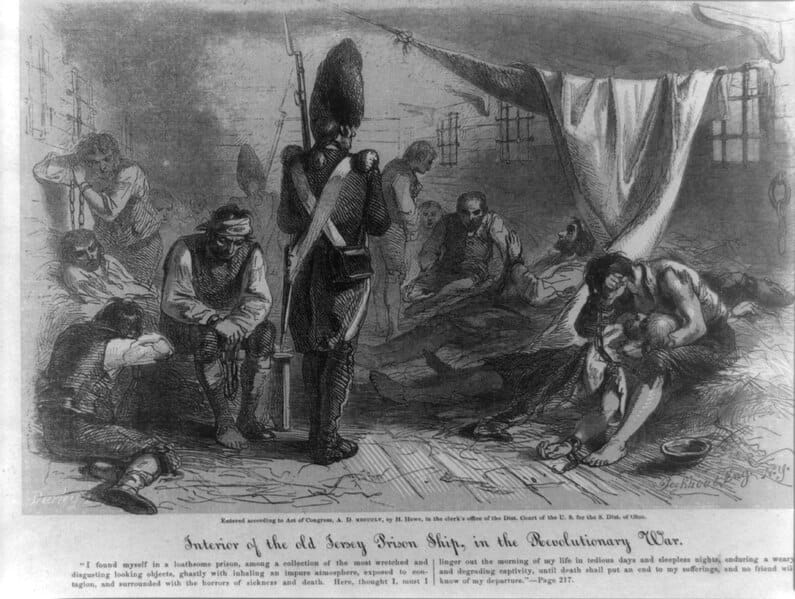
Our archival research shows the Old Jersey earned a reputation as a “floating hellscape”. We discovered a March 1935 article by Commander Louis H. Roddis, U.S. Navy, in the Proceedings of the U.S. Naval Institute, which details life aboard.
Roddis draws heavily on the account of Captain Thomas Dring, a New England sailor captured while serving on the American privateer ship the Chance⁵. Dring described grim conditions aboard the ship. Guards and officers stayed in the aft section, while prisoners crammed the lower, squalid decks⁵. New captives arrived at the quarterdeck, where officials recorded their names, ranks, and former ships before sending them below⁵.
Prisoners received food on a fixed weekly ration system, but it was far smaller than regular British Navy provisions⁵. Official rations included biscuit, salted pork or beef, peas, oatmeal, flour, and occasional butter⁵.
In practice, prisoners often received stale, moldy, or nearly spoiled food. Fresh produce appeared almost never⁵. An elderly trader, “Dame Grant,” sold small amounts of vegetables and milk to prisoners from a boat near the hulks⁵. Prisoners with money purchased items from her. When she died in 1780, prisoners mourned one of the few relief sources from the harsh shipboard diet⁵.
Interestingly, Dame Grant could access the Old Jersey despite its squalid conditions and notorious reputation. Her presence highlights the often overlooked role of women during the Revolutionary War. It invites us to expand our perspective of the conflict, considering the contributions and presence of women alongside men.
In Sickness and Imprisonment
Roddis cites Dring’s records, noting that overcrowding, poor sanitation, and limited ventilation allowed disease to thrive⁵. Prison ships like the Jersey became almost perfect breeding grounds for contagious illness⁵. Respiratory infections, including colds, influenza, and pneumonia, were common. More serious epidemics also spread rapidly. Smallpox and typhus, frequent causes of death at Yellow Springs, posed the greatest threats.
Aboard the Jersey, typhus spread easily through lice living in clothing that could not be washed. Cramped, damp conditions made it especially deadly. British jailors treated prisoners with indifference, worsening the situation. Dysentery and typhoid fever caused many deaths as well⁵.
Prisoners also suffered from scurvy due to a lack of fresh food, although they mentioned it less frequently⁵.
Dring described smallpox outbreaks soon after arriving on the ship. Some prisoners tried risky self-inoculation, deliberately introducing material from infected pustules into their own skin to gain immunity⁵.
Unlike the sick and injured at Washington Hall, prisoners on the Jersey had no medical specialists like Dr. Otto Sr. to guide them. Prisoners themselves served as nurses, although Dring noted bitterly that some men exploited dying shipmates rather than helping them⁵.
Daily Life Aboard The Old Jersey
According to Roddis, based on Dring’s account, daily life aboard the Jersey followed a harsh routine. Prisoners could go on deck during daylight but had to go below at sunset. Guards placed heavy gratings over the hatches and stood watch with fixed bayonets⁵.
Below deck, conditions became suffocating, especially in warm weather, as hundreds crowded the dark, poorly ventilated space. Prisoners could not use lamps, making movement difficult and dangerous at night. Some slept in hammocks, while others lay on the wooden deck.
Makeshift bunks along one side were reserved for the sick, though they were usually full. Despite these oppressive conditions, prisoners created informal rules to maintain order among themselves⁵.
Occasionally, small work parties went ashore to collect water or provisions⁵. Dring noted prisoners coveted these assignments because they offered a brief escape from the foul air and congestion⁵. These outings also created opportunities for escape, and many prisoners tried to flee.
Some prisoners forced open barred air holes in the hull and lowered themselves into the water, hoping to swim to shore. The shore lay roughly two miles away, and guards heavily patrolled the beaches, making escape extremely dangerous.
Some escapees drowned, while others were immediately recaptured or shot by British guards⁵. Dring described one attempt where an armed boat pursued escapees. One man was shot and brought back aboard the ship to die⁵.
Through these accounts, Roddis shows that the Jersey became infamous among American prisoners. The ship represented not only confinement, but also overcrowding, disease, desperation, and the constant struggle to survive.
According to Silas Talbot⁷, another prisoner aboard the Jersey, Dring’s experiences were typical. Talbot recorded that Dring’s account reflected the common hardships faced by men confined on the ship:
“The scantiness of the allowance, the bad quality of the provisions, the brutality of the guards, and the sick, pining for comforts they could not obtain, altogether furnished continually one of the greatest scenes of human distress and misery ever beheld… The Jersey prison-ship had been as destructive as a field of battle.” ⁷
To Us, Today
Through our research on Washington Hall at Yellow Springs and the people connected to it, we see how precarious and vital medical care was during the war. The Old Jersey highlights what people faced when care was absent and cruelty prevailed.
Prisoners like Dring and Talbot documented the Jersey’s reputation as a “floating hellscape,” giving a vivid picture of suffering and horror.
While our study began with the three young men from Yellow Springs, many aspects of the Jersey reflect the experiences of others we have studied. The prison ship serves as a dark mirror connecting themes from the past to its events.
At Washington Hall, doctors like Dr. Otto Sr. administered smallpox inoculations in strictly sanitary conditions. Neighbors such as Abigail Hartman-Rice and Christina Hench, mother of Henry and Peter Hench, provided food and care to the sick. This network helped many survive. On the Jersey, prisoners faced starvation, squalid conditions, and desperation. They often risked their lives to perform their own inoculations.
John Rose went on from Yellow Springs to become a privateer aboard the Revenge, yet men like him captured at sea- such as Captain Thomas Dring on the Chance— often ended up on the Jersey. Illnesses like “putrid fever” may have killed Dr. Kennedy at Washington Hall, but his illness and death are remembered centuries later as a tragedy. In contrast, countless prisoners aboard the Jersey died without treatment or record– today, they are mostly forgotten.
This contrast between care and neglect and between survival and desperation makes the deaths of Henry Hench, Peter Hench, and Henry Holman especially harrowing.
Understanding their suffering shows the stakes that Dr. Otto Sr. and Sarah Kennedy tried to spare them from with their letters. Though they failed, remembering these stories matters. They show the resilience and compassion of communities and highlight the consequences of systemic cruelty. These stories remain important to remember today as a testament to human endurance.

⚓🛳️☠️
Learn more about the history of Yellow Springs
You can read the more in-depth version of this post here
Follow us on Substack, Instagram, and Facebook
⚓🛳️☠️
Works Cited
- Encyclopaedia Britannica, s.v. “Ship of the Line,” accessed March 12, 2026, https://www.britannica.com/technology/ship-of-the-line.
- N. A. M. Rodger, The Command of the Ocean: A Naval History of Britain, 1649–1815 (London: Penguin Books, 2004), https://archive.org/details/commandofoceanna0000rodg
- “HMS Jersey (1736),” Wikipedia, last modified February 1, 2026, https://en.wikipedia.org/wiki/HMS_Jersey_(1736)
- Edward J. Wawrzynczak and Jane V. S. Wickenden, “From ‘Sick Comforts’ to ‘Doctor’s Garden’: British Naval Hospital Ships, 1620 to 1815,” British Journal for Military History 9, no. 1 (March 2023): 38, https://journals.gold.ac.uk/index.php/bjmh/article/download/1687/1792/2067
- Louis H. Roddis, “The New York Prison Ships of the American Revolution,” Proceedings 61, no. 3 (March 1935), https://www.usni.org/magazines/proceedings/1935/march/new-york-prison-ships-american-revolution.
- “The HMS Jersey,” History.com, https://www.history.com/articles/the-hms-jersey
- Christopher Hawkins, The Adventures of Christopher Hawkins (New York: Privately printed, 1864), 11, cited in Matthew Kraemer, “American Suffering Aboard the HMS Jersey,” Revolution NJ, https://www.revnj.org/blog/hms-jersey.